Last Tuesday, a new student named Sarah sat in our tuition car, clutching her provisional licence with shaking hands and worrying she’d stall in front of a queue of traffic. If you feel that same knot in your stomach, you’re certainly not alone. It’s completely normal to worry about “shouty” instructors or getting tangled up in technical jargon. At Pass4you Driving School, we’ve helped thousands of learners find their feet, and our 83.33% first time pass rate proves that a calm, patient approach works best. Knowing exactly what to expect on first driving lesson uk can turn that initial anxiety into genuine confidence before you even turn the key.
We believe that learning to drive should be an exciting milestone, not a source of dread. You’ll discover exactly what happens during those initial two hours behind the wheel, from the moment Simon or your instructor greets you to your very first move-off. We’ll break down the “Cockpit Drill” into simple, manageable steps and explain how our dual controls act as your permanent safety net. By the end of this 2026 guide, you’ll know exactly what to bring and how we’ll support you in becoming a safe driver for life.
Key Takeaways
Prepare for your big day by understanding the essential paperwork requirements and what to expect during the initial 20-metre eyesight test.
Get to grips with the “DSSSM” cockpit drill, the vital safety routine that helps every new driver feel calm and in control of the vehicle.
Discover exactly what to expect on first driving lesson uk, from using dual controls for safety to making your very first move-off in a quiet area.
Explore how Milton Keynes’ unique grid system is navigated by starting in “the shallows” to build your confidence away from busy main roads.
Learn why a patient, professional mentor is key to achieving an 83.33% first-time pass rate and becoming a safe driver for life.
Preparing for the Big Day: What to Bring and Do Beforehand
Your first time behind the wheel is a significant milestone. It marks the beginning of a journey toward personal freedom and independence. At Pass4you, we understand that those initial nerves are completely natural. Simon’s calm and patient approach is specifically designed to turn that early anxiety into genuine confidence from the moment you sit in the driver’s seat. Knowing exactly what to expect on first driving lesson uk helps settle your mind so you can focus on the skills you’re about to learn.
The Provisional Licence Check in 2026
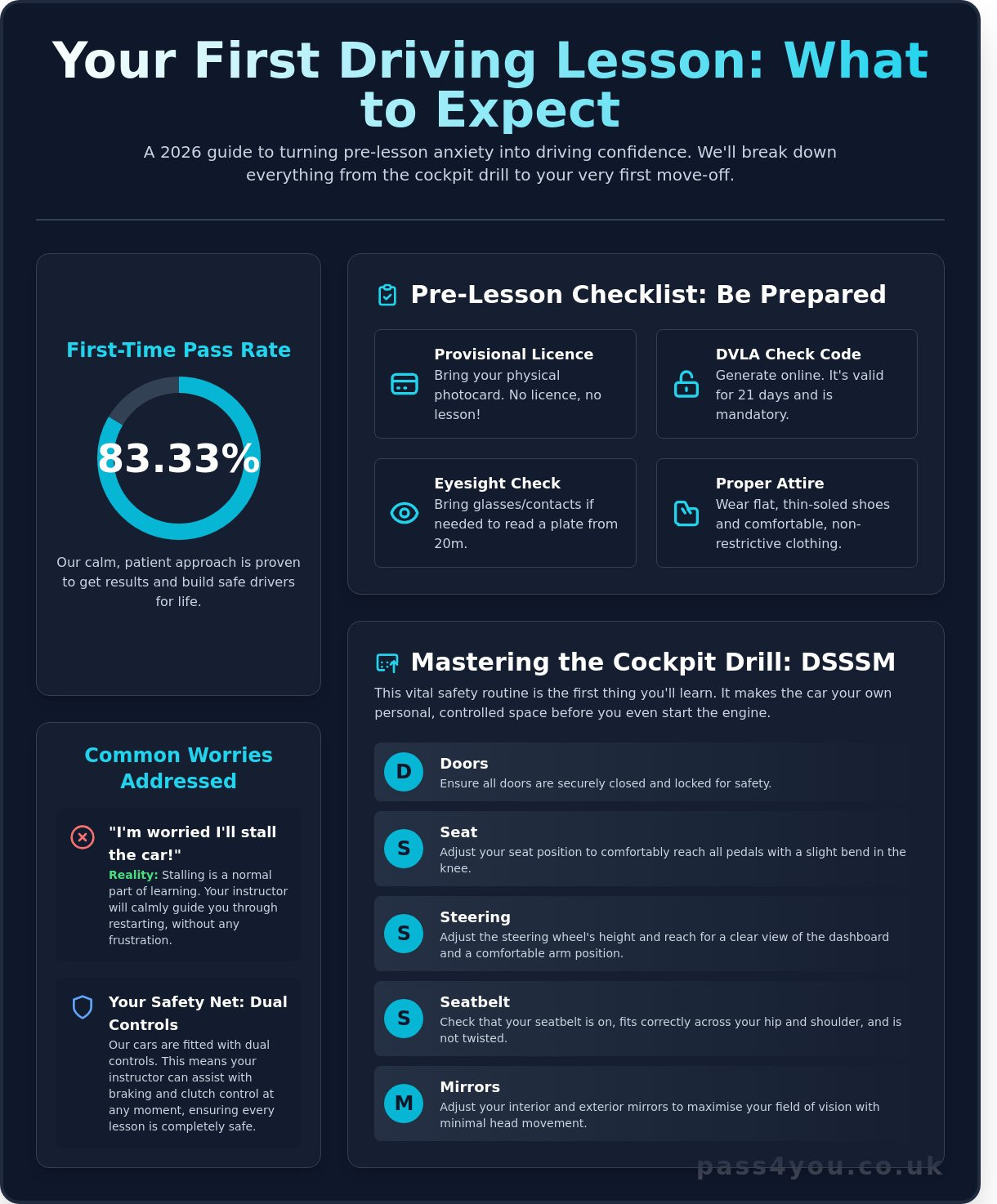
Before you even turn the engine on, there is some essential administration to complete. You must have your physical provisional driving licence with you. Since the DVLA abolished the paper counterpart, instructors require a digital check code generated from the GOV.UK website. This code is valid for 21 days and allows us to verify your driving record to ensure our insurance covers you. In 2026, this process remains a strict requirement; without that 8-character code and your plastic card, the lesson cannot proceed. If you forget these, your instructor is legally barred from letting you drive. This safety measure protects you, the instructor, and the public.
The first practical task isn’t actually driving. It’s a mandatory eyesight test. You’ll be asked to read a standard UK number plate from a distance of 20 metres. This is a non-negotiable part of the UK driving test process and it applies to your very first lesson too. If you usually wear glasses or contact lenses for distance, ensure they’re on your face or in your eyes before Simon arrives. Failing this simple check means the lesson ends immediately, as safety is our absolute priority in every session.
What to Wear for Maximum Control
Your choice of footwear directly impacts your ability to handle the car’s pedals. We strongly recommend flat shoes with thin soles. Chunky trainers or heavy boots significantly reduce the ‘feel’ of the pedals, which makes it much harder to find the biting point on the clutch. High heels or flip-flops are also a safety risk because they can slip or get caught in the floor mats. Choose clothing that is comfortable and allows for a full range of motion. You’ll be performing frequent ‘over-the-shoulder’ blind spot checks, so you don’t want a stiff collar or a tight jacket restricting your neck and shoulder movement.
Mental preparation is just as important as your physical gear. Accept right now that you will probably stall the car at least once. Even the students who contribute to our 83.33% first-time pass rate stalled during their first hour. Stalling is simply a sign that you’re learning how the engine and clutch interact. Simon won’t shout or get frustrated; he’ll simply talk you through the restart process with patience. Being a ‘safe driver for life’ starts with staying calm when things don’t go perfectly. To ensure you’re ready, follow this checklist:
Double-check your bag for your physical provisional licence.
Generate your DVLA check code at least 24 hours in advance.
Wear thin-soled shoes like pumps or flat trainers for better pedal feel.
Bring your glasses or contacts if you need them for distance.
Have a light snack and stay hydrated to keep your concentration sharp.
Preparing properly ensures you get the most value for money from your session. When you know what to expect on first driving lesson uk, you can arrive at the car feeling ready to learn rather than worried about the logistics. This professional preparation sets the tone for a productive, stress-free experience in Milton Keynes.
The ‘Cockpit Drill’: Mastering the DSSSM Routine
Before you even think about turning the key, you’ll be introduced to the ‘Cockpit Drill’. This is the essential foundation for every single drive you’ll ever take. Knowing exactly what to expect on first driving lesson uk sessions can really help settle those initial nerves. Approximately 1 in 4 of our new learners tell us they feel quite anxious before they arrive, but this calm, structured routine is designed to put you at ease. It’s not about rushing into traffic; it’s about making sure you’re safe, comfortable, and in total control of your environment.
We use the DSSSM acronym to help you remember the steps. It stands for Doors, Seat, Steering, Seatbelt, and Mirrors. This routine is the very first thing you’ll learn because it transforms the car from a complex machine into a space that’s tailored specifically to you. By following the Official government guide to learning to drive, you’re starting your journey with the same professional standards required for the practical test.
Doors and Seat: Finding Your Perfect Position
You’ll start by checking that all doors are securely closed. This includes a quick glance to the passenger side and the rear to ensure no one is at risk if you move off. Once the car is secure, you’ll focus on your seating position. You need to adjust the seat height and reach so you can depress the clutch pedal fully to the floor while maintaining a slight bend in your knee. If your leg is locked straight, you won’t have the necessary finesse for smooth gear changes. The clutch bite point is the specific moment when the engine’s power begins to transfer to the wheels, allowing the car to move. Getting this right takes roughly 15 minutes of your first lesson, but it’s vital for your comfort and safety. Simon always suggests that a comfortable driver is a confident driver, and we take the time to ensure your posture is perfect.
Steering and Mirrors: Setting Your Field of Vision
Setting your field of vision is the next priority. To check your distance from the steering wheel, use the ‘wrist on top’ rule; stretch your arm out and rest your wrist on the top of the rim. If your arm is flat and your wrist sits comfortably, you’ll have enough leverage to steer without straining. Your mirrors are your primary tools for awareness, but they don’t show everything. A blind spot is an area around the vehicle that cannot be directly observed by the driver while looking through the mirrors, which is why a physical head check is a habit we build from day one. You’ll adjust the interior mirror to frame the rear window and the door mirrors to show the road behind and a tiny sliver of the side of the car.
Mastering this drill at the start builds a professional ‘safe driver’ habit that lasts a lifetime. It might seem like a lot to remember, but our patient driving instructors will guide you through it until it becomes second nature. Since we maintained an 83.33% first-time pass rate throughout 2023, we know that these small details make a massive difference. Taking the time to get your cockpit ready shows a level of responsibility that sets the tone for the rest of your training. It ensures that when you finally do move off, you aren’t fighting the car; you’re working with it.
First Lesson Expectations vs. Reality: Addressing the Fear
Many learners arrive for their first hour of tuition feeling a mix of excitement and genuine dread. You might worry about stalling in the middle of a busy junction or causing a tailback that stretches for miles. The reality is much more controlled and supportive. Your instructor won’t expect you to handle heavy traffic immediately. Instead, they usually spend the first 15 minutes driving you to a “quiet area.” This is typically a secluded residential street or a quiet industrial estate with minimal traffic flow. This strategy ensures you can focus on the car’s mechanics without the pressure of other drivers watching your every move.
Understanding what to expect on first driving lesson uk starts with the “controls talk.” Before you even turn the key, your instructor will guide you through the cockpit drill. You’ll learn how to adjust your seat and mirrors to meet the official UK driving standards for safety and vision. They will explain what the pedals, gears, and indicators actually do. This isn’t a lecture; it is a hands-on introduction where you get to feel the weight of the steering wheel and the click of the gear stick while the car is stationary. This foundational knowledge builds the confidence you need to move from the passenger side to the driver’s seat.
How Dual Controls Work
One of the biggest fears for new drivers is the idea of losing control and hitting something. This is why professional tuition cars are fitted with dual controls. Your instructor has their own set of brake and clutch pedals on the passenger side of the footwell. If you make a mistake or fail to see a hazard, they can take over instantly. It is physically impossible for you to “crash” the car during these early stages because your mentor is always one step ahead of the vehicle’s movement. They also use these pedals to help you smooth out your first few gear changes, gently assisting with the clutch to prevent the car from jerking. This safety net allows you to learn in a completely stress-free environment.
Your First Move-Off: The POM Routine
Once you are comfortable with the layout, it is time for your very first taste of motion. We use the POM routine to ensure every move-off is safe and legal. This stands for:
Preparation: Putting the car into first gear and finding the “bite point.”
Observation: Checking all mirrors and your blind spots with a full 360-degree look.
Manoeuvre: Releasing the handbrake and moving away smoothly.
Finding the “bite point” for the first time is a milestone for every learner. It is that specific moment when the engine connects with the wheels and the back of the car dips slightly. You don’t need to panic if you stall the engine; it happens to about 95% of students on their first day. Simon or your chosen instructor will stay calm and help you reset without any shouting or frustration. Most first lessons end with the student successfully driving in 2nd gear and feeling a massive sense of achievement. This patient, structured approach is a core reason why we maintain an 83.33% first-time pass rate for our students.
Learning to Drive in Milton Keynes: The Best First-Time Spots
Milton Keynes offers a unique environment for new drivers that differs significantly from traditional UK towns. While the area is famous for its 130 roundabouts, your first hour behind the wheel won’t involve tackling the V6 Grafton Street or the high-speed H8 Standing Way. We start in what we call the ‘shallows.’ These are quiet, wide residential areas where you can master the basics of car control without the pressure of heavy traffic or complex junctions. Our priority is building your confidence in a controlled, low-stress setting.
Many nervous students worry about the ‘Roundabout Myth.’ They imagine they’ll be thrown onto a three-lane junction within minutes of starting. This simply doesn’t happen. When considering what to expect on first driving lesson uk in a town like MK, remember that your instructor’s job is to keep you safe. You’ll spend your first session in 20mph or 30mph zones, focusing on the cockpit drill and basic moving off and stopping. You won’t even see a major grid road until Simon is 100% sure you’re ready to handle higher speeds.
Why the MK Grid System Helps Learners
The grid system is actually a beginner’s best friend. Unlike the narrow, winding streets found in older towns, MK roads are generally wide and offer excellent visibility. This clear layout helps you focus on your feet and the steering wheel rather than worrying about tight gaps or obscured corners. The logical numbering of H and V roads also makes it much easier to orientate yourself as you progress. We typically start in estates like Loughton, Shenley Church End, or Monkston Park. These areas provide long, straight stretches of road that are perfect for practicing gear changes and smooth braking.
The transition from quiet side streets to slightly busier local roads is handled at your own pace. Because the grid roads act as the main arteries for through-traffic, the residential ‘squares’ remain remarkably quiet during the day. This allows us to find plenty of space to practice your first junctions without a queue of cars forming behind you. It’s this patient, structured approach that helps our students achieve an 83.33% first-time pass rate.
Local Knowledge: Avoiding the Stress
At Pass4you, we use our deep local knowledge to choose ‘nursery’ routes based on the specific time of your lesson. A road that is quiet at 10:00 am might be a school run hotspot at 3:15 pm. Simon knows exactly where to go to ensure you have the space you need. We also use specific local landmarks, such as the MK Stadium or the Snowzone, to help you understand your positioning within the town. This helps reduce the mental load of navigation so you can focus on the car.
Learning in the same Volkswagen tuition vehicles used for the Milton Keynes test centres provides an extra layer of consistency. You’ll become familiar with the car’s dimensions and controls in the very same areas where you’ll eventually take your test. This familiarity is a huge advantage when it comes to reducing pre-test nerves. We don’t just teach you how to pass; we teach you how to be a safe driver for life on the roads you’ll use every day.
If you’re ready to start your journey in a calm and supportive environment, you can book your first lesson with Simon today and see why our patient approach makes all the difference.
Why Your Choice of Instructor Matters for a First-Time Pass
Choosing who sits in the passenger seat is the most critical decision you’ll make before you even turn the ignition. Many national driving schools treat students like a number on a corporate spreadsheet, following a rigid checklist that doesn’t account for individual nerves. At Pass4you, we take a different path. Simon focuses on building a genuine connection because a relaxed learner absorbs information far more effectively than a stressed one. Getting a clear idea of what to expect on first driving lesson uk roads is easier when you have a mentor who explains the “why” behind every action rather than just barking orders.
Our results speak for themselves. We maintain an 83.33% first-time pass rate, which is significantly higher than the national average. While it’s tempting to hunt for the lowest hourly rate, cheap lessons often prove expensive in the long run. If an instructor lacks a structured, patient approach, you might end up needing 60 hours of tuition instead of 35. By getting it right from the start, you save hundreds of pounds and avoid the frustration of repeated test failures. We don’t just teach you how to pass a 40-minute exam; we build a “Safe Driver for Life” mindset from your very first hour behind the wheel. This involves understanding road psychology and hazard perception, not just memorising test routes around Milton Keynes.
The Value of Patience and Empathy
Instructors who lose their temper or rush through the syllabus are the primary reason students give up. We’ve seen many nervous Milton Keynes learners arrive at Pass4you after negative experiences with “shouty” instructors elsewhere. Simon’s calm, empathetic style is designed to rebuild that shattered confidence. We’ve helped students who were once terrified of dual carriageways pass their test with zero faults. We tailor the pace of every lesson to your individual comfort level. If you need more time to master the biting point or steering control, we stay there until you feel 100% ready to move on. Knowing what to expect on first driving lesson uk sessions with us means knowing you’ll never be pressured to do something you aren’t ready for.
Booking Your Journey to Freedom
Starting your lessons is a simple, transparent process. We recommend booking 2-hour blocks rather than single hours. This format allows you to settle into the car, travel to different types of road layouts, and properly consolidate what you’ve learned. It accelerates your progress and provides better value for money. When you make your first call, tell us about your goals and any specific concerns. We want to know if you’re nervous or if you’ve had a bad experience before. This helps Simon prepare the perfect introductory session for you. You’ll find that our professional, friendly approach makes the road to your pink licence much smoother.
Your first time in the driver’s seat is a milestone you’ll remember forever. By preparing your provisional licence early and understanding the DSSSM cockpit drill, you’ve already done the hard work. Knowing exactly what to expect on first driving lesson uk helps turn that initial anxiety into genuine excitement. The reality of driving is rarely as scary as the version in your head; it’s simply a matter of taking things one step at a time with a professional by your side.
At Pass4you, we specialise in helping nervous students become safe drivers for life. You’ll learn at your own pace in modern Volkswagen tuition vehicles, guided by Simon’s 5-star rated, patient instruction. Our proven methods have led to an impressive 83.33% first-time pass rate for our students in Milton Keynes. We don’t just teach you how to pass a test. We give you the tools to handle the road with total composure. You’ll save time and money by getting it right from the very start with a mentor who actually listens to your concerns.
The road is waiting for you. We can’t wait to see you succeed and enjoy the freedom that comes with your new licence.
Frequently Asked Questions
Will I have to drive home on my first lesson?
You won’t have to drive home on your first day. Your instructor will drive you to a quiet side road or a dedicated training area away from busy traffic first. This ensures you’re in a safe environment while you learn the basic controls. Once the session ends, Simon or your instructor will drive you back to your starting point so you can stay relaxed.
What happens if I stall the car in traffic?
Stalling is a perfectly normal part of the learning process and nothing to be embarrassed about. If it happens, your instructor will calmly talk you through the restart procedure without any pressure. Since our cars have dual controls, we can help manage the situation to keep you safe. We’ve helped students achieve an 83.33% first time pass rate by staying patient during these small hiccups.
Do I need to have passed my theory test before my first lesson?
You don’t need to pass your theory test before starting your practical lessons. You only need a valid UK provisional driving licence to get behind the wheel for the first time. We actually recommend starting your lessons alongside your theory revision. Seeing how road signs and rules work in real life helps you understand what to expect on first driving lesson uk sessions and beyond.
How many driving lessons will I need to pass my test in 2026?
The Driver and Vehicle Standards Agency (DVSA) data shows that most learners need about 45 hours of professional tuition plus 22 hours of private practice. However, every student is different and some progress much faster. Our goal is to make you a safe driver for life as efficiently as possible. By using a structured training programme, many of our students require fewer than the national average number of hours.
Can I learn in an automatic car for my first lesson?
You can certainly choose to learn in an automatic car from your very first lesson. This is often a great choice for nervous learners because there’s no clutch pedal or gear stick to worry about. It allows you to focus entirely on steering and road positioning. Just keep in mind that an automatic licence doesn’t permit you to drive manual vehicles later.
What should I do if I’m extremely nervous about my first lesson?
It’s completely natural to feel anxious, so please tell your instructor how you’re feeling before you start. We specialise in helping nervous students feel calm and supported throughout their journey. Simon has a fantastic reputation for being patient and understanding with every learner. We’ll start in a very quiet area where there’s no pressure, ensuring you feel safe and confident from the moment you sit in the car.
Will my driving instructor pick me up from home or college?
Yes, your instructor will pick you up from a location that suits you, whether that’s home, work, or college. We offer flexible pick-up and drop-off points within our service areas to make your lessons as convenient as possible. Just let us know your preferred location when you book. This door-to-door service is part of our commitment to providing excellent value for money.
Is the first driving lesson just ‘talking’ or will I actually drive?
You will definitely get to drive during your first session. While we spend a short time explaining the cockpit drill and safety controls, we aim to get you moving as soon as you feel ready. Understanding what to expect on first driving lesson uk means knowing you’ll likely try moving off and stopping in a quiet street. It’s a hands-on experience designed to build your skills from day one.

Leave a Reply