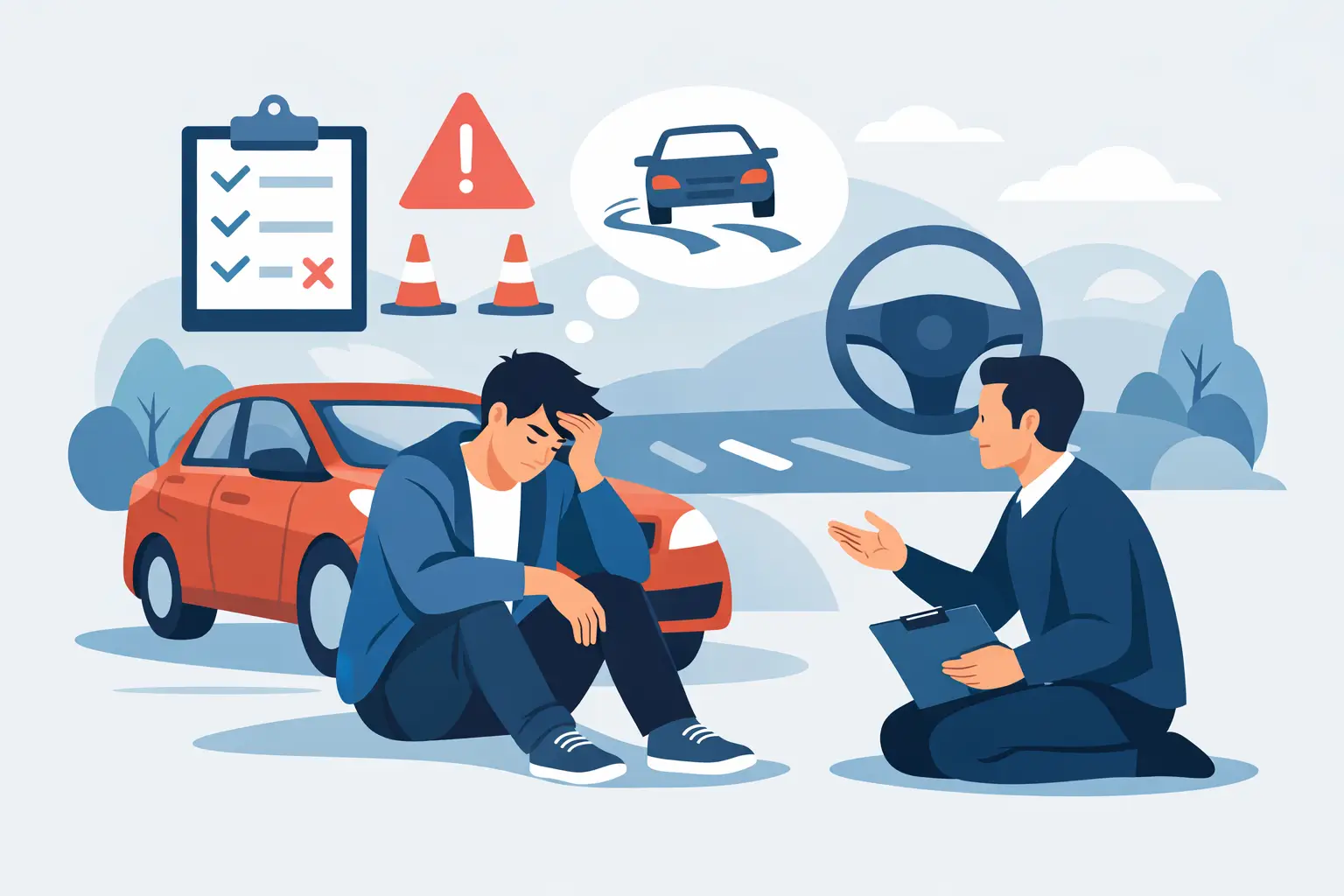
Failing a driving test can knock your confidence in a matter of minutes. One serious fault, a few driving faults, or simply letting nerves take over, and suddenly all that effort feels wasted. The good news is that driving test help after failing is usually much more straightforward than learners expect. A failed test is not proof that you cannot drive. More often, it is a sign that a few specific habits, decisions or nerves need the right attention.
For many learners, the hardest part is not the feedback sheet. It is what happens next in your head. You start replaying the roundabout, the junction, the manoeuvre, or the moment the examiner asked you to pull up on the left. Some people rush to rebook immediately. Others avoid driving for weeks because they feel embarrassed. Neither reaction is always the right one. What helps is a calm, honest look at why the test went wrong and what will actually improve your chances next time.
What driving test help after failing should focus on
The best driving test help after failing is not about doing endless lessons for the sake of it. It is about identifying whether the problem was knowledge, skill, consistency, or nerves.
If you failed because of a clear driving issue, such as observations at roundabouts, lane discipline, meeting traffic or hesitation at junctions, the solution is technical. You need focused practice in those areas until your responses become reliable under pressure. If you drove well in lessons but made unusual mistakes on test day, nerves may have played a bigger part than your actual standard of driving.
That distinction matters. A learner who needs more experience should not rebook too quickly. A learner who is test-ready but anxious may not need a long delay – they may need a few well-structured lessons to rebuild confidence and sharpen routines.
Start with the examiner’s feedback, not your frustration
Straight after a fail, it is easy to focus on the result and ignore the detail. That is a mistake. The examiner’s feedback and your driving test report are the clearest guide to what needs work.
Look carefully at where the faults happened. Was it one repeated issue across the drive, such as mirrors not being used consistently? Was it one major lapse in concentration? Did the fault come from poor planning, weak clutch control, rushed decisions, or panic? The answer tells you what kind of support you actually need.
It also helps to be honest about whether the fail reflected your normal driving. Sometimes learners know, deep down, that their lessons had become a bit hit and miss. At other times, they were driving well but let the pressure of the test affect them. There is no benefit in pretending one is the other.
Common reasons learners fail
Some faults come up again and again because they are linked to pressure. Learners often struggle with effective observation, especially at roundabouts and when moving off. Junction judgement is another common issue, particularly when the roads feel busy and decisions suddenly seem urgent.
Positioning can also let people down. That includes lane choice, road position on turns, and keeping safe clearance from parked cars. Then there is speed awareness – not just speeding, but driving too slowly or hesitating in a way that affects other road users.
A surprising number of fails are also linked to nerves rather than a lack of ability. When anxiety builds, routines disappear. Mirrors are missed. Signals are delayed. A manoeuvre you have done well many times in lessons suddenly feels unfamiliar.
Rebuilding confidence without hiding from the problem
Confidence after a failed test should be built on evidence, not positive thinking alone. Telling yourself you will be fine next time is not enough if the same weakness is still there. Equally, one bad result should not make you believe you are a bad driver.
The most effective way to rebuild confidence is to return to structured practice quickly, while the test experience is still fresh. That does not mean cramming random hours on the road. It means going back over the areas that caught you out, understanding why they happened, and proving to yourself that you can handle them properly.
A calm instructor makes a real difference here. Learners who have had poor experiences in the past often improve fastest when lessons feel patient, clear and consistent. If you are based in Milton Keynes areas such as Monkston, Walnut Tree or Broughton, it can help to practise on the kinds of roads and test conditions you are likely to face locally, rather than driving aimlessly.
Should you rebook straight away?
It depends on the reason for the fail.
If your result came from one isolated mistake and your overall drive was strong, rebooking soon can make sense. Your driving standard may already be close, and waiting too long can actually make nerves worse because the test starts to feel bigger in your mind.
If the report showed several recurring faults, it is usually better to pause and fix them properly before choosing another date. Rebooking too soon can lead to another fail, which costs more money and often damages confidence further.
This is where honest advice matters. A good instructor should tell you whether you are nearly there or whether more work is needed. That answer is not always what a learner wants to hear, but it is far more useful than being sent to test unprepared.
How to use lessons properly after a failed test
After a fail, lessons should become more targeted. You do not need to start from scratch, but you do need structure.
Begin by revisiting the exact situations that caused the faults. If roundabouts were the problem, practise different sizes and traffic levels until your approach becomes settled. If your manoeuvre went wrong, break it down and work on control, observation and timing separately before putting it back together.
Mock tests can also help, but only if used well. A mock test should not be there to catch you out. It should show whether the improvements are holding up when you are under a bit of pressure. That is often the point where nervous habits reappear.
For some learners, a short run of two-hour lessons or an intensive refresher is more effective than scattered one-hour sessions. It keeps the learning fresh and gives enough time to work through a weakness properly instead of rushing.
When nerves were the main reason
If you know the fail was mainly about nerves, the goal is to make test conditions feel more familiar. That means practising independent driving, following sat nav directions if relevant, and getting used to driving without constant prompts.
You should also work on your pace before the test. Many nervous learners rush because silence feels uncomfortable. Others slow down too much because they are overthinking every choice. Both problems improve when you practise staying calm between hazards instead of treating every second like an emergency.
Simple routines help. Take a breath before moving off. Reset after a mistake rather than assuming the test is ruined. Keep your focus on the next decision, not the last one. Plenty of learners pass even after making minor faults because they stay composed and continue to drive safely.
Choosing the right support matters
Not all driving test help after failing is equal. If lessons have been unclear, inconsistent or rushed, changing approach can make a big difference. You need feedback that is specific, patient and honest. You also need lessons that are tailored to your level rather than delivered in a one-size-fits-all way.
That is why many learners look for an instructor with a strong pass record and calm teaching style, especially after a setback. At Pass4you, the focus is not just on getting pupils through the test quickly, but on helping them become safe, competent drivers for life. That matters because lasting confidence comes from knowing you can genuinely handle the road, not just scrape through one test route.
What to do before your next test
As your next test approaches, aim for consistency rather than perfection. You do not need to drive like a robot. You need to show that you can make safe, sensible decisions for the majority of the drive.
In the final lessons, focus on the quality of your routines, your awareness, and your ability to recover calmly if something does not go exactly to plan. Make sure your instructor is happy that your standard is stable, not just good on your best day.
A failed test can feel personal, but it usually is not. Most of the time, it is simply useful feedback delivered in an unpleasant way. If you respond with the right practice, the right support and a realistic plan, the next result can look very different.
One bad day does not decide what kind of driver you will become. What matters now is what you do with the lesson.
Leave a Reply