
Last month, a driver in Milton Keynes discovered they’d paid over £180 in car tax for a Vauxhall Corsa that hadn’t left their driveway since October. It’s a stressful situation that many of us face when a car is no longer in use, and the fear of a £1,000 DVLA fine for an untaxed vehicle only adds to the pressure. You likely want to do the right thing and stop wasting money, but the confusion over what counts as a public road can make you feel stuck. It’s completely normal to feel a bit anxious about getting the paperwork wrong.
We’re here to help you feel confident and in control of your vehicle’s status. In this guide, you’ll learn the simplest way to sorn a vehicle legally so you can stop those monthly payments immediately. We’ll show you how to navigate the online declaration process and ensure your car is stored safely on private land. We’re covering everything from 2026 tax refund rules to the exact steps you need to take to keep your bank balance healthy and your record clean.
Key Takeaways
- Understand exactly what a Statutory Off Road Notification is and why it is a vital legal step to protect yourself from costly DVLA fines.
- Learn the specific situations where you should declare a car off the road, such as when buying your first vehicle before passing your driving test in Milton Keynes.
- Discover the strict rules regarding where you can legally store your car to ensure you remain compliant with UK road regulations and avoid vehicle seizure.
- Follow our simple, stress-free guide on how to sorn a vehicle using your V5C or V11 documents for immediate peace of mind and potential tax refunds.
- Find out the essential “three pillars” you must have in place before you can safely and legally end your notification and get back behind the wheel.
What is SORN? Understanding Statutory Off Road Notifications
If you’ve decided to take your car off the road, perhaps to save money while you’re at university or because a project car needs major repairs, you must inform the DVLA. This process is called making a Statutory Off-Road Notification (SORN). It’s a formal legal declaration that your vehicle isn’t being used or parked on public highways. While many drivers still refer to ‘Road Tax’, the official term is Vehicle Excise Duty (VED), and SORN is your way of pausing that financial commitment legally.
Since 16 December 2013, the rules have become much simpler for owners. You no longer need to renew your declaration every year. By 2026, this continuous declaration system remains the standard, meaning once you sorn a vehicle, it stays in that state until you tax it, sell it, or scrap it. It’s a reassuring system that removes the worry of missing a renewal deadline while your car sits safely in a garage or on a private driveway.
The Legal Framework: Why the DVLA Requires SORN
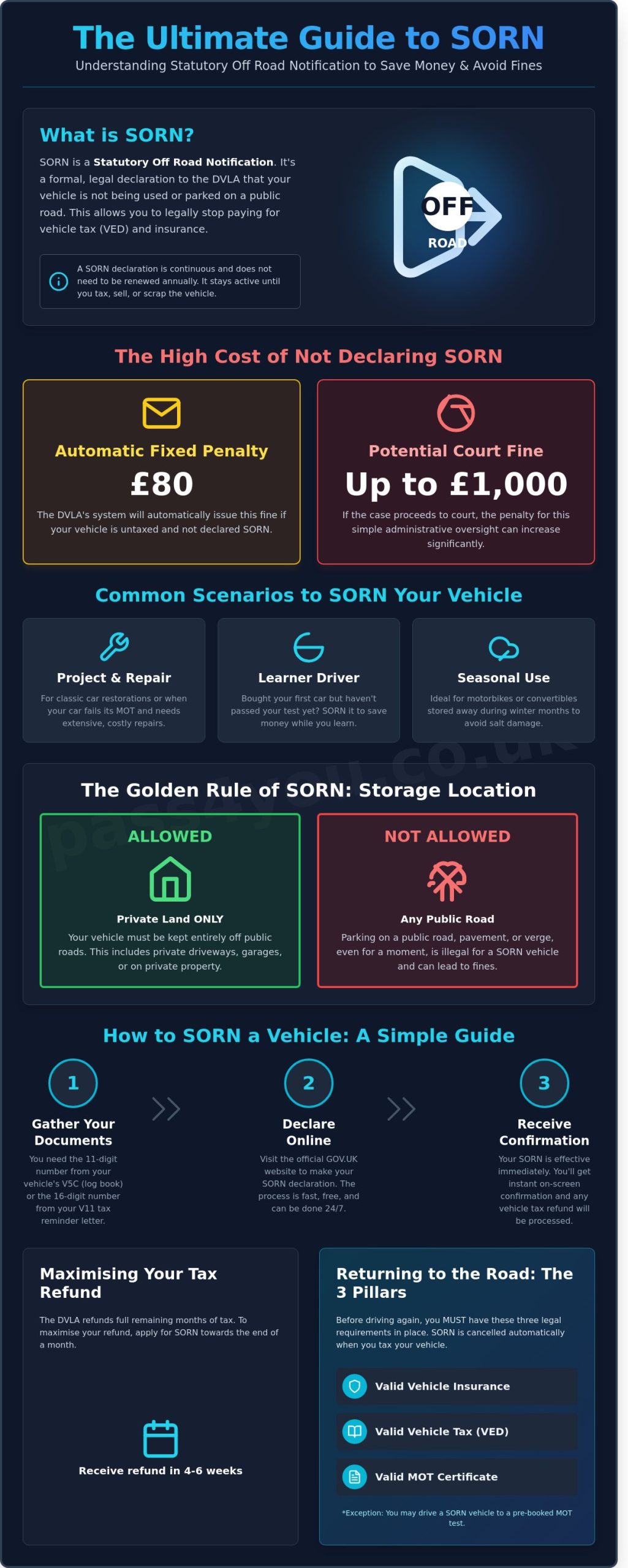
The DVLA uses a system called Continuous Insurance Enforcement (CIE). This regulation requires every registered vehicle to be either taxed and insured, or declared SORN. SORN is the only legal way to stop paying VED without selling the vehicle. If you ignore this requirement, the DVLA’s computer systems will automatically flag the discrepancy. Failing to sorn a vehicle properly leads to an automatic £80 fixed penalty. If the case goes to court, you could face a fine of up to £1,000, which is a heavy price for a simple administrative oversight.
SORN vs. Cancelled Insurance: Key Differences
A common and expensive mistake is thinking that cancelling your insurance policy automatically tells the DVLA your car is off the road. It doesn’t. If you cancel your insurance without a SORN in place, you’re breaking CIE rules. When you declare SORN, your V5C log book status is updated, but you remain the registered keeper.
You’ll also find that your MOT requirements change. While a car is SORNed, you don’t need a valid MOT certificate. However, you must ensure the vehicle is roadworthy and has a fresh MOT before you ever think about driving it on a public road again. Keeping these records straight ensures you stay on the right side of the law and maintain your confidence as a responsible owner.
When Should You SORN a Vehicle? Common Scenarios for Drivers
Deciding to sorn a vehicle is often a savvy financial move rather than a sign of a permanent mechanical failure. It’s a practical tool for drivers who want to pause their spending when a vehicle isn’t in active use. Common situations include keeping a classic car tucked away for a six-month restoration project or storing a motorbike during the icy months between October and March. If a car fails its MOT and requires repairs exceeding £550, declaring it off-road prevents you from paying for tax while the vehicle sits on your driveway awaiting parts.
You must ensure the vehicle is kept entirely on private land, such as a garage or a private drive. When you need to make a SORN is the moment the car is no longer used on public highways. This simple step stops the automated DVLA systems from flagging you for being untaxed or uninsured, which can lead to fixed penalty notices of £80 or more.
The Learner Driver Scenario: Protecting Your First Car
Many students at Pass4you Driving School choose to buy their first car months before they’ve even booked their practical test in Milton Keynes. It’s a brilliant way to stay motivated. However, if you aren’t ready to drive it yet, keeping it taxed is an unnecessary drain on your savings. By using a SORN, you can keep your car safely on the drive while you focus on achieving our 83.33% first-time pass rate. This allows you to build up your confidence with Simon without worrying about monthly tax outgoings.
Economic Benefits: Managing Your Vehicle Tax Refund
The DVLA calculates refunds based on full months of remaining tax. If you apply for a SORN on the 3rd of the month, you won’t get a refund for those remaining days. It’s smarter to time your application towards the end of the month to maximise your return. Most drivers receive their refund cheque or bank transfer within 4 to 6 weeks.
- Students: If you’re heading to university for a three-year degree and leaving your car at home, a SORN is essential.
- Seasonal Drivers: Owners of soft-top convertibles often declare a SORN from November to April to avoid winter salt damage.
- Project Cars: Long-term restorations that might take 12 months or more should always be declared off-road.
It’s a straightforward process that puts you back in control of your motoring budget. Once you’re ready to get back behind the wheel, you can simply tax the vehicle again and hit the road with peace of mind.
The Rules of the Road: Where Can a SORN Vehicle Be Kept?
When you decide to sorn a vehicle, the law is very specific about where that car must stay. A Statutory Off Road Notification is only valid if the vehicle is kept entirely on private land. This includes your personal driveway, a private garage, or a garden. You cannot leave it on any road maintained at the public expense. Many drivers mistakenly believe a resident parking permit or a quiet cul-de-sac counts as being off-road, but if the council maintains the tarmac, your SORN is invalid. To stay on the right side of the law, you must Register your vehicle as off the road (SORN) before moving it to its designated storage spot.
Public Roads and the DVLA Camera Network
The DVLA uses a massive network of Automatic Number Plate Recognition (ANPR) cameras to spot untaxed cars instantly. In 2023, enforcement teams across the UK clamped or towed over 50,000 vehicles for tax and SORN violations. Driving a SORN vehicle on a public highway, even for a quick trip to the local shops, can result in a fine of up to £2,500. If your car is spotted on the street, it is likely to be clamped on the spot. You’ll then face a £100 release fee plus daily storage costs that quickly add up.
Private Land Nuances for MK Residents
Milton Keynes has unique layouts that can make SORN compliance a little tricky for local drivers. Our estates often feature shared parking courts or areas near redways that might feel private but are actually council-maintained land. If you live in an apartment block with shared resident parking, check your lease carefully. Unless the space is legally deeded to you and is not maintained by the local authority, it might not qualify as private land for SORN purposes. A SORN vehicle must be entirely off the public road, including any overhanging parts. This means if your bumper or tow bar sticks out over the public pavement, the vehicle is technically on the road and subject to fines. We want you to feel confident and safe, so always double-check your boundaries before you sorn a vehicle.
- Legal: Private driveways, internal garages, and privately owned car parks.
- Illegal: Council-owned estates, public lay-bys, and any road with a permit scheme.
- The 100% Rule: Every inch of the car must be behind your property line.
How to SORN a Vehicle: A Step-by-Step Practical Guide
Taking your car off the road might feel like a big step, but the process is designed to be straightforward and stress-free. To sorn a vehicle successfully, you’ll first need to have your paperwork ready. Grab your 11-digit reference number from your V5C log book or the 16-digit number found on your V11 tax reminder letter. Having these digits to hand ensures you can complete the process in under five minutes without any fuss.
Applying Online: The Fastest Method
Using the official GOV.UK digital service is the most efficient way to manage your application. If you use the 11-digit V5C number, the SORN starts immediately. If you use the 16-digit V11 number, the SORN begins on the first day of the next month. If you’ve lost your V5C, you must apply for a replacement, which currently costs £25, before you can complete the declaration online. Once finished, you’ll receive a confirmation email. Save this document; it’s useful proof for your insurance provider if you’re switching to a “laid-up” policy. For those who prefer planning ahead, you can post a V890 form to the DVLA to register the status up to 60 days in advance.
If you’re feeling unsure about any part of vehicle ownership or road safety, our calm and patient driving instructors are here to help you build lasting confidence.
Maintaining a Vehicle While it is SORN
Keeping your car in good condition while it’s stationary prevents expensive repairs when you’re ready to drive again. Batteries often lose charge if left for more than 14 days. Investing in a £35 to £50 trickle charger will keep the battery healthy without overcharging it. Tyre care is equally vital. To prevent flat spots, increase the tyre pressure by 10 or 15 PSI above the standard level, or move the car a few inches every few weeks. Because the UK sees an average of 156 days of rain each year, a high-quality, breathable car cover is a smart investment to protect the paintwork from damp and debris. You can check your vehicle’s status at any time using the DVLA’s vehicle enquiry service to ensure your sorn a vehicle declaration is active and your records are up to date.
Returning to the Road: Ending Your SORN and Driving Again
Getting your car back on the tarmac requires more than just turning the ignition key. To legally end the period where you sorn a vehicle, you must satisfy the “three pillars” of road legality: road tax, a valid MOT, and insurance. Missing just one of these can lead to a £1,000 fine or vehicle seizure. You must ensure all three are active before the wheels touch a public road.
The easiest way to cancel your SORN is to pay your vehicle tax online via the DVLA website. Once the payment is processed, the SORN is cancelled automatically. You don’t need to send a separate letter or make a phone call. When you decide to no longer sorn a vehicle, the transition is instant. There is exactly one legal exception to driving a SORN car: you can drive it directly to a pre-booked MOT appointment. You must have insurance for this trip, and the test centre should have your registration on their schedule to prove your intent if you are stopped.
The Checklist for Getting Back Behind the Wheel
Before you head out, update your insurance policy. You need to tell your provider the car is no longer in “laid up” cover and is returning to active use. If your MOT expired while the car was off-road, book a slot at a local Milton Keynes test centre immediately. Mechanical health is just as vital as legal paperwork. Check your brake fluid levels and tyre pressures. Tyres often develop flat spots if left stationary for more than 90 days, which can cause dangerous vibrations at high speeds.
Confidence on the Road with Pass4you
If your car has been tucked away for several months, your own driving skills might feel a bit rusty. It’s perfectly normal to feel a flicker of anxiety after a long break from the driver’s seat. Simon and the team at Pass4you specialise in building that lost confidence through tailored refresher lessons. We understand that road layouts and traffic density in Milton Keynes can be daunting if you haven’t faced them lately.
We apply the same patient, calm mentorship that earned us our 83.33% first-time pass rate to help experienced drivers get back into the swing of things. We’ll help you polish your observations and master those complex roundabouts again. Our goal is to ensure you feel like a safe driver for life every time you pull out of your driveway.
Master Your Vehicle Admin and Get Road Ready
Managing your car’s legal status shouldn’t be a headache. Whether you’re putting a car away for winter or waiting for repairs, you must sorn a vehicle correctly to avoid automatic fines of up to £1,000. Always ensure your car stays on private property, such as a driveway or garage, while the notification is active. When you’re ready to return to the tarmac, double check that your MOT is current and your insurance is fully updated before you start the engine.
Understanding the rules is just as vital as mastering the wheel. If you’re looking to build your confidence behind the wheel, Book your driving lessons in Milton Keynes with Pass4you today. We’ve helped hundreds of students achieve an impressive 83.33% first-time pass rate. You’ll benefit from calm and patient instruction from Simon while learning in modern Volkswagen tuition vehicles. We don’t just teach you how to pass; we ensure you’re a safe, capable driver for the long term. We’re ready when you are.
Frequently Asked Questions
Can I drive my car if it is SORN to an MOT appointment?
You can drive a SORN vehicle to a pre-booked MOT appointment. This is the only legal exception to the rule. You must have proof of your appointment ready if you are stopped by the police. It’s a sensible way to get your car back on the road safely. We always recommend checking your tyres and lights before the trip to help secure a first time pass.
How long does a SORN last once I have declared it?
Your SORN lasts indefinitely until you tax, sell, or scrap the vehicle. You no longer need to renew it every 12 months because the rules changed in 2013. This provides great peace of mind for owners who need a break from driving. It’s a simple, permanent solution that keeps you on the right side of the law while your car is safely tucked away.
Do I get a refund on my car insurance if I SORN my car?
You don’t get an automatic refund on your car insurance when you sorn a vehicle. SORN only alerts the DVLA that you aren’t using the road. To get money back, you must contact your insurer to cancel the policy. Many providers charge a cancellation fee of around £50. This might mean it’s better to keep the policy active for fire and theft protection.
Can I SORN a vehicle if I don’t have the V5C log book?
You can SORN your car using the 16 digit reference number on your V11 tax reminder letter. If you have lost both the V5C and the V11, you’ll need to apply for a replacement log book. This is done using a V62 form and costs £25. It’s a calm and manageable process that ensures your vehicle remains legally declared while you wait for your new paperwork.
What happens if I sell a vehicle that is currently SORN?
SORN status ends the moment you sell the vehicle. The notification doesn’t transfer to the new owner. They must either tax the car or make their own SORN declaration before they can keep it off-road. This ensures the DVLA records stay accurate. It’s a responsible way to handle the handover and helps the new owner start their journey as a safe, legal driver.
Is it legal to keep a SORN car on a driveway without a cover?
It’s completely legal to keep a SORN car on your driveway without a cover. The law only requires that the vehicle stays on private land and off public roads. While a cover can protect your car from the British weather, it isn’t a legal requirement. Just ensure no part of the vehicle, like the bumper, hangs over onto a public pavement or highway.
How much does it cost to SORN a vehicle in 2026?
It costs £0 to sorn a vehicle in 2026. The government has kept this service free to encourage drivers to register their cars correctly. You can complete the process in minutes online or by post without spending a penny. It’s a helpful, cost-effective way to manage your car’s status if you’re taking a break from the road to save on running costs.
Can I SORN my car if it is parked in a rented garage?
You can SORN your car if it’s parked in a rented garage. The main rule is that the vehicle must be off the public highway. A private rented garage qualifies as off-road storage. This is a brilliant way to keep your car safe and secure. Just make sure you don’t park it on the road outside the garage while you’re moving things around.


Leave a Reply