
Last Tuesday, a new driver named Chloe found herself circling Old Street, gripped by the fear that she’d accidentally crossed a line she couldn’t see. She isn’t alone; Transport for London issued over 1.5 million penalty charge notices in 2023, often to drivers who simply didn’t understand how the congestion charge works. It’s a common worry that can turn a simple trip into a stressful ordeal, especially when you’re still building your confidence on the road.
We know that navigating the capital’s busy junctions is hard enough without worrying about a £180 fine landing on your doorstep. You deserve to feel calm and in control behind the wheel, rather than scanning every signpost in a panic. This guide will help you master the zone boundaries, current costs, and the best “set and forget” payment methods for 2026. You’ll learn exactly how to distinguish this fee from the ULEZ and where the cameras start. We’ve simplified everything so you can focus on the road and enjoy the freedom of city driving without the fear of a hidden cost.
Key Takeaways
- Gain the confidence to navigate central London by understanding exactly where and when the daily fee applies.
- Master the 2026 congestion charge pricing, including how to pay the standard £18 fee and avoid increased late payment penalties.
- Clear up the common confusion between the ULEZ and central London’s specific zones to ensure you stay safe and compliant.
- Discover stress-free payment methods like Auto Pay to keep your journeys calm and ensure you never face a fine.
- Learn Pass4you Driving School’s expert tips for driving into the capital from Milton Keynes, helping you plan a professional, anxiety-free route.
What is the London Congestion Charge and Where Does it Apply?
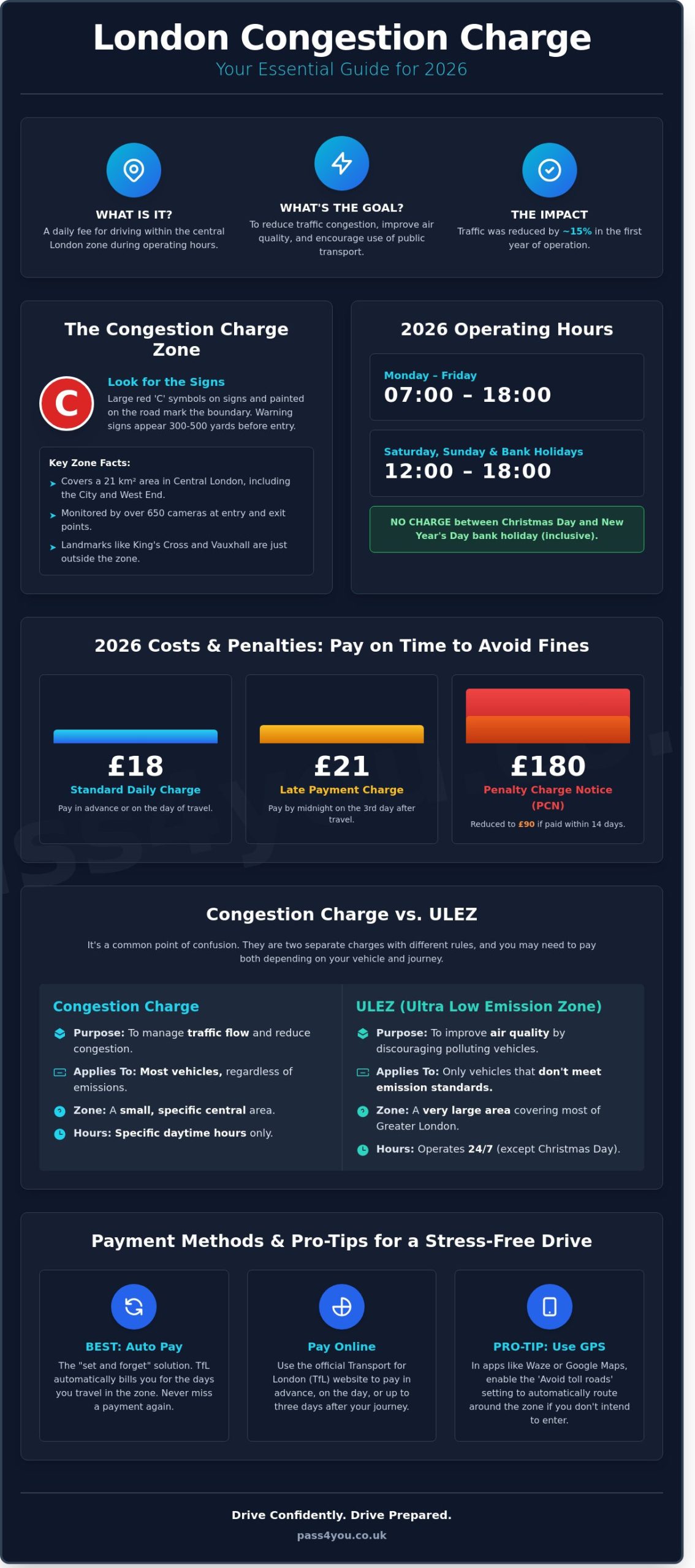
Driving into central London can feel like a big step for any learner or newly qualified driver. It’s a busy environment, but staying calm and prepared makes all the difference. The congestion charge is a daily fee of £15 that applies to most vehicles driving within the central London zone. This isn’t a 24-hour charge; it applies between 07:00 and 18:00 Monday to Friday, and 12:00 to 18:00 on Saturdays, Sundays, and bank holidays. There is no charge between Christmas Day and New Year’s Day bank holiday inclusive.
The history of the London Congestion Charge started on 17 February 2003. Its primary goal was to tackle the heavy gridlock that once paralysed the city’s heart. By charging a fee, Transport for London (TfL) successfully reduced traffic volume by approximately 15% in the first year alone. Beyond just clearing the roads, the scheme aims to improve air quality and encourage people to use London’s extensive public transport network. For you as a driver, this means fewer cars on the road, which can help you feel more confident and less rushed during your journey.
For new drivers, the congestion charge matters because it requires forward thinking. Missing a payment or accidentally entering the zone can lead to a Penalty Charge Notice (PCN) of £160, though this is halved if you pay within 14 days. Avoiding the zone entirely often requires advanced route planning. We always suggest our students take a moment to look at their route before setting off. Being proactive helps you stay in control and keeps your driving experience positive and stress-free.
Mapping the Congestion Charge Zone Boundaries
The zone covers a specific 21-square-kilometre area within the London Inner Ring Road. This includes major hubs like the City of London and the West End. You’ll find that key landmarks such as King’s Cross station, Marylebone, and Vauxhall sit just outside the boundary line. If you’re worried about drifting into the zone, modern technology is a fantastic safety net. GPS apps like Waze or Google Maps have settings to specifically ‘avoid toll roads’. Turning this on before you start the engine ensures your sat-nav guides you around the perimeter rather than through the middle. It’s a simple way to maintain your peace of mind while navigating unfamiliar streets.
Recognising the Signs and Road Markings
You don’t need to memorise every street corner to know when you’re entering the charging area. The most important visual guide is a large red circle with a white letter ‘C’ inside. This symbol is used consistently across London. You’ll typically see advance warning signs 300 to 500 yards before you reach the boundary, giving you plenty of time to change your route if you need to. As you cross the line, look down at the tarmac. Large ‘C’ symbols are painted directly onto the road surface as a final notification. There are over 650 cameras monitoring these entry points, so the system is very efficient. By keeping your eyes moving and staying observant, you’ll spot these markers easily and remain a safe, informed driver.
Congestion Charge Rules for 2026: Costs and Operating Hours
Driving into central London should not be a source of anxiety for any motorist. If you have been practicing your skills with a patient driving instructor, you already possess the focus and confidence needed to handle busy city environments. Understanding the 2026 pricing structure ensures you can plan your journey without any unexpected financial surprises. The standard daily charge for entering the zone is £18, provided you pay in advance or on the day of your travel. This fee is a necessary part of London’s strategy to reduce traffic volume and improve air quality for everyone.
The operating hours are strictly enforced to manage peak travel times effectively. From Monday to Friday, the congestion charge is active between 07:00 and 18:00. On Saturdays, Sundays, and bank holidays, the hours change to 12:00 until 18:00. It is helpful to remember that the zone is not active 365 days a year. There is a specific grace period during the festive season where no charges are applied. This break runs from Christmas Day, 25 December, through to the New Year’s Day bank holiday inclusive, allowing families to visit the capital more easily during the holidays.
Managing your payments is straightforward if you stay organised. You can check the official Congestion Charge costs and payment portal to see if your vehicle is registered for any specific discounts or to settle your balance online. If you miss the initial deadline, the cost increases. Paying by midnight on the third day after your journey results in a late payment fee of £21. Staying on top of these deadlines helps you remain a responsible and stress-free driver.
Understanding the Multi-Day Payment Window
The Three-Day Rule acts as a safety net for those who might forget to pay immediately. Transport for London (TfL) introduced this window to reduce the number of Penalty Charge Notices (PCNs) issued for simple forgetfulness, though the £3 increase from the standard rate serves as a firm reminder to pay promptly. You only need to pay once per day, regardless of how many times you cross the boundary. The congestion charge is a flat daily fee that allows you to drive within the zone as many times as you need without extra costs. This flexibility is vital for those who need to make multiple deliveries or appointments within the city centre throughout a single afternoon.
Exemptions and Discounts in 2026
Specific groups of drivers can access significant savings, provided they register their vehicles correctly. Blue Badge holders are eligible for a 100% discount on the daily charge. To secure this, you must register with TfL and pay a small administrative fee, which was set at £10 in previous years to cover processing costs. Residents living within the zone also benefit from a 90% discount, ensuring that those who call central London home aren’t unfairly penalised for essential local trips. It is important to check your eligibility annually to ensure your discount remains active.
The rules regarding the Cleaner Vehicle Discount have changed significantly as London moves toward its 2030 climate goals. By 2026, the vast majority of petrol and diesel cars no longer qualify for any discounts, as the scheme now focuses exclusively on zero-emission technology. Even many older hybrid models that previously enjoyed exemptions are now subject to the full £18 daily fee. This shift reflects a 25% increase in the stringency of emissions standards over the last five years, encouraging drivers to consider the most environmentally friendly transport options available.
Congestion Charge vs. ULEZ: What is the Difference?
Many learners and experienced drivers from Milton Keynes feel a bit anxious when heading into the capital for the first time. It’s easy to see why. You might hear people use these terms interchangeably, but they are separate schemes with very different goals. While both require a payment to enter certain parts of the city, they don’t cover the same ground or look for the same things in your vehicle.
The primary difference lies in why the charge exists. The congestion charge is a traffic management tool designed to reduce the sheer volume of cars in the busiest streets. It’s about space and time. On the other hand, the Ultra Low Emission Zone (ULEZ) is an environmental initiative. It focuses on air quality and the age of your engine. Since 29 August 2023, the ULEZ expanded to cover all 32 London boroughs, making it a much larger area than the original central zone. If you drive a non-compliant car anywhere inside the M25, you’re likely in the ULEZ. The Transport for London website shows that the Congestion Charge zone remains limited to the very centre of the city, including areas like Marylebone, Vauxhall, and the City of London.
ULEZ: The Ultra Low Emission Zone Explained
The ULEZ operates 24 hours a day, every day of the year, with the single exception of Christmas Day. If your vehicle doesn’t meet specific Euro emissions standards, you’ll need to pay a £12.50 daily fee. Generally, this affects petrol cars registered before 2006 and diesel cars registered before September 2015. It’s a significant cost for those who haven’t upgraded their vehicles. Before you set off from Milton Keynes, it’s a smart idea to use the TfL vehicle checker. This tool tells you exactly where your car stands so you aren’t surprised by a letter in the post. We always teach our students that being prepared is the best way to stay calm and confident behind the wheel.
Do I Have to Pay Both Charges?
You might find yourself facing the “Double Charge” if your journey takes you into the very heart of the city. This happens because the Congestion Charge zone sits directly inside the ULEZ. If you drive into Soho or the City between 07:00 and 18:00 on a weekday, or 12:00 and 18:00 on weekends, you could be liable for both. For a driver in an older, non-compliant diesel car, this means paying £12.50 for the ULEZ and £18 for the daily Congestion Charge. That’s a total of £30.50 just for one day of driving. It’s a steep price that makes public transport or a newer car look much more attractive.
To help you stay on top of these costs, follow this simple checklist before you start your engine:
- Check ULEZ status: Enter your registration on the TfL website to see if your car meets the emissions standards.
- Check the ‘C’ zone: Look at your destination on a map to see if it falls within the small central London boundary.
- Check the time: Remember that the Congestion Charge has specific operating hours, while ULEZ is almost always active.
Modern tuition vehicles, like our Volkswagens, are usually ULEZ compliant. Understanding these rules helps you become a safe driver for life, capable of handling complex city regulations without the stress. We want you to feel in control of your journey, whether you’re driving around Milton Keynes or heading into the heart of London.
How to Pay the Congestion Charge and Avoid Fines
Driving through the heart of the capital doesn’t have to be a stressful experience if you have a clear plan. Staying calm and focused on the road is much easier when you aren’t worrying about missed payments or hidden fees. By setting up the right systems before you hit the M25, you can ensure your journey remains smooth and professional. Being prepared is a hallmark of a confident driver, and managing the congestion charge is simply another part of your pre-trip checklist.
The Benefits of TfL Auto Pay
Setting up Auto Pay is the most reliable way to handle your payments without any manual effort. Once you register your vehicle and payment card on the official Transport for London (TfL) website, cameras read your number plate every time you enter the zone. You’ll be billed automatically at the end of each month for only the days you actually drove. We recommend this for any driver who visits London even just a few times a year. It provides total peace of mind because you can’t accidentally forget to pay. You won’t face the £21 late payment fees because the system always ensures you are charged the lowest daily rate available for your vehicle type.
For those who prefer to manage things manually, the ‘TfL Pay to Drive in London’ mobile app is a fantastic tool for quick updates on the move. It allows you to check if a postcode sits within the charging zone and pay for your journey in seconds. You can also pay online via the official TfL portal. Be extremely careful to avoid unofficial third-party ‘copycat’ websites. These sites often appear at the top of search results and charge extra service fees for no reason. Always check that the URL ends in ‘.gov.uk’ or is the official ‘tfl.gov.uk’ domain to keep your money safe.
Dealing with a Penalty Charge Notice (PCN)
Missing a payment happens to the best of us, but it is important to act quickly to keep costs down. If you drive within the zone during charging hours and fail to pay by midnight on the third day after travel, you’ll likely receive a Penalty Charge Notice (PCN). Currently, the standard PCN cost is £180. However, if you pay within 14 days of the notice being issued, the fine is reduced by 50 percent to £90. This significant reduction is why you should check your post regularly after a trip to the city.
One common mistake that leads to escalating fines is failing to update your logbook (V5C) address with the DVLA. If you’ve moved house and haven’t updated your records, the PCN will be sent to your old address. You might only find out about the fine when it has reached hundreds of pounds or moved to debt collection. If you do receive a fine that you believe is unfair, you have the right to appeal. Valid reasons for challenging a fine include your vehicle being cloned, the vehicle being sold before the date of the alleged offence, or a genuine medical emergency. Building your skills behind the wheel is about more than just steering; it’s about being a safe and responsible driver for life who understands the rules of the road.
Remember that the congestion charge operates between 07:00 and 18:00 on weekdays, and 12:00 to 18:00 on weekends and bank holidays. There is no charge between Christmas Day and New Year’s Day inclusive. By keeping these times in mind and using Auto Pay, you can focus entirely on your driving and enjoy the freedom that comes with being a licensed driver in the UK.
Navigating London Confidently as a New Driver
Driving from Milton Keynes to the heart of the capital is a significant milestone for any new driver. The journey typically involves a 50-mile stint down the M1, followed by the A41. This transition from three lanes of motorway to the busy streets of North West London can feel overwhelming if you aren’t prepared. However, with a bit of planning and a calm mindset, it becomes just another road to master. You’ve already got the skills; now it’s about applying them in a denser environment.
Simon often shares a crucial tip with his students: focus on the road, not the paperwork. It’s easy to get distracted looking for places to pay the congestion charge the moment you see the boundary signs. Remember that London uses an Automatic Number Plate Recognition (ANPR) system. The cameras will catch your plate regardless. You don’t need to stop or find a kiosk immediately. You have until midnight on the third day after your journey to pay the £15 fee online. Prioritise your lane positioning and your mirrors; the payment can be handled from the comfort of your sofa later.
New drivers often struggle with ‘information overload’ in London. The sheer volume of signs for bus lanes, red routes, and low emission zones can be dizzying. The trick is to filter the noise. Focus on the road markings and your immediate surroundings. If you miss a turn because you were checking a sign, don’t swerve. London’s road network is interconnected. Simply follow the flow of traffic and let your sat-nav recalculate. Staying calm is your best tool for safety.
Practical Tips for Your First Trip to Central London
Choose your entry point carefully to reduce stress. Major junctions like Marylebone Road have large, clear ‘C’ symbols painted on the tarmac, making the boundary impossible to miss. If you have a passenger, turn them into a co-pilot. Ask them to watch for zone entry signs and navigate, leaving you free to manage the steering and pedals. For the ultimate low-stress introduction, time your first visit for a Sunday morning. Since the congestion charge doesn’t start until 12:00 on weekends, you can enjoy quieter streets and gain confidence before the midday rush begins.
Safe Driving for Life with Pass4you
Our approach at Pass4you is built on patience. We know that the leap from quiet Milton Keynes estates to the city centre feels huge. That’s why we don’t just teach you to pass a test; we prepare you for the reality of UK driving. Our instructors use a supportive, non-shouting method that helps you stay relaxed even when traffic gets heavy. With our impressive 83.33% first-time pass rate, we’ve helped hundreds of learners become capable, independent drivers who don’t fear the city.
Building your skills in complex environments is the best way to ensure you stay safe on the road for years to come. Whether it’s tackling multi-lane roundabouts or navigating urban toll zones, we provide the expert guidance you need to succeed. Book a lesson with Pass4you to build your confidence on all road types and start your journey toward becoming a truly versatile driver. We don’t just aim for a pass; we aim for your long-term safety and confidence behind the wheel.
Take Control of Your Future on the Road
Mastering the congestion charge rules is just one part of becoming a capable road user in 2026. You’ll stay ahead of the game by remembering the £15 daily rate and the 07:00 to 18:00 weekday operating times. Avoiding the £180 fines is simple once you’ve built the habit of checking your route and payment deadlines. These details might feel overwhelming now, but they quickly become second nature with the right professional support.
At Pass4you, we focus on building your skills through calm and patient instruction in modern VWs. We understand that learning to drive can be nerve-wracking, which is why we’ve developed a supportive approach that leads to our impressive 83.33% first-time pass rate. Our expert local knowledge of Milton Keynes and the surrounding areas ensures you’re prepared for any road layout or traffic condition. We don’t just teach you to pass a test; we help you become a safe driver for life. You’ll soon find that the freedom of the open road is worth every moment of practice.
Start your journey to becoming a confident driver with Pass4you
We’re ready to help you get behind the wheel and start your new chapter with total confidence.
Frequently Asked Questions
Is there a Congestion Charge on weekends in 2026?
Yes, you’ll need to pay the daily £15 charge if you drive within the zone between 12:00 and 18:00 on Saturdays, Sundays, and bank holidays. These specific weekend hours were made permanent in February 2022 and continue to apply throughout 2026. Planning your trip outside these times helps you stay calm and avoid unnecessary costs. It’s a simple way to keep your journey stress-free while you gain confidence on busier London roads.
Can I pay the Congestion Charge after I have driven in the zone?
You can pay the charge up to three days after your journey, but the price increases if you don’t pay on the day. While the standard daily rate is £15, paying in the three-day window after travel raises the fee to £17. We always recommend setting up Auto Pay to avoid any missed payments. This small step ensures you’re always a safe and responsible driver without the worry of unexpected bills arriving in the post later.
Do electric cars have to pay the Congestion Charge?
Yes, from 25 December 2025, all electric vehicle owners must pay the full daily congestion charge just like petrol or diesel drivers. The previous 100% discount for cleaner vehicles has been phased out to help manage traffic levels in central London. Even if you’re driving a zero-emission car, you’ll need to budget for the £15 fee. This change ensures every road user contributes to reducing traffic in our busy capital.
What is the fine for not paying the London Congestion Charge?
If you forget to pay, you’ll receive a Penalty Charge Notice for £180. You can reduce this fine to £90 if you pay it within 14 days of the issue date. If you don’t pay within 28 days, the cost increases to £270. We want you to feel confident and prepared for every trip, so checking the zone boundaries before you set off is a brilliant habit to form. It keeps your driving experience positive and affordable.
Is the Congestion Charge the same as ULEZ?
No, these are two separate schemes with different goals and boundaries. The congestion charge is a £15 daily fee designed to reduce traffic volume in central London during peak hours. In contrast, the Ultra Low Emission Zone (ULEZ) operates 24 hours a day across all London boroughs to improve air quality. Depending on your vehicle’s emissions, you might need to pay both charges if you enter the very centre of the city. Understanding these rules helps you feel in safe, professional hands.
How do I know if my hotel is inside the Congestion Charge zone?
You should check your hotel’s postcode on the Transport for London website to see if it falls within the boundary. You’ll also see large red circles with a white ‘C’ on road signs as you enter the zone. If your hotel is inside the perimeter, you’ll be liable for the charge every day you move your car. Many hotels just outside the zone offer safer, more affordable parking options for visitors who want to avoid the fee.
Do learner drivers have to pay the Congestion Charge during a lesson?
Yes, learner drivers must pay the daily fee if their lesson takes place within the zone during operating hours. There are no exemptions for driving schools or students. At Pass4you, we often plan routes that help you build experience in various conditions while being mindful of your budget. Learning to navigate these zones correctly is a fantastic way to become a more capable and prepared driver for life. It builds the real-world skills you need for success.
Is there a discount for disabled drivers or Blue Badge holders?
Blue Badge holders can receive a 100% discount on the charge after registering their vehicle with TfL. You’ll need to pay a one-off £10 registration fee to set this up, which then lasts as long as your badge is valid. This helpful discount ensures that those with mobility needs can still access central London safely and conveniently. It’s an important part of making the city’s roads accessible for everyone who needs them.
Leave a Reply