You might think manual cars are a relic of the past, but choosing a manual licence in 2026 is actually the smartest move you can make for your driving future. It’s completely normal to feel a knot in your stomach when you think about stalling at a busy junction or searching for driving schools for manual transmission that actually understand your nerves. We know that coordinating the clutch while steering through a complex Milton Keynes roundabout feels daunting, especially when you’re worried about the £62 cost of a driving test if things go wrong.
You’ll master the art of gear changes through a calm, patient approach that replaces anxiety with genuine control. You won’t just pass; you’ll gain a full UK licence that lets you drive any vehicle, saving you from the long-term limitations of an automatic-only qualification. At Pass4you Driving School, we’ve helped hundreds of nervous learners find their feet on the road. This guide explains why manual mastery is still the best value for money and how our 83.33% first-time pass rate helps you become a safe driver for life.
Key Takeaways
Understand why a manual licence remains the UK’s gold standard and how this lifelong investment provides greater vehicle flexibility and career opportunities.
Discover how to master the “biting point” and complex manoeuvres with a calm, supportive approach that removes the anxiety of stalling.
Learn how to identify the best driving schools for manual transmission by prioritising instructor patience, modern vehicles, and proven success rates.
Explore how a “tried and tested” tuition technique helps nervous students in Milton Keynes achieve an impressive 83.33% first-time pass rate.
The Enduring Appeal of Driving Schools for Manual Transmission
In 2026, the UK’s roads are more diverse than ever. While electric vehicles are becoming common, the manual gearbox remains the gold standard for many motorists. Some learners worry that the shift toward EVs makes a manual licence obsolete. This is a common misconception. Over 18 million manual cars are still registered in the UK. Learning with driving schools for manual transmission ensures you aren’t limited to a specific type of vehicle. It provides a deeper psychological connection to the driving experience. You aren’t just a passenger; you’re in control of the engine’s power. This connection helps you feel the road and anticipate how the car reacts in different weather conditions.
Pass4you focuses on making this process calm and manageable. We know that the thought of “clutch control” can be daunting for many people. Simon has helped hundreds of nervous students overcome this anxiety through a patient, step by step approach. Our 83.33% first time pass rate is a testament to our effective methods. We don’t just teach you to pass a test; we help you become a safe driver for life. Understanding how manual transmissions work gives you the technical foundation to handle any vehicle, from a small city car to a large delivery van. It’s about total freedom and building genuine confidence behind the wheel.
Manual vs. Automatic: Making the Right Choice for Your Future
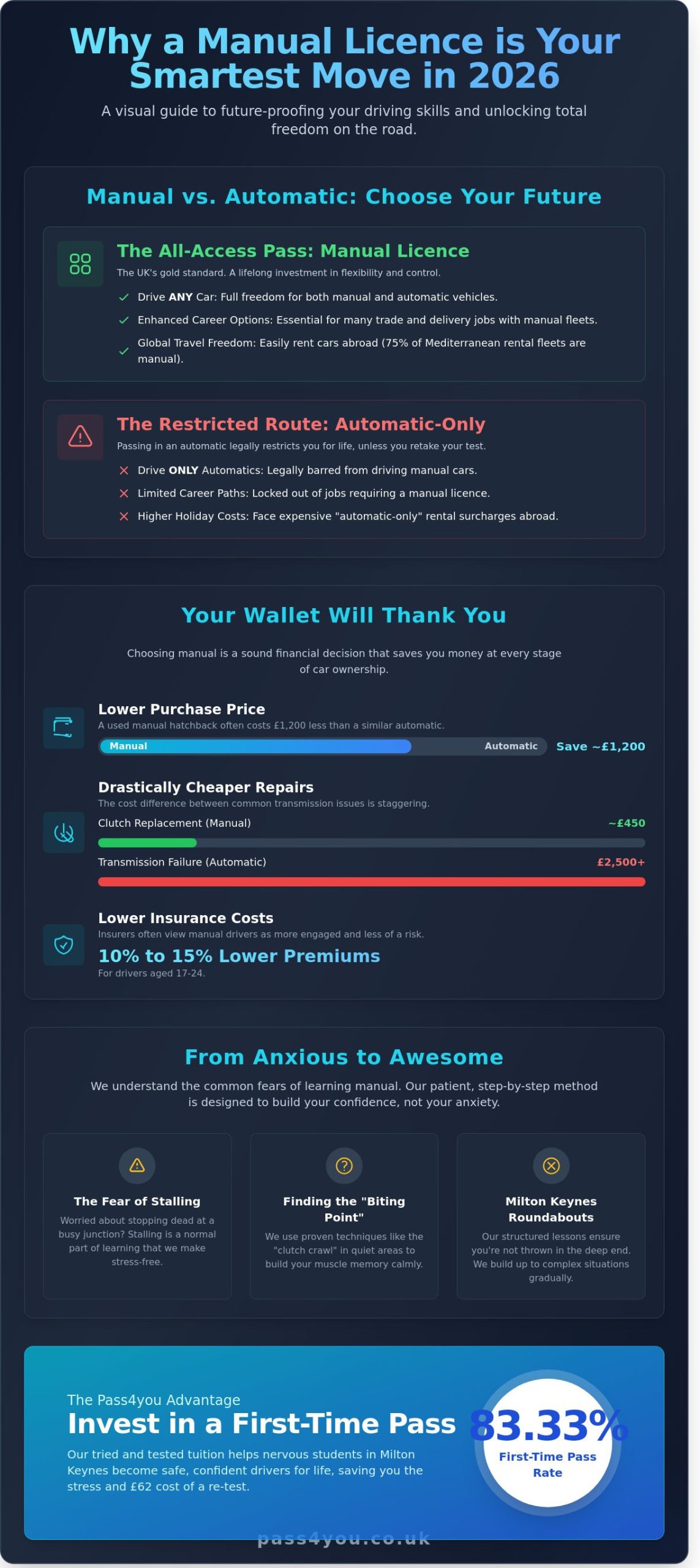
The legal difference between licence types is clear and carries long term consequences. A manual licence allows you to drive both manual and automatic cars. If you pass in an automatic, you’re legally restricted to that transmission. If you ever need to drive a friend’s manual car or a company van for work, you’d be breaking the law. A manual qualification is a future-proof decision for your career. Many trade and delivery jobs still rely on manual fleets. Additionally, hiring cars abroad is much easier. In 2025, 75% of rental fleets in Mediterranean countries consisted of manual vehicles. Having that flexibility saves you from expensive “automatic only” rental surcharges when you’re on holiday.
Financial Advantages of Choosing Manual Classes
Mastering manual gears can save you thousands of pounds over your lifetime. Manual cars are generally cheaper to purchase than their automatic counterparts. On the used market in 2026, a manual hatchback often costs £1,200 less than an automatic version with similar mileage. Maintenance is another vital factor. Automatic gearboxes are complex and expensive to repair. A clutch replacement might cost £450, whereas a total automatic transmission failure can exceed £2,500. Insurance is also a key consideration for new drivers. For a driver aged 17 to 24, insurance premiums for manual cars are typically 10% to 15% lower than for automatics. This is because insurers often view manual drivers as more engaged with the task of driving. Choosing driving schools for manual transmission is the most cost-effective way to start your journey on the road while keeping your future costs low.
Mastering the Mechanics: What to Expect in Manual Driving Lessons
Choosing reputable driving schools for manual transmission ensures you receive a structured introduction to the car’s controls. Your journey begins with the “cockpit drill,” where you’ll learn to adjust your environment for safety. From there, the progression moves from basic pedal familiarisation to complex manoeuvres like parallel parking and emergency stops. This step-by-step approach is designed to build your confidence without overwhelming you. You won’t be expected to tackle busy roundabouts on day one. Instead, you’ll spend time in quiet residential areas until your hand-foot coordination becomes second nature.
Finding the “biting point” is often the biggest worry for new students. It’s the precise moment where the clutch plates engage to move the car. Our instructors, such as Simon, use a calm and supportive method to help you master this feeling. We understand that stalling is a natural part of the learning process. In fact, many of our students who achieve our 83.33% first-time pass rate started their first lesson feeling nervous about this very thing. By focusing on a patient environment, we remove the stress of stalling, allowing you to focus on the fluid driving behaviour that examiners look for.
The Fundamentals of Clutch Control
Muscle memory is the secret to perfect clutch control. Top instructors use specific exercises, such as the “clutch crawl,” where you move the car slowly using only the clutch in a controlled car park environment. This builds the physical sensitivity required for more difficult tasks. How do you handle slow-moving traffic? It’s all about small, precise movements of your left foot to keep the car steady without constantly stopping and starting.
Hill starts are another area where learners often feel anxious. You’ll learn to use the handbrake in tandem with the biting point to prevent rolling backwards. Common mistakes include “riding the clutch,” which means keeping your foot slightly pressed down while driving. This habit can lead to premature wear and tear. Considering a clutch replacement in the UK can cost upwards of £500, learning to use the pedal correctly is a genuine investment for life. If you’re looking to build these skills in a relaxed atmosphere, you might want to book a lesson with our patient team.
Gear Selection and Road Anticipation
When should you change gear? While every car is slightly different, a general rule is to use engine sound and speed as your guides. In most petrol cars, you’ll look to shift up at roughly 2,500 RPM. Shifting at the right time isn’t just about speed; it’s vital for maintaining engine health and achieving better fuel efficiency. A car in the wrong gear will feel sluggish or over-revved, which can distract you from the road ahead.
Selecting the correct gear is also a major part of hazard perception. As you approach a junction or a pedestrian crossing, downshifting allows for engine braking, giving you more control over the vehicle’s deceleration. This proactive approach shows the examiner that you’re thinking ahead and prioritising safety. This level of expertise is why many learners seek out driving schools for manual transmission that prioritise long-term safety over quick fixes.
Block changing is the practical technique of skipping unnecessary gears, such as shifting from fifth gear directly into second when approaching a hazard, to ensure the car remains balanced and fuel-efficient during your practical driving test.
Why a Manual Licence is an Investment for Life
Choosing to learn in a manual car is about much more than just shifting gears. It is a long-term investment in your flexibility as a driver. When you pass your test in a manual vehicle, you earn the right to drive both manual and automatic cars. This “two-for-one” qualification is incredibly valuable. According to 2024 market data from Auto Trader, manual cars still make up approximately 65% of the UK’s used car listings. By holding a manual licence, you gain access to a significantly larger and more affordable pool of vehicles. Budget-conscious new drivers often find that a manual 2018 Ford Fiesta or Vauxhall Corsa can be £1,000 to £1,500 cheaper than its automatic equivalent.
Professional opportunities also expand when you can handle a clutch. Many trade industries, including construction, plumbing, and delivery services, rely on fleets of light commercial vehicles. As of early 2025, roughly 75% of the UK’s van fleet remains manual. If you are looking for a career in these sectors, having a manual licence isn’t just a bonus; it’s often a mandatory requirement. We’ve seen many students come to us because they missed out on a job opportunity simply because they were restricted to automatic vehicles. We take a patient, step-by-step approach to help you master these skills so you never have to turn down a career move.
Beyond the practicalities, there is a deep sense of satisfaction that comes from mastering a manual gearbox. Driving enthusiasts often talk about the “connection” to the car. You aren’t just a passenger in the driver’s seat; you’re the one making the decisions. This level of engagement is why many driving schools for manual transmission are seeing a resurgence in 2026. Learners want to feel in control, and they want the confidence that comes from knowing exactly how their vehicle works under the bonnet.
Manual Driving and Vehicle Control
Manual cars offer superior control in challenging conditions. On a slushy January morning in Milton Keynes, engine braking allows you to slow down safely without relying solely on your foot brake, which reduces the risk of skidding. You’ll find that manual gears provide the precision needed for steep inclines or tight parking spots. Our instructors focus on helping you develop a personalised driving style, ensuring you feel calm and safe regardless of the British weather.
The Transition to Modern Hybrids and Performance Cars
You might think manual skills are becoming obsolete, but the opposite is true for performance enthusiasts. Many high-end sports cars use paddle-shift systems that require an intimate understanding of gear ratios and engine revs. Furthermore, the niche market for manual performance cars is thriving. Models like the Honda Civic Type R or the Porsche 718 Cayman hold their value exceptionally well because of their manual gearboxes. By 2026, driving schools for manual transmission have noted that students are increasingly interested in these “drivers’ cars” as future investments. Learning these skills now ensures you’re prepared for the exciting world of high-performance motoring later in life.
Finding the Right Driving School for Manual Instruction
Selecting the right environment for your training is the most important decision you’ll make after deciding to drive a manual car. You aren’t just looking for a vehicle with a gear stick; you’re looking for a mentor who understands the specific anxieties of gear changes and hill starts. When researching driving schools for manual transmission, your focus should be on the instructor’s reputation for patience and their specific pass rates. A high-quality instructor doesn’t just teach you to pass a test; they teach you to be a safe driver for life.
At Pass4you, we’ve developed a tried and tested technique over many years. This experience is reflected in our 83.33% first-time pass rate, a figure that stands significantly higher than the national average. We believe that the car you learn in matters just as much as the person sitting next to you. That’s why we use modern, reliable Volkswagen vehicles. These cars offer smooth gear transitions and excellent visibility, making the learning process much less daunting for a beginner.
The Qualities of a First-Class Manual Instructor
A great instructor is calm, patient, and adapts to your pace. You should look for someone who organises lessons around your specific weaknesses rather than following a rigid, one-size-fits-all checklist. One-on-one tuition is a non-negotiable requirement. Some schools still practice “piggybacking,” where the previous student stays in the car while you start your lesson. We never do this. Your time is yours alone, ensuring you have the full, undivided attention of your mentor to build your confidence without distraction.
Navigating Milton Keynes: A Unique Challenge for Manual Drivers
Milton Keynes presents a very specific set of challenges for those learning to use a manual gearbox. The city’s famous grid system and endless roundabouts require constant gear changes and precise clutch control. You need an instructor who knows exactly how to approach the high-speed dual carriageways, such as the V6 Grafton Street or the H8 Standing Way. Understanding the local nuances of the Bletchley and Milton Keynes test centres is essential. We’ve spent years mastering these specific routes, ensuring you won’t face any surprises on the day of your practical exam.
It’s often tempting to choose the cheapest lesson price you can find, but this is usually a false economy. Cheap lessons frequently lead to a longer learning process and more failed attempts. Instead, you should evaluate “value for money.” A slightly higher hourly rate for a top-tier instructor often means you’ll need fewer lessons overall to reach test standard. When comparing driving schools for manual transmission, consider the total cost of reaching your licence, not just the price of the first hour. Investing in quality instruction from the start saves you hundreds of pounds in the long run.
If you’re ready to start your journey with a patient, experienced professional who knows every corner of Milton Keynes, we can help. Our goal is to make you feel safe and capable from your very first gear change.
Start Your Journey with Pass4you: The Milton Keynes Experts
Choosing between the various driving schools for manual transmission in Buckinghamshire can feel daunting. At Pass4you, we make that choice easy by focusing on results and student comfort. Our learners currently benefit from an 83.33% first-time pass rate. This figure isn’t a result of luck. It comes from a structured, tried and tested technique developed over years of navigating the unique grid system and busy roundabouts of Milton Keynes. We don’t just teach you how to move a car; we teach you how to command it with confidence.
Simon’s approach is the heartbeat of our success. He understands that most students arrive with a degree of anxiety, especially when facing the complexities of a manual gearbox. He creates a supportive environment where mistakes are treated as vital learning steps rather than failures. You won’t find any shouting or high-pressure tactics here. Instead, you’ll find a patient mentor who adapts each lesson to your specific pace. This personalised attention is why so many of our students transition from nervous beginners to competent drivers in fewer hours than the national average.
The vehicle you learn in matters just as much as the instructor. Our modern Volkswagen cars serve as the perfect centre for your learning experience. We chose these vehicles because they offer exceptional reliability and a forgiving clutch action, which is essential for those early lessons. The cabin provides a clear, ergonomic layout that helps you focus on the road ahead rather than fumbling for controls. When you combine Simon’s expert tuition with a high-quality VW, you have the best possible toolkit for success.
Our Proven Success Rate and Testimonials
Our 83.33% pass rate is backed by real stories from Milton Keynes residents. We’ve helped learners from Bletchley to Wolverton who previously felt they’d never master gear changes. Our focus remains on “safe driving for life,” ensuring you’re prepared for the A5 or the M1 long after the examiner hands you your certificate. We believe in total transparency. You’ll always find our pricing clear and our booking process straightforward, with no hidden fees or unexpected costs.
Book Your First Lesson Today
Getting started is a simple process. Ensure you have your provisional licence ready and consider starting your theory test preparation alongside your practical lessons. During your very first hour, we won’t throw you onto the H6 or V8 immediately. We’ll start in a quiet residential pocket of Milton Keynes so you can get comfortable with the car’s controls at your own speed. You’ll learn the basics of the “cockpit drill” and moving off safely without the pressure of heavy traffic. This gradual build-up ensures you feel capable and secure from day one. If you’re ready to gain your independence, Book your manual driving lessons with Simon at Pass4you today and take the first step toward your full UK driving licence.
Take Control of Your Future on the Road
Mastering a manual gearbox is about more than just shifting gears; it’s about gaining total control over your vehicle and your future mobility. Even in 2026, a manual licence remains a versatile investment that allows you to drive any car or light commercial vehicle without restrictions. When you evaluate driving schools for manual transmission, you need a partner who understands the unique challenges of Milton Keynes roundabouts and grid roads. Our approach focuses on building your confidence through a calm, patient, and mentor-led experience. We provide modern Volkswagen tuition vehicles to ensure you’re learning in a safe and comfortable environment. You’ll benefit from our deep local knowledge of test routes, which has helped us maintain an impressive 83.33% first-time pass rate. We’ve spent years honing a tried and tested technique that turns nervous learners into safe drivers for life. It’s time to stop worrying about stalls and start looking forward to the freedom that comes with a full UK licence. You can do this, and we’re here to help every step of the way.
Is it harder to pass a driving test in a manual car?
It’s slightly more challenging because you need to master clutch control and gear changes. According to DVSA statistics from 2023, the pass rate for manual tests was 47% compared to 53% for automatic. However, our patient teaching methods ensure you feel confident. Once you’ve mastered the coordination, many learners find they prefer the extra control a manual gearbox provides during difficult road conditions or hill starts.
Can I switch from manual to automatic lessons if I find it too difficult?
You can switch to automatic lessons whenever you like. If you find the manual gearbox is causing unnecessary stress, moving to an automatic car lets you focus entirely on the road. We want you to feel calm and safe while learning. It’s better to switch and gain your independence sooner than to struggle and lose your confidence. We’ll always support whichever path helps you become a safe driver.
How many manual driving lessons will I need on average to be test-ready?
The Driver and Vehicle Standards Agency (DVSA) states that most learners need 44 hours of professional lessons plus 22 hours of private practice. At Pass4you, our structured approach helps many students reach test standard efficiently. While everyone learns at their own pace, our 83.33% first time pass rate shows that our focused, patient instruction gets results without wasting your time or money on unnecessary extra lessons.
Are manual cars cheaper to insure for young drivers in 2026?
Manual cars are typically cheaper to insure for young drivers in 2026. Data from UK insurance providers indicates that premiums for manual vehicles are often 15% lower than their automatic counterparts. This is because manual gearboxes are simpler and less expensive to repair or replace if they fail. Choosing one of the many driving schools for manual transmission can actually save you hundreds of pounds in annual running costs once you’ve passed.
What happens if I stall during my driving test?
Stalling doesn’t mean you’ve failed your test immediately. If you stall but restart the car safely and don’t cause a hazard to other road users, the examiner will likely record it as a minor driving fault. You’re allowed up to 15 minor faults on your practical exam. We’ll teach you exactly how to recover quickly and calmly so a simple stall doesn’t ruin your chances of success on the day.
Do Pass4you instructors cover all areas of Milton Keynes for manual lessons?
Our instructors cover all areas of Milton Keynes, from Bletchley and Fenny Stratford up to Wolverton and Newport Pagnell. Whether you live in the MK1 or MK15 postcode, Simon and the team provide door-to-door service for your convenience. We know the local test routes around the Tilbrook and Bletchley centres perfectly. This local expertise is one reason why we’re one of the most trusted driving schools for manual transmission in the region.
Can I take manual lessons before I have passed my theory test?
You can start your practical manual lessons as soon as you have your provisional licence in hand. You don’t need to wait until you’ve passed your theory test. In fact, seeing road signs and handling junctions in real life often makes the theory questions much easier to understand. We recommend starting your driving tuition early so you can build your confidence behind the wheel while you study for the multiple-choice exams.
Will I be able to drive a van with a manual car licence?
Passing your manual test gives you a Category B licence, which allows you to drive vehicles up to 3,500kg. This includes most standard transit vans and delivery vehicles used by major UK couriers. If you pass in an automatic, you’re restricted to automatic vans only. A manual licence offers much more flexibility for your future career or DIY projects. It’s a versatile qualification that ensures you aren’t limited by the vehicle type.
Leave a Reply