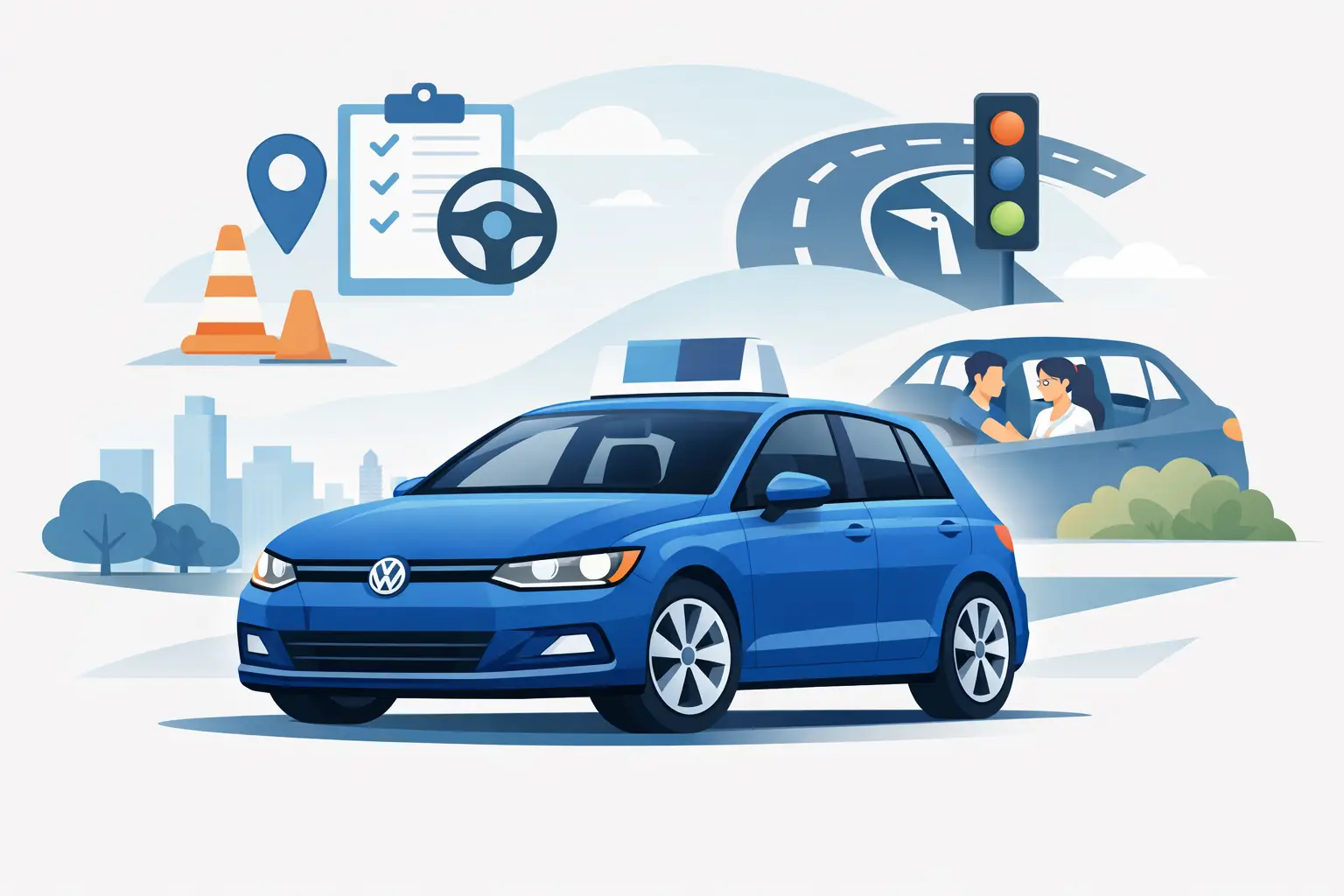
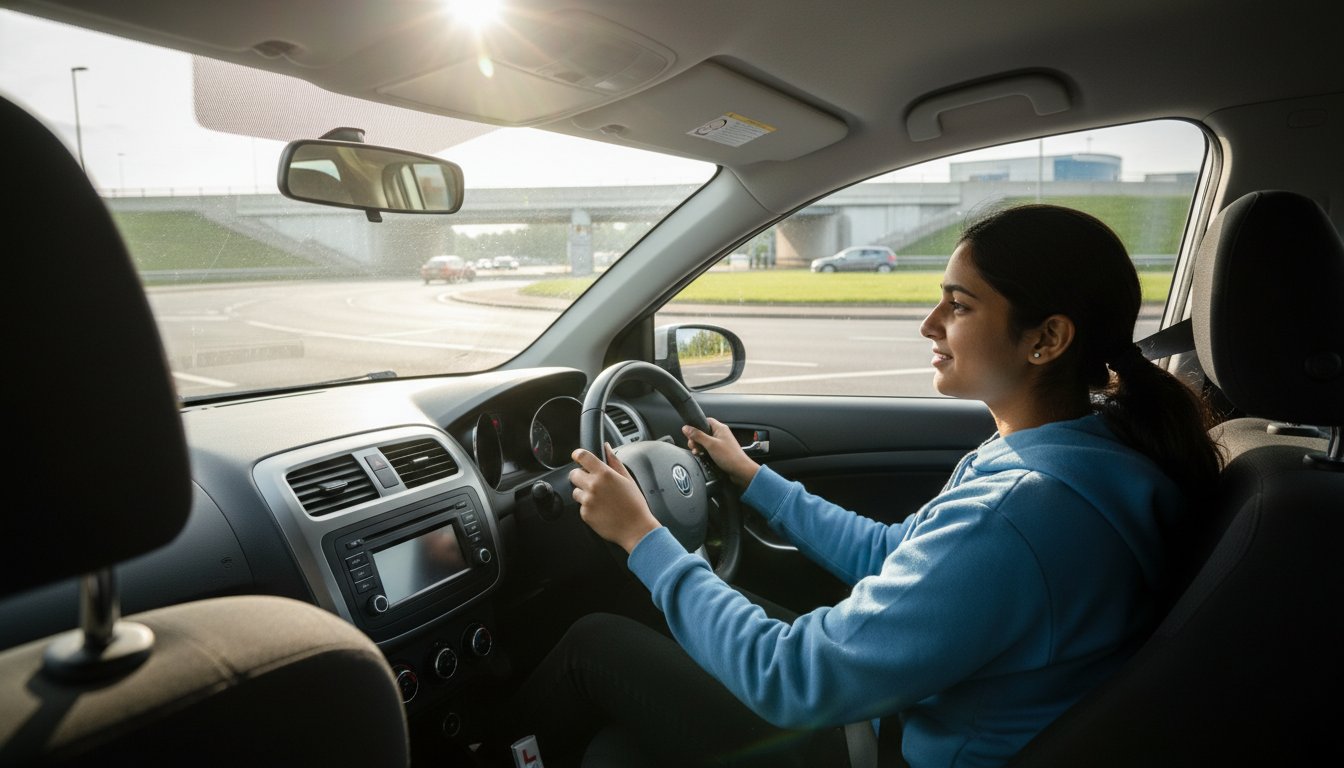
A learner usually notices the car before anything else. If the seat feels awkward, the clutch is unpredictable, or the controls seem overly complicated, confidence can disappear before the lesson has properly begun. That is why the right Volkswagen driving school car can make such a noticeable difference – not just to comfort, but to how quickly a pupil settles, learns and progresses.
For many learners, especially complete beginners or nervous drivers, the tuition car needs to do two jobs at once. It should be easy enough to drive without feeling flimsy, and reassuring enough to build trust from the first lesson. Volkswagen models used for driving tuition often strike that balance well, which is one reason they remain a popular choice with instructors who care about both pass rates and long-term driving standards.
What makes a Volkswagen driving school car a strong choice?
A good tuition vehicle is not chosen for badge value. It is chosen because it helps pupils learn safely, clearly and without unnecessary stress. That is where Volkswagen tends to perform well.
The steering is usually predictable, the pedals are progressive, and the clutch bite point is often easier to judge than in cars that feel overly sensitive. Those details matter more than many learners realise. Early lessons are full of small tasks that already demand a lot of concentration – moving off, checking mirrors, controlling speed, steering accurately and listening to instruction. If the car itself is awkward, each of those tasks becomes harder.
By contrast, a car that feels stable and forgiving gives the learner more mental space. They can focus on decision-making and observation rather than battling with the vehicle. That often leads to steadier progress over time.
Comfort matters more than people think
Driving lessons are not five-minute journeys. Many pupils now choose longer sessions because they make better use of time and allow more practice on roundabouts, dual carriageways, manoeuvres and independent driving. In a two-hour lesson, comfort becomes a genuine part of the learning experience.
Volkswagen tuition cars are often praised for supportive seating, sensible cabin layout and good visibility. That may sound like a small point, but it helps keep a learner calm. If a pupil is physically comfortable, they are less likely to become tense, distracted or tired too quickly.
This is particularly important for nervous drivers. Anxiety behind the wheel often shows up physically first – tight shoulders, overgripping the wheel, shallow breathing and rushed pedal control. A calm, well-laid-out car helps remove one layer of pressure. It does not solve nerves on its own, but it certainly does not add to them.
Clear controls support faster learning
One of the biggest frustrations for learners is feeling overwhelmed. There is already a lot to remember in each lesson, so the car should not create extra confusion.
Volkswagen interiors are typically straightforward, with controls placed logically and a driving position that is easy to adjust. From a teaching point of view, that supports structured learning. A pupil can understand the setup quickly, develop routines and begin repeating them with confidence.
Consistency is crucial when someone is learning to drive. Repeated actions become habits, and good habits are what carry learners through the test and into everyday driving afterwards. If the car responds consistently, it is much easier for the instructor to coach precise improvements.
That is especially useful when working on the areas where pupils often lose marks – moving off under control, approaching junctions at the right speed, parking accurately and keeping the car balanced in slower traffic.
Safety and reassurance go together
Safety features are expected in modern tuition vehicles, but what matters is how they contribute to the learner’s confidence. A solid-feeling car with reliable braking and stable road handling can make ordinary situations feel less intimidating.
Think about a pupil joining a busy roundabout for the first time or meeting traffic on a narrow residential road. In those moments, a planted and predictable car is reassuring. The learner is more likely to stay composed and respond properly when the vehicle feels secure beneath them.
That same reassurance matters for parents too. If a family is paying for lessons, they want to know their son or daughter is learning in a modern, well-maintained car that supports safe instruction. For working adults returning to lessons after a long gap, the same principle applies. Trust in the vehicle is part of trust in the whole learning process.
Is a Volkswagen driving school car right for every learner?
Usually, yes – but there are still individual preferences. Some learners take to a car immediately, while others need a lesson or two to adjust. Height, leg position, footwear and previous driving experience can all affect how a car feels at first.
The useful thing about a Volkswagen as a tuition car is that it tends to suit a wide range of learners. Complete beginners often like the predictable controls, while more test-ready pupils benefit from the way the car rewards smoother, more accurate driving. It can support both ends of the journey – from the first clutch control exercise to polishing independent driving before test day.
That said, the car is only part of the picture. A high-quality vehicle does not replace a patient instructor. Learners make the best progress when the car and the teaching style work together. Calm explanations, clear lesson structure and honest feedback still matter most.
How the right car can improve confidence after a bad experience
Some pupils come to lessons carrying more than nerves. They may have changed instructor, failed a test, or spent money on lessons that did not feel productive. In that situation, the car can play an unexpected role in rebuilding confidence.
A stable, easy-to-read vehicle gives the learner a fresh start. They are not fighting unfamiliar quirks or trying to second-guess a difficult clutch. They can begin focusing on what they are doing well and where they need to improve.
That matters because confidence in driving should be earned, not faked. A pupil gains real confidence when they understand the car, can predict how it will respond and start making good decisions consistently. The right tuition vehicle helps create those early wins.
Why instructors often choose Volkswagen for tuition
Driving instructors are practical people. They rely on a car every day, across different road types, traffic conditions and pupil ability levels. Their choice usually comes down to reliability, ease of use, comfort and whether the car supports effective teaching.
Volkswagen has built a strong reputation in those areas. For an instructor, that means fewer distractions and more consistent lessons. For a pupil, it means they are learning in a car designed to feel stable, modern and easy to manage.
There is also a professional impression to consider. Learners often feel more reassured stepping into a clean, well-presented, modern Volkswagen than they would in an older or less refined vehicle. That first impression helps set the tone. It says the lessons are being taken seriously.
For a driving school built around calm, structured teaching and strong first-time pass results, that fit makes sense. At Pass4you, for example, using a modern Volkswagen tuition vehicle supports the wider aim – helping learners in and around Milton Keynes become confident, safe drivers without wasting time on ineffective lessons.
Test preparation and everyday driving
The driving test is the immediate goal for most pupils, but it should not be the only one. A learner who passes without feeling genuinely ready often struggles afterwards when driving alone.
This is another reason a well-balanced tuition car matters. A Volkswagen driving school car tends to feel close enough to the sort of car many people may drive after passing. It gives a realistic sense of road position, clutch control, braking and general handling rather than encouraging shortcuts that only work in a very specific vehicle.
That makes test preparation more useful. Pupils are not just learning how to get through forty minutes with an examiner. They are learning habits they can carry into commuting, supermarket car parks, school runs and motorway driving later on.
For learners in busier parts of Milton Keynes, where roundabouts, changing speed limits and mixed traffic conditions are part of normal driving, that practical confidence is especially valuable.
What learners should really look for
If you are choosing a driving school, the make of car should not be the only factor, but it should not be dismissed either. The best setup is a combination of patient instruction, clear lesson planning, a proven teaching record and a car that helps rather than hinders progress.
A Volkswagen is a strong option because it supports the fundamentals properly. It gives many learners the calm, predictable driving experience they need in order to focus, improve and build confidence. That can make lessons feel less stressful and more productive, which is exactly what most pupils want.
If you are starting from scratch, feeling nervous, or returning after a setback, do not underestimate the value of learning in a car that feels stable, comfortable and easy to understand. Sometimes progress begins with something as simple as sitting in the right seat, turning the key, and realising this feels manageable after all.
Last Tuesday, a learner named Sarah in Milton Keynes realised she wasn’t quite ready for her upcoming practical, but she was terrified that trying to change my driving test would mean losing her £62 fee or waiting another six months. It’s a common worry that many of our students share. You want to feel 100% calm and prepared before you sit in that examiner’s car; however, the DVSA rules regarding the three clear working days notice often feel like a complicated puzzle. We understand that life happens and sometimes you just need a little more time to perfect those tricky parallel parks or gain more road confidence.
At Pass4you, we believe your journey to becoming a safe driver for life should be as stress-free as possible. We’ll show you exactly how to manage your appointment, avoid the frustration of paying twice, and even find those elusive earlier slots using our proven methods. You don’t have to navigate the booking system alone or settle for a date that doesn’t work for your schedule. This guide breaks down the latest 2026 regulations and provides a simple, step-by-step plan to get your test date exactly where it needs to be.
Key Takeaways
Master the official DVSA process to safely reschedule your appointment or switch to a more convenient test centre.
Avoid unnecessary costs by learning the 2026 notice rules, ensuring you can change my driving test without having to pay the booking fee again.
Uncover the most effective ways to spot earlier cancellation slots and understand the reality of using third-party apps versus manual searching.
Use our professional criteria and mock test results to decide if you are genuinely prepared for the road or if a postponement is the safer choice.
Find out how Pass4you’s patient instruction in Milton Keynes supports your journey toward an impressive 83.33% first-time pass rate.
How to Change Your Driving Test Appointment Online
Life doesn’t always go to plan. Perhaps you need more time to master your reverse park, or maybe your instructor suggests a few extra lessons to secure that 83.33% first-time pass rate we strive for. Deciding to change my driving test is a sensible move if it helps you feel calm and prepared. In 2026, the only secure way to manage your booking is through the official DVSA website. This service is free to use, so you should avoid third-party booking sites that often charge unnecessary administrative fees.
The online portal is accessible daily from 6:00 am until 11:40 pm. This wide window allows you to check for new slots early in the morning when cancellations often appear. You can move your appointment to a later date or even switch to an entirely different test centre if you’ve moved house or found a location with better availability. Taking control of your booking helps reduce nerves and ensures you’re heading into the exam with total confidence.
What You Need Before You Start
Having your details ready makes the process much smoother. You’ll need your Great Britain or Northern Ireland driving licence number to log in. If you can’t find your test reference number, don’t worry. You can use your theory test pass certificate number instead. It’s also a great idea to have your driving instructor’s personal reference number on hand. This lets you check their availability within the portal, ensuring you don’t pick a time when they’re already helping another student. Always check your internet connection first. A drop in signal could cause you to lose your place in the digital queue during busy periods.
Step-by-Step DVSA Portal Navigation
To begin, visit the ‘Change your driving test appointment’ page on the GOV.UK website. Once you enter your details, you’ll reach a personal dashboard. From here, follow these steps:
Select the ‘change’ option next to your current test date.
Choose whether you want to change the date, the test centre, or both.
Browse the calendar for available slots in 2026.
Confirm your new selection to receive an immediate updated booking email.
You can change your appointment up to six times. If you need to change my driving test more than that, you’ll have to cancel and rebook. Remember that you must provide at least three clear working days’ notice. If you change it later than this, you’ll lose your original fee and have to pay again. Staying organised helps you remain a safe driver for life without wasting money on lost bookings.
Notice Periods and Fees: When Will You Have to Pay Again?
Feeling nervous about your upcoming appointment is completely normal. However, if you realise you aren’t quite ready to sit the exam, you must act quickly to protect your money. A standard practical car test costs £62 in 2026. If you don’t follow the DVSA notice rules, you’ll lose that fee and have to pay the full amount again for a new slot. Understanding the calendar is the best way to stay in control of your budget and your nerves.
The ‘3 Full Working Days’ Rule
To change my driving test without paying another £62, you must give at least 3 clear working days’ notice. This doesn’t include the day you make the change or the day of the test itself. Monday to Saturday are considered working days by the DVSA. Sundays and Bank Holidays don’t count towards your notice period, so you need to plan ahead if your test falls early in the week. For example, if your test is booked for a Friday, you must complete your change by the previous Monday at the latest.
The 10-day rule is also a vital part of the 2026 regulations. If you’ve recently taken a test and didn’t pass, the DVSA requires you to wait 10 working days before you can sit another one. This gap is designed to give you enough time to work with your instructor on any faults. Our team focuses on building your skills so you feel prepared the first time. You can learn more about how our patient teaching style helps students build lasting confidence.
Exceptions for Short-Notice Changes
Life can be unpredictable, and sometimes you might need to change my driving test at the very last minute. The DVSA may offer a refund or a free late change in very specific, unavoidable circumstances. You can claim your money back if you have a sudden illness or a bereavement in your immediate family. You’ll need to provide firm evidence, such as a doctor’s note or a formal certificate, within 10 working days of the original test date.
If your driving licence is stolen just before the test, you must report it to the police immediately to obtain a crime reference number. Without this specific proof, the DVSA won’t waive the fee. They’re firm but fair, and having your paperwork in order makes the process much smoother. Always keep your instructor in the loop, as they can often provide the extra reassurance you need during a stressful situation.
Finding an Earlier Slot: The Truth About Cancellation Appointments
Finding a sooner date often feels like a full-time job. These “cancellation” slots appear when another learner decides to change my driving test date or when the DVSA releases new blocks of examiner capacity. While it’s tempting to grab the first date you see, you need a calm strategy to navigate the system effectively without becoming overwhelmed.
Currently, the DVSA allows you to reschedule your appointment a maximum of 6 times. Once you hit this limit, you’ll have to cancel your booking entirely and start the process again from scratch. This is a strict rule designed to prevent people from “hoarding” slots or constantly shifting dates. Most successful learners find that manual checking is just as effective as paid apps. While third-party apps send notifications, they often lag by 120 seconds or more. By the time you log in, the slot has usually been taken by someone already on the portal. Checking the official government website yourself ensures you’re seeing real-time availability without spending extra money.
Strategies for Finding Sooner Dates
The 6 am Rule: The DVSA booking system typically refreshes early in the morning. Logging on at 6:00 am on a Tuesday or Wednesday often reveals slots that were cancelled late the previous night.
Expand Your Search: If you’re prepared for different road types, look at centres within a 15-mile radius. Don’t book a rural centre if you’ve only ever driven in city traffic, as the different hazards can be startling.
The Instructor Check: Always message your instructor before you click ‘confirm’. If they’re already booked for another student’s test at that time, you’ll have wasted one of your 6 precious change attempts.
The Risks of Rushing Your Test
A “quick” test date is only a bargain if you’re actually ready to pass. If you grab a slot for next week but haven’t mastered your reverse bay park or independent driving sections, you’re likely to face a disappointing result. A weekday practical test costs £62. When you add the cost of car hire and a pre-test warm-up lesson, a fail can set you back over £150 in total.
We’ve seen many nervous learners feel pressured to rush because they’re tired of waiting. However, taking an extra 21 days to polish your skills ensures you’re a safe driver for life. Moving your test back slightly is often the most cost-effective choice. It saves you the emotional toll of a “fail” result and the financial burden of rebooking and waiting another 18 weeks for a new slot. Patience now leads to confidence on the big day.
Should I Change My Driving Test? 4 Signs You’re Not Quite Ready
Deciding whether to go ahead with your booking or postpone can feel like a heavy burden. You might feel a rush to get your licence, but heading to the test centre before you’re prepared often leads to a cycle of failed attempts and lost confidence. At Pass4you, we’ve seen that students who wait until they’re truly “test-ready” are far more likely to join our 83.33% first-time pass rate group. If you’re doubting your skills, it’s usually a sign that you should change my driving test to a later date.
Performance Indicators for Test Readiness
Your driving should feel like a natural habit rather than a struggle. Consider these three markers of readiness:
Physical and Verbal Prompts: If your instructor still needs to use the dual controls or give you verbal reminders about mirrors or speed, you aren’t ready to drive independently.
Manoeuvre Consistency: You should be able to complete the parallel park, emergency stop, and reversing into a bay accurately 9 out of 10 times without any guidance.
Emotional Control: During the independent driving section, you should feel calm and in control of the vehicle. If your heart races or you feel panicked by simple SatNav directions, more practice is needed.
The Mock Test Litmus Test
A mock test is a realistic rehearsal of the DVSA exam conditions. At Pass4you, we use these sessions in Milton Keynes to simulate the exact pressure of the real exam. If you fail a mock test with several serious faults, it’s a clear signal to change my driving test. Failing a mock isn’t a setback; it’s a valuable tool that identifies exactly where your safety gaps are. We find that students who treat the mock test as the “real deal” develop the mental resilience needed to handle the actual examiner on the day.
Trusting the Professional Over the Pressure
You might face pressure from well-meaning family or friends who tell you to “just have a go” because the wait times are long. While they want the best for you, they don’t see your driving from a professional perspective. Simon and the team at Pass4you have spent years honing a tried and tested technique to ensure you’re a safe driver for life, not just for forty minutes. Your instructor’s advice is your most valuable asset. If they suggest you aren’t ready, they’re protecting your confidence and your wallet from an avoidable fail.
How Pass4you Supports Your Test Journey in Milton Keynes
Learning to drive in Milton Keynes presents unique challenges, from the iconic grid system to the high-speed roundabouts that can intimidate even the most prepared learners. At Pass4you, we don’t just teach you to pass; we build your confidence through patient, expert instruction. Our impressive 83.33% first-time pass rate is a testament to our methods. We focus on creating a calm environment where you can master the car at your own pace. If you feel you need more time to master the local roads, we provide the honest feedback you need to decide if you should change my driving test to a later date.
Our approach is built on flexibility and local knowledge. We understand that life happens, and sometimes your original test date no longer fits your progress. We help you manage your lesson schedule to ensure you’re peaking at exactly the right moment. By focusing on safety and skill rather than just “passing the box,” we ensure you’re ready for the A5, the V-roads, and everything in between.
Personalised Guidance from Simon
Simon is a calm, experienced mentor who knows exactly when a student is ready for the real thing. He understands the anxiety that comes with the Milton Keynes road layout, especially the complex roundabouts that often trip up learners. When you work with Simon, you get a tailored plan. If you choose to change my driving test, he’ll help you organise your remaining lessons to stay sharp. You’ll gain direct experience on actual test routes, learning how to navigate tricky junctions and high-traffic areas with total composure.
Booking Your Success with Pass4you
Our “safe driver for life” philosophy is designed to reduce test-day nerves by replacing uncertainty with genuine skill. We don’t believe in shortcuts. Instead, we offer comprehensive mock tests to verify your abilities before the big day. These mocks simulate the exact conditions of the Milton Keynes test centre, giving you a clear picture of your readiness. This data-driven approach saves you money in the long run by ensuring you only take the test when your success is likely. Our students feel prepared because they’ve already proven they can handle the pressure.
Deciding to change my driving test shouldn’t feel like a setback. It’s often the smartest move you can make to ensure you’re truly prepared for the DVSA examiners. Remember that you must provide at least three clear working days of notice to avoid losing your £62 booking fee. This window allows you to find a cancellation slot that fits your schedule or simply gives you the extra time needed to master those tricky roundabouts in Milton Keynes. Success on the road comes from feeling relaxed and capable behind the wheel.
At Pass4you, Simon provides calm and patient instruction in modern Volkswagen tuition vehicles to help you build that essential confidence. Our students benefit from a proven approach that has resulted in an impressive 83.33% first-time pass rate. We don’t just teach you to pass; we help you become a safe driver for life through a structured, stress-free learning programme tailored to your specific needs. Don’t let nerves or a rushed timeline stand in your way. Book your calm and patient driving lessons in Milton Keynes today and start your journey with a mentor who genuinely cares about your progress. You’re closer to that full pink licence than you think.
Frequently Asked Questions
How many times can I change my driving test date?
You can change your driving test appointment up to 6 times before the system requires you to cancel and start again. This limit is set by the DVSA to ensure the booking system remains fair for all learners. If you find you’ve reached this 6-change limit, you’ll need to cancel your current booking, wait for a refund, and then pay the £62 fee again for a brand-new slot.
Can I change my driving test centre after I have booked?
You can change your driving test centre location at any time through the official DVSA website. To change my driving test centre, log in using your 16-digit driving licence number and your booking reference. You’ll then see a list of alternative centres. Wait times can vary significantly, with some centres like Milton Keynes showing 18-week waits while others may have slots much sooner.
What is the latest I can change my driving test without losing my fee?
You must change your test date at least 3 clear working days before your appointment to keep your £62 fee. This 3-day window doesn’t include Sundays, public holidays, or the day of the test itself. If you try to reschedule with only 48 hours notice, you’ll lose your money and have to pay the full fee again. It’s best to decide at least 5 days in advance.
Do I need my instructor’s permission to change my test date?
You don’t need your instructor’s legal permission to change your date, but it’s highly recommended to consult them first. Your instructor needs to be available and their car must be free for the new time. At Pass4you, we help students achieve an 83.33% first-time pass rate by ensuring they only move their test when they feel calm and safe. Coordination with your mentor prevents unnecessary stress.
How do I find a driving test cancellation for an earlier date?
You can find an earlier driving test cancellation by checking the DVSA booking service regularly or using a dedicated notification app. New slots appear when other learners reschedule or cancel their appointments. Many of our students find an earlier date within 72 hours by logging on at 6:00 am when the system updates. This proactive approach helps you get on the road much faster than waiting months.
Is there a charge for changing my driving test appointment online?
There is no additional charge to change my driving test appointment online as long as you provide the required 3-day notice. Rescheduling is a free service provided by the DVSA to help learners find the most suitable time. You’ll only need to pay an extra £13 if you move a weekday booking to a weekend or evening slot, as these premium times carry a higher total cost.
What happens if I change my test and then decide I want the original date back?
You cannot get your original date back once you’ve confirmed a new appointment because the system releases it instantly. As soon as you click confirm, your old slot becomes available for any other learner in the UK to book. If you change your mind, you’ll have to manually search the live database again. There’s no guarantee that your previous time or any other nearby date will be available.
Can I change my test if I haven’t passed my theory test yet?
You cannot book or change a practical driving test until you have successfully passed your theory test and received your certificate. The DVSA booking system requires your valid theory pass number before it lets you access the practical test calendar. Remember that your theory certificate expires exactly 2 years after your pass date. If it expires, you’ll need to pass the theory exam again before booking a practical.
The moment many learners wobble is not usually at a big roundabout or during a parallel park. It is often much earlier – when they start to feel slightly more confident and stop paying attention to the basics. That is why safe driving habits for learners matter so much. Good habits reduce panic, cut down avoidable mistakes and make you far more likely to pass your test as a calm, consistent driver rather than a lucky one.
At Pass4you, we see this all the time with new learners, nervous drivers and pupils who have picked up poor routines elsewhere. The learners who improve fastest are not always the boldest. They are the ones who repeat the right actions until those actions become automatic.
Why safe driving habits for learners matter early on
A driving test does not just assess whether you can move a car from one place to another. It checks whether you can make sound decisions, stay aware of risk and control the car without rushing or guessing. The safest learners usually look more settled because they are not trying to remember everything at once. Their habits are doing part of the work for them.
This matters beyond the test as well. Plenty of people can scrape through a lesson by copying what the instructor says in the moment. That is different from becoming a driver who naturally checks mirrors before changing speed, reads hazards early and leaves enough room around the car. The goal is not to perform for 40 minutes. It is to become safe for years.
Start with observation, not speed
Most learner mistakes begin with weak observation. A rushed move-off, a late mirror check or a missed pedestrian can quickly turn a manageable situation into a serious fault. New drivers sometimes focus too heavily on clutch control, gears or road position and forget that observation should lead every decision.
A simple rule helps here: see first, act second. Before moving off, changing lane, slowing down, turning or stopping, your eyes should already be working ahead and around the car. That means regular mirror checks, scanning the road well in front and noticing what might change next.
In quieter residential areas around Milton Keynes, for example, the road can look easy and open. That often encourages learners to relax too much. But parked cars, hidden junctions, cyclists and people stepping out between vehicles can appear quickly. Safe driving is not about assuming the road is clear. It is about checking properly every time.
Build a mirror routine you can trust
Mirror checks only help if they happen at the right time and for the right reason. A vague glance every now and then is not enough. You need a routine that becomes second nature.
The strongest learners check mirrors before changing speed, before signalling, before changing direction and after dealing with a hazard when they need to reassess what is behind them. Over-checking can sometimes become distracting, but under-checking is far more common. If your instructor keeps reminding you about mirrors, that is not bad luck. It is a sign the habit has not settled yet.
Keep your decisions calm and early
Learners often think confidence means being decisive. It does, but not in a rushed way. Good drivers make early decisions, not sudden ones. If you notice a parked van ahead, ease off the gas and assess the situation before you reach it. If you think a traffic light may change, be ready instead of charging forward and hoping for the best.
This is one of the biggest differences between a safe learner and a stressed one. A stressed learner reacts late. A safe learner reads the road early and gives themselves time. You do not need to drive slowly all the time, but you do need to avoid last-second choices.
Leave space and you gain options
Following too closely is a classic learner problem, especially once basic control starts to improve. When you feel more comfortable steering and changing gear, it is easy to let the gap shrink without realising it.
Space gives you thinking time. It helps with smoother braking, better planning and lower stress. In wet weather, at night or on faster roads, that gap should increase. There is no prize for sitting close to the car in front. A sensible following distance is one of the simplest safe driving habits for learners, and one of the most valuable.
Learn to treat speed limits as context, not targets
A 30 mph limit does not mean 30 is always the right speed. It means that is the maximum under good conditions. This is where many learners get confused. They worry so much about being too slow that they forget speed should match the road, traffic, visibility and hazards.
If there are parked cars on both sides, children nearby or a tight bend ahead, easing down below the limit can be the safer choice. On the other hand, driving much too slowly on a clear road can create uncertainty and hold up traffic. It depends on what is happening around you.
Your aim should be steady, appropriate progress. Examiners and instructors are not looking for speed for its own sake. They want to see judgement.
Use the cockpit routine every time
Safe habits begin before the car even moves. Setting your seat, steering position, mirrors and seatbelt properly affects everything that follows. When learners skip this or rush it, their control often suffers. They may struggle with clutch movement, misjudge observation angles or feel tense at junctions.
A proper setup is not wasted time. It is part of driving well. The same goes for basic readiness. Are the doors secure? Do you understand the controls? Are you mentally switched on, or still thinking about work, college or the last lesson?
This matters even more if you are learning through intensive lessons or preparing for a test in a short timeframe. Progress comes faster when each lesson starts with focus rather than fluster.
Safe driving habits for learners in busy traffic
Busy roads can make learners feel they have to prove themselves. That usually leads to one of two problems: hesitating too much or forcing decisions. Neither is ideal.
In heavier traffic, the best habit is controlled patience. Keep your observations active, protect your space and do not let other drivers rush you into a poor move. If a gap is not right, wait. If you need a moment longer at a roundabout, take it. But stay prepared so that when a safe opportunity comes, you can move positively.
This balance is a skill, and it improves with quality practice. Areas with mixed road types, multi-lane roundabouts and changing traffic flow are useful because they teach learners how to stay composed while processing more information. The key is not to be fearless. It is to remain methodical.
Do not let one mistake create three more
A common pattern in lessons is this: a learner stalls, misses a turning or chooses the wrong lane, then mentally spirals and makes several more mistakes. Safe drivers recover quickly. They do not pretend the error did not happen, but they also do not let it take over the next five minutes.
If you make a mistake, stabilise the car, check around you and deal with what is in front of you now. One wrong turn is usually far less serious than a panicked correction. Part of safe driving is emotional control, and that takes practice too.
Build habits between lessons, not just during them
You do not need to be behind the wheel to improve. Many learners make faster progress when they actively review what happened in a lesson. Think about where you felt calm, where you felt rushed and what your instructor had to remind you about more than once.
Watching the road as a passenger can help as well. Notice how drivers approach junctions, how early they react to brake lights and how road signs affect decisions. Not every driver on the road is a good example, of course, so this works best alongside proper tuition. Still, it sharpens awareness.
If you are learning in places such as Monkston, Walnut Tree or Broughton, you may already know certain local roads as a passenger. That familiarity can help, but only if you avoid becoming casual. Known roads still require the same careful habits as unfamiliar ones.
Confidence should be earned, not rushed
Every learner wants to reach the stage where driving feels natural. That comes from repetition, structure and calm instruction, not from pushing ahead before the basics are secure. There is nothing wrong with wanting to pass quickly, but the quickest long-term progress usually comes from getting the habits right early.
If you focus on observation, space, planning and consistency, your driving starts to look calmer almost immediately. More importantly, it starts to become safer in a way that lasts beyond test day.
A helpful way to think about it is this: every lesson is not just about getting better at driving today. It is about becoming the kind of driver people feel safe sitting beside tomorrow.
Last Tuesday, a learner in Milton Keynes slowed down for a crossing puffin, waiting anxiously for a flashing amber light that simply never appeared. If you feel a knot in your stomach every time you see a pedestrian near the kerb, you aren’t alone. It’s completely normal to feel confused by the “bird” names or worry that a simple signal error will cost you your licence. Many students find the transition from Pelican to Puffin crossings one of the trickiest parts of the practical syllabus.
At Pass4you, Simon has helped hundreds of local students achieve our 83.33% first time pass rate by replacing that anxiety with genuine confidence. We’ll help you master the “intelligent” sensors of the Puffin crossing so you can approach every junction with a calm, focused mind. This 2026 guide explains the exact light sequences you’ll face on your Milton Keynes driving test and provides the specific visual cues to identify these crossings from over 50 yards away. You’ll move from second-guessing the signals to driving like a pro who is ready for anything the road throws at them.
Key Takeaways
Understand why the modern crossing puffin is replacing older Pelican systems and how its “intelligent” sensors create a safer, more efficient environment for everyone on the road.
Learn how advanced kerb and crossing detectors manage traffic flow by automatically adjusting light timings based on real-time pedestrian movement.
Discover the crucial difference in light sequences—specifically the removal of the flashing amber phase—to ensure you react correctly and safely during your practical driving test.
Master the essential mirror checks and observation techniques needed to approach these crossings with the calm confidence required for a first-time pass.
Gain expert insights into navigating Milton Keynes’ unique grid system and complex crossings with the patient, professional guidance of Simon and the Pass4you team.
What is a Puffin Crossing? The Modern Standard for UK Roads
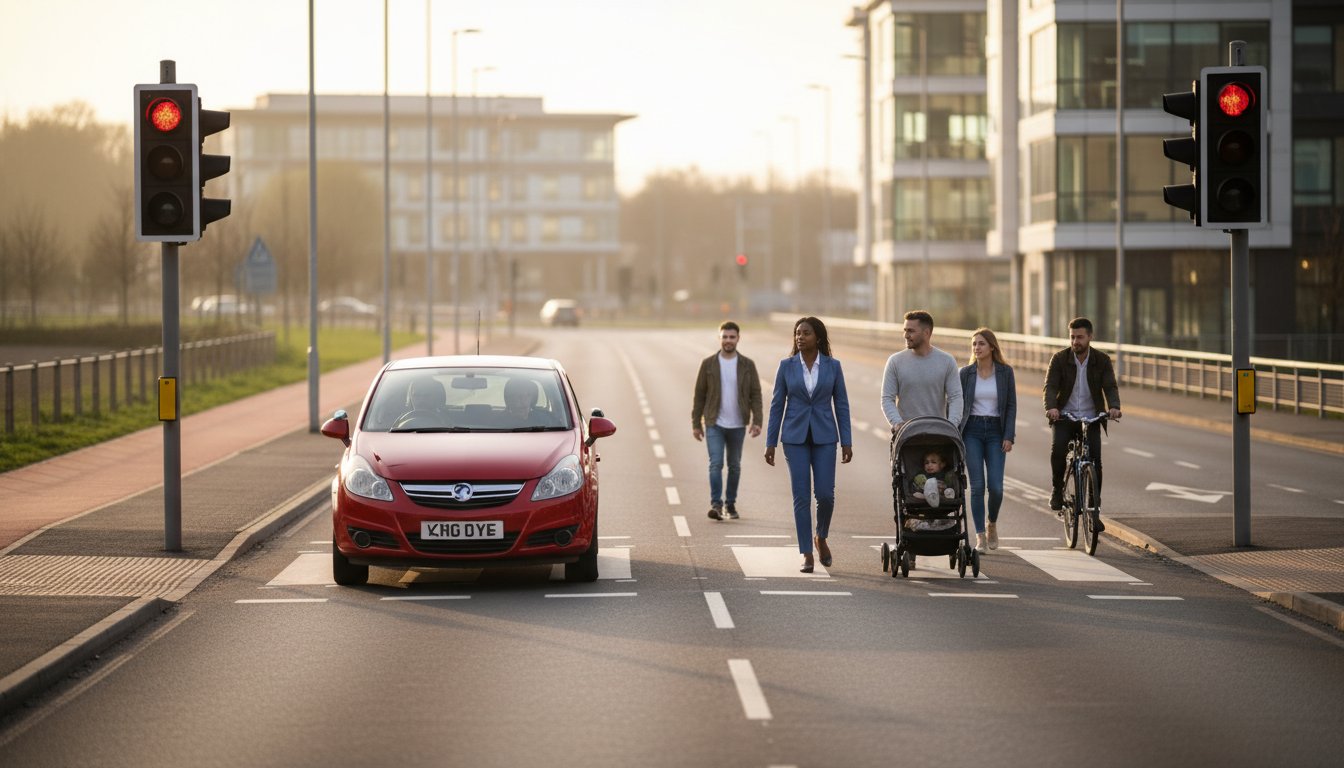
A Puffin crossing is the smart successor to the older Pelican style you might still see in some towns. It stands for Pedestrian User-Friendly Intelligent. This technology helps you stay calm and confident during your driving lessons. Since 2016, the Department for Transport has pushed for these to become the primary standard across the UK. Local councils are actively replacing older signals to reduce accidents and keep traffic moving. When you’re behind the wheel of a tuition car, seeing a crossing puffin ahead shouldn’t cause any stress; it’s there to help you.
The Meaning Behind the Puffin Name
The word “Intelligent” is the most important part for you to remember as a learner. Unlike older systems, a crossing puffin uses sophisticated infrared sensors and thermal mats to detect if someone is actually waiting. If a pedestrian presses the button but then decides to walk away or cross during a gap in traffic, the “intelligent” system cancels the request. This means you won’t be sat at a red light for no reason. It’s a system designed to respect your time and help you maintain a steady progress. Our instructors have found this predictability helps our students achieve that 83.33% first time pass rate by reducing unnecessary stops and anxiety.
Visual Markers for Learner Drivers
Identifying these crossings early allows you to plan your approach with ease. You can spot them by looking for two specific features:
Near-side signals: The “red man” and “green man” aren’t on the far side of the road. They’re located on the control box right next to the pedestrian.
Top-mounted sensors: You’ll see small black devices perched on top of the traffic light poles. These are the sensors that track pedestrian movement and speed.
Because the green man is on the near side of the road, pedestrians have to look towards the oncoming traffic to see when it’s safe to cross. This design change has improved pedestrian safety significantly since its widespread rollout. As a driver, you’ll notice there’s no flashing amber phase. The lights move from red to red and amber, then green, just like a standard junction. This simplicity helps you focus on your mirrors and move off safely when the way is clear. You don’t have to worry about the tricky judgement call that comes with a flashing amber light, making your journey much smoother.
The Technology Behind Puffin Crossings: Why Drivers Benefit
A crossing puffin is far more advanced than the older Pelican systems you might have seen. These “Pedestrian User Friendly Intelligent” crossings use smart sensors to make decisions in real time. This technology isn’t just there for people on foot; it’s designed to keep you moving safely and reduce unnecessary stops during your driving test. Understanding how these sensors work will help you stay patient and focused on the road ahead.
How Sensors Improve Traffic Flow
The Pedestrian Kerb Detector (PKD) is a clever bit of kit that watches the waiting area. If a pedestrian presses the button but then decides to walk away or cross during a gap in traffic, the PKD cancels the request. You won’t have to stop at a red light for an empty pavement. This is a huge win for traffic flow in busy areas like Milton Keynes city centre, where unnecessary stops can quickly cause gridlock during peak hours.
Once someone is actually in the road, the Pedestrian Crossing Detector (PCD) takes over. These sensors track how fast the person is moving. If an elderly person or someone with a pushchair needs extra time, the red light stays on for them. If a fast walker clears the road in three seconds, the lights change back to green much sooner. Research by the Transport Research Laboratory has shown that this intelligent timing can reduce vehicle delays by up to 16% compared to older fixed-timer crossings. It makes your journey more predictable and helps you maintain that confident driving style we help you develop in our lessons.
Accessibility and Safety Features
Puffin crossings are built with inclusivity in mind. Underneath the push-button box, there’s a small tactile cone. It spins when the green man appears, which is vital for visually impaired pedestrians who can’t see the signal. This feature ensures everyone stays safe without needing loud, distracting beepers that can confuse drivers at complex junctions. You’ll know the crossing is active even if you can’t hear a sound.
You’ll also notice the signals are on the “near-side,” right next to where the person is standing. This encourages pedestrians to look towards the oncoming traffic while they wait for the signal. By keeping their eyes on the road rather than a light across the street, the risk of a pedestrian stepping out unexpectedly is significantly lower. These safety improvements contribute to the 17% reduction in pedestrian accidents often recorded when older crossings are upgraded to modern technology. This extra layer of safety gives you peace of mind as you approach a crossing puffin during your practical test.
Puffin vs Pelican Crossing: Spotting the Key Differences
When you are driving around Milton Keynes, especially near the Bletchley or Leighton Buzzard test centres, you will encounter both types of crossings. The biggest difference is how the lights communicate with you. A Pelican crossing uses a flashing amber light, while a crossing puffin uses the same sequence as a standard junction. It is much calmer for learners because you do not have to judge whether a pedestrian is still on the stripes. Our students often find this predictability helps them maintain a steady, confident pace during their practical test.
The “Flashing Amber” Mystery Solved
On a Pelican crossing, the flashing amber phase means you must give way to pedestrians on the crossing, but you can go if the road is clear. This often causes hesitation. Data from driving assessments suggests this phase leads to 15% more minor faults for learners who are unsure when to proceed. Puffin crossings remove this stress entirely. They follow the standard traffic light sequence: red, red and amber, then green. You simply stay stopped until the red and amber appears, which makes the crossing puffin much easier to handle when you are feeling nervous.
Comparing the Pedestrian Experience
You can spot the difference by looking at where the pedestrian signals are located. On a Pelican, the “green man” is on the opposite side of the road. On a Puffin, the signals are near-side, located right above the push button. This design is intentional. It encourages pedestrians to look towards the oncoming traffic while they wait for the signal.
Sensors: Puffins use infrared cameras to track pedestrian movement.
Safety: Department for Transport studies show that Puffin installations can reduce pedestrian accidents by 17% compared to older designs.
Efficiency: If a pedestrian presses the button but walks away, the sensor cancels the request so you do not stop for no reason.
Milton Keynes Council has been modernising road layouts since 2016, replacing older Pelicans with smarter technology. On a typical 40 minute test route, you are 80% more likely to encounter a Puffin on modern grid roads like the V6 or H8. Understanding these sensors helps you stay patient and professional, ensuring you remain a safe driver for life.
Approaching a Puffin Crossing: Practical Tips for Your Driving Test
Approaching a crossing puffin requires more than just looking at the lights. It’s about anticipation and demonstrating that you’re a calm, confident driver. In Milton Keynes, where traffic can get busy around the Hub or the V6 Grafton Street, your timing must be spot on. You need to show the examiner you aren’t rattled by sudden changes in the road environment. We’ve helped hundreds of students master these situations, maintaining our 83.33% first time pass rate by focusing on these exact details.
Observation and Mirror Work
Check your interior and door mirrors the moment you spot the crossing ahead. This isn’t a tick-box exercise; it’s vital for safety. If you need to slow down, you must know how close the vehicle behind you is. Scan the pavement for pedestrians standing near the push-button. Since sensors control a crossing puffin, the lights stay red until the person has safely reached the other side. Don’t let a long red light make you impatient. Stay calm, keep your feet still, and wait for the green signal to appear.
Common Practical Test Faults to Avoid
DVSA data from the 2023/24 period shows that “response to traffic signals” remains a top 10 reason for test failure in the UK. To ensure you stay on the right side of the result sheet, watch out for these frequent errors:
Failing to stop on amber: if the light changes and you have enough distance to stop safely, you must do so. Don’t try to “beat” the light.
Creeping forward: wait for the green light. Don’t let the car roll or find the bite too early while pedestrians are still crossing.
Blocking the crossing: in heavy Milton Keynes traffic, only move forward if your exit is clear. Stopping on the white zigzag markings is a serious fault.
If you’re feeling nervous about these technical parts of the test, remember that Simon is here to guide you. We focus on building your skills until these checks become second nature, making you a safe driver for life. Our patient approach ensures you won’t feel rushed or pressured during your lessons.
Ready to build your confidence behind the wheel? Book your Milton Keynes driving lessons with Simon today and join our list of successful first-time passes.
Mastering Milton Keynes Road Types with Pass4you
Learning to drive in Milton Keynes presents unique challenges. From the famous H and V grid system to the high-speed roundabouts, it’s a lot to take in. At Pass4you, Simon and the team specialise in turning these complexities into second nature. We don’t just teach you how to pass. We focus on building your confidence so you feel ready for any crossing puffin or multi-lane junction you encounter. Our methods are tried and tested, resulting in an 83.33% first-time pass rate. This success comes from our patient, calm approach that prioritises safe driving for life over quick fixes. You’ll learn to anticipate traffic flow and manage the unique rhythm of MK roads with total ease.
Patient Instruction for Nervous Learners
Many students come to us after feeling rushed or shouted at elsewhere. Simon’s calm nature is the perfect antidote to driving anxiety. He takes the time to explain the logic behind road rules. He ensures you understand why a crossing puffin behaves differently than older systems, focusing on the sensors that keep you safe. One local student, Sarah from Bletchley, shared that she nearly gave up before finding Simon’s supportive style. We believe that when you truly understand the road, the nerves naturally fade away. We focus on value for money by teaching you correctly from day one, which often means fewer lessons in the long run.
Local Experience Near the Milton Keynes Test Centre
Our lessons are specifically tailored to the routes used by the Milton Keynes Test Centre. We spend time practising at the exact crossings and roundabouts you’ll face on your big day. This isn’t just about memorising routes. It’s about developing the skills to handle the specific challenges of MK driving, like the busy dual carriageways and pedestrian-heavy areas near the shopping centres. By familiarising yourself with these local hotspots, you’ll feel like a pro when the examiner asks you to follow the road ahead. You can book your first lesson with Pass4you today and start with confidence. We’ll help you master every grid road and crossing with ease, ensuring you’re a safe driver for life.
Master Every Pedestrian Crossing With Confidence
Understanding the smart technology behind a modern crossing puffin is a vital step toward becoming a safe, independent driver. These intelligent systems use infrared sensors to manage traffic flow, removing the confusion of the old-fashioned flashing amber lights found at Pelican crossings. When you’re on your driving test, reacting correctly to these signals shows the examiner you have the high-level observation skills required for UK roads in 2026.
Learning to navigate busy Milton Keynes junctions doesn’t need to be a source of anxiety. We focus on building your skills through calm and patient instruction, ensuring you feel completely at ease behind the wheel of our modern Volkswagen tuition vehicles. Our proven methods have led to an 83.33% first-time pass rate, helping hundreds of local students trade their L-plates for total freedom. You’ve got the theory down; now it’s time to put it into practice with a mentor who actually listens and understands your concerns.
We’re ready to help you gain the skills and confidence you need to stay safe on the road for life.
Frequently Asked Questions
Does a Puffin crossing have a flashing amber light?
No, a Puffin crossing does not have a flashing amber light. It uses the standard traffic light sequence where red is followed by red and amber together. This is a key difference from the older Pelican crossing which many learners find confusing. Our students prefer the Puffin because it mirrors the traffic lights you see at every major junction in Milton Keynes, making it much more predictable for new drivers.
How can I tell if I am at a Puffin or a Pelican crossing from a distance?
You can identify a Puffin crossing from a distance by looking for where the “green man” signal is located. On a Pelican crossing, the lights are on the far side of the road. On a Puffin crossing, the pedestrian signal is located on the near-side control box right next to the person waiting. This design encourages pedestrians to look towards oncoming traffic while waiting for the signal to change, which is much safer for everyone.
Can I drive through a Puffin crossing if the pedestrian has finished crossing but the light is still red?
No, you must never drive through a red light even if the pedestrian has reached the pavement. A red light at a crossing puffin is a mandatory stop signal until it changes to green or red and amber. Driving through a red light is a serious offence that can lead to 3 penalty points and a fine of £100. Always wait for the lights to change to ensure you stay safe and keep your licence.
Why are Puffin crossing lights on the near-side of the road?
Puffin crossing lights are on the near-side to improve pedestrian safety by forcing users to look at oncoming traffic while they wait for the signal. This positioning also helps people with limited vision who might struggle to see lights across a wide road. Since their introduction in 1992, this layout has helped reduce pedestrian accidents by 17 percent according to Department for Transport studies. It keeps everyone focused on the road environment.
What happens if the sensors on a Puffin crossing stop working?
If the sensors on a Puffin crossing fail, the system is designed to revert to a fixed timing cycle similar to a standard traffic light. This ensures the crossing remains functional even if the infrared or pressure sensors stop detecting movement. If you notice a crossing is behaving strangely, it’s best to treat it with extra caution and stay patient. Our instructors often remind students that being observant is the best way to handle technical glitches.
Is it an automatic fail to go through an amber light at a Puffin crossing?
Going through an amber light is not always an automatic fail, but it depends on your speed and distance from the line. You must stop at amber unless you have already crossed the stop line or are so close that stopping might cause an accident. In a driving test, failing to stop when it was safe to do so will result in a serious fault. Over 45 percent of test failures are linked to junction and signal errors, so keep a calm approach.
What is the difference between a Toucan crossing and a Puffin crossing?
The main difference is that a Toucan crossing allows both pedestrians and cyclists to cross together without dismounting. You can remember this because “two-can” cross. A crossing puffin is designed specifically for pedestrians and uses smart sensors to manage the light timings. Toucan crossings are often wider to accommodate bicycles and are frequently found on designated cycle routes or near parks where people are more active.
Are Puffin crossings safer for pedestrians than Zebra crossings?
Puffin crossings are generally considered safer than Zebra crossings because they use traffic signals to stop vehicles. While a Zebra crossing relies on drivers spotting pedestrians and stopping, a Puffin crossing uses infrared sensors to ensure the lights stay red until the person has safely reached the other side. Statistics from 2023 show that signal-controlled crossings have lower accident rates on busy roads with speeds over 30mph. They provide a more confident experience for both drivers and walkers.
If you need your licence for work, college, family life or simply a bit of independence, it makes sense to want to learn to drive quickly UK learners often do not need more pressure – they need a better plan. Fast progress usually comes from structured lessons, regular practice and calm teaching, not from rushing or cutting corners.
The biggest mistake learners make is assuming that quicker means cramming in hours without direction. It does not. The learners who tend to pass sooner are the ones who build skill in the right order, practise consistently and work with an instructor who keeps lessons focused on progress rather than just filling time.
What helps you learn to drive quickly in the UK?
Learning quickly depends on three things: how often you drive, how well your lessons are structured, and how confident you feel behind the wheel. If one of those is missing, progress usually slows.
For example, a learner who has one lesson every fortnight may spend the first part of each session remembering what they did last time. A learner who drives every week, or takes longer sessions, is far more likely to keep improving from one lesson to the next. That is one reason two-hour lessons and intensive courses can work well for people who want faster results.
Confidence matters just as much as frequency. Nervous learners are often told they just need more time, but that is only partly true. What they usually need is clear instruction, patience and lessons paced properly. When a learner feels at ease, they take in more information and make better decisions on the road.
Start with the right kind of lesson plan
If your goal is speed, random weekly lessons are not always the best fit. They can work, especially if you are also getting private practice, but many learners benefit from a more deliberate plan.
Standard hourly lessons suit people with busy schedules who want to build steadily. Two-hour lessons often help learners progress faster because there is time to settle in, practise a topic properly and correct mistakes before the lesson ends. Intensive driving courses can be a strong option if you need to pass within a shorter timeframe, but they are not ideal for everyone.
That is the trade-off. Intensive learning can speed things up, but only if you can cope with the pace. Some learners thrive when they drive for several days close together. Others absorb more by spacing lessons out slightly. A good instructor will tell you honestly which route makes sense for your experience level and confidence.
Why some learners pass quickly and others stall
It is rarely about natural talent. Most delays come from inconsistent tuition, poor habits or lessons that are not tailored to the learner.
A common problem is spending too long repeating easy routes. It can feel comfortable, but comfort is not the same as progress. To pass your test, you need to deal with roundabouts, meeting traffic, parked cars, lane discipline, independent driving and varied road conditions. If your lessons are too repetitive, you may feel better than you actually are.
Another issue is changing instructors too often or learning from someone whose teaching style does not suit you. If explanations are unclear or the atmosphere feels tense, progress slows very quickly. Calm, personalised instruction is not just a nice extra. It has a direct effect on how efficiently you learn.
Learn to drive quickly UK learners trust by practising between lessons
Private practice can shorten the learning process significantly, as long as it is done properly. Even one or two extra drives between professional lessons can help you remember routines, improve clutch control and feel more natural in traffic.
That said, quality matters more than simply clocking up miles. Practising the same short journey to the shops every week will not necessarily prepare you for a practical test. The best private practice follows what you are learning in lessons. If you have been covering junctions, manoeuvres or roundabouts, your extra driving should reinforce those skills.
It also helps if the supervising driver is calm and consistent. Mixed messages can slow you down. If your instructor teaches one method and your family member insists on another, it becomes harder to build reliable habits.
The quickest route is not always the cheapest
Many learners look for the lowest hourly price and assume that saves money. Sometimes it does. But if cheap lessons are disorganised, stressful or unproductive, you may end up paying for more of them.
Value is about progress. A professional instructor with a clear structure, modern teaching methods and a strong first-time pass record may cost more per lesson, but often gets better results in fewer hours. That usually matters more than a small difference in price.
This is especially important if you have already had a poor experience elsewhere. Quite a few learners come to a new instructor after wasting time with someone who arrived late, gave little feedback or let lessons drift. Starting again can feel frustrating, but the right tuition often gets things back on track quickly.
What to look for in an instructor if you want fast results
If you want to learn efficiently, look beyond availability and price. You need an instructor who is patient, organised and willing to adapt lessons to your pace.
A good driving instructor should explain clearly, spot patterns in your mistakes and build your confidence without sugar-coating things. They should know when to push you and when to slow down. Fast progress comes from that balance.
Social proof matters here too. Reviews from previous pupils can tell you a lot about whether an instructor is calm, reliable and genuinely focused on helping learners pass. A strong first-time pass rate is also a useful sign, provided it is backed up by real teaching quality rather than pressure.
For learners in and around Milton Keynes, local knowledge can help as well. Familiarity with nearby roads, common test routes and the traffic conditions in areas such as Monkston, Walnut Tree or Broughton can make lessons more relevant and better targeted.
How to prepare for the practical test sooner
Passing quickly is not just about becoming test-ready in the car. It also means avoiding preventable delays.
Make sure your theory test is booked and passed as early as possible. Many learners leave it too late and then find that, even when their driving improves, they cannot book a practical test straight away. If your goal is speed, your theory should be part of the plan from the beginning.
You also need to be honest about readiness. Booking a test too soon can backfire. A failed attempt often knocks confidence and creates extra cost. In many cases, waiting a little longer to reach a stronger standard is actually the faster route overall.
An instructor who knows your level well should guide that decision. At Pass4you, that results-focused approach matters because a quick pass only counts if it is earned by safe, consistent driving and genuine confidence on the road.
If you are nervous, you can still learn quickly
Being anxious does not mean you will need endless lessons. In fact, some nervous learners progress very well once they feel understood.
The key is not to force confidence. It is to build it. That might mean starting on quieter roads, breaking complex skills into smaller steps and giving you time to repeat them until they feel manageable. Once the basics settle, progress often speeds up naturally.
Nervous learners are sometimes among the safest drivers long term because they take instruction seriously and think carefully about risk. The aim is not to get rid of caution. It is to stop nerves from interfering with decision-making.
A quicker pass starts with better habits
If you want to move through your driving lessons at a good pace, focus on consistency. Arrive ready to learn, ask questions when something does not make sense, and keep practising the routines that trip you up. Small improvements in observation, planning and control add up faster than most learners expect.
There is no single number of lessons that suits everyone, and anyone promising a guaranteed pass by a certain date should be treated carefully. But with regular tuition, a structured approach and the right support, learning quickly is realistic for many UK learners.
The best way to save time is not to rush. It is to learn properly, with an instructor who keeps you calm, keeps you progressing and keeps the standard high from your first lesson onwards.
Imagine sitting in the driver’s seat on a rainy Tuesday morning, your hands trembling slightly as you search for “driving instructors near me” on your phone. You aren’t just looking for a car and a license; you’re looking for a mentor who won’t shout when you stall at a busy junction or make you feel small for a simple mistake. It’s completely natural to feel anxious about being pressured into extra lessons or, worse, failing your test and losing your hard-earned savings. You deserve to feel calm, supported, and capable every time you turn the key.
In this guide, we’ll show you how to find a patient expert who focuses on your individual needs. We’ll help you understand the vital difference between a fully qualified ADI and a trainee PDI, ensuring you get the professional standard required to join the 83.33% of our students who pass their test on the very first attempt. You’ll discover how to vet local options and compare national schools with independent experts to find the perfect fit for your 2026 goals. We’re going to break down the exact steps to build genuine confidence, save money through efficient teaching, and help you become a safe driver for life.
Key Takeaways
Learn why searching for driving instructors near me is about more than a short commute, focusing instead on finding a mentor who builds your confidence.
Discover the critical difference between ADI and PDI qualifications and how checking a DVSA grade ensures you receive the highest standard of tuition.
Understand why local independent schools often provide better value and a more patient, personal touch compared to large national franchises.
Master a 5-step vetting checklist to verify local pass rates and identify instructors who prioritise a calm and supportive learning environment.
See how a specialised local approach can help you conquer complex road layouts, like Milton Keynes’ roundabouts, to achieve a first-time pass.
Finding the Best Driving Instructors Near Me: Why Location is Just the Start
Most people start their journey by typing driving instructors near me into a search engine because they want a short commute. While proximity matters for your schedule, it’s actually the least important factor in becoming a confident driver. You aren’t just hiring a car and a passenger; you’re choosing a mentor. A local expert who knows the specific 2026 test routes in your area is helpful, but finding someone who adapts to your specific learning style is what actually gets you the license.
Every legal teacher in the UK must be a qualified Approved Driving Instructor (ADI). This qualification means they’ve passed rigorous DVSA exams on theory, driving ability, and instructional technique. However, the badge on the windscreen doesn’t tell you if they have the patience to handle your nerves. At Pass4you, we believe that a calm professional creates a familiar, safe environment that allows you to focus on the road instead of your anxiety.
The “Nervous Learner” Factor
Shouting or rushing is the primary reason why 35% of students switch instructors before their first attempt. When an instructor is impatient, your brain enters a state of high stress that blocks new information. A calm teaching environment helps you build muscle memory 20% faster because you’re relaxed enough to process your mistakes. Simon at Pass4you prioritises a reassurance-first approach for every new driver. This method is a major reason why we maintain an 83.33% first-time pass rate. When you feel supported, you learn more in one hour than you would in three hours of high-pressure coaching.
Convenience vs Quality
It’s tempting to book the first of the driving instructors near me who has an immediate opening tomorrow. You should be cautious of “instant” availability. The best instructors in 2026 are often booked 3 to 4 weeks in advance because their results speak for themselves. Choosing quality over immediate convenience saves you money in the long run. A high-quality instructor can often reduce your total lesson count by 10 to 15 hours. We focus on making you a “safe driver for life,” which provides far better value for money than a cheap, rushed course that leads to a failed test. Waiting a few extra days for a proven professional like Simon ensures you’re investing in a successful outcome, not just a series of appointments.
Understanding Qualifications: What Makes an Approved Driving Instructor (ADI)?
Selecting the right person to guide you through your driving journey is a big decision. When you search for “driving instructors near me”, you’ll see many options, but not all are equal. The Driver and Vehicle Standards Agency (DVSA) regulates the industry to keep you safe. They ensure every professional meets strict standards through a rigorous three-part testing process. This oversight gives you peace of mind that your instructor has the knowledge to help you succeed. The DVSA also conducts standards checks every 2 to 4 years to ensure teaching quality remains high.
The Green Badge vs The Pink Badge
It’s vital to check the badge displayed in the tuition vehicle’s windscreen. A green octagonal badge signifies a fully qualified Approved Driving Instructor (ADI). These professionals have completed all Approved Driving Instructor (ADI) qualifications, including advanced driving theory, driving ability, and instructional techniques. Conversely, a pink triangular badge indicates a Potential Driving Instructor (PDI). These are trainees who’ve completed 40 hours of training but haven’t yet passed their final exam.
Green Badge: Fully qualified, background-checked, and regularly assessed by the DVSA.
Pink Badge: A trainee who may still be learning how to teach complex manoeuvres.
At Pass4you, we believe you deserve the best value for your money. That’s why Simon focuses on providing expert, calm tuition that leads to our 83.33% first-time pass rate. While some schools charge full price for PDIs, we ensure your lessons are led by a seasoned professional who understands the local test routes inside out. This experience helps turn nervous students into confident, safe drivers for life.
The Importance of Modern Tuition Vehicles
Finding the right driving instructors near me also involves looking at the equipment they use. The car you learn in matters just as much as the person sitting next to you. We use modern, reliable vehicles like the Volkswagen Polo because they’re designed with the learner in mind. These cars offer excellent visibility and light controls, making tasks like parallel parking much simpler. Every vehicle is fitted with dual controls, allowing your instructor to step in if a situation becomes tricky. This safety net helps you build confidence faster without the fear of making a mistake in traffic. You can book your first lesson in a clean, professional environment today to see the difference a modern car makes.
Local Independence vs National Franchises: Which is Right for You?
Choosing between a big national brand and a local school changes your entire learning experience. Many learners search for driving instructors near me assuming a household name guarantees better results. In reality, national franchises often prioritise volume over individual success. These large companies charge instructors high weekly fees, sometimes exceeding £150, which means the person sitting next to you might be stressed about overheads rather than focusing on your steering. Local schools like Pass4you operate differently. We don’t answer to a corporate office; we answer to you.
Our 83.33% first-time pass rate stands in sharp contrast to the national average, which usually sits around 47%. This success comes from deep familiarity with local roads. While a national instructor might be new to the area, a local expert knows exactly which hidden junctions in Milton Keynes catch people out. Before you book, you should Find a local DVSA-approved instructor to ensure they have the right credentials to guide you through these specific local challenges.
The Value for Money Argument
Cheap lessons are often a false economy. If a lesson costs £5 less but you need 15 more of them to reach test standard, you’ve spent hundreds extra. Failing a driving test in 2026 isn’t just disappointing, it’s expensive. Between the £62 DVSA fee and the cost of car hire for the day, a single fail can set you back over £200. We focus on efficient, tried and tested techniques that build your confidence quickly. It’s about getting you safe and ready for the road in the shortest time possible without cutting corners.
Personalised Mentorship
When you learn with us, you aren’t just a reference number in a database. You have a direct relationship with your instructor, Simon. This removes the frustration of dealing with call centres or automated bots when you need to reschedule a lesson. Local driving instructors near me rely entirely on their community reputation to survive. Simon’s patient, calm approach has been honed over years of helping nervous learners who felt overwhelmed by larger schools. We are invested in your success because every “pass” photo we share strengthens our standing in the local area. You get a mentor, not just a service provider.
The 5-Step Checklist for Vetting Your Local Driving School
Finding the right person to sit beside you for 40 hours requires more than a quick search for driving instructors near me. You need a mentor who builds your confidence while keeping you safe. Follow this five-step checklist to ensure you’re choosing a professional who values your success as much as you do.
Analyze the pass rate: Don’t settle for the national average of 47.9%. Look for schools like Pass4you that maintain a verified 83.33% first-time pass rate. Higher rates usually mean more efficient teaching and fewer lessons overall.
Read the sentiment in reviews: Look beyond the star rating. Search for keywords like “patient,” “calm,” and “confidence-building.” If students mention they felt rushed or shouted at, keep looking.
Check the equipment: You’ll spend a lot of time in that driver’s seat. Ensure the car is a modern, well-maintained model with dual controls. A clean, reliable vehicle reflects the instructor’s professionalism and your safety.
Ask for a syllabus: A professional won’t just tell you to “drive around.” They should have a structured, tried and tested technique that tracks your progress through specific modules.
Test their transparency: From your first call, assess their communication. Are they clear about costs, or are there hidden fees? A trustworthy school is honest about everything from the start.
Questions to Ask Before You Book
Before you commit your time and money, ask these three vital questions. “How do you handle nervous students who have had bad experiences before?” A good instructor, like Simon, will explain their patient approach. “What is your specific first-time pass rate for Milton Keynes learners?” This ensures they know the local test routes inside out. Finally, ask “Can I choose between manual and automatic lessons based on my needs?” Having this flexibility is essential for your comfort and long-term driving goals.
Spotting Red Flags
Avoid instructors who use their mobile phones during your lesson. It’s dangerous and shows a lack of respect for your time. Be wary of schools demanding large upfront payments of £500 or more before you’ve even had a trial lesson. Reliability is also key. If an instructor is consistently late or cancels at the last minute, they aren’t the right fit for your journey to independence. It’s vital to find the best driving instructors near me who actually care about your progress rather than just filling a diary slot.
Ready to start with a team that puts your confidence first? Book your first lesson with Pass4you today and experience the difference of a patient, professional approach.
Pass Your Test in Milton Keynes with Pass4you’s Proven Method
Milton Keynes is famous for its unique grid system and complex roundabouts. If you’re looking for driving instructors near me in this area, you need a specialist who understands the specific challenges of the local roads. We focus heavily on the “Roundabout City” aspect of MK. This means we spend dedicated time on the H and V road junctions, ensuring you can navigate every exit with total confidence. Our 83.33% first-time pass rate is a genuine game-changer for local learners. It proves that our structured approach works better than generic teaching methods. We take you from a nervous beginner to a safe driver for life. Our goal is to make sure you feel comfortable behind the wheel long after your test day is over.
Specialised training for the MK grid system and dual carriageways.
Mastery of complex roundabouts, from the city centre to the outskirts.
A proven 83.33% first-time pass rate that saves you time and money.
Calm, patient instruction designed to eliminate driving anxiety.
The Pass4you Technique
We’ve spent over 15 years developing our teaching style right here in Milton Keynes. We know that every learner has different hurdles. Some people struggle with high-speed merges, while others find parallel parking stressful. That’s why we create a bespoke learning plan for every student we meet. We focus on the freedom a driving licence provides. It opens up jobs and social opportunities that were previously out of reach. You aren’t just another number to us; you’re an individual who deserves a calm, patient environment. We’ve seen hundreds of students grow from anxious novices into confident road users through this personalised approach.
Start Your Journey Today
It’s easy to get started. When you book your first session, Simon will pick a quiet spot where you can get comfortable with the car’s controls without any pressure. We believe in providing the best value driving lessons in MK by teaching you correctly from the start. This reduces the total number of hours you’ll need, which is much better for your budget. Don’t waste time with driving instructors near me who shout or rush you. Instead, Book your first lesson with Simon at Pass4you today and experience a more supportive way to learn. We’re ready to help you gain your independence.
Take Control of Your Future on the Road
Choosing the right teacher is the most important step in your journey to becoming a safe driver. You now know how to verify ADI qualifications and why vetting driving instructors near me is essential for your long-term success. Don’t settle for a rushed experience when you can have professional, calm guidance tailored to your specific needs.
At Pass4you, we’ve helped hundreds of learners in Milton Keynes achieve their goals through Simon’s patient, 5-star rated instruction. You’ll build your skills in modern Volkswagen tuition vehicles using a method that currently boasts an 83.33% first-time pass rate. We believe that learning to drive should be an empowering experience, not a stressful one. By focusing on confidence and safety, we ensure you’re ready for the road, not just the test. It’s your turn to experience the freedom that comes with a pink license.
We can’t wait to see you behind the wheel and help you become a confident driver for life.
Frequently Asked Questions
How do I find the best driving instructors near me in Milton Keynes?
You should look for instructors with a proven first-time pass rate and positive local testimonials. Our lead instructor, Simon, has mentored students across Milton Keynes since 2010, focusing on a calm and patient approach. When searching for driving instructors near me, prioritize those who offer personalized lesson plans rather than generic, one-size-fits-all instruction. This ensures you build the confidence needed to handle local junctions and roundabouts safely.
Can I start driving lessons before I pass my theory test?
Yes, you can begin your practical driving lessons as soon as you have your provisional license in hand. Many of our students find that seeing road signs and traffic situations in person helps them understand the theory material much faster. Simon will guide you through the practical application of the Highway Code during your sessions. This combined learning method is why 83.33% of our students pass their test on the first attempt.
How many driving lessons does the average person need to pass?
The DVSA states that the average learner requires 45 hours of professional tuition and 22 hours of private practice to reach test standard. At Pass4you, our structured and patient teaching style often helps students reach this level more efficiently. We focus on quality over quantity, ensuring you’re a safe driver for life rather than just teaching you to pass a test. This focused approach saves you money by reducing the total lessons needed.
What is the current first-time pass rate for Pass4you students?
Our current first-time pass rate is 83.33%, which we’ve maintained through 2024 and 2025. This high success rate is a result of our calm, supportive environment and Simon’s years of expertise in the Milton Keynes area. We don’t just aim for a pass; we aim for a confident, safe driver who feels ready for the road. Our data-driven success gives nervous learners the reassurance they need to get behind the wheel.
Should I choose a local driving school or a national franchise?
Choosing a local school like Pass4you offers a tailored, personal experience that large national franchises can’t match. You’ll work directly with Simon, who knows every specific challenge of the local Milton Keynes test routes. National brands often have high staff turnover and less consistency in their teaching styles. Our five-star rating from over 150 local students proves that a dedicated, local mentor provides the best value for your money.
What happens if I don’t get along with my driving instructor?
You should always feel comfortable and supported, so you’re encouraged to change instructors if the rapport isn’t right. Learning to drive is a significant investment, and a shouting or impatient instructor will only hinder your progress. At Pass4you, we pride ourselves on being friendly and understanding, especially with nervous learners. If you’ve had a bad experience elsewhere, Simon’s patient methods will help rebuild your confidence and make driving enjoyable again.
How much do driving lessons cost in Milton Keynes for 2026?
In 2026, our standard hourly rate is £42, with further discounts available when you book blocks of 10 or 20 hours. While you might find cheaper rates elsewhere, our 83.33% pass rate means you’ll likely need fewer lessons overall to reach the required standard. We believe in total transparency, so there are no hidden fees or surprise costs. Investing in high-quality, professional tuition is the most cost-effective way to get your license.
Do you offer driving lessons in a manual or automatic car?
We specialize in manual driving lessons, which grants you a full license to drive both manual and automatic vehicles. Learning manual gives you more control and a wider choice of cars once you pass your test. When you’re looking for driving instructors near me, it’s vital to choose a mentor who makes manual gear changes feel simple. Simon’s calm guidance ensures that even the most nervous students master the clutch and gears with total confidence.
If you have ever finished a one-hour lesson feeling like you had only just settled in, you are not imagining it. For many learners, two hour driving lessons Milton Keynes make far better use of time, especially when you want steady progress, clearer routines and enough space to practise properly without rushing.
A longer lesson gives you time to get comfortable, deal with the busy parts of the drive, and then repeat key skills while they are still fresh. That matters whether you are a complete beginner, a nervous learner, or someone getting back behind the wheel after a failed test. More time in the car often means less stop-start learning and a better chance of building real confidence.
Why two hour driving lessons in Milton Keynes work so well
Milton Keynes is a practical place to learn because it offers a broad mix of driving situations. You can move from quieter residential roads to faster dual carriageways, tackle roundabouts, and work on independent driving without covering huge distances. The challenge for learners is that a short lesson can be over before you have properly worked through those different road types.
With two-hour sessions, there is more room to structure the lesson properly. You can begin with a recap, settle any nerves, then move into focused practice on a specific area that needs work. That could be roundabouts, lane discipline, meeting traffic, hill starts, bay parking or handling busier routes at the right speed. Instead of doing one attempt and moving on because the clock is against you, you can repeat the skill until it starts to feel natural.
That extra time is often the difference between understanding a manoeuvre and actually feeling confident doing it alone.
What you can get done in a two-hour lesson
A longer session is not about driving around for the sake of it. It should be structured, purposeful and matched to your stage of learning.
For beginners, two hours can be a very efficient way to cover the basics without feeling hurried. You have time to learn the cockpit drill, move off and stop safely, practise clutch control, and deal with simple junctions in one lesson. There is less pressure to cram everything into a short slot, and that helps many new learners stay calmer.
For pupils at an intermediate level, the value is often in connecting skills together. You might work on roundabouts, then follow that with dual carriageways, mirror checks, planning ahead and position on approach. In a one-hour lesson, those things can feel separate. In a two-hour lesson, they begin to make sense as part of normal driving.
For test-ready learners, the longer lesson is especially useful. You can complete a mock test route, talk through faults clearly, then spend time correcting them straight away. That kind of immediate practice can be far more productive than waiting until the next week to revisit the same issue.
Two hour driving lessons Milton Keynes for nervous learners
Nervous learners often worry that a longer lesson will be more tiring, but in many cases the opposite is true. A calm, patient two-hour lesson can remove the pressure that comes with feeling rushed.
In shorter lessons, a nervous driver may spend the first twenty minutes settling their breathing, finding the biting point smoothly again, and getting used to traffic. By the time they are properly focused, the lesson is nearly over. That can leave them feeling frustrated, even when they are improving.
A two-hour session gives more room to recover from mistakes and move on positively. If a roundabout goes badly or a parking attempt does not come off first time, there is still plenty of lesson left to put it right. That can do a great deal for confidence because the learner leaves on a better drive, not on a wobble.
This matters even more if you have had a poor experience with a previous instructor. Good teaching is not just about telling someone what they did wrong. It is about explaining clearly, keeping the car calm, and helping the learner understand how to improve on the next attempt.
Is a two-hour lesson better than a one-hour lesson?
It depends on the learner, but for many people the answer is yes.
If you are very new and mentally tired after forty-five minutes, you may prefer to start with shorter sessions. Some complete beginners benefit from building up gradually. There is nothing wrong with that. Good instruction should fit the learner, not force everyone into the same format.
But once you are comfortable with the basics, two-hour lessons often offer better value in real learning terms. You are spending less of the session on settling in and more on active practice. You can also travel a little further to work on routes or road types that matter for your progress, which is useful in areas around Monkston, Walnut Tree, Broughton or Brooklands where traffic patterns and junction types can vary.
For working professionals and key workers, the practical benefit is obvious as well. Fewer, longer lessons can be easier to fit around shifts and work commitments than multiple shorter sessions.
How longer lessons can help you pass more quickly
Passing quickly does not mean cutting corners. It means learning efficiently, building the right habits early and avoiding wasted lessons where very little sticks.
Two-hour sessions can speed progress because they allow more continuity. You have time to practise, receive feedback, and apply that feedback while the point is still fresh. That is far more effective than ending a lesson just after an instructor has identified an issue.
This is one reason many serious learners choose longer sessions or combine them with block bookings. The aim is not just to spend more time in the car, but to make each session count. When teaching is calm, structured and personalised, learners usually improve faster because they understand not only what to do, but why they are doing it.
At Pass4you, that structured approach sits behind a strong first-time pass rate of 83.33%. That figure matters because it reflects more than test technique. It points to consistent teaching, clear lesson planning and an approach that helps learners become safe, capable drivers rather than simply hoping for a lucky test day.
What to look for when booking two-hour driving lessons
The lesson length matters, but the quality of the teaching matters more.
A good two-hour lesson should feel focused from start to finish. Your instructor should set a clear aim, explain things in simple language and adapt to your pace. If you are struggling with a skill, they should break it down without making you feel under pressure. If you are progressing quickly, they should move you on instead of dragging out content you have already mastered.
It also helps to learn in a modern tuition car that is easy to drive and properly maintained. Comfort matters more than many people realise, especially if you are still getting used to coordination, observations and road positioning all at once.
Look for proof as well as promises. Consistent five-star feedback, local reputation and a track record of first-time passes tell you much more than vague claims about being the cheapest or the best. Driving lessons are not an area where cutting corners usually saves money. Good instruction often saves money by reducing wasted time.
Who benefits most from two-hour lessons?
They are particularly useful for learners who want to make steady progress each week, people returning after a failed test, and anyone with limited availability. They also suit pupils who need more repetition to build confidence, because the lesson allows enough time for mistakes, corrections and success in one sitting.
They can be an excellent option if you are preparing for a test date and need to sharpen specific areas quickly. They also work well for learners who have a basic level of control but need more experience in real traffic, on larger roundabouts and on faster roads.
The key is not simply choosing a longer slot. It is choosing tuition that is patient, consistent and genuinely built around your needs.
A sensible way to think about value
The cheapest lesson is not always the most economical one. If a shorter lesson leaves you feeling rushed, forgetful or underprepared, you may need more sessions overall. A well-run two-hour lesson can often deliver more progress per booking because there is enough time to practise properly and finish on a clear sense of improvement.
That is what most learners want. Not flashy sales language, not pressure, and not guesswork. Just calm, professional teaching that helps you improve, keeps you safe and gives you a strong chance of passing when the time comes.
If you are weighing up your options, think about how you learn best. If you want more time to settle in, more opportunity to repeat key skills, and more value from each lesson, two-hour sessions are often the smarter choice. The right instructor will make that extra time feel productive, reassuring and well spent.
Did you know that according to official DVSA data for 2023/24, only 44.2% of learners successfully passed their theory test? It’s a sobering figure that shows how easily those tricky multiple-choice questions can trip you up when you’re studying your car theory online. We know it feels overwhelming to face the 307 pages of the Highway Code, and the fear of missing a hazard in the perception clips is enough to make anyone nervous. You might feel like the wording is designed to catch you out, but we’re here to help you see through the traps and feel completely prepared.
At Pass4you, we believe every learner can become a safe driver for life with the right support. This guide will help you master the material using the same patient, expert-led approach that has helped us maintain an 83.33% first-time pass rate. We’ve simplified the study process so you can feel calm and ready before you even book your test. You’ll learn about the most effective 2026 study resources, proven strategies for the Hazard Perception section, and how to use mock tests to build genuine confidence for the road ahead.
Key Takeaways
Understand the essential digital shift and how it helps you prepare for both the multiple-choice and hazard perception sections with ease.
Master the 14 core categories using car theory online tools that feature spaced repetition to build your long-term memory and confidence.
Explore the top-rated apps and official DVSA resources that provide the “gold standard” of study materials for 2026 learners.
Learn how to use mock tests effectively to reach a consistent 95% pass rate, ensuring you feel calm and ready for the real thing.
Discover why passing your theory early allows you to focus on car control and safe driving during your practical lessons in Milton Keynes.
Understanding the Car Theory Online: Why Digital Prep is Essential
Starting your journey toward a full driving licence should feel exciting, not stressful. Preparing for your car theory online is the most effective way to build the confidence you need before sitting in the exam room. Since the DVSA transitioned to a fully digital format, using traditional books often leaves learners feeling unprepared for the interactive nature of the actual test. Digital platforms provide a calm, structured environment where you can master the material at your own pace.
We’ve seen that students who use digital mock tests are better equipped to handle the pressure. Our 83.33% first-time pass rate at Pass4you shows that the right preparation makes all the difference. By 2026, the DVSA question bank has evolved to include more real-world scenarios. This makes digital simulations vital for success. You aren’t just memorising facts; you’re learning to react like a professional.
The Two Pillars of the Modern Theory Test
The exam is split into two distinct sections. You’ll start with 50 multiple-choice questions. These cover 14 specific topics ranging from road signs to vehicle safety. You must correctly answer 43 out of 50 to pass this part. Immediately after, you’ll face the hazard perception test. This involves watching 14 high-definition video clips. You’ll need to identify developing hazards by clicking at the right moment. Because you must pass both sections in one sitting to get your certificate, consistent practice is key to avoiding a retake.
Benefits of Studying for Your Theory Online
Digital study tools offer advantages that a paper book simply can’t match. They allow you to track your progress and focus on the areas where you feel less confident. Here is why online prep works:
Instant Feedback: You’ll see exactly why an answer was wrong immediately after clicking. This helps reinforce the correct road sign knowledge and clears up confusion quickly.
Interactive Hazards: Practising the clicking rhythm on 14 video clips ensures you don’t click too early or too late during the real exam.
Anxiety Reduction: The interface of a car theory online platform mimics the DVSA test centre software. Nothing will feel unfamiliar on the day.
Using these tools helps you become a safe driver for life. It’s about more than just a certificate; it’s about feeling calm and prepared behind the wheel. When you’re ready to move from the screen to the driver’s seat, that foundation of knowledge makes every lesson with your instructor more productive.
Mastering the Multiple-Choice Section Using Online Tools
Succeeding in your test requires a structured approach to the 14 core categories defined by the DVSA. These topics range from basic alertness to complex motorway rules. When you study for your car theory online, you shouldn’t just aim to pass; you should aim to understand. Modern apps now use spaced repetition algorithms. This method schedules reviews of difficult topics at specific intervals, ensuring the information sticks in your long-term memory. It’s a proven way to build the confidence you need before heading to the test centre.
Don’t treat the practice questions as a simple memory test. The 2026 question bank is designed to catch out those who haven’t grasped the underlying principles. Open a digital copy of the Highway Code in a separate tab while you work. If you get a question wrong about vehicle handling, read the corresponding rule immediately. This creates a mental link between the theory and the practical application. If you find the technical jargon confusing, our patient instructors at Pass4you can help clarify these rules during your practical lessons.
How to Tackle Tricky Wording
The exam often uses specific phrasing to test your attention to detail. Words like “always,” “never,” or “usually” change the entire meaning of a sentence. For example, a question might ask what you should “usually” do in a certain weather condition. Read every question twice. If you’re unsure, use the “flag” function available in most online mock tests. This allows you to move on and return to the difficult 5% of questions at the end, keeping your stress levels low and your mind clear.
Top Categories to Focus On
Road and traffic signs: Data shows that roughly 30% of marks are lost here. Don’t just learn the shapes; understand that circles give orders, triangles warn, and rectangles inform.
Safety margins and stopping distances: You must know the 2-second rule for dry roads and how this doubles to 4 seconds in the rain. At 70mph, your total stopping distance is approximately 96 metres.
Vulnerable road users: This category focuses on cyclists, pedestrians, and horse riders. It’s about empathy and safety. You’ll need to know the specific 1.5-metre clearance required when overtaking a cyclist at speeds under 30mph.
By focusing on these high-impact areas, you’ll feel much more prepared. Remember that the goal is to become a safe driver for life, not just to get a certificate. Taking the time to master your car theory online properly will save you money and time in the long run by reducing the number of practical lessons you might need.
Best Online Resources and Apps for 2026
Preparing for your car theory online doesn’t have to be a source of stress. We’ve seen many learners feel overwhelmed by the sheer volume of apps available. To stay calm and focused, you need tools that are accurate for the 2026 test standards. The Official DVSA Learning Zone remains the gold standard because it uses the actual question bank and hazard perception clips you’ll face on test day. It’s a professional, web-based portal that helps you build a solid foundation of road knowledge.
If you prefer studying on your phone, the Theory Test 4 in 1 App is a fantastic choice. It’s famous for its “Pass Guarantee,” which promises to refund your test fee if you fail after completing their study plan. This feature builds massive confidence. For those who want a deeper dive, the Safe Driving for Life website offers a comprehensive subscription service. It’s the official partner of the DVSA, ensuring every piece of advice is legally sound and up to date for 2026.
You might wonder if you should stick to free resources. While free apps exist, they often contain outdated questions or intrusive adverts that break your concentration. Investing about £5 in a premium app is a smart move for your “first time pass” goal. Spending a small amount now is better value for money than paying the £23 retest fee because you studied the wrong material.
Comparing the Top Theory Platforms
The DVSA Official App is the most reliable tool for authentic hazard perception clips. If you enjoy tracking your progress, Theory Test Pro provides detailed analytics that show exactly which categories need more work. We find that students who use these reports feel much more prepared. For tricky road junctions, YouTube channels like Driving Test Success offer clear visual guides that make complex rules easy to understand.
Choosing the Right Tool for Your Learning Style
Visual learners: You should prioritise platforms with high-quality video content and hazard perception simulators. Seeing the hazards develop helps you react faster.
Read/Write learners: Look for apps that include a digital version of the Highway Code. Deep-dive explanations help you memorise the “why” behind the rules.
Kinesthetic learners: Use interactive mock tests that mimic the real test centre interface. This familiarises you with the UI, so you don’t feel nervous on the day.
Our goal is to help you become a safe driver for life. By choosing the right car theory online resources, you’re not just passing a test; you’re gaining the skills to stay confident on the road. We’ve helped 83.33% of our students pass their tests by focusing on these proven, patient study methods.
How to Know You Are Ready: The Mock Test Milestone
You’ve spent hours revising your car theory online, but how do you know if you’re truly prepared? A common trap for many learners is “false confidence.” This happens when you repeat the same practice questions so often that you begin to recognise the answer’s position on the screen rather than understanding the underlying road rule. To ensure you’re actually learning, you should aim for a consistent 95% pass rate during your final week of practice.
At Pass4you, we recommend following the “Three-Pass Rule.” This simple strategy requires you to pass three full-length mock tests in a row. If you fail the third one, your streak resets to zero. This discipline proves your knowledge is stable and not just a result of a lucky set of questions. It’s the best way to feel calm and in control when the real day arrives.
To get the most out of your practice, you must simulate real test conditions at home. Don’t let yourself get distracted by your surroundings. Follow these steps for a true simulation:
Put your phone in another room or switch it to “Do Not Disturb.”
Clear your desk of all notes, Highway Code books, or revision apps.
Use a strict 57-minute timer to mirror the official exam duration.
Analysing Your Mock Test Results
Don’t just look at the final score; you need to dig into the data. Look for patterns in your mistakes. Are you consistently failing questions about vehicle loading or legal documents? These are your “blind spots.” You should also check your pace. Successful students usually finish the multiple-choice section with at least 15 minutes left. This extra time allows you to review any questions you flagged as “unsure” without feeling rushed or panicked.
Mental Preparation for the Test Centre
Simon always tells his students to treat the real exam like just another session of car theory online. Maintaining a patient, steady mindset is vital for the hazard perception part of the test. If you’re anxious, you might click too early or too often, which can lead to a zero score for that clip. Stay focused and breathe. When you head to the Milton Keynes Theory Test centre on Midsummer Boulevard, or your local office, remember to bring your provisional photocard licence. You cannot sit the test without it, and you’ll lose your booking fee.
Our 83.33% first-time pass rate at Pass4you comes from this exact blend of rigorous practice and mental calmness. We believe in building your confidence so you feel like a pro before you even turn the key in the ignition.
Ready to move from the screen to the driver’s seat? Book your driving lessons with Pass4you and start training with Milton Keynes’ most patient instructors.
From Theory to Practice: Applying Your Knowledge in Milton Keynes
Passing your theory test early transforms your experience in the driver’s seat. When you’ve mastered your car theory online before your first lesson, you aren’t just memorizing facts; you’re building a safety net for your brain. It allows you to dedicate your full attention to physical car control rather than wondering what a specific road marking means. You’ll find your lessons move much faster when you aren’t stopping to discuss basic rules.
Simon at Pass4you explains: “A student who knows their theory is a student who stays calm.” This calmness is vital when you first navigate the busy grid system of Milton Keynes. If you understand the rules of the road, you won’t feel overwhelmed when you approach a complex roundabout or a busy junction. You’ve already done the hard work of learning the logic; now you just have to apply it. Bridging the gap between a screen and the steering wheel is the most exciting part of your journey toward independence in 2026.
Theory in Action: Real-World Scenarios
In Milton Keynes, applying “stopping distances” is critical when driving near the busy shopping centres or the Hub. You’ll quickly see why the gaps you learned about during your car theory online studies matter when a pedestrian steps out unexpectedly. On our high-speed dual carriageways, recognizing hazard patterns early allows you to change lanes safely before a situation becomes dangerous. This level of preparation saves you significant money. By coming to your first lesson with a strong knowledge base, you can reduce the total number of hours needed to reach test standard, often saving learners hundreds of pounds.
Book Your Practical Lessons with Pass4you
Our 83.33% first-time pass rate isn’t an accident. It’s built on a foundation of strong theory knowledge and patient, expert instruction. We don’t just teach you how to pass a test; we help you become a safe driver for life. If you’re ready to take what you’ve learned and get behind the wheel, we’re here to support you every step of the way. Our instructors specialize in building confidence in nervous learners through a calm and supportive environment.
Ready to get behind the wheel? Book your first lesson in Milton Keynes today and join a driving school that values patience, safety, and your long-term success. We’ve helped thousands of local students find their freedom, and we’d love to help you do the same.
Start Your Journey to Driving Freedom Today
Mastering your car theory online is the first major milestone on your path to independence. By using the latest 2026 digital resources and consistently achieving a 90% score on your mock tests, you’ll build the essential foundation needed to be a safe driver for life. Digital tools provide the rules, but getting behind the wheel is where that knowledge truly comes to life.
At Pass4you, we specialize in turning your study efforts into practical success on the roads of Milton Keynes. Our expert instructors provide calm and patient guidance in modern VW vehicles, ensuring you feel supported at every turn. We’re proud of our 83.33% first-time pass rate, a figure that reflects our commitment to high quality instruction rather than rushed sessions. You don’t have to face the stress of learning with instructors who shout or rush you. We’ve helped hundreds of local students become confident drivers through our tried and tested techniques.
We can’t wait to help you earn your license and enjoy the freedom of the open road.
Frequently Asked Questions
Can I take my car theory test online from home?
No, you cannot take the official car theory test from home in 2026. While you can use a car theory online platform to practice your skills, the actual exam must be completed at one of the 160 DVSA-regulated test centres across the UK. This ensures the integrity of the test and provides a calm, controlled environment where you can focus entirely on your success without any home distractions.
How much does the car theory test cost in 2026?
The car theory test costs £23 in 2026. This fee covers both the multiple-choice questions and the hazard perception part of the exam in a single session. We recommend booking directly through the official GOV.UK website to avoid third-party booking sites that often charge an extra £10 to £15 in unnecessary administration fees. Investing this £23 wisely means preparing thoroughly so you pass the first time.
What is the pass mark for the multiple-choice and hazard perception sections?
You need to score at least 43 out of 50 in the multiple-choice section and 44 out of 75 in the hazard perception section. You must pass both parts during the same sitting to receive your certificate. Our students often find that consistent practice helps them reach these targets comfortably. Aiming for a mock score of 48 or higher during your revision ensures you feel confident on the big day.
How long is the theory test certificate valid for?
Your theory test certificate is valid for exactly 2 years from the date you pass the exam. If you don’t pass your practical driving test within this 730 day window; you’ll need to pay for and pass the theory test again. We help our students plan their lessons effectively so they’re ready for the practical exam well before this expiry date arrives, saving you time and money.
Can I start driving lessons before I pass my theory test?
Yes, you can absolutely start your professional driving lessons before passing your theory test. In fact, 75% of our learners find that seeing road signs and hazards in real time makes the car theory online study materials much easier to understand. Combining practical experience with your revision builds a deeper level of confidence. It helps you become a safe driver for life rather than just memorizing facts for a screen.
What happens if I fail one part of the theory test but pass the other?
If you fail either the multiple-choice or the hazard perception section, you’ll fail the entire test. You won’t get a partial pass, so you’ll need to book a new appointment and pay the £23 fee again. You must wait at least 3 working days before retaking the exam. This is why we focus on a balanced study plan to ensure both skills are equally sharp before you head to the centre.
How many hazard perception clips are there in the car theory test?
There are 14 CGI video clips in the hazard perception part of the test. 13 of these clips contain one developing hazard, while one clip features two distinct hazards. You can score up to 5 points for each hazard depending on how quickly you react. Practicing with official DVSA revision tools helps you identify the 15 total hazards accurately and without the stress of clicking too often or too early.
Is the online theory test exactly the same as the one at the test centre?
The official test at the centre uses the same format and software as high-quality car theory online mock tests. While the specific questions you see on exam day are kept secret, they cover the same 14 categories found in your revision bank. Using a realistic simulator ensures that the layout, timer, and navigation feel familiar. This familiarity helps reduce nerves and supports our 83.33% first-time pass rate.
If your test is coming up, it is completely normal to start thinking about driving test routes Milton Keynes and whether you can somehow rehearse the exact roads in advance. Most learners do. The good news is that you do not need to memorise a route to pass. What you do need is a calm, reliable understanding of the kinds of roads, junctions and decisions you are likely to face on the day.
That matters in Milton Keynes more than in many places because the road system has its own character. The grid roads, roundabouts, national speed limit stretches and busy urban areas can feel very different from each other, sometimes within a few minutes of the same drive. Learners who pass confidently are usually the ones who have practised adapting, not just repeating.
What driving test routes in Milton Keynes are really testing
A practical test is not there to catch you out with a secret route. The examiner is looking for safe, consistent driving across a range of everyday situations. That includes your observations, speed choice, lane discipline, positioning, planning and reactions when something changes unexpectedly.
In Milton Keynes, that often means moving between quieter residential roads and faster multi-lane sections without losing composure. One minute you may be dealing with parked cars and meeting traffic, and the next you are approaching a large roundabout where early lane choice makes a real difference. It is this change of pace that often unsettles learners, especially if they are fine in one environment but less confident in another.
The test can include independent driving, sat nav directions, manoeuvres and normal stops. You might also be asked to pull up on the left in a residential area, move off safely on a slight incline, or respond to changing traffic conditions near a shopping area or school zone. None of that is unusual. What matters is how well you read the road.
The road features that catch learners out
When people search for driving test routes Milton Keynes, they are usually trying to work out where mistakes are most likely. That is a sensible question. Certain features come up again and again in lessons because they demand good judgement rather than simple repetition.
Roundabouts are the obvious one. Milton Keynes has a huge number of them, from straightforward mini-roundabouts to larger, faster layouts where lane discipline matters. Learners often make one of two mistakes here. They either hesitate too much and miss safe opportunities, or they commit too early without proper observation. Both can lead to trouble.
Grid roads bring a different challenge. Because they can feel open and predictable, some learners switch off slightly. Speed creeps up, mirrors get checked less carefully, and lane changes become rushed. A fast road does not remove the need for planning. If anything, it increases it.
Residential estates can be more awkward than learners expect as well. Areas with parked cars, bends, pedestrian activity and tighter spacing require patience. This is where examiners often see whether someone is truly in control of the car at low speed. Good clutch control, careful observation and sensible road positioning matter just as much here as on a dual carriageway.
Then there are the transitions. Moving off a quiet estate road onto a busier section, leaving a roundabout into the correct lane, or reducing speed smoothly as the environment changes – these are the moments that separate rehearsed driving from genuinely safe driving.
Why memorising routes is not enough
It is understandable to want the exact test route, but routes can vary and examiners can change direction at any point. Even if you happen to practise a road that appears on your test, traffic, weather and parked vehicles can make it feel completely different on the day.
This is why strong instruction focuses on route familiarity in the right way. You should know the local road types, common hazards and typical pressure points. But you also need to cope when something does not go to plan. Maybe your usual lane is blocked. Maybe another driver cuts across you at a roundabout. Maybe you take a wrong turn during independent driving. None of those automatically mean failure. Unsafe reactions are the issue, not the surprise itself.
A learner who has only memorised patterns can become flustered quickly. A learner who understands priorities, positioning and planning can recover and continue safely.
How to practise for Milton Keynes test roads properly
The best preparation is varied, purposeful practice. That means driving at different times of day, on a mix of road types, and with enough repetition to build confidence without becoming dependent on a fixed routine.
Start by making sure you are comfortable on roundabouts of different sizes. Not just one or two you know well, but a proper mix. Work on reading signs early, choosing the correct lane, judging traffic flow and exiting without drifting. If roundabouts are your weak point, avoid the temptation to hope for an easy route. Fix the weakness directly.
You should also practise moving between speed zones smoothly. In Milton Keynes, that can happen quite often. A safe driver does not simply react late to a sign. They scan ahead, notice the road environment changing and adjust in good time.
Residential driving deserves focused practice too. If you live near areas such as Monkston, Walnut Tree or Broughton, use those quieter roads to sharpen your meeting traffic judgement, moving off safely, and awareness around parked cars and pedestrians. These roads are useful because they help you slow the whole process down and build proper control.
If nerves are a factor, mock tests can help. Done properly, they show where mistakes are coming from. Sometimes the issue is knowledge. More often, it is timing, routine or pressure. A learner might know they should check mirrors before changing direction, but under stress they rush the sequence. That is fixable with calm, repeated practice.
Common faults on Milton Keynes driving tests
Most test faults are not dramatic. They tend to be small lapses in routine that build up under pressure. Observation at roundabouts is a big one, especially when learners look but do not really assess what they are seeing. Positioning can also be inconsistent, particularly on approach to right turns or when following lane markings through larger junctions.
Speed is another area where judgement matters. Some learners drive too quickly to buy themselves confidence, which usually has the opposite effect. Others drive too slowly on suitable open roads and create hesitation behind them. The correct speed is the one that is safe, legal and appropriate for the conditions.
Signals are sometimes misunderstood as well. Examiners want signals that help other road users, not automatic signalling regardless of context. A signal given too late, or one that confuses someone else, can create unnecessary risk.
One final point is recovery. Learners sometimes assume a minor slip means they have failed, then lose focus for the rest of the test. That mindset causes more problems than the original mistake. One imperfect moment does not define the drive. Staying calm does.
What good instruction changes
The right instructor will not just drive you around likely test areas and hope repetition does the job. They will explain why certain roads are difficult, what good decision-making looks like, and how to spot your own patterns before they become faults.
That is especially important for nervous learners or those who have failed before. Confidence does not come from empty reassurance. It comes from evidence. When you have handled busy roundabouts repeatedly, corrected poor habits and seen your progress clearly, test-day nerves become more manageable.
At Pass4you, that is exactly how lessons are approached – calm, structured and focused on both passing the test and becoming a safe driver for life. For some learners, weekly lessons are the best fit. For others, especially those close to test standard or needing faster progress, longer lessons or an intensive course may be the smarter option. It depends on your current level, availability and how you learn best.
The best mindset for test day
Treat the test route as a normal drive where safety comes first. Listen carefully, take a second when you need one, and keep your routine steady. If you are asked to follow signs or a sat nav and make a wrong turn, do not panic. Continue safely and let the examiner guide the rest.
Milton Keynes can test your adaptability because the roads change character quickly. But that also means good preparation goes a long way. When you have practised enough to stay composed on roundabouts, grid roads and residential streets alike, the route itself becomes less intimidating.
The aim is not to know every possible road by memory. The aim is to become the sort of driver who can handle whichever road comes next with confidence, patience and sound judgement.
Did you know that choosing the cheapest instructor often ends up costing you over £500 more in the long run? It’s a common trap for learners looking at driving schools mk, where a low hourly rate usually masks a lack of experience or a teaching style that drags lessons out for months. You’re likely feeling the pressure of those 20-week waiting lists at Bletchley test centre or the genuine dread of tackling the Abbey Hill roundabout for the first time. It’s completely normal to worry about an instructor who might lose their temper or waste your hard-earned money on endless lessons that go nowhere.
We believe you deserve a calm, patient mentor who builds your confidence instead of knocking it down. This article will show you how to identify instructors with a proven 83.33% first-time pass rate so you can stop worrying about the cost and start focusing on your freedom. We’ll compare the leading providers in Milton Keynes and give you the exact questions to ask to ensure you’re getting true value for money and a safe start to your life on the road.
Key Takeaways
Understand how navigating the unique Milton Keynes grid system with a specialist can reduce your total lesson count and save you hundreds of pounds.
Discover why local driving schools mk often provide a more personalised, consistent experience compared to national franchises.
Learn to identify key success markers, such as an 83.33% first-time pass rate and the use of modern, reliable tuition vehicles.
Gain insider knowledge on the Bletchley Test Centre, including common “fail spots” and how to master local roundabouts with confidence.
See how a patient, mentor-led approach can help even the most nervous students transform into safe, independent drivers for life.
Finding Your Way: Why Choosing the Right Driving School in MK Matters
Learning to drive in Milton Keynes is a significant milestone that brings a unique set of challenges. It isn’t just about operating a vehicle; it’s about gaining the confidence to navigate one of the most distinct road layouts in the country. When searching for driving schools mk, you’ll find that the instructor’s temperament is just as vital as their technical knowledge. A patient, calm mentor can be the difference between a student who thrives and one who gives up after three lessons due to anxiety. We’ve helped many learners who were previously shouted at or rushed by aggressive instructors, proving that a supportive environment is essential for success.
The Milton Keynes Grid System Challenge
The MK grid system requires a specific teaching method that you won’t find in traditional high-street towns. Our local instructors focus heavily on the transition between H (horizontal) and V (vertical) roads, where speed and positioning are critical. Roundabouts in Milton Keynes are notorious for their multiple lanes and fast-moving traffic. We ensure you build your skills progressively, starting in quiet residential areas before moving to dual carriageways. Understanding the UK driving test procedures is vital, but mastering the local “roundabout culture” is what makes you a safe driver for life. By the time your test date arrives, those 70mph stretches will feel like second nature rather than a source of panic.
The True Cost of “Cheap” Lessons
It’s tempting to choose an instructor based solely on the lowest hourly rate, but “cheap” lessons often prove expensive. Consider these facts about the current market:
A £25 lesson often results in a higher total lesson count, sometimes exceeding 65 hours of tuition.
Quality instructors charging £40 or more typically help students pass in 35 to 40 hours, saving you over £400 overall.
National booking agents often take a 30% commission, which means the instructor you get is frequently underpaid and unmotivated.
We pride ourselves on an 83.33% first-time pass rate, which is significantly higher than the national average. In 2026, the MK driving test waitlist has hit a peak of 24 weeks. This means you don’t have the luxury of failing; you need to be “test-ready” the first time. Our tried and tested techniques focus on value for money by ensuring every minute in the car is productive, professional, and entirely focused on your success.
Key Criteria: What to Look for in Milton Keynes Driving Instructors
Choosing between driving schools mk involves more than just comparing hourly rates. You need a mentor who understands the anxiety of those first few hours behind the wheel. Look for an instructor with a reputation for being calm and patient, especially if you’re a nervous learner. Testimonials often highlight this; students frequently mention how Simon’s supportive approach helped them overcome their fears and build genuine confidence. Beyond personality, check the data. A high first-time pass rate, such as 83.33%, is a clear indicator of effective, professional teaching that focuses on being a safe driver for life.
Navigating the complex grid system and high-speed roundabouts requires specific local expertise. Your instructor should be intimately familiar with the Bletchley test routes and the quirks of local junctions. You can use the Official DVSA driving test centre locator to confirm where your practical exam will likely take place. Knowing the specific lanes of the V6 or H8 roads before your test day is vital for success. If you’re feeling overwhelmed, looking at driving lessons in Milton Keynes with a focus on patience can make all the difference.
Decoding Instructor Grades and Qualifications
The DVSA grades instructors to ensure high standards of tuition. A Grade A instructor demonstrates a high level of ability, while a Grade B is also fully qualified. It’s best to avoid PDIs (Provisional Driving Instructors) who are still in training if you want the most experienced guidance. In 2026, the best instructors commit to ongoing professional development to stay ahead of new safety technology and evolving road laws. This expertise ensures you don’t just learn the basics; you master the road.
The Importance of the Tuition Vehicle
Your car matters. Learning in a modern Volkswagen Golf or Polo provides a stable, technical foundation. These 2026 models feature advanced safety tech and responsive handling that keep you safe while you’re still finding your feet. You’ll also need to decide between manual or automatic transmissions. While manuals offer more control, many MK students now choose automatic to focus purely on the road layout. A reliable, modern vehicle ensures your lessons aren’t interrupted by mechanical issues, providing better value for money in the long run.
National Giants vs. Local Experts: Comparing Your Options in MK
Choosing between larger national providers and a local specialist is the first big decision you’ll face. Big brands offer slick apps and national call centres, but they often operate on a high-volume franchise model. This means you might find yourself as just another reference number in a database. Local driving schools mk like Pass4you Driving School take a different approach. We focus on quality over quantity. Our 83.33% first-time pass rate isn’t a lucky accident. It’s the result of dedicated, one-on-one attention that national chains struggle to replicate.
The Franchise Model vs. Independent Schools
National franchises frequently prioritise filling lesson slots over long-term student success. When you book with a giant, your money often goes toward corporate overheads rather than the instructor’s pocket. This can lead to high instructor turnover. Independent schools rely entirely on their local reputation in Milton Keynes. Every lesson we deliver must meet the National Standard for Driver and Rider Training to ensure you’re safe and competent. You get direct access to your instructor’s mobile number, not a 0330 waiting loop. This direct line makes scheduling simple and keeps communication clear.
Personalisation and Student Rapport
Consistency is the secret to passing quickly. Large schools often swap instructors if someone leaves or changes areas, which resets your progress. At Pass4you Driving School, “The Simon Factor” ensures you have the same patient mentor every week. Simon has spent over 15 years helping nervous learners find their feet. One student recently shared that they almost gave up driving entirely before starting lessons here. By tailoring the pace to the individual, we help learners overcome anxiety faster than standard, rigid programmes. When looking at driving schools mk, you’ll find that we don’t just teach you to pass a test. We build the confidence you need to be a safe driver for life.
Direct Booking: Talk to your instructor, not a call centre agent in a different city.
Consistent Instruction: Learn in the same car with the same person every single time.
Local Knowledge: We know the specific quirks of the Milton Keynes grid system and test routes.
Proven Results: Our 83.33% pass rate significantly exceeds the national average.
Navigating the MK Test Centres: Bletchley and Beyond
The Bletchley Test Centre is the primary hurdle for most learners in Milton Keynes. On the day of your practical exam, you’ll likely meet your examiner at the Cadman Square site. It’s a busy location, so arriving 10 minutes early helps you settle your nerves. Looking ahead to 2026, the DVSA expects high demand to continue. You should plan to book your slot at least 22 weeks in advance to secure a date that fits your schedule. If you’re looking at driving schools mk, choosing one that understands these local logistics is vital for a stress-free experience.
Mock tests are our secret weapon at Pass4you. We don’t just drive around; we recreate the exact pressure of the exam. This approach is why our students achieve an 83.33% first-time pass rate. It turns the unknown into a familiar routine. When you’ve already “passed” a mock test with Simon, the real thing feels like just another drive through Bletchley.
Mastering the Bletchley Test Routes
Milton Keynes is famous for its grid system, but the Bletchley routes offer unique challenges. You’ll need to master the double roundabouts near the A421 and Saxon Street. These require quick decision-making and perfect lane discipline. High-speed sections on the dual carriageways demand confident acceleration to match the flow of traffic. In contrast, the narrow residential streets of Bletchley, like those around Whaddon Way, test your clearance and speed control when passing parked cars. Data from the DVSA shows the top 5 reasons for failure in Milton Keynes include:
Inadequate observation at junctions and roundabouts
Incorrect use of mirrors when changing direction
Poor steering control on tight corners
Failure to move off safely from the side of the road
Incorrect response to traffic lights and signals
Preparation Beyond the Steering Wheel
Success isn’t just about moving the car. We integrate your theory knowledge directly into your practical driving schools mk lessons. Understanding why a road sign exists makes following it much easier. If you feel anxious, Simon’s patient and calm mentoring style is designed to build your confidence. We focus on breathing techniques and mental preparation to keep “test day nerves” at bay.
Since we use modern Volkswagen vehicles, you’ll need to know the specific “Show Me, Tell Me” questions for these models. Whether it’s checking the brake fluid levels or operating the rear demister, we’ll practice these until they’re second nature. You’ll feel like a pro before you even turn the key.
Why Pass4you is the Favourite Choice for Milton Keynes Learners
Choosing between driving schools mk can feel overwhelming, but Pass4you stands out because of a single, powerful figure: 83.33%. That’s our first-time pass rate. It isn’t a fluke or a lucky streak. It’s the direct result of a calm, supportive environment where the focus stays on your progress, not just the clock. You’ll learn in a modern Volkswagen, a premium vehicle that makes those early stalls and tricky manoeuvres feel much more manageable.
The heart of Pass4you is Simon. He’s more than an instructor; he’s a patient mentor who understands that every learner is different. If you’ve had a bad experience with an instructor who shouted or made you feel small, Simon is the antidote. He’s built a reputation for being incredibly patient, turning the most anxious students into safe drivers for life. We don’t just teach you how to pass a test; we teach you how to handle the road with confidence long after the examiner has signed your certificate.
A Tried and Tested Technique
Our curriculum isn’t just a list of boxes to tick. We’ve developed a structured programme that builds your skills logically and efficiently. This methodical approach is why so many people in Milton Keynes recommend us to their friends and family. We often meet students who were told they were “un-teachable” by other driving schools mk. After a few sessions in our Volkswagen, they’re usually the ones posting photos of their pass certificates. Our testimonials are full of stories from nervous learners who finally found their feet with us.
Structured Safety: Every lesson builds on the last to ensure no gaps in your knowledge.
Student Recommendations: Over 90% of our new enquiries come from word-of-mouth referrals.
Nervous Specialist: We use specific techniques to lower anxiety and build genuine road confidence.
Start Your Journey Today
We believe in transparency and value for money. While we don’t aim to be the cheapest per hour, our 83.33% success rate means you’ll likely need fewer lessons overall to reach test standard. We offer clear pricing and discounted lesson blocks to help you manage your budget. Your journey begins with an assessment lesson, allowing Simon to evaluate your current skill level and create a tailored plan just for you. Don’t let nerves hold you back any longer. Join the 83% and book your MK driving lessons with Pass4you to start your journey toward freedom today.
Secure Your Freedom on the Milton Keynes Roads
Finding the right fit among driving schools mk shouldn’t feel like a gamble. You’ve now seen that local expertise beats national call centres every time, especially when you’re navigating the complex roundabouts near Bletchley. It’s about finding a patient mentor who understands your nerves and provides a safe, modern environment for learning. Simon at Pass4you focuses on building your confidence from day one. He ensures you aren’t just passing a test but becoming a safe driver for life. With an impressive 83.33% first-time pass rate and a consistent stream of 5-star reviews from MK learners, our results speak for themselves. You’ll learn in a modern VW tuition vehicle designed for comfort and ease of use. This keeps your stress levels low while your skills grow. Don’t let anxiety hold you back from the independence you deserve. We’re here to support you through every junction and parallel park until that pink licence is finally in your hands.
How many driving lessons do I need to pass in Milton Keynes?
Most learners require approximately 45 hours of professional tuition and 22 hours of private practice to reach the DVSA test standard. At Pass4you, our tried and tested techniques often reduce this total for our students. We focus on building your confidence quickly, ensuring you become a safe driver for life rather than just teaching you to pass a specific test.
What is the current pass rate for the Bletchley Test Centre?
The Bletchley Test Centre recorded a pass rate of 44.8% according to the 2023/24 DVSA statistics. While the local average might seem daunting, our students benefit from a much higher success rate. We maintain a verified 83.33% first time pass rate because we understand every unique roundabout and junction across the Milton Keynes area. This local expertise helps you feel calm on the big day.
Can I start driving lessons in MK before passing my theory test?
You can absolutely start your driving lessons in MK before passing your theory test. We actually recommend this approach because practical experience makes the theory content much easier to understand. Simon provides a calm and patient environment where you can apply road signs and hazard perception rules in real time. It is a great way to build your confidence before the exam.
Do you offer automatic driving lessons in Milton Keynes?
We currently focus on manual driving lessons to ensure you have the freedom to drive any vehicle after your test. If you are searching for driving schools mk that provide a supportive environment, our manual lessons are designed for nervous learners. Simon’s patient teaching style helps you master the clutch and gears with total confidence, making the manual process feel simple and manageable.
How much do driving lessons cost in MK for 2026?
Our 2026 lesson rates are £45 per hour, which reflects our commitment to high quality, professional instruction. We focus on value for money rather than just being the cheapest option on the market. By using our efficient methods, most students require fewer total hours. This saves you money over your entire learning journey while ensuring you are a safe, competent driver.
What happens if I need to change my driving lesson time?
We require at least 48 hours’ notice if you need to reschedule or cancel your appointment. This policy ensures we can offer that time slot to another student waiting for lessons. We understand that life happens, so we’ll always try to be as flexible as possible to find a new time that fits your schedule. Consistent lessons are the best way to maintain your progress.
Why is Pass4you better than a national driving school?
Pass4you offers a personal, one on one service with Simon, whereas national schools often feel like faceless corporations. You won’t have to worry about different instructors or inconsistent teaching methods. Our 83.33% first time pass rate is significantly higher than the national average, proving that our patient, mentor led approach delivers better results for local students who want to pass quickly and safely.
How do I book my practical driving test in Milton Keynes?
You should book your practical test via the official GOV.UK website, which currently costs £62 for weekday slots. Don’t use third party booking sites that charge extra fees. We’ll help you decide when you’re truly ready, ensuring you feel confident and prepared to tackle the Bletchley or Leighton Buzzard routes without any unnecessary nerves. Our goal is to ensure you pass the first time.