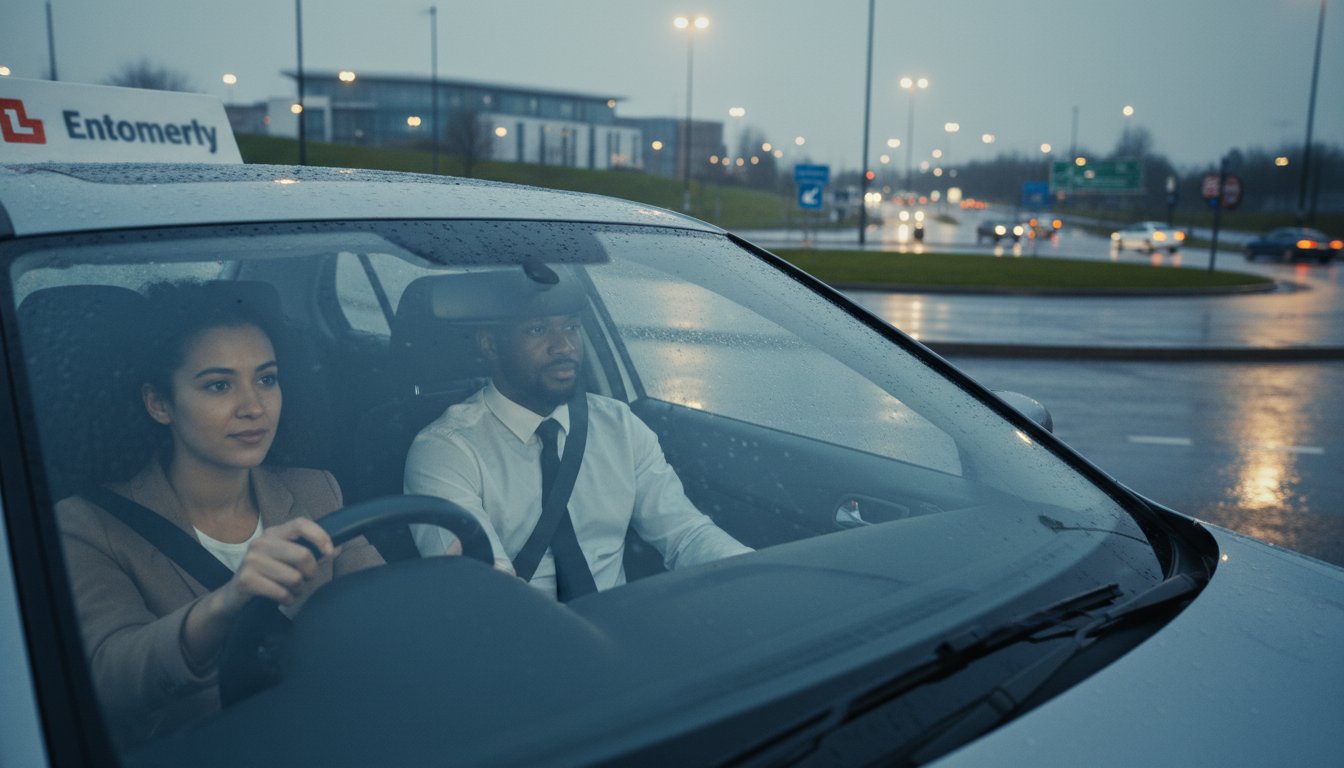
What if a heavy downpour during your driving lesson is actually the best thing that could happen to your chances of passing? It’s completely natural to feel a bit of dread when you look out the window and see grey skies. You might worry about skidding on slick roads or struggle to see clearly through a blurred windscreen. It often feels like the weather is making your journey to a driving licence much harder than it needs to be.
We understand that taking driving lessons in the rain for learners can feel intimidating at first. However, we’re here to help you master the skills needed to handle wet British roads safely and with total confidence. By the end of this guide, you’ll know how to turn a rainy day into your secret advantage, helping you join the 83.33% of our students who pass their test first time. We’ll cover everything from adjusting your braking distances to mastering your car’s wipers and demisters so you can stay calm behind the wheel.
Key Takeaways
- Learn why rainy weather is actually a secret advantage that helps you prove your competence to DVSA examiners.
- Master the essential “Rain Routine” to manage visibility and prepare your vehicle for safe travel before starting your engine.
- Use driving lessons in the rain for learners to adapt your car control and understand why the two-second rule must double on wet roads.
- Develop the observation skills needed to anticipate common hazards like heavy spray and reduced grip on dual carriageways.
- Find out how a calm, professional mentor can help you maintain our 83.33% first-time pass rate even in the most challenging British weather.
Why Driving Lessons in the Rain are Your Secret Advantage
Many students feel a dip in their stomach when they see grey clouds on the morning of a lesson. You might be tempted to reach for your phone and reschedule. Don’t do it. Taking driving lessons in the rain for learners is actually a massive shortcut to becoming a safe driver for life. While fair-weather students only know how to handle dry tarmac, you’ll be building a toolkit of skills that others simply don’t have. Rain provides a unique classroom where you learn grip, visibility, and patience in real-time.
Cancelling a rainy session doesn’t just stall your momentum; it’s a financial drain. If you avoid the rain now, you’ll likely need extra hours later to catch up when the seasons change. Since we maintain an 83.33% first time pass rate at Pass4you, we know that consistency is what gets you that pink licence. Every wet mile you drive with Simon is an investment in your confidence. It’s much better to experience your first skid or heavy downpour with a professional instructor beside you than to face it alone after you’ve passed.
The DVSA Perspective: Rain on Your Driving Test
The DVSA doesn’t stop tests just because it’s drizzling. Examiners specifically look for your ability to use wipers and lights without being prompted. In 2026, “driving for the conditions” remains a core competency that can make or break your result. You’ll need to show you understand that stopping distances double on wet roads. Interestingly, DVSA data suggests that candidates who have practiced in varied weather are less likely to commit serious faults related to speed or following distances. You’ll prove you’re competent by adjusting your gap to the car in front, showing the examiner you’re a responsible, thinking driver.
Building Resilience and Confidence
Facing poor weather early on helps you move past the nervous learner phase quickly. Simon at Pass4you uses these days to sharpen your hazard perception skills during driving lessons in the rain for learners. You’ll learn how to spot deep puddles and understand what is hydroplaning, which is the dangerous moment your tyres lose contact with the road surface. This isn’t about being scared; it’s about developing professional behaviour. By the time your test date arrives, a bit of rain won’t rattle you. You’ll stay calm and patient, knowing you’ve handled these conditions many times before. This proactive approach transforms anxiety into the quiet confidence needed for a successful result.
The Rain Routine: Preparing Your Vehicle and Managing Visibility
Visibility is your first line of defence during driving lessons in the rain for learners. Before you pull away from the kerb, you must establish a solid “Rain Routine” to ensure your surroundings are clear. This preparation reduces the anxiety of wet weather driving by putting you in control of your environment from the second you sit in the driver’s seat. It’s much easier to manage a downpour when you aren’t struggling to see through a foggy windscreen.
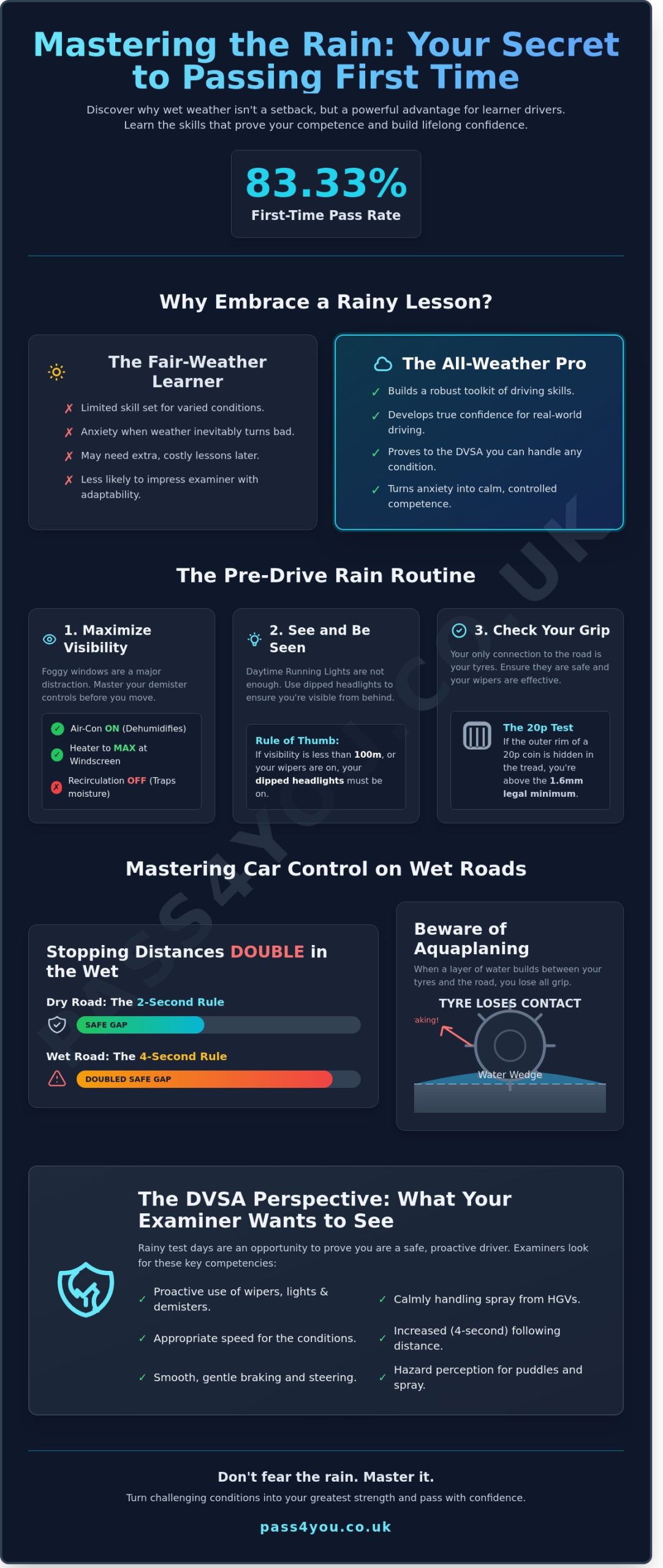
Start by checking your lights. UK law requires you to use dipped headlights when visibility is reduced to less than 100 metres. Don’t rely on daytime running lights; they often don’t illuminate your rear bulbs, making you nearly invisible to drivers behind you. Only use fog lights if visibility drops significantly below that 100-metre mark, as they can dazzle others when the road surface is reflective. If the rain is heavy enough that you’ve turned your wipers on, your dipped headlights should be on too.
Mastering the Demister: Keeping Windows Clear
Windows fog up because your warm breath meets the cold glass, causing condensation. It’s a common distraction that can lead to panic if you don’t know how to fix it. To clear it quickly, turn your heater to its highest setting and point the vents at the windscreen. If your car has air conditioning, turn it on. It acts as a dehumidifier, pulling moisture out of the cabin far faster than heat alone. A frequent mistake learners make is hitting the “recirculation” button. This traps the damp air inside, making the fog worse. Always keep it set to “fresh air” to maintain clarity during your driving lessons in the rain for learners.
Exterior Checks: Wipers and Tyres
Your tyres are the only thing connecting you to the road. You can check your tread depth easily with the “20p test”. Insert a 20p coin into the main tread grooves; if the outer rim of the coin is hidden, your tyres have more than the 1.6mm legal minimum. For better safety, AAA’s tips for driving in the rain suggest regular inspections of your wiper blades too. If they leave streaks or make a juddering sound, the rubber has likely perished and needs replacing. Perished blades are a major hazard during a sudden storm.
Match your wiper speed to the rainfall intensity. Use the intermittent setting for light drizzle and move to higher speeds as the downpour increases. Finally, take a moment to wipe your side windows and mirrors with a cloth before you start the engine. Rain droplets can distort your view of hazards, so starting with clean glass is essential for safe observations. If you’re feeling nervous about these checks, our calm and patient instructors can walk you through the process step-by-step until you feel fully prepared.
Mastering Car Control: Physics and Braking on Wet Roads
When you take driving lessons in the rain for learners, you’ll quickly notice that the car feels different. Rain creates a thin layer of lubrication between your tyres and the road surface, which significantly reduces friction. In our Volkswagen tuition vehicles, which we maintain to the highest safety standards, this change in physics means your steering might feel slightly lighter and your brakes won’t feel quite as “bitey” as they do on a warm July afternoon.
On a dry day, Simon will teach you the two-second rule to maintain a safe gap from the car in front. When the clouds open over Milton Keynes, you must double this. The “Four-Second Rule” is your best friend in wet weather. This extra time allows for the fact that a car travelling at 30mph needs about 23 metres to stop on a dry road, but this distance can extend to 46 metres or more when the tarmac is soaked. According to 2023 data from the Department for Transport, “slippery road due to weather” remains a top contributing factor in road accidents, which is why we focus so heavily on these adjustments.
Smoothness is the secret to maintaining traction. Any sudden jerks on the steering wheel or aggressive stabs at the pedals can break the delicate grip your tyres have on the road. We’ll help you develop a “silk-smooth” technique, ensuring your Volkswagen stays balanced and predictable even when the weather is anything but.
Stopping Distances and Braking Technique
The Highway Code is clear that stopping distances are at least double in wet weather. To manage this safely, we’ll practice the progressive braking technique. You don’t just “stomp” on the pedal. Instead, you apply light pressure initially to clear the film of water from the brake discs, then increase pressure steadily as you feel the car slow, and finally ease off slightly as you come to a halt. This early planning is vital when navigating busy Milton Keynes routes like the H6 Childs Way, where traffic flow can change in a heartbeat.
Understanding and Avoiding Hydroplaning
Hydroplaning, or aquaplaning, occurs when your tyres lose contact with the road and begin to “surf” on a layer of water. You’ll know it’s happening if the steering suddenly feels feather-light or the engine noise increases because the wheels are spinning freely. If this happens during your driving lessons in the rain for learners, don’t panic. Stay calm and follow these steps:
- Ease your foot off the accelerator slowly.
- Do not hit the brakes, as this can cause a skid.
- Keep the steering wheel straight and steady.
- Wait for the tyres to regain their grip on the tarmac.
Our instructors are experts at helping you identify these situations before they become stressful. We’ll show you how to look for standing water and “shiny” patches on the road, giving you the confidence to handle any downpour with ease.
Navigating Common Hazards for Learners in Wet Weather
Rainy conditions change the way you need to observe the road. It isn’t just about looking for other cars; it’s about anticipating how the water affects everyone’s behaviour. During your driving lessons in the rain for learners, we’ll help you develop a wider scanning pattern to spot hazards earlier. You’ll learn to look for reflections on the tarmac and watch the “rooster tail” of spray from vehicles ahead to judge road dampness.
Managing spray is a vital skill, especially on faster roads. A large heavy goods vehicle can displace up to 50 litres of water every second in heavy downpours. This creates a thick mist that can temporarily block your view. We teach you to increase your following distance to at least four seconds. This simple change keeps you out of the worst of the spray and gives you a much clearer view of the road ahead.
Standing water is another significant risk. In 2023, local authorities across England and Wales filled 1.4 million potholes, but many remain hidden beneath puddles. If you drive through a deep puddle, you risk aquaplaning or damaging the car’s suspension. We’ll show you how to safely navigate these areas by slowing down and keeping your steering steady.
Your “Show Me, Tell Me” knowledge needs to adapt too. You should be ready to demonstrate how to use the demister controls or operate the windscreen wipers without taking your eyes off the road. Simon will guide you through these controls until they feel like second nature, ensuring you stay focused on the drive.
Milton Keynes Specifics: Roundabouts and Dual Carriageways
Milton Keynes presents unique challenges during wet weather due to our grid system. When rain first hits, the V and H roads become incredibly greasy as oil and rubber dust rise to the surface. We’ll practice gentle steering and progressive braking at busy junctions like the Northfield or Brinklow roundabouts. You’ll learn to manage lane changes on the V8 or H6 with confidence, even when visibility is low and spray is high.
Vulnerable Road Users: Pedestrians and Cyclists
Rain makes people hurry, which often leads to unpredictable choices. A pedestrian might suddenly dash across the road to reach a bus shelter or shop doorway. You must stay alert for these sudden movements. Cyclists also face extra hurdles, such as slippery drain covers and deep puddles that can knock them off balance. Always give them at least 1.5 metres of space when overtaking.
It’s also important to remember your legal responsibilities. Splashing a pedestrian is considered “driving without reasonable consideration” under Section 3 of the Road Traffic Act 1988. This can result in a fine of up to £5,000 and three penalty points on your licence. We’ll help you develop the patience to slow down and avoid puddles near pavements.
Ready to build your confidence behind the wheel regardless of the weather? Book your driving lessons in Milton Keynes with Pass4you today and become a safe driver for life.
Turning Rain into Confidence with Pass4you
Learning to drive in the UK means you’ll eventually face a downpour. At Pass4you, we don’t see a wet forecast as a reason to cancel. Instead, we see it as a vital opportunity to build real-world skills. Our calm and patient approach is specifically designed to handle the toughest weather conditions. Simon has spent years helping nervous learners find their feet, and his supportive nature ensures you stay relaxed even when the wipers are on full speed. This dedicated environment is exactly how we maintain our impressive 83.33% first-time pass rate, regardless of the British clouds.
Simon is the favourite instructor for nervous learners in Milton Keynes because he understands that anxiety doesn’t just come from the car, but from the environment around it. By focusing on steady, incremental progress, he transforms driving lessons in the rain for learners from a source of stress into a badge of confidence. You won’t just learn to operate a vehicle; you’ll learn to read the road and stay composed when conditions are less than perfect. Ready to become a safe driver for life? Book your first lesson today and start your journey with a team that cares about your success.
Expert Instruction in Modern Vehicles
Our Volkswagen tuition cars are selected for their top-tier safety ratings and driver-assist technology. These vehicles feature advanced anti-lock braking systems (ABS) and electronic stability control, which are essential for maintaining grip on slick MK roads. We tailor your lesson plan to the current weather forecast, ensuring you get practical experience with rain sensors and demisting controls when they matter most. If you want to master the local roundabouts and dual carriageways, you can learn more about driving lessons in Milton Keynes through our comprehensive guide.
The Pass4you Method: Value and Success
We believe in providing genuine value for money. Learning in all weather conditions actually saves you money in the long run because it prevents the need for extra “top-up” lessons later in your driving career. Our training is designed to be realistic, fully preparing you for your practical driving test by exposing you to the exact scenarios you might face on the day. We’ve helped hundreds of local students pass first time, and we’re ready to help you do the same. By choosing driving lessons in the rain for learners with Pass4you, you’re investing in a lifetime of safe, confident motoring.
Master the Roads Whatever the Weather
Mastering wet weather physics and keeping your visibility clear transforms a rainy day from a potential hazard into a massive learning advantage. You’ve now seen how managing your braking distances and preparing your vehicle can make all the difference. Taking driving lessons in the rain for learners isn’t just about getting through a difficult hour; it’s about building the deep confidence you need to become a safe driver for life. At Pass4you, we specialise in turning nervous students into capable motorists through calm, patient, and expert instruction.
Our 83.33% first-time pass rate is a result of our proven techniques and the comfort of our modern Volkswagen tuition vehicles. Whether the sun is shining or the clouds have burst over Milton Keynes, Simon provides a supportive environment where you can learn at your own pace without any pressure. You don’t have to face the elements alone when you have a mentor who’s dedicated to your success. Book your first lesson with Milton Keynes’ top-rated school today. We’re ready to help you trade those L-plates for a full licence with total confidence.
Frequently Asked Questions
Is it harder to pass your driving test in the rain?
Passing your driving test in the rain isn’t more difficult if you stay calm and adjust your driving to the conditions. Examiners look for your ability to drive safely, so using your wipers correctly and increasing your following distance shows you’re a responsible driver. In fact, driving slightly slower due to the weather can give you more time to think. Our 83.33% first-time pass rate proves that our students succeed regardless of the British weather.
Do driving lessons get cancelled if it is raining?
Driving lessons rarely get cancelled because of rain unless the conditions are officially deemed dangerous by the Met Office, such as severe flooding. Taking driving lessons in the rain for learners is actually a fantastic opportunity to build confidence under the guidance of a patient instructor like Simon. Learning to handle wet roads now ensures you’re prepared for real-world driving. We only postpone lessons if visibility falls below 100 metres or if there’s a risk of aquaplaning.
What should I wear for a driving lesson in the rain?
You should wear flat, thin-soled shoes that provide a good grip on the pedals, as wet soles can easily slip. Avoid heavy boots or wellies that reduce your “feel” for the clutch and brake. It’s also wise to wear a light, breathable jacket rather than a bulky coat that restricts your movement when checking mirrors. If you’re damp from the walk to the car, your instructor will show you how to use the heater to stay comfortable and focused.
How much do I need to slow down when the road is wet?
You should generally reduce your speed by at least 10% to 20% on wet roads to maintain full control of the vehicle. If the speed limit is 60mph, dropping to 50mph provides the extra time needed to react to hazards. Stopping distances double on wet tarmac, increasing from 23 metres to 46 metres at 30mph. Staying within these safe margins helps you remain a calm and confident driver, which is exactly what we teach at Pass4you.
Can I use my fog lights during heavy rain?
You should only use your rear fog lights if visibility drops below 100 metres, as specified in Rule 226 of the Highway Code. Using them in normal rain can dazzle drivers behind you and mask your brake lights, which creates a safety risk. For most driving lessons in the rain for learners, simply using dipped headlights is the correct way to stay visible. Your instructor will help you identify exactly when the conditions require that extra level of lighting.
What happens if I splash a pedestrian during my driving lesson?
Splashing a pedestrian is a motoring offence under Section 3 of the Road Traffic Act 1988, which covers driving without reasonable consideration for others. If caught, you could face a fixed penalty notice of £100 and 3 points on your licence, though fines can rise to £5,000 in court. During your lessons, Simon will teach you to spot puddles early and slow down or move out safely. This ensures you protect vulnerable road users while building your reputation as a safe driver.
How do I stop my windows from steaming up while driving?
You can stop your windows from steaming up by turning on the air conditioning and directing the airflow toward the windscreen. The aircon acts as a dehumidifier, removing moisture from the cabin in seconds. If the car doesn’t have aircon, turn the heater up and crack a window slightly to equalise the temperature. Keeping the glass clear is vital for safety, and your instructor will guide you through these controls before you even set off.
What is the four-second rule in rainy weather?
The four-second rule is the minimum time gap you should maintain between your car and the vehicle ahead when roads are wet. While the standard gap is two seconds in dry conditions, rain reduces tyre grip and increases your stopping distance by 100%. To measure this, pick a stationary object like a lamp post; once the car ahead passes it, you should be able to count to four before you reach the same spot. This simple habit keeps you safe.