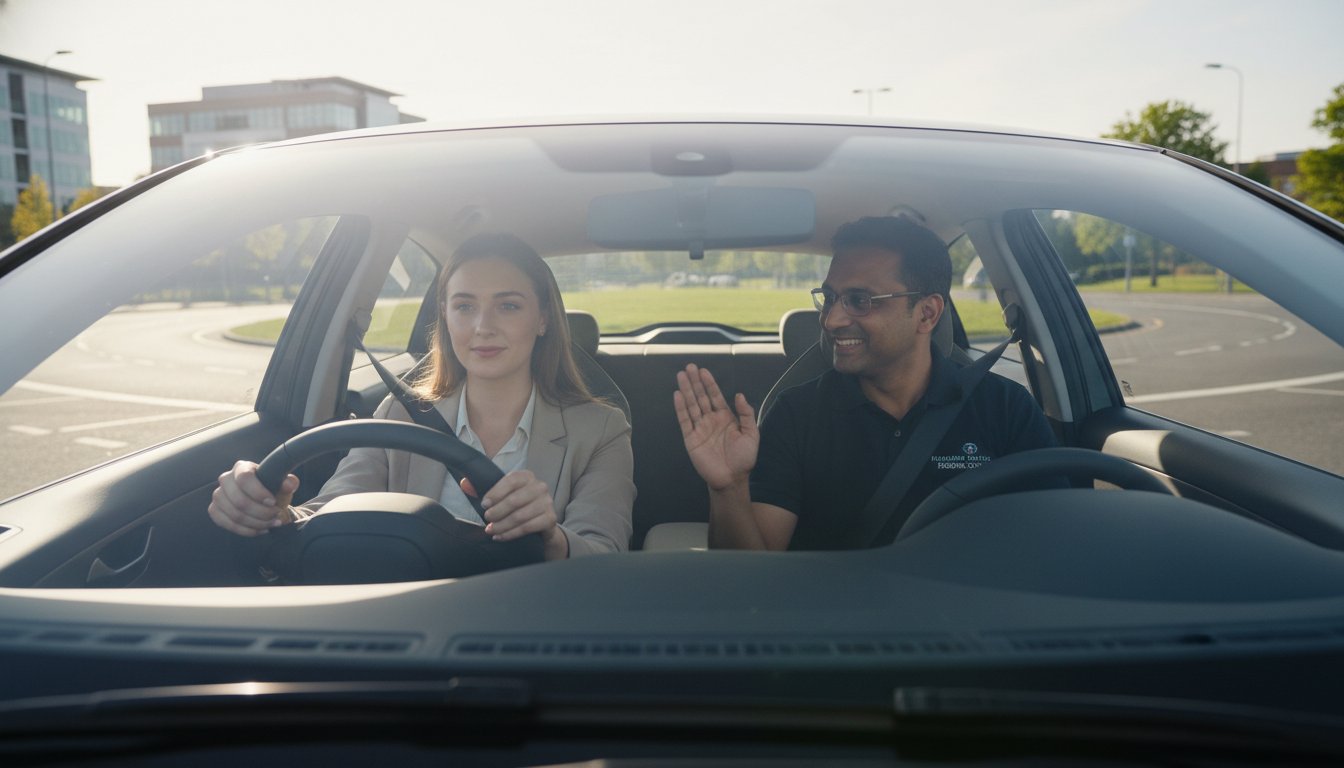
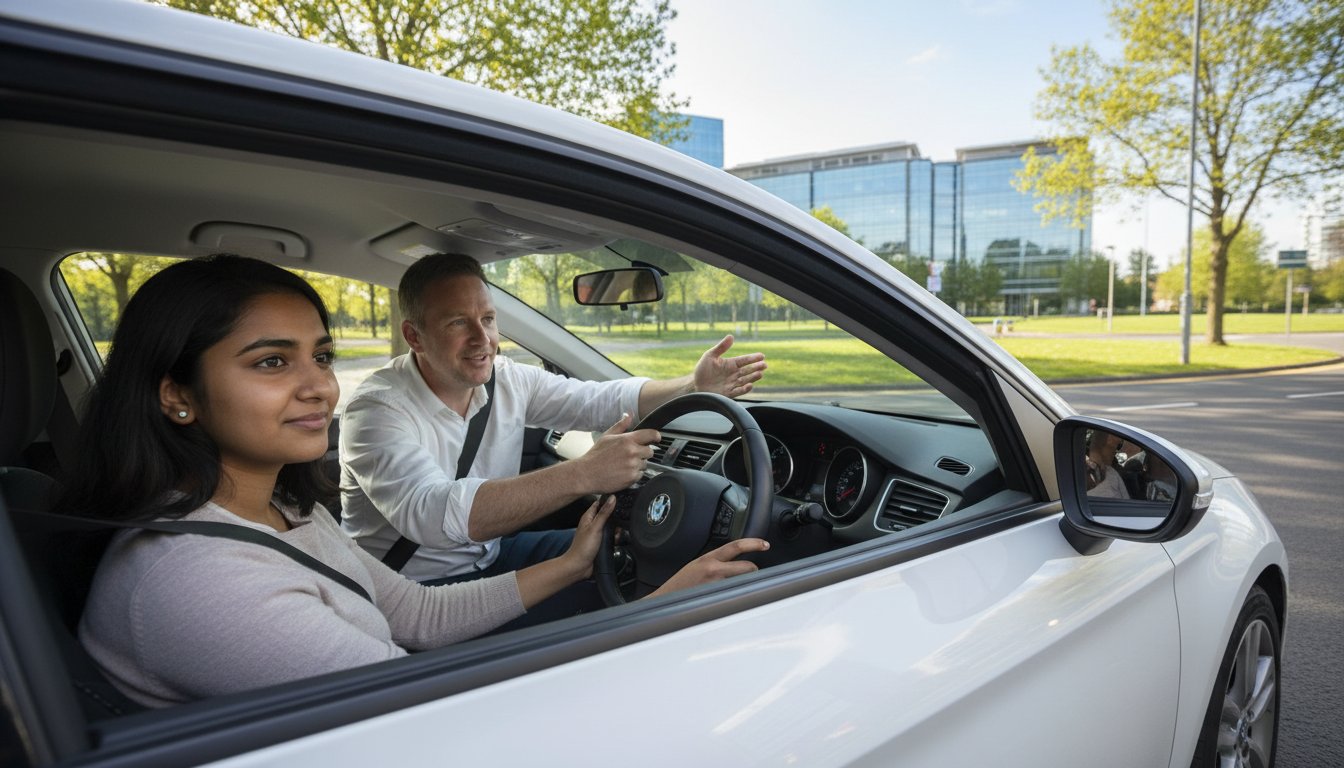
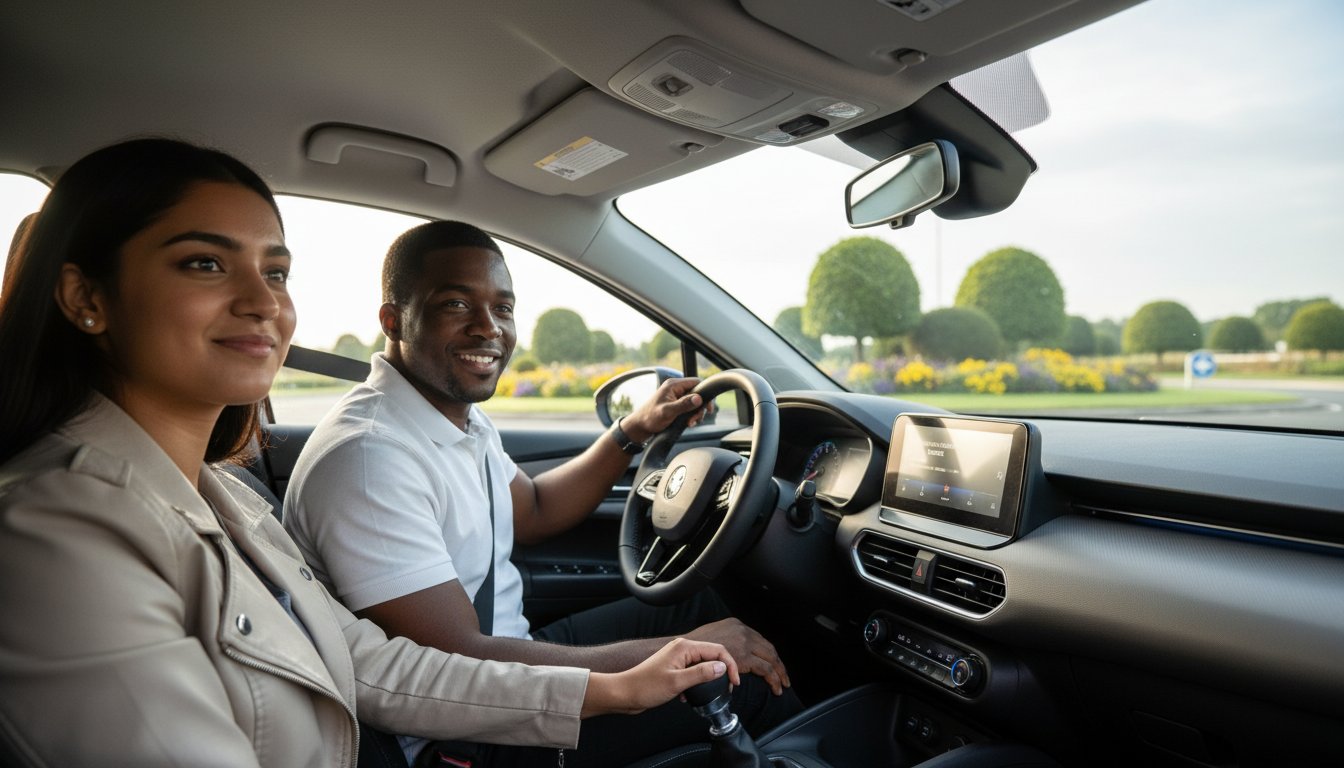
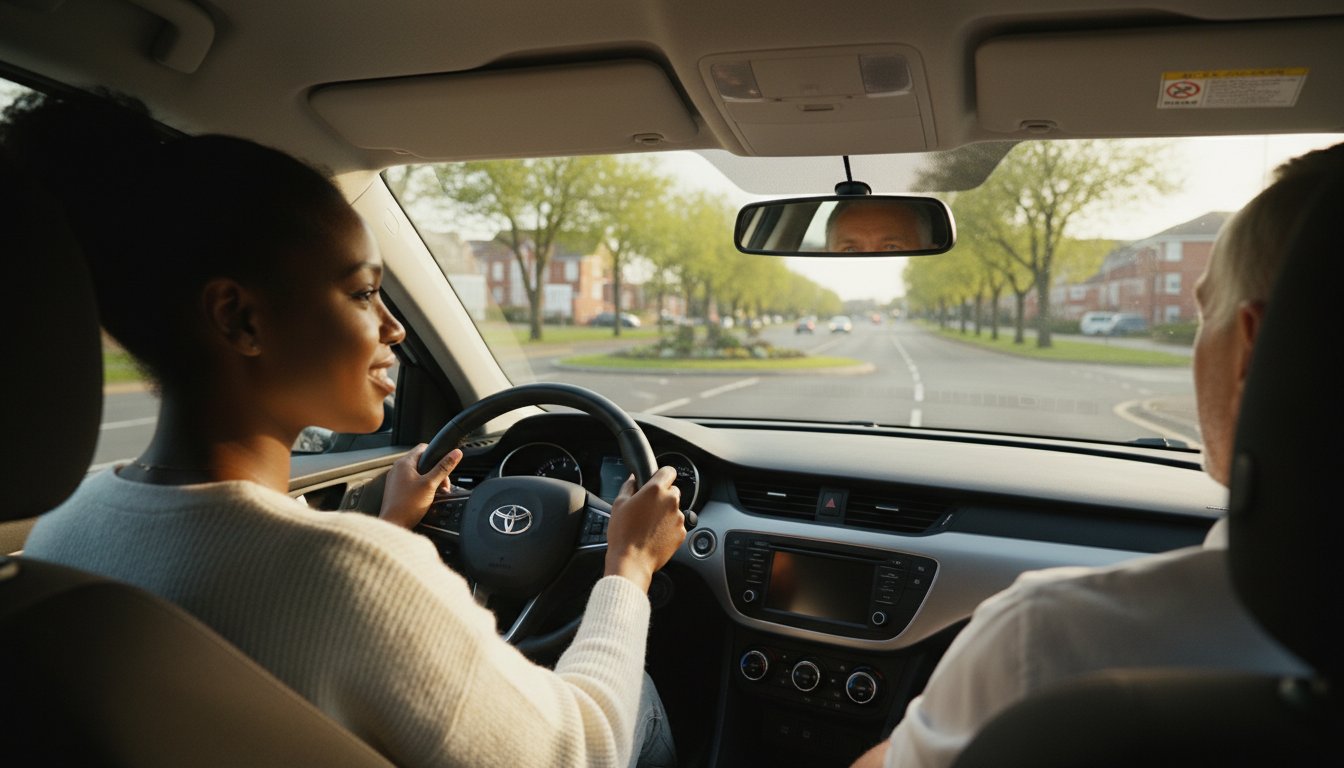
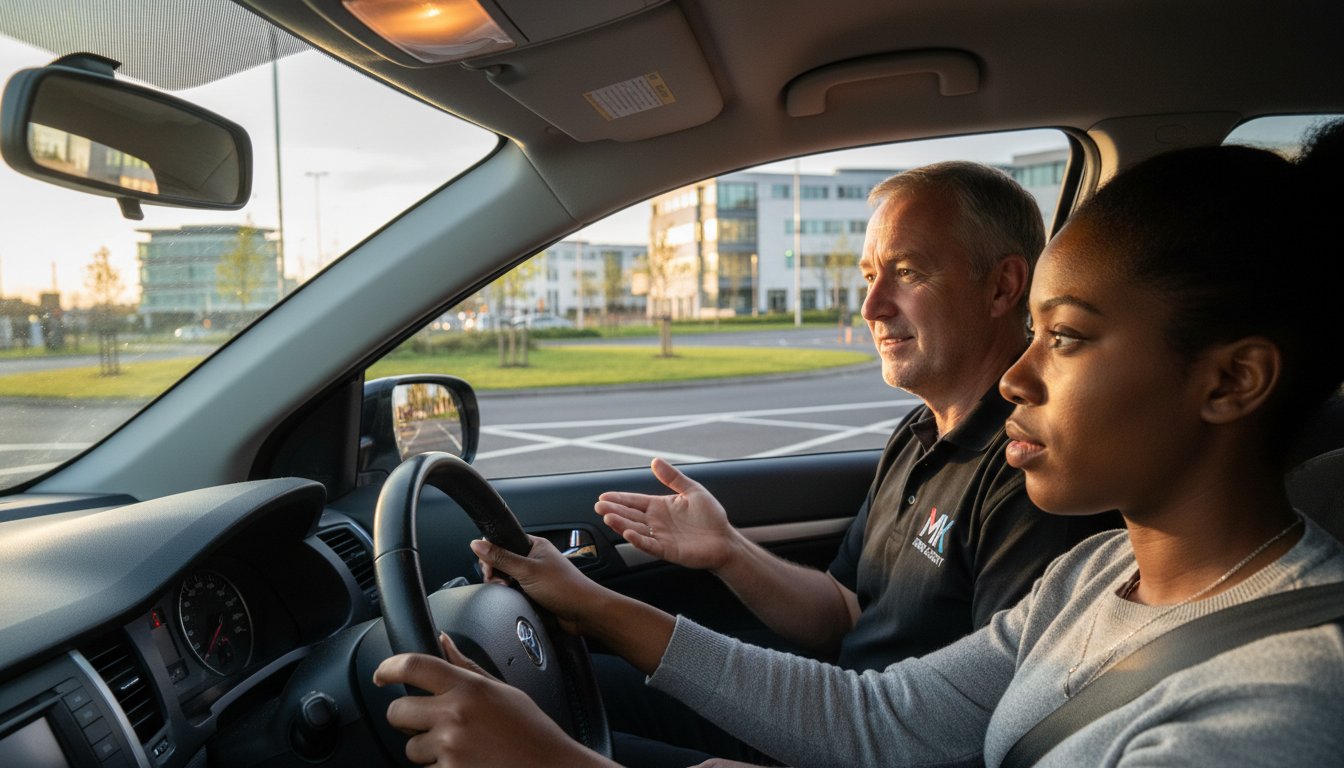
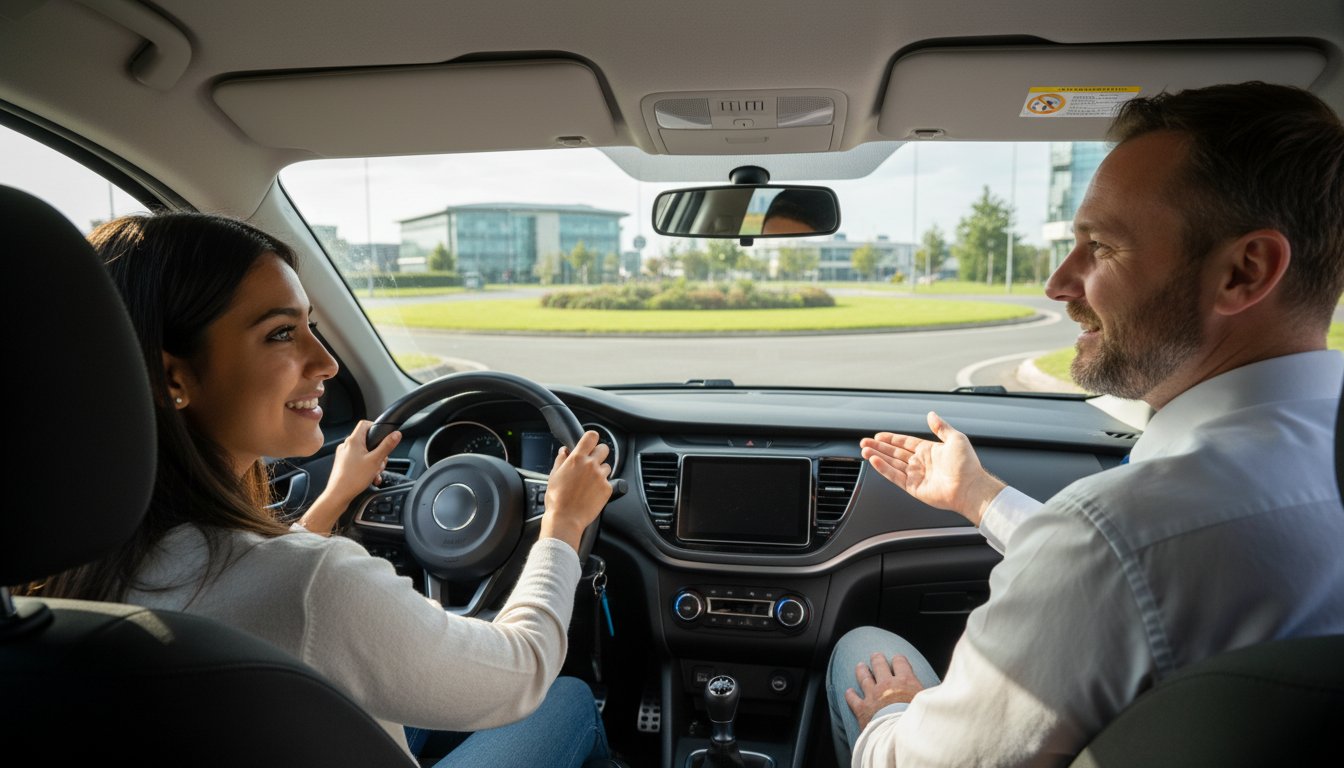
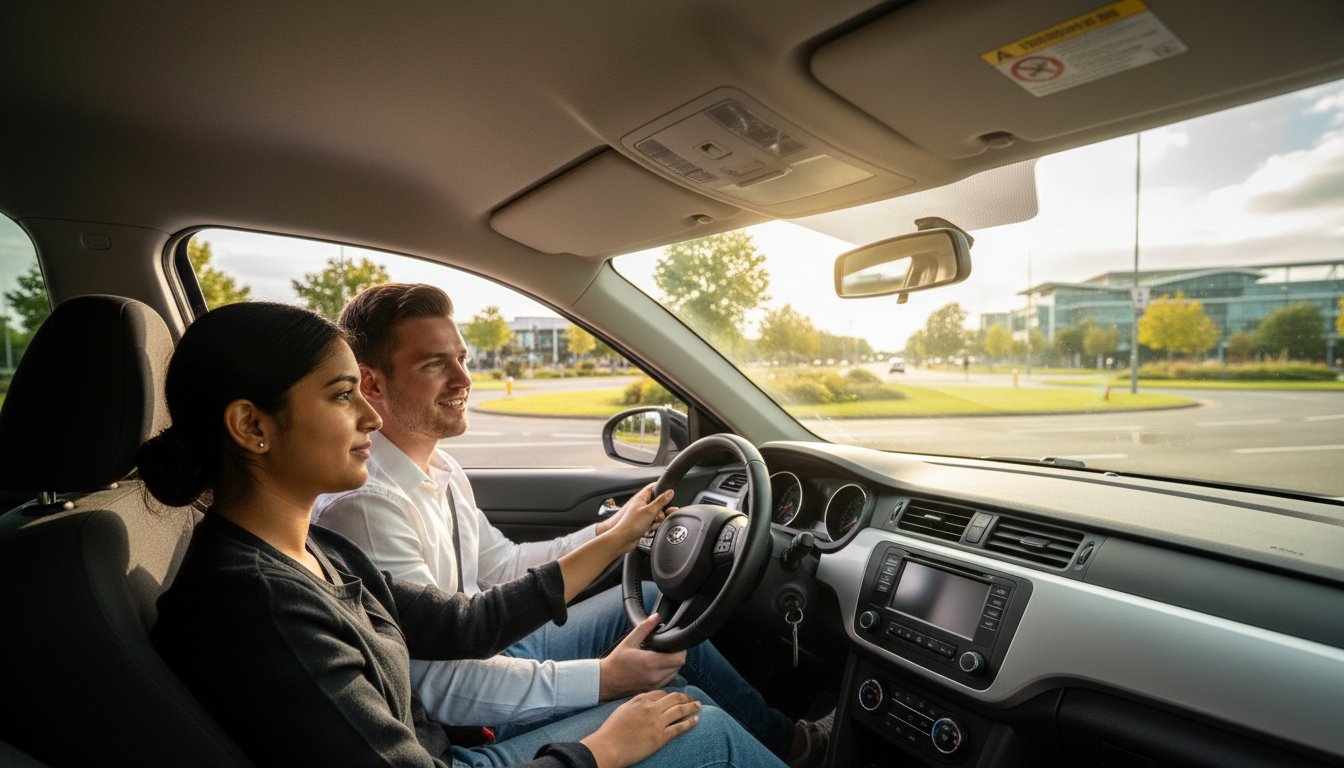
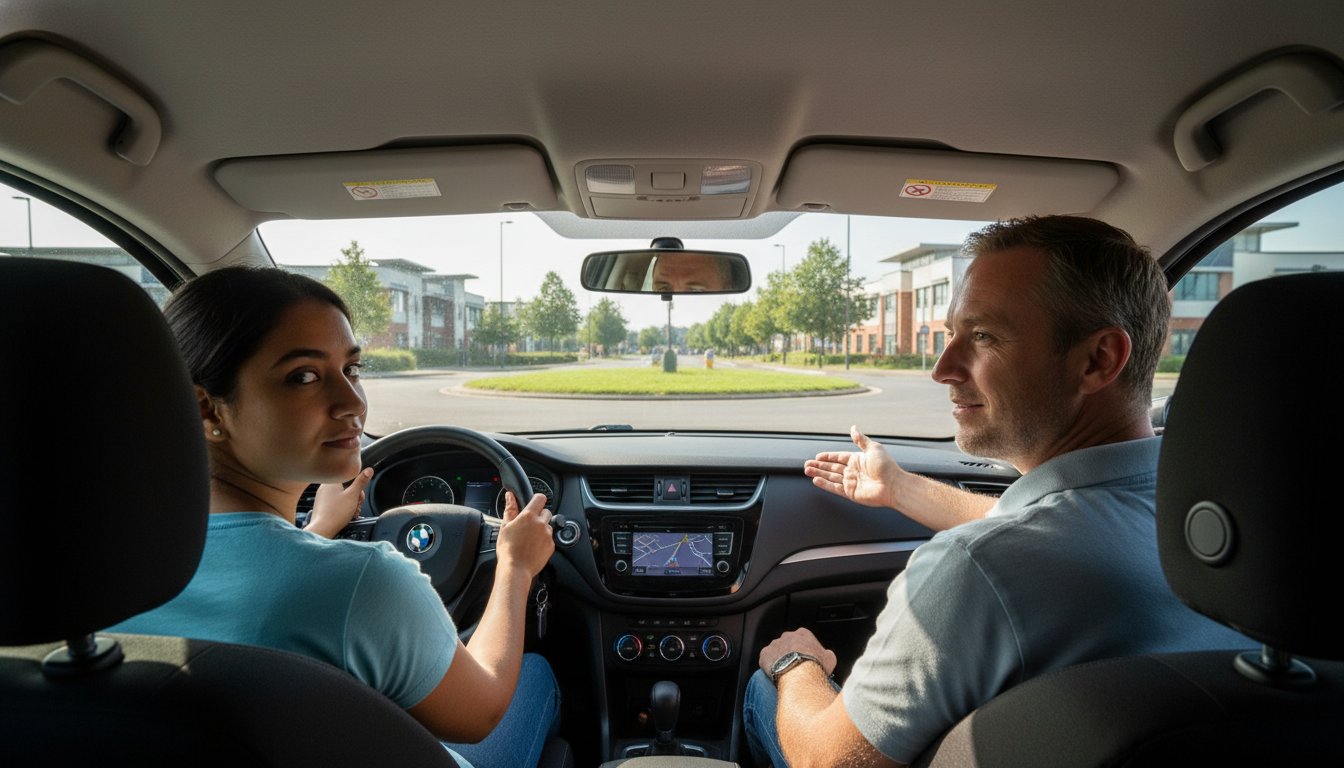
Last Tuesday, a new student named Sarah sat in our tuition car, clutching her provisional licence with shaking hands and worrying she’d stall in front of a queue of traffic. If you feel that same knot in your stomach, you’re certainly not alone. It’s completely normal to worry about “shouty” instructors or getting tangled up in technical jargon. At Pass4you Driving School, we’ve helped thousands of learners find their feet, and our 83.33% first time pass rate proves that a calm, patient approach works best. Knowing exactly what to expect on first driving lesson uk can turn that initial anxiety into genuine confidence before you even turn the key.
We believe that learning to drive should be an exciting milestone, not a source of dread. You’ll discover exactly what happens during those initial two hours behind the wheel, from the moment Simon or your instructor greets you to your very first move-off. We’ll break down the “Cockpit Drill” into simple, manageable steps and explain how our dual controls act as your permanent safety net. By the end of this 2026 guide, you’ll know exactly what to bring and how we’ll support you in becoming a safe driver for life.
Key Takeaways
Prepare for your big day by understanding the essential paperwork requirements and what to expect during the initial 20-metre eyesight test.
Get to grips with the “DSSSM” cockpit drill, the vital safety routine that helps every new driver feel calm and in control of the vehicle.
Discover exactly what to expect on first driving lesson uk, from using dual controls for safety to making your very first move-off in a quiet area.
Explore how Milton Keynes’ unique grid system is navigated by starting in “the shallows” to build your confidence away from busy main roads.
Learn why a patient, professional mentor is key to achieving an 83.33% first-time pass rate and becoming a safe driver for life.
Preparing for the Big Day: What to Bring and Do Beforehand
Your first time behind the wheel is a significant milestone. It marks the beginning of a journey toward personal freedom and independence. At Pass4you, we understand that those initial nerves are completely natural. Simon’s calm and patient approach is specifically designed to turn that early anxiety into genuine confidence from the moment you sit in the driver’s seat. Knowing exactly what to expect on first driving lesson uk helps settle your mind so you can focus on the skills you’re about to learn.
The Provisional Licence Check in 2026
Before you even turn the engine on, there is some essential administration to complete. You must have your physical provisional driving licence with you. Since the DVLA abolished the paper counterpart, instructors require a digital check code generated from the GOV.UK website. This code is valid for 21 days and allows us to verify your driving record to ensure our insurance covers you. In 2026, this process remains a strict requirement; without that 8-character code and your plastic card, the lesson cannot proceed. If you forget these, your instructor is legally barred from letting you drive. This safety measure protects you, the instructor, and the public.
The first practical task isn’t actually driving. It’s a mandatory eyesight test. You’ll be asked to read a standard UK number plate from a distance of 20 metres. This is a non-negotiable part of the UK driving test process and it applies to your very first lesson too. If you usually wear glasses or contact lenses for distance, ensure they’re on your face or in your eyes before Simon arrives. Failing this simple check means the lesson ends immediately, as safety is our absolute priority in every session.
What to Wear for Maximum Control
Your choice of footwear directly impacts your ability to handle the car’s pedals. We strongly recommend flat shoes with thin soles. Chunky trainers or heavy boots significantly reduce the ‘feel’ of the pedals, which makes it much harder to find the biting point on the clutch. High heels or flip-flops are also a safety risk because they can slip or get caught in the floor mats. Choose clothing that is comfortable and allows for a full range of motion. You’ll be performing frequent ‘over-the-shoulder’ blind spot checks, so you don’t want a stiff collar or a tight jacket restricting your neck and shoulder movement.
Mental preparation is just as important as your physical gear. Accept right now that you will probably stall the car at least once. Even the students who contribute to our 83.33% first-time pass rate stalled during their first hour. Stalling is simply a sign that you’re learning how the engine and clutch interact. Simon won’t shout or get frustrated; he’ll simply talk you through the restart process with patience. Being a ‘safe driver for life’ starts with staying calm when things don’t go perfectly. To ensure you’re ready, follow this checklist:
Double-check your bag for your physical provisional licence.
Generate your DVLA check code at least 24 hours in advance.
Wear thin-soled shoes like pumps or flat trainers for better pedal feel.
Bring your glasses or contacts if you need them for distance.
Have a light snack and stay hydrated to keep your concentration sharp.
Preparing properly ensures you get the most value for money from your session. When you know what to expect on first driving lesson uk, you can arrive at the car feeling ready to learn rather than worried about the logistics. This professional preparation sets the tone for a productive, stress-free experience in Milton Keynes.
The ‘Cockpit Drill’: Mastering the DSSSM Routine
Before you even think about turning the key, you’ll be introduced to the ‘Cockpit Drill’. This is the essential foundation for every single drive you’ll ever take. Knowing exactly what to expect on first driving lesson uk sessions can really help settle those initial nerves. Approximately 1 in 4 of our new learners tell us they feel quite anxious before they arrive, but this calm, structured routine is designed to put you at ease. It’s not about rushing into traffic; it’s about making sure you’re safe, comfortable, and in total control of your environment.
We use the DSSSM acronym to help you remember the steps. It stands for Doors, Seat, Steering, Seatbelt, and Mirrors. This routine is the very first thing you’ll learn because it transforms the car from a complex machine into a space that’s tailored specifically to you. By following the Official government guide to learning to drive, you’re starting your journey with the same professional standards required for the practical test.
Doors and Seat: Finding Your Perfect Position
You’ll start by checking that all doors are securely closed. This includes a quick glance to the passenger side and the rear to ensure no one is at risk if you move off. Once the car is secure, you’ll focus on your seating position. You need to adjust the seat height and reach so you can depress the clutch pedal fully to the floor while maintaining a slight bend in your knee. If your leg is locked straight, you won’t have the necessary finesse for smooth gear changes. The clutch bite point is the specific moment when the engine’s power begins to transfer to the wheels, allowing the car to move. Getting this right takes roughly 15 minutes of your first lesson, but it’s vital for your comfort and safety. Simon always suggests that a comfortable driver is a confident driver, and we take the time to ensure your posture is perfect.
Steering and Mirrors: Setting Your Field of Vision
Setting your field of vision is the next priority. To check your distance from the steering wheel, use the ‘wrist on top’ rule; stretch your arm out and rest your wrist on the top of the rim. If your arm is flat and your wrist sits comfortably, you’ll have enough leverage to steer without straining. Your mirrors are your primary tools for awareness, but they don’t show everything. A blind spot is an area around the vehicle that cannot be directly observed by the driver while looking through the mirrors, which is why a physical head check is a habit we build from day one. You’ll adjust the interior mirror to frame the rear window and the door mirrors to show the road behind and a tiny sliver of the side of the car.
Mastering this drill at the start builds a professional ‘safe driver’ habit that lasts a lifetime. It might seem like a lot to remember, but our patient driving instructors will guide you through it until it becomes second nature. Since we maintained an 83.33% first-time pass rate throughout 2023, we know that these small details make a massive difference. Taking the time to get your cockpit ready shows a level of responsibility that sets the tone for the rest of your training. It ensures that when you finally do move off, you aren’t fighting the car; you’re working with it.
First Lesson Expectations vs. Reality: Addressing the Fear
Many learners arrive for their first hour of tuition feeling a mix of excitement and genuine dread. You might worry about stalling in the middle of a busy junction or causing a tailback that stretches for miles. The reality is much more controlled and supportive. Your instructor won’t expect you to handle heavy traffic immediately. Instead, they usually spend the first 15 minutes driving you to a “quiet area.” This is typically a secluded residential street or a quiet industrial estate with minimal traffic flow. This strategy ensures you can focus on the car’s mechanics without the pressure of other drivers watching your every move.
Understanding what to expect on first driving lesson uk starts with the “controls talk.” Before you even turn the key, your instructor will guide you through the cockpit drill. You’ll learn how to adjust your seat and mirrors to meet the official UK driving standards for safety and vision. They will explain what the pedals, gears, and indicators actually do. This isn’t a lecture; it is a hands-on introduction where you get to feel the weight of the steering wheel and the click of the gear stick while the car is stationary. This foundational knowledge builds the confidence you need to move from the passenger side to the driver’s seat.
How Dual Controls Work
One of the biggest fears for new drivers is the idea of losing control and hitting something. This is why professional tuition cars are fitted with dual controls. Your instructor has their own set of brake and clutch pedals on the passenger side of the footwell. If you make a mistake or fail to see a hazard, they can take over instantly. It is physically impossible for you to “crash” the car during these early stages because your mentor is always one step ahead of the vehicle’s movement. They also use these pedals to help you smooth out your first few gear changes, gently assisting with the clutch to prevent the car from jerking. This safety net allows you to learn in a completely stress-free environment.
Your First Move-Off: The POM Routine
Once you are comfortable with the layout, it is time for your very first taste of motion. We use the POM routine to ensure every move-off is safe and legal. This stands for:
Preparation: Putting the car into first gear and finding the “bite point.”
Observation: Checking all mirrors and your blind spots with a full 360-degree look.
Manoeuvre: Releasing the handbrake and moving away smoothly.
Finding the “bite point” for the first time is a milestone for every learner. It is that specific moment when the engine connects with the wheels and the back of the car dips slightly. You don’t need to panic if you stall the engine; it happens to about 95% of students on their first day. Simon or your chosen instructor will stay calm and help you reset without any shouting or frustration. Most first lessons end with the student successfully driving in 2nd gear and feeling a massive sense of achievement. This patient, structured approach is a core reason why we maintain an 83.33% first-time pass rate for our students.
Learning to Drive in Milton Keynes: The Best First-Time Spots
Milton Keynes offers a unique environment for new drivers that differs significantly from traditional UK towns. While the area is famous for its 130 roundabouts, your first hour behind the wheel won’t involve tackling the V6 Grafton Street or the high-speed H8 Standing Way. We start in what we call the ‘shallows.’ These are quiet, wide residential areas where you can master the basics of car control without the pressure of heavy traffic or complex junctions. Our priority is building your confidence in a controlled, low-stress setting.
Many nervous students worry about the ‘Roundabout Myth.’ They imagine they’ll be thrown onto a three-lane junction within minutes of starting. This simply doesn’t happen. When considering what to expect on first driving lesson uk in a town like MK, remember that your instructor’s job is to keep you safe. You’ll spend your first session in 20mph or 30mph zones, focusing on the cockpit drill and basic moving off and stopping. You won’t even see a major grid road until Simon is 100% sure you’re ready to handle higher speeds.
Why the MK Grid System Helps Learners
The grid system is actually a beginner’s best friend. Unlike the narrow, winding streets found in older towns, MK roads are generally wide and offer excellent visibility. This clear layout helps you focus on your feet and the steering wheel rather than worrying about tight gaps or obscured corners. The logical numbering of H and V roads also makes it much easier to orientate yourself as you progress. We typically start in estates like Loughton, Shenley Church End, or Monkston Park. These areas provide long, straight stretches of road that are perfect for practicing gear changes and smooth braking.
The transition from quiet side streets to slightly busier local roads is handled at your own pace. Because the grid roads act as the main arteries for through-traffic, the residential ‘squares’ remain remarkably quiet during the day. This allows us to find plenty of space to practice your first junctions without a queue of cars forming behind you. It’s this patient, structured approach that helps our students achieve an 83.33% first-time pass rate.
Local Knowledge: Avoiding the Stress
At Pass4you, we use our deep local knowledge to choose ‘nursery’ routes based on the specific time of your lesson. A road that is quiet at 10:00 am might be a school run hotspot at 3:15 pm. Simon knows exactly where to go to ensure you have the space you need. We also use specific local landmarks, such as the MK Stadium or the Snowzone, to help you understand your positioning within the town. This helps reduce the mental load of navigation so you can focus on the car.
Learning in the same Volkswagen tuition vehicles used for the Milton Keynes test centres provides an extra layer of consistency. You’ll become familiar with the car’s dimensions and controls in the very same areas where you’ll eventually take your test. This familiarity is a huge advantage when it comes to reducing pre-test nerves. We don’t just teach you how to pass; we teach you how to be a safe driver for life on the roads you’ll use every day.
If you’re ready to start your journey in a calm and supportive environment, you can book your first lesson with Simon today and see why our patient approach makes all the difference.
Why Your Choice of Instructor Matters for a First-Time Pass
Choosing who sits in the passenger seat is the most critical decision you’ll make before you even turn the ignition. Many national driving schools treat students like a number on a corporate spreadsheet, following a rigid checklist that doesn’t account for individual nerves. At Pass4you, we take a different path. Simon focuses on building a genuine connection because a relaxed learner absorbs information far more effectively than a stressed one. Getting a clear idea of what to expect on first driving lesson uk roads is easier when you have a mentor who explains the “why” behind every action rather than just barking orders.
Our results speak for themselves. We maintain an 83.33% first-time pass rate, which is significantly higher than the national average. While it’s tempting to hunt for the lowest hourly rate, cheap lessons often prove expensive in the long run. If an instructor lacks a structured, patient approach, you might end up needing 60 hours of tuition instead of 35. By getting it right from the start, you save hundreds of pounds and avoid the frustration of repeated test failures. We don’t just teach you how to pass a 40-minute exam; we build a “Safe Driver for Life” mindset from your very first hour behind the wheel. This involves understanding road psychology and hazard perception, not just memorising test routes around Milton Keynes.
The Value of Patience and Empathy
Instructors who lose their temper or rush through the syllabus are the primary reason students give up. We’ve seen many nervous Milton Keynes learners arrive at Pass4you after negative experiences with “shouty” instructors elsewhere. Simon’s calm, empathetic style is designed to rebuild that shattered confidence. We’ve helped students who were once terrified of dual carriageways pass their test with zero faults. We tailor the pace of every lesson to your individual comfort level. If you need more time to master the biting point or steering control, we stay there until you feel 100% ready to move on. Knowing what to expect on first driving lesson uk sessions with us means knowing you’ll never be pressured to do something you aren’t ready for.
Booking Your Journey to Freedom
Starting your lessons is a simple, transparent process. We recommend booking 2-hour blocks rather than single hours. This format allows you to settle into the car, travel to different types of road layouts, and properly consolidate what you’ve learned. It accelerates your progress and provides better value for money. When you make your first call, tell us about your goals and any specific concerns. We want to know if you’re nervous or if you’ve had a bad experience before. This helps Simon prepare the perfect introductory session for you. You’ll find that our professional, friendly approach makes the road to your pink licence much smoother.
Your first time in the driver’s seat is a milestone you’ll remember forever. By preparing your provisional licence early and understanding the DSSSM cockpit drill, you’ve already done the hard work. Knowing exactly what to expect on first driving lesson uk helps turn that initial anxiety into genuine excitement. The reality of driving is rarely as scary as the version in your head; it’s simply a matter of taking things one step at a time with a professional by your side.
At Pass4you, we specialise in helping nervous students become safe drivers for life. You’ll learn at your own pace in modern Volkswagen tuition vehicles, guided by Simon’s 5-star rated, patient instruction. Our proven methods have led to an impressive 83.33% first-time pass rate for our students in Milton Keynes. We don’t just teach you how to pass a test. We give you the tools to handle the road with total composure. You’ll save time and money by getting it right from the very start with a mentor who actually listens to your concerns.
The road is waiting for you. We can’t wait to see you succeed and enjoy the freedom that comes with your new licence.
Frequently Asked Questions
Will I have to drive home on my first lesson?
You won’t have to drive home on your first day. Your instructor will drive you to a quiet side road or a dedicated training area away from busy traffic first. This ensures you’re in a safe environment while you learn the basic controls. Once the session ends, Simon or your instructor will drive you back to your starting point so you can stay relaxed.
What happens if I stall the car in traffic?
Stalling is a perfectly normal part of the learning process and nothing to be embarrassed about. If it happens, your instructor will calmly talk you through the restart procedure without any pressure. Since our cars have dual controls, we can help manage the situation to keep you safe. We’ve helped students achieve an 83.33% first time pass rate by staying patient during these small hiccups.
Do I need to have passed my theory test before my first lesson?
You don’t need to pass your theory test before starting your practical lessons. You only need a valid UK provisional driving licence to get behind the wheel for the first time. We actually recommend starting your lessons alongside your theory revision. Seeing how road signs and rules work in real life helps you understand what to expect on first driving lesson uk sessions and beyond.
How many driving lessons will I need to pass my test in 2026?
The Driver and Vehicle Standards Agency (DVSA) data shows that most learners need about 45 hours of professional tuition plus 22 hours of private practice. However, every student is different and some progress much faster. Our goal is to make you a safe driver for life as efficiently as possible. By using a structured training programme, many of our students require fewer than the national average number of hours.
Can I learn in an automatic car for my first lesson?
You can certainly choose to learn in an automatic car from your very first lesson. This is often a great choice for nervous learners because there’s no clutch pedal or gear stick to worry about. It allows you to focus entirely on steering and road positioning. Just keep in mind that an automatic licence doesn’t permit you to drive manual vehicles later.
What should I do if I’m extremely nervous about my first lesson?
It’s completely natural to feel anxious, so please tell your instructor how you’re feeling before you start. We specialise in helping nervous students feel calm and supported throughout their journey. Simon has a fantastic reputation for being patient and understanding with every learner. We’ll start in a very quiet area where there’s no pressure, ensuring you feel safe and confident from the moment you sit in the car.
Will my driving instructor pick me up from home or college?
Yes, your instructor will pick you up from a location that suits you, whether that’s home, work, or college. We offer flexible pick-up and drop-off points within our service areas to make your lessons as convenient as possible. Just let us know your preferred location when you book. This door-to-door service is part of our commitment to providing excellent value for money.
Is the first driving lesson just ‘talking’ or will I actually drive?
You will definitely get to drive during your first session. While we spend a short time explaining the cockpit drill and safety controls, we aim to get you moving as soon as you feel ready. Understanding what to expect on first driving lesson uk means knowing you’ll likely try moving off and stopping in a quiet street. It’s a hands-on experience designed to build your skills from day one.
Did you know that while the national average pass rate often sits below 50%, students at Pass4you Driving School achieve a remarkable 83.33% first-time pass rate? It’s completely normal to feel a knot in your stomach when you think about stalling at a busy Milton Keynes roundabout or dealing with a “shouty” instructor who lacks patience. You likely feel like you’re throwing money away on driving lessons that don’t seem to lead anywhere, leaving you stuck in a cycle of anxiety and slow progress.
We understand those fears because we’ve helped hundreds of nervous learners find their feet. This guide will show you how to navigate the road to your licence with total confidence, save significant sums on tuition, and master the specific challenges of our local dual carriageways. You’ll learn the secrets to finding a calm mentor like Simon who actually listens to your concerns. We’re going to walk through the proven strategies for passing your practical test on the first attempt in 2026, ensuring you become a safe driver for life.
Key Takeaways
Learn why prioritising long-term value over the lowest hourly rate can save you up to £500 on the total cost of your driving tuition.
Discover whether a manual or automatic gearbox is the best fit for your future, considering the “licence for life” versus modern ease of driving.
Gain the specific skills needed to master the Milton Keynes grid system and navigate complex roundabouts with absolute confidence.
Understand what to expect from your first driving lessons to ensure you transition smoothly from a nervous beginner to a safe, capable driver.
Find out how a calm, one-on-one mentoring style delivers an 83.33% first-time pass rate by focusing on your individual needs and building lasting confidence.
What to Expect from Your First Driving Lessons in 2026
Starting your journey behind the wheel is a huge milestone that brings a mix of excitement and nerves. In 2026, driving lessons follow a highly structured curriculum regulated by the Driver and Vehicle Standards Agency (DVSA). This isn’t just about learning to operate a machine; it’s a transformation from a provisional licence holder into a calm, confident road user. Our instructors, like Simon, focus on building your skills through a patient, step by step programme that prioritises your safety and comfort above all else.
By 2026, the standards for passing the UK driving test have evolved to include a 15% heavier focus on eco-driving and advanced hazard perception. You’ll learn how to anticipate traffic flow 200 yards ahead to avoid unnecessary braking, which saves fuel and reduces wear on the vehicle. Your first lesson will always begin with the “cockpit drill.” This involves learning the DSSSM routine: Doors, Seat, Steering, Seatbelt, and Mirrors. Once you’re comfortable, you’ll move on to the POM routine (Prepare, Observe, Move) to master moving off and stopping safely in a quiet, low traffic area.
The Legal Requirements Before You Start
You must have your provisional driving licence before you can touch the pedals. It’s easiest to apply online via the GOV.UK website, which currently costs £34 and usually arrives within 5 working days. On your first lesson, your instructor will conduct a mandatory eyesight test. You must be able to read a standard UK number plate from a distance of 20 metres. If you need glasses or contact lenses to do this, you must wear them every time you drive. You don’t need to pass your theory test before starting practical driving lessons, and many students find that seeing the road in person actually makes the theory revision much easier to understand.
Setting Realistic Expectations for Your Progress
Every learner is unique, and we celebrate that diversity in learning speeds. Data from the DVSA shows that the average learner requires 45 hours of professional tuition combined with 22 hours of private practice to reach test standards. However, don’t feel pressured by these numbers. Some students find their rhythm in 30 hours, while others prefer 60 hours to feel truly safe. Your “behaviour” behind the wheel, such as your ability to stay calm under pressure and your willingness to listen to feedback, significantly impacts how quickly you’ll progress. At Pass4you, we maintain an 83.33% first time pass rate because we wait until you are genuinely ready, ensuring you don’t just pass the test, but become a safe driver for life.
Be Patient: Mastery of the clutch can take three or four lessons to click.
Stay Consistent: Booking at least two hours of tuition per week helps retain muscle memory.
Ask Questions: There are no “silly” questions when you’re in the driver’s seat.
Quality vs. Price: Calculating the Real Cost of Learning to Drive
Choosing the cheapest instructor on social media often feels like a win for your bank balance. However, this is one of the most common traps learners fall into. If you save £5 per hour on driving lessons but end up needing 20 additional hours of tuition because the teaching is unstructured, you’ve actually spent an extra £500. Cheap lessons frequently result in a “retest cycle” where learners fail due to gaps in their knowledge, leading to more instructor hire fees and DVSA booking costs. It’s a false economy that adds months of delay to your freedom.
We prefer to look at the “Cost-per-Pass” rather than the hourly rate. Our 83.33% first-time pass rate means our students are significantly more likely to succeed on their first attempt compared to the national average, which often sits below 50%. When you pass first time, you save the £62 weekday test fee and the cost of several weeks of remedial lessons. It’s about getting you on the road safely and quickly, rather than dragging out the process just to keep an hourly rate low. Our goal is to make you a safe driver for life, not just for the duration of the test.
The vehicle you learn in matters just as much as the person sitting next to you. We use modern tuition vehicles like the Volkswagen Golf because they are designed with ergonomics in mind. A modern car with light controls, electronic handbrakes, and clear visibility reduces learner fatigue during a two-hour session. If you aren’t fighting with a heavy clutch or a vague gearbox, you can focus your mental energy on the road. Before you book, you should review the official government guide to learning to drive to understand the full legal requirements of the journey ahead.
What You’re Actually Paying For
Your investment covers far more than just a seat in a car. You’re paying for instructor expertise and a commitment to ongoing DVSA Continued Professional Development (CPD). This ensures your training follows the latest safety standards and teaching techniques. A professional environment also keeps you calm. High stress levels inhibit memory retention; if you’re shouted at or rushed, you won’t learn. We provide a patient, supportive atmosphere that helps you stay confident and retain information effectively, which is vital for long-term success.
Block Booking vs. Pay-As-You-Go
Consistency is the secret to passing quickly. Regular weekly sessions build muscle memory far more effectively than sporadic drives. If you leave a two-week gap between sessions, you’ll spend the first 15 minutes of your next hour just refreshing your memory. While pay-as-you-go offers flexibility, block booking your driving lessons secures your slot and ensures a steady progression through the syllabus. We always prioritise value for money by ensuring every minute of your lesson is spent moving towards test readiness, helping you reach that 83.33% success bracket sooner.
Manual vs. Automatic: Choosing the Right Path for Your Future
Deciding whether to learn in a manual or an automatic car is one of the first big choices you will make. Your decision impacts how quickly you feel confident behind the wheel and which vehicles you can legally drive later. In 2023, the Driver and Vehicle Standards Agency (DVSA) reported that automatic tests accounted for 324,000 of all practical exams taken, representing a 20 percent increase from the previous year. This shift shows that more learners are prioritising a simpler, calmer experience on the road.
Manual gearboxes have long been seen as the traditional way to learn. Passing in a manual car grants you a “licence for life,” meaning you are qualified to drive both manual and automatic vehicles. This flexibility is vital if you plan to buy a budget second-hand car or if you intend to work in a trade where delivery vans are often manual. However, the rise of electric vehicles (EVs) is rapidly changing the landscape. The UK government has set a target for all new cars to be zero-emission by 2035, and since EVs do not have traditional gearboxes, automatic driving is quickly becoming the new standard for driving lessons across the country.
The learning curve differs significantly between the two. Manual cars require you to master the coordination of the clutch pedal and gear stick, which gives you more control over the engine’s power. This is helpful in hilly areas or during wintry conditions. Conversely, an automatic car handles the gear changes for you, allowing you to keep both hands on the steering wheel and your eyes firmly on the road. This simplified approach often reduces the time needed to reach test-readiness by approximately 10 to 15 hours of tuition.
The Pros and Cons of Manual Lessons
Manual driving lessons are often the preferred choice for those watching their budget. Older used cars, specifically those priced under £4,000, are predominantly manual, making your first car purchase more affordable. The biggest hurdle is mastering clutch control. Stalling at a busy junction is a common fear for learners, but Simon’s patient and reassuring teaching style helps you find the biting point with confidence. You should follow the official steps to learning to drive to ensure you are following the correct legal path. While manual takes longer to learn, the ability to drive any car globally is a significant advantage for future car rentals or career changes.
Why Automatic Might Be Your Best Choice
Automatic cars are ideal if you find multi-tasking difficult or feel particularly nervous about the technical side of driving. By removing the gear lever and clutch pedal, you can focus entirely on hazard perception and positioning. This lead to faster progress; many students at Pass4you find they are ready for their test much sooner than they expected. With our school’s 83.33% first time pass rate, we see how a calm environment without the stress of stalling builds safe drivers quickly. Choosing automatic is also a way of future-proofing your skills. Since nearly 54 percent of all new cars sold in the UK in 2021 were already automatic, you are learning the way the world is already moving.
Mastering Milton Keynes: Navigating Roundabouts and the Grid System
Milton Keynes presents a unique environment for any learner. Designed in 1967, the town follows a strict grid system that differs from almost every other UK city. While the layout is logical, it creates specific pressures during a practical test. You’ll find yourself moving between quiet 30mph residential streets and 70mph dual carriageways every few minutes. This constant shifting requires high levels of concentration and precise speed control. Many students find the “H” (Horizontal) and “V” (Vertical) roads intimidating because they demand quick decision-making at high speeds. Success comes from understanding that these roads aren’t just paths; they’re the connectors between the 130+ roundabouts that define the area.
The secret to tackling the grid system with confidence lies in your lane discipline. On roads like the V6 Grafton Street or the H8 Standing Way, you must anticipate your exit long before you reach the junction. Local knowledge is vital here. For instance, the double mini-roundabouts in Bletchley or the complex lane changes near the MK test centre are frequent “fail spots” for the unprepared. Our driving lessons focus on these specific local hazards, ensuring you aren’t surprised by a sudden lane merge or a hidden speed sign on test day.
Roundabout Mastery: From Small to Multi-Lane
Roundabouts are the biggest hurdle for learners in Milton Keynes. You’ll encounter spiral systems where the lanes naturally “push” you outward toward your exit. It’s easy to drift across solid white lines if you aren’t looking ahead. We teach you to follow the road markings by their colour and position rather than just following the car in front. Effective observation is about more than just looking; it’s about timing. You need to judge the speed of approaching traffic on a busy junction like the Abbey Hill roundabout so you can move off safely without making other drivers brake.
Preparing for the Milton Keynes Practical Test
Taking mock tests on actual routes used by the Bletchley and MK centres is a core part of our strategy. This builds the muscle memory needed for the independent driving section, whether you’re following a Sat Nav or road signs. Simon’s patient approach is specifically designed to keep your heart rate down when things get busy. With an 83.33% first-time pass rate, our methods prove that a calm environment leads to better results. We don’t just teach you to pass; we ensure you’re a safe driver for life who can handle high-speed merges and complex junctions without panic.
If you want to build the confidence needed to conquer the MK grid system, Simon is ready to help you succeed.
Why Pass4you is the Favourite Choice for Milton Keynes Learners
Choosing where to take your driving lessons in Milton Keynes is a decision that dictates how quickly you’ll gain your independence. While national franchises often treat students like numbers on a spreadsheet, Pass4you offers what we call the ‘Simon Effect’. Simon isn’t just an instructor; he’s a dedicated mentor who understands that every learner has a distinct starting point. This personal, one-on-one approach is the reason we’ve maintained an 83.33% first-time pass rate, a figure that stands significantly higher than the local average at the Bletchley or Wolverton test centres.
National franchises often rotate instructors or use rigid, scripted teaching methods that don’t account for individual nerves. Simon takes the opposite approach. He provides a consistent environment where the focus is entirely on your specific needs. If you struggle with the V6 Grafton Street junctions, you’ll spend time there until it feels like second nature. When you learn with us, you aren’t just another booking in a call centre’s database. You’re a student with a name, a specific set of goals, and a mentor who is personally invested in your success. This bespoke attention ensures you don’t waste money on unnecessary hours.
Our philosophy moves beyond the narrow goal of just passing a 40 minute test. We focus on ‘Safe Driving for Life’. This means we teach you how to handle the H6 Childs Way at rush hour or navigate the complex roundabouts of central Milton Keynes with genuine skill, not just memorised routines. By the time your test date arrives, you won’t feel like you’re performing a trick for an examiner. You’ll feel like a competent driver who belongs on the road. We don’t believe in “test route coaching” where you only learn the specific roads an examiner might take you on. That’s a shortcut that leads to accidents later. Instead, we ensure you can handle any situation the UK road network throws at you.
From Nervous Learner to Confident Driver
We’ve helped countless students who felt they were “untrainable” or “too anxious” to learn. One student recently joined us after failing three times with a different school; they passed with zero faults after just ten hours with Simon. We achieve this by maintaining a quiet, supportive atmosphere inside the car. There’s no shouting, no rushing, and no judgement. Each lesson begins with a clear objective and ends with a debrief so you know exactly what you’ve mastered. This structured progress turns driving lessons from a source of stress into a source of pride.
Your Next Steps: Booking and Beyond
Ready to get started? We currently offer lessons across most MK postcodes, but our diary fills up fast because of our high success rate. To secure your spot, simply get in touch to check our current availability. For your very first lesson, you’ll need to have your provisional driving licence ready. Please also ensure you bring any glasses or contact lenses if you require them for distance vision. We suggest a two-hour block for your first session to give us enough time to get you comfortable behind the wheel without feeling rushed. We’ll handle the rest, guiding you from your first pull-away to that final, successful test result.
Don’t let the fear of a failed test hold you back from the life you want to lead. Join the hundreds of Milton Keynes residents who’ve found success with a patient, professional instructor who actually cares about your progress. Start your journey to freedom with Pass4you today!
Start Your Journey to Driving Independence Today
Mastering the Milton Keynes grid system requires more than just luck; it takes the right preparation and a calm environment. You’ve explored how choosing between manual and automatic gearboxes impacts your future and why focusing on quality over the lowest price saves you money in the long run. By understanding what to expect from your first driving lessons, you’re already ahead of the curve for 2026.
At Pass4you, we’re proud to help our students achieve an 83.33% first-time pass rate. You’ll learn at your own pace in modern Volkswagen tuition vehicles, supported by 5-star rated patient instructors who specialise in building confidence. We know that learning can feel overwhelming, so we focus on a reassuring, mentor-led approach that has made us the top choice for local learners. Our goal is to ensure you don’t just pass your test, but become a safe, capable driver for life.
How many driving lessons will I need to pass my test in 2026?
Most learners in 2026 require approximately 45 hours of professional instruction combined with 22 hours of private practice to reach test standard. While these are the national averages, our students often need fewer sessions because we use a tried and tested technique. Simon’s patient approach ensures you don’t waste time repeating basic skills. We focus on providing value for money, helping you become a safe driver for life as efficiently as possible.
Can I start taking driving lessons before I pass my theory test?
You can certainly start your driving lessons before you’ve passed your theory test. In fact, we recommend beginning your practical training early because seeing road signs and traffic situations in real life makes the theory material much easier to grasp. You just need to be 17 years old and hold a valid provisional licence. Combining hands-on experience with your revision often leads to a deeper understanding of road safety and a more confident performance.
What is the current first-time pass rate for Pass4you in Milton Keynes?
Our current first-time pass rate in Milton Keynes is an exceptional 83.33%. This figure is significantly higher than the national average, which typically sits around 48% according to recent DVSA data. We achieve these results through calm, supportive instruction that builds genuine confidence in every student. Simon focuses on eliminating common mistakes early in your training, ensuring you’re fully prepared for the specific challenges of local test routes before your big day arrives.
Are your driving instructors DVSA approved and CRB checked?
Every instructor at Pass4you is fully DVSA approved and has passed a comprehensive enhanced DBS check, which replaced the old CRB system. Simon is a highly experienced professional who undergoes regular standards checks to maintain his Grade A status. This means you’re learning with a mentor who meets the highest safety and teaching requirements in the UK. You’ll feel completely safe and relaxed during every session in our modern, dual-controlled cars.
Do you offer intensive driving courses or just weekly lessons?
We offer both intensive driving courses and traditional weekly lessons to suit your specific schedule and learning style. Our intensive options are perfect if you’re looking to pass quickly, while weekly sessions provide a steady pace for those who prefer more time to process new skills. Whether you choose a 20-hour fast-track course or a standard two-hour weekly slot, Simon’s friendly and understanding teaching style remains the same. We tailor every plan to your individual needs.
What happens if I need to cancel or change my driving lesson date?
We require at least 48 hours’ notice if you need to cancel or reschedule your appointment. This policy allows us to offer the slot to another student and keeps our schedule running smoothly. If you cancel with less than 48 hours’ notice, the full lesson fee of £38 is usually charged. We aim to be as flexible as possible because we know life happens, but consistent attendance is vital for maintaining your progress and building confidence.
Which driving test centres do you cover in the Milton Keynes area?
We primarily cover the Bletchley driving test centre, which is the main hub for the Milton Keynes area. Simon knows the local test routes extensively, including the complex roundabouts and high-speed dual carriageways that often trip up nervous learners. By practicing in the exact areas where your examiner will take you, you’ll feel much more comfortable. This local expertise is a key reason why our students achieve such a high first-time pass rate.
Is it better to learn in a manual or an automatic car in 2026?
Choosing between manual and automatic depends on your goals, but manual remains a popular choice in 2026 for its flexibility. A manual licence allows you to drive both types of vehicles, whereas an automatic licence restricts you to gearless cars. Many students find automatic cars easier to master because there’s no clutch to worry about. However, our driving lessons in manual cars are designed to be calm and stress-free, helping even anxious students master gears quickly.
The Driver and Vehicle Standards Agency (DVSA) reports that the average learner requires 45 hours of professional tuition plus 22 hours of private practice to reach the required standard. It’s completely normal to feel anxious about these figures or worry about wasting money on unnecessary sessions. You’ve likely heard conflicting stories from friends about passing in ten hours, but you want to ensure you’re actually a safe driver for life, not just someone who got lucky on the day.
If you’re wondering exactly how many driving lessons to pass test uk in 2026, you’re in the right place to find a realistic answer. Here at Pass4you Driving School, we’ll help you understand the specific factors that influence your timeline and show you how a patient, structured approach can actually save you money by reducing the total number of hours required. This guide breaks down the costs, explains how to reach test-standard efficiency faster, and gives you the confidence to choose an instructor who puts your progress first.
Key Takeaways
Understand the official DVSA benchmarks to learn how many driving lessons to pass test uk and why combining professional tuition with private practice is the most efficient route.
Discover how choosing the right lesson frequency and duration can prevent “lesson burnout” and help you master the road in fewer total sessions.
Compare the learning timelines for manual and automatic gearboxes to see which transmission type helps you reach your goals faster and more confidently.
Identify the specific skills you must master to be truly “test-ready,” from independent driving to perfecting every essential road manoeuvre.
Learn how a calm, patient approach can significantly improve your chances of joining the 83.33% of our students who achieve a first-time pass.
The National Average: How Many Lessons Does the DVSA Recommend?
Most people starting their driving journey want a straight answer to the question: how many driving lessons to pass test uk? While every learner is unique, the Driver and Vehicle Standards Agency (DVSA) provides a clear statistical starting point. Their data shows that the average successful candidate requires 45 hours of professional tuition to reach the required standard. This isn’t just about learning where the pedals are; it’s about developing the muscle memory and hazard perception needed to stay safe on modern, busy roads.
In addition to professional lessons, the DVSA suggests that learners benefit from an extra 22 hours of private practice. This brings the total recommended experience to 67 hours before you head to the test centre. These figures serve as a helpful benchmark for budgeting your time and money. However, they aren’t strict rules. At Pass4you, we’ve seen students pass with fewer hours, while others prefer more time to feel truly calm and collected. The goal isn’t just to scrape through the exam; it’s to become a safe driver for life.
There is a massive difference between “learning to move the car” and being “test-ready”. Most learners can master basic car control, like moving off and stopping, within the first five hours. Becoming test-ready is a higher bar. It requires you to handle complex junctions, unpredictable pedestrians, and high-speed dual carriageways without needing your instructor to intervene. For a detailed look at what the examiners are looking for, you can check this UK driving test overview to understand the full scope of the assessment.
Professional Instruction vs. Private Practice
Professional instruction from an Approved Driving Instructor (ADI) is the foundation of your success. Instructors like Simon are trained to spot small mistakes before they become dangerous habits. When you learn with a professional, you’re getting a structured syllabus designed to cover every possible scenario you might face during your test. We focus on building your confidence slowly and patiently, ensuring you never feel rushed or overwhelmed by the traffic around you.
Relying solely on private practice with parents or friends can be risky. While their intentions are good, family members often pass on outdated techniques or “shortcuts” that lead to immediate faults on a modern driving test. It’s also common for these sessions to become stressful, leading to arguments that knock your confidence. The best approach is to use private practice as a way to reinforce the professional habits Simon teaches you. This balanced method helps you reach that 67-hour competency goal much faster and more effectively.
The Legal Minimum: Is There One?
Technically, there is no legal minimum number of hours you must complete before booking your test. You could, in theory, apply for your practical exam the day after receiving your provisional licence. However, doing this is almost always a false economy. Test waiting lists are currently long, and the cost of a failed test includes both the booking fee and the price of additional remedial lessons.
Booking a test too early often results in a “fail” and a significant blow to your self-esteem. We take pride in our 83.33% first-time pass rate because we only encourage students to book when they are genuinely ready. Our patient, mentor-led approach ensures that when you do arrive at the test centre, you feel like a competent driver rather than a nervous student. It’s about value for money; fewer tests mean less money spent in the long run.
The DVSA sets a benchmark of 45 hours of professional tuition as the standard for ensuring a learner is safe and competent on the road.
5 Factors That Influence Your Learning Timeline
Every learner starts from a different position. If you have spent years riding a moped or spent weekends practicing steering in a private field, you will likely shave 10 hours off your total tally. These students already understand the basics of road positioning and “the bite” of a clutch. When people ask how many driving lessons to pass test uk, they often forget that previous exposure to vehicle controls creates a massive head start. Your age plays a role too. Data suggests that 17-year-olds often develop the necessary muscle memory for gear changes faster than those in their 40s. However, older learners frequently bring better hazard perception skills from years of being a passenger or cyclist.
The “Nervous Learner” factor is perhaps the most significant variable. Anxiety triggers a “fight or flight” response that makes it physically harder for the brain to retain complex instructions. This is where the quality of your mentor becomes vital. A shouting instructor will only increase your stress and extend your learning timeline. Simon at Pass4you focuses on a calm, patient atmosphere. This supportive environment is a key reason why our students achieve an 83.33% first time pass rate. A mentor who builds your confidence rather than knocking it down helps you master difficult manoeuvres in half the time.
According to DVSA’s Ready to Pass? guidance, the average learner requires 45 hours of professional tuition combined with 22 hours of private practice. However, these figures aren’t set in stone. Your learning style and how you process physical tasks will ultimately dictate your personal journey. Some people are visual learners who benefit from diagrams, while others need to “feel” the car’s movements repeatedly before it clicks.
The Importance of Lesson Consistency
Consistency is the enemy of “skill fade.” If you leave a two-week gap between sessions, the first 20 minutes of your next lesson are usually spent retracing old ground. We recommend 1.5 to 2-hour sessions for maximum focus. This duration allows enough time to drive to various road types, such as dual carriageways or busy roundabouts, without feeling rushed. Block-booking your sessions ensures a steady progression through the syllabus and prevents you from losing your preferred time slot in Simon’s diary.
Private Practice: The Secret Speed-Up
Private practice is a fantastic way to reinforce what you have learned with an instructor. You should use a learner driver logbook to track your progress and show your supervisor exactly what needs work. Focus on “low-stakes” skills like clutch control in a quiet car park or basic observation on familiar local streets. Before you start, ensure the vehicle is properly insured for a learner and displays L-plates on the front and rear. If you want to see how a structured approach can reduce your total cost, you can book your first session with Simon today.
Remember that private practice should complement, not replace, professional training. Friends and family might have “bad habits” that could lead to a fail on your practical test. Use your time with Simon to learn the correct, modern techniques, then use private sessions to build the “mileage” and confidence that only comes with time behind the wheel. Balancing these two types of practice is the fastest way to reach test-ready status.
Manual vs. Automatic: Does the Gearbox Affect the Count?
Choosing between a manual or automatic car is one of the first decisions you’ll make. It significantly changes the answer to how many driving lessons to pass test uk. On average, learners opting for an automatic gearbox require 15 to 20 fewer hours of professional tuition than those in a manual. This gap exists because automatic learners don’t have to master the complex coordination of a clutch pedal and gear stick. While a manual learner might spend their first five to eight hours just trying not to stall, an automatic learner is often already practicing junctions and roundabouts by their second lesson.
The manual transmission hurdle is a physical one. You have to find the “biting point” with your left foot while balancing the accelerator with your right. If you get it wrong at a busy junction, the car stalls. This can be incredibly stressful for a nervous driver. According to the RAC’s driving test guide, mastering car control is a vital foundation before you can tackle complex road layouts. By removing the gearbox from the equation, you simplify the learning process and often reach a test-ready standard much faster.
Why Automatic is Faster
Automatic cars eliminate the risk of stalling and gear-change errors. This allows you to keep both hands on the wheel and your eyes on the road. It’s an ideal choice if you find physical coordination overwhelming or if you want to pass your test in a shorter timeframe. With the UK moving toward electric vehicles (EVs), which are almost all automatic, an auto-only licence is becoming more practical. By 2030, the majority of cars on UK roads will likely be automatic, making the manual “advantage” less relevant for daily commuting.
Learning in Milton Keynes: Roundabouts and Dual Carriageways
Milton Keynes presents a unique challenge for any student. Our famous grid system and high-speed dual carriageways, such as the H6 Childs Way or the V8 Saxon Street, require high-level observation skills. Navigating dozens of roundabouts in a single hour is exhausting in a manual car. You’re constantly shifting from fourth gear down to second and back again. In an automatic, you can focus entirely on your lane positioning and exit signals.
At Pass4you, we use modern, easy-to-drive Volkswagen vehicles that make the technical side of driving much simpler. Local knowledge of the Bletchley and Milton Keynes test centres is vital for success. Simon’s patient and calm teaching style ensures you don’t feel rushed when approaching these busy junctions. This supportive environment is why we maintain an 83.33% first-time pass rate. We focus on making you a safe driver for life, whether you choose the traditional manual route or the faster automatic path. When calculating how many driving lessons to pass test uk, remember that your choice of gearbox is the biggest factor in your total cost and timeline.
While an automatic licence is quicker to obtain, you won’t be legally allowed to drive a manual car later. If you’re looking for the most versatile licence, manual is still the way to go. However, if your priority is building confidence and getting on the road quickly, the automatic option offers excellent value for money. You’ll likely need fewer than the 45-hour national average, saving you hundreds of pounds in lesson fees.
The “Ready for Test” Checklist: Beyond the Hours
While tracking your progress by the clock is a helpful starting point, your instructor looks for specific milestones before suggesting you book your practical exam. It isn’t just about how many driving lessons to pass test uk you’ve completed; it’s about your ability to handle the car safely without a safety net. At Pass4you, Simon ensures every student meets a rigorous internal standard that goes far beyond simply steering the car. We want you to feel calm and capable when you finally meet the examiner.
Your instructor will assess your readiness based on several key performance indicators. You must be able to drive for a full lesson without any verbal prompts or physical intervention from the dual controls. If Simon has to remind you to check a blind spot or adjust your speed, you aren’t quite ready for the pressure of a test. You also need to master the four core manoeuvres: parallel parking, forward bay parking, reversing into a bay, and pulling up on the right side of the road before reversing two car lengths. These must be completed with 100% accuracy and, more importantly, constant all-round observations.
Independent Driving: You must follow a sat-nav or road signs for 20 minutes, which covers 50% of the modern UK driving test.
Show Me, Tell Me: You need to be confident with all 19 possible questions regarding vehicle safety and maintenance.
Emergency Stop: While this only occurs in 1 in 5 tests, you must be able to perform it instantly and safely.
Consistency: You should be able to drive through various road types, from narrow residential streets to busy dual carriageways, without making serious mistakes.
The Role of the Mock Test
The mock test is a vital tool we use to simulate the exact atmosphere of the DVSA exam. It helps you understand the weight of the situation without the risk of losing your £62 test fee. During these sessions, we look for “serious” or “dangerous” faults that would result in an immediate fail. By identifying these issues in a controlled environment, we can fix them before they become a problem on the big day. Mock tests are brilliant for alleviating nerves because they turn the unknown into a familiar routine. Students who pass a mock test with us often report feeling much more relaxed during the actual exam.
Mental Readiness and Confidence
Confidence is the bridge between being a learner and becoming a qualified driver. We focus on moving you from a mindset of “I hope the examiner is nice” to “I know I am a safe driver”. Test readiness is the ability to drive safely without any help. This mental shift is crucial because it allows you to handle small mistakes without letting them spiral into larger ones. If you stall the car, a ready driver stays calm, secures the vehicle, and restarts it safely without panic. Simon’s patient teaching style is designed to build this resilience, ensuring you don’t just pass the test but remain a safe driver for life. Our 83.33% first-time pass rate proves that when you feel confident, the results follow naturally.
If you want to build the skills and confidence needed for a first-time pass, book your driving lessons with Simon today and start your journey toward independence.
Pass4you: Why Quality Instruction Saves You Money
When you’re researching how many driving lessons to pass test uk, the final number is often decided by the quality of instruction you receive. It’s tempting to pick the school with the lowest hourly rate, but this is a common trap that leads to lesson burnout and a mountain of hidden costs. At Pass4you, we focus on efficiency and confidence. Our 83.33% first-time pass rate is significantly higher than the national average of 48%. This isn’t just a statistic; it represents dozens of students who saved hundreds of pounds by avoiding repeated test fees and extra blocks of lessons.
Simon provides a calm, patient atmosphere that is the direct opposite of the high-pressure environments that cause learners to stall in their progress. When you’re stressed, you don’t retain information. This leads to wasted hours repeating the same manoeuvres over and over. By maintaining a supportive environment, we ensure every minute of your lesson is productive. We also look beyond the 40-minute practical exam. Our goal is to make you a safe driver for life. We teach you how to anticipate hazards and manage real-world traffic, not just how to tick boxes for an examiner.
Tried and Tested Techniques
Our success comes from a structured yet flexible methodology. We’ve spent years honing a technique that works for nervous beginners and those looking to polish their skills. Each student receives a personalised lesson plan tailored to their specific strengths. If you’re a natural at clutch control but struggle with observations, we’ll pivot our focus to ensure you’re balanced and ready. We don’t believe in dragging out the process; we want you on the road as soon as you’re safely prepared.
You’ll also benefit from learning in a modern, reliable Volkswagen tuition vehicle. These cars are chosen for their ease of use and excellent safety features, making them the perfect environment for building confidence. We hear from many Milton Keynes learners who switched to us after feeling stuck with other instructors. One learner recently passed with only three minor faults after just ten hours with Simon, despite failing twice with a different school previously. This shows that the right instructor can drastically reduce the total number of hours you need.
Your Next Steps to Freedom
The journey to independence shouldn’t be a source of anxiety. To get started, you simply need to reach out and book your introductory session. We highly recommend tackling your theory test as early as possible. Practical test slots in the UK are currently in high demand. If you pass your theory early, we can secure a practical date that aligns perfectly with your progress, avoiding frustrating delays that can cause your skills to fade.
Don’t spend another month wondering how many driving lessons to pass test uk. Instead, choose the path that leads to a first-time pass and lifelong safety. Book your first lesson with Pass4you today and experience our patient approach. Your new life behind the wheel is closer than you think, and we’re here to help you reach it without the stress.
Get Behind the Wheel with Confidence
The DVSA suggests a national average of 45 hours of professional tuition, yet your individual journey depends on your personal pace and the support you receive. Whether you choose a manual or automatic gearbox, the goal remains the same. You want to feel safe and prepared for the road ahead without wasting money on endless, repetitive sessions. Understanding how many driving lessons to pass test uk students require often comes down to the quality of the instruction. You’ll progress much faster with a mentor who understands your nerves and tailors every session to your specific needs.
Simon provides patient, calm instruction in modern Volkswagen tuition vehicles, ensuring you build the skills necessary to succeed. By focusing on excellence from day one, you reduce the total number of hours needed and save your hard-earned cash. It’s time to stop worrying about the numbers and start looking forward to the freedom of the open road. You’ve got the potential to be a safe driver for life; you just need the right environment to prove it.
Is 20 driving lessons enough to pass the test in the UK?
20 driving lessons is usually not enough for most learners to reach the required safety standard for the UK practical test. The Driver and Vehicle Standards Agency (DVSA) reports that the average learner needs 45 hours of professional tuition to pass. While some students with previous experience might manage with fewer sessions, we focus on making you a safe driver for life rather than just rushing to the finish line.
Can I pass my driving test in 2 weeks with an intensive course?
You can pass your test in 14 days with a structured intensive course, provided you have already passed your theory test. These fast-track programmes involve 4 to 6 hours of driving daily to build muscle memory quickly. Success depends on your ability to absorb information under pressure and the current 24-week average waiting time for practical test slots at most UK centres.
How many hours of private practice should I do alongside my lessons?
You should aim for approximately 22 hours of private practice to supplement your professional tuition. This extra time behind the wheel helps you familiarise yourself with local roads and builds confidence in a relaxed environment. Combining professional lessons with family practice is a proven way to reduce the total number of how many driving lessons to pass test uk you will eventually need.
What is the average pass rate for first-time drivers in Milton Keynes?
The average first-time pass rate at the Milton Keynes Bletchley test centre is 46.7% based on 2023/24 DVSA data. Our students at Pass4you reach a much higher 83.33% first-time pass rate because Simon uses a calm and patient approach. This professional guidance helps you feel confident on the road, rather than feeling rushed or pressured during your learning journey.
Does the DVSA require a certificate of completed hours before the test?
No, the DVSA does not require you to show a certificate or proof of completed hours when you arrive for your practical test. Your instructor will simply sign your photocard licence digitally or on paper to confirm you are ready. While there is no legal minimum, we only recommend booking your slot once you consistently meet the National Standard for driving without any help from your instructor.
Why do some people need 60 or more hours to pass?
Some learners require 60 hours or more due to factors like high anxiety, long gaps between lessons, or starting later in life. If you only take one hour a week, you often spend the first 20 minutes refreshing what you forgot in the previous session. We find that students who have had negative experiences with shouting instructors often need extra time to rebuild their confidence and unlearn bad habits.
Can I take my driving test in my own car?
You can use your own car for the practical test if it meets specific DVSA requirements, such as having an extra rear-view mirror for the examiner. The vehicle must be taxed, insured for a test, and have a valid MOT. Most of our students prefer using our tuition cars because they are fitted with dual controls; this provides an extra layer of safety and reassurance during the high-pressure environment of the test.
How much do driving lessons cost in Milton Keynes for 2026?
Standard driving lessons in Milton Keynes are expected to average £42 per hour by January 2026. We focus on providing value for money rather than just being the cheapest option available. By using our efficient teaching methods, you will likely need fewer sessions, which lowers the overall cost of how many driving lessons to pass test uk in the long run.
You might think manual cars are a relic of the past, but choosing a manual licence in 2026 is actually the smartest move you can make for your driving future. It’s completely normal to feel a knot in your stomach when you think about stalling at a busy junction or searching for driving schools for manual transmission that actually understand your nerves. We know that coordinating the clutch while steering through a complex Milton Keynes roundabout feels daunting, especially when you’re worried about the £62 cost of a driving test if things go wrong.
You’ll master the art of gear changes through a calm, patient approach that replaces anxiety with genuine control. You won’t just pass; you’ll gain a full UK licence that lets you drive any vehicle, saving you from the long-term limitations of an automatic-only qualification. At Pass4you Driving School, we’ve helped hundreds of nervous learners find their feet on the road. This guide explains why manual mastery is still the best value for money and how our 83.33% first-time pass rate helps you become a safe driver for life.
Key Takeaways
Understand why a manual licence remains the UK’s gold standard and how this lifelong investment provides greater vehicle flexibility and career opportunities.
Discover how to master the “biting point” and complex manoeuvres with a calm, supportive approach that removes the anxiety of stalling.
Learn how to identify the best driving schools for manual transmission by prioritising instructor patience, modern vehicles, and proven success rates.
Explore how a “tried and tested” tuition technique helps nervous students in Milton Keynes achieve an impressive 83.33% first-time pass rate.
The Enduring Appeal of Driving Schools for Manual Transmission
In 2026, the UK’s roads are more diverse than ever. While electric vehicles are becoming common, the manual gearbox remains the gold standard for many motorists. Some learners worry that the shift toward EVs makes a manual licence obsolete. This is a common misconception. Over 18 million manual cars are still registered in the UK. Learning with driving schools for manual transmission ensures you aren’t limited to a specific type of vehicle. It provides a deeper psychological connection to the driving experience. You aren’t just a passenger; you’re in control of the engine’s power. This connection helps you feel the road and anticipate how the car reacts in different weather conditions.
Pass4you focuses on making this process calm and manageable. We know that the thought of “clutch control” can be daunting for many people. Simon has helped hundreds of nervous students overcome this anxiety through a patient, step by step approach. Our 83.33% first time pass rate is a testament to our effective methods. We don’t just teach you to pass a test; we help you become a safe driver for life. Understanding how manual transmissions work gives you the technical foundation to handle any vehicle, from a small city car to a large delivery van. It’s about total freedom and building genuine confidence behind the wheel.
Manual vs. Automatic: Making the Right Choice for Your Future
The legal difference between licence types is clear and carries long term consequences. A manual licence allows you to drive both manual and automatic cars. If you pass in an automatic, you’re legally restricted to that transmission. If you ever need to drive a friend’s manual car or a company van for work, you’d be breaking the law. A manual qualification is a future-proof decision for your career. Many trade and delivery jobs still rely on manual fleets. Additionally, hiring cars abroad is much easier. In 2025, 75% of rental fleets in Mediterranean countries consisted of manual vehicles. Having that flexibility saves you from expensive “automatic only” rental surcharges when you’re on holiday.
Financial Advantages of Choosing Manual Classes
Mastering manual gears can save you thousands of pounds over your lifetime. Manual cars are generally cheaper to purchase than their automatic counterparts. On the used market in 2026, a manual hatchback often costs £1,200 less than an automatic version with similar mileage. Maintenance is another vital factor. Automatic gearboxes are complex and expensive to repair. A clutch replacement might cost £450, whereas a total automatic transmission failure can exceed £2,500. Insurance is also a key consideration for new drivers. For a driver aged 17 to 24, insurance premiums for manual cars are typically 10% to 15% lower than for automatics. This is because insurers often view manual drivers as more engaged with the task of driving. Choosing driving schools for manual transmission is the most cost-effective way to start your journey on the road while keeping your future costs low.
Mastering the Mechanics: What to Expect in Manual Driving Lessons
Choosing reputable driving schools for manual transmission ensures you receive a structured introduction to the car’s controls. Your journey begins with the “cockpit drill,” where you’ll learn to adjust your environment for safety. From there, the progression moves from basic pedal familiarisation to complex manoeuvres like parallel parking and emergency stops. This step-by-step approach is designed to build your confidence without overwhelming you. You won’t be expected to tackle busy roundabouts on day one. Instead, you’ll spend time in quiet residential areas until your hand-foot coordination becomes second nature.
Finding the “biting point” is often the biggest worry for new students. It’s the precise moment where the clutch plates engage to move the car. Our instructors, such as Simon, use a calm and supportive method to help you master this feeling. We understand that stalling is a natural part of the learning process. In fact, many of our students who achieve our 83.33% first-time pass rate started their first lesson feeling nervous about this very thing. By focusing on a patient environment, we remove the stress of stalling, allowing you to focus on the fluid driving behaviour that examiners look for.
The Fundamentals of Clutch Control
Muscle memory is the secret to perfect clutch control. Top instructors use specific exercises, such as the “clutch crawl,” where you move the car slowly using only the clutch in a controlled car park environment. This builds the physical sensitivity required for more difficult tasks. How do you handle slow-moving traffic? It’s all about small, precise movements of your left foot to keep the car steady without constantly stopping and starting.
Hill starts are another area where learners often feel anxious. You’ll learn to use the handbrake in tandem with the biting point to prevent rolling backwards. Common mistakes include “riding the clutch,” which means keeping your foot slightly pressed down while driving. This habit can lead to premature wear and tear. Considering a clutch replacement in the UK can cost upwards of £500, learning to use the pedal correctly is a genuine investment for life. If you’re looking to build these skills in a relaxed atmosphere, you might want to book a lesson with our patient team.
Gear Selection and Road Anticipation
When should you change gear? While every car is slightly different, a general rule is to use engine sound and speed as your guides. In most petrol cars, you’ll look to shift up at roughly 2,500 RPM. Shifting at the right time isn’t just about speed; it’s vital for maintaining engine health and achieving better fuel efficiency. A car in the wrong gear will feel sluggish or over-revved, which can distract you from the road ahead.
Selecting the correct gear is also a major part of hazard perception. As you approach a junction or a pedestrian crossing, downshifting allows for engine braking, giving you more control over the vehicle’s deceleration. This proactive approach shows the examiner that you’re thinking ahead and prioritising safety. This level of expertise is why many learners seek out driving schools for manual transmission that prioritise long-term safety over quick fixes.
Block changing is the practical technique of skipping unnecessary gears, such as shifting from fifth gear directly into second when approaching a hazard, to ensure the car remains balanced and fuel-efficient during your practical driving test.
Why a Manual Licence is an Investment for Life
Choosing to learn in a manual car is about much more than just shifting gears. It is a long-term investment in your flexibility as a driver. When you pass your test in a manual vehicle, you earn the right to drive both manual and automatic cars. This “two-for-one” qualification is incredibly valuable. According to 2024 market data from Auto Trader, manual cars still make up approximately 65% of the UK’s used car listings. By holding a manual licence, you gain access to a significantly larger and more affordable pool of vehicles. Budget-conscious new drivers often find that a manual 2018 Ford Fiesta or Vauxhall Corsa can be £1,000 to £1,500 cheaper than its automatic equivalent.
Professional opportunities also expand when you can handle a clutch. Many trade industries, including construction, plumbing, and delivery services, rely on fleets of light commercial vehicles. As of early 2025, roughly 75% of the UK’s van fleet remains manual. If you are looking for a career in these sectors, having a manual licence isn’t just a bonus; it’s often a mandatory requirement. We’ve seen many students come to us because they missed out on a job opportunity simply because they were restricted to automatic vehicles. We take a patient, step-by-step approach to help you master these skills so you never have to turn down a career move.
Beyond the practicalities, there is a deep sense of satisfaction that comes from mastering a manual gearbox. Driving enthusiasts often talk about the “connection” to the car. You aren’t just a passenger in the driver’s seat; you’re the one making the decisions. This level of engagement is why many driving schools for manual transmission are seeing a resurgence in 2026. Learners want to feel in control, and they want the confidence that comes from knowing exactly how their vehicle works under the bonnet.
Manual Driving and Vehicle Control
Manual cars offer superior control in challenging conditions. On a slushy January morning in Milton Keynes, engine braking allows you to slow down safely without relying solely on your foot brake, which reduces the risk of skidding. You’ll find that manual gears provide the precision needed for steep inclines or tight parking spots. Our instructors focus on helping you develop a personalised driving style, ensuring you feel calm and safe regardless of the British weather.
The Transition to Modern Hybrids and Performance Cars
You might think manual skills are becoming obsolete, but the opposite is true for performance enthusiasts. Many high-end sports cars use paddle-shift systems that require an intimate understanding of gear ratios and engine revs. Furthermore, the niche market for manual performance cars is thriving. Models like the Honda Civic Type R or the Porsche 718 Cayman hold their value exceptionally well because of their manual gearboxes. By 2026, driving schools for manual transmission have noted that students are increasingly interested in these “drivers’ cars” as future investments. Learning these skills now ensures you’re prepared for the exciting world of high-performance motoring later in life.
Finding the Right Driving School for Manual Instruction
Selecting the right environment for your training is the most important decision you’ll make after deciding to drive a manual car. You aren’t just looking for a vehicle with a gear stick; you’re looking for a mentor who understands the specific anxieties of gear changes and hill starts. When researching driving schools for manual transmission, your focus should be on the instructor’s reputation for patience and their specific pass rates. A high-quality instructor doesn’t just teach you to pass a test; they teach you to be a safe driver for life.
At Pass4you, we’ve developed a tried and tested technique over many years. This experience is reflected in our 83.33% first-time pass rate, a figure that stands significantly higher than the national average. We believe that the car you learn in matters just as much as the person sitting next to you. That’s why we use modern, reliable Volkswagen vehicles. These cars offer smooth gear transitions and excellent visibility, making the learning process much less daunting for a beginner.
The Qualities of a First-Class Manual Instructor
A great instructor is calm, patient, and adapts to your pace. You should look for someone who organises lessons around your specific weaknesses rather than following a rigid, one-size-fits-all checklist. One-on-one tuition is a non-negotiable requirement. Some schools still practice “piggybacking,” where the previous student stays in the car while you start your lesson. We never do this. Your time is yours alone, ensuring you have the full, undivided attention of your mentor to build your confidence without distraction.
Navigating Milton Keynes: A Unique Challenge for Manual Drivers
Milton Keynes presents a very specific set of challenges for those learning to use a manual gearbox. The city’s famous grid system and endless roundabouts require constant gear changes and precise clutch control. You need an instructor who knows exactly how to approach the high-speed dual carriageways, such as the V6 Grafton Street or the H8 Standing Way. Understanding the local nuances of the Bletchley and Milton Keynes test centres is essential. We’ve spent years mastering these specific routes, ensuring you won’t face any surprises on the day of your practical exam.
It’s often tempting to choose the cheapest lesson price you can find, but this is usually a false economy. Cheap lessons frequently lead to a longer learning process and more failed attempts. Instead, you should evaluate “value for money.” A slightly higher hourly rate for a top-tier instructor often means you’ll need fewer lessons overall to reach test standard. When comparing driving schools for manual transmission, consider the total cost of reaching your licence, not just the price of the first hour. Investing in quality instruction from the start saves you hundreds of pounds in the long run.
If you’re ready to start your journey with a patient, experienced professional who knows every corner of Milton Keynes, we can help. Our goal is to make you feel safe and capable from your very first gear change.
Start Your Journey with Pass4you: The Milton Keynes Experts
Choosing between the various driving schools for manual transmission in Buckinghamshire can feel daunting. At Pass4you, we make that choice easy by focusing on results and student comfort. Our learners currently benefit from an 83.33% first-time pass rate. This figure isn’t a result of luck. It comes from a structured, tried and tested technique developed over years of navigating the unique grid system and busy roundabouts of Milton Keynes. We don’t just teach you how to move a car; we teach you how to command it with confidence.
Simon’s approach is the heartbeat of our success. He understands that most students arrive with a degree of anxiety, especially when facing the complexities of a manual gearbox. He creates a supportive environment where mistakes are treated as vital learning steps rather than failures. You won’t find any shouting or high-pressure tactics here. Instead, you’ll find a patient mentor who adapts each lesson to your specific pace. This personalised attention is why so many of our students transition from nervous beginners to competent drivers in fewer hours than the national average.
The vehicle you learn in matters just as much as the instructor. Our modern Volkswagen cars serve as the perfect centre for your learning experience. We chose these vehicles because they offer exceptional reliability and a forgiving clutch action, which is essential for those early lessons. The cabin provides a clear, ergonomic layout that helps you focus on the road ahead rather than fumbling for controls. When you combine Simon’s expert tuition with a high-quality VW, you have the best possible toolkit for success.
Our Proven Success Rate and Testimonials
Our 83.33% pass rate is backed by real stories from Milton Keynes residents. We’ve helped learners from Bletchley to Wolverton who previously felt they’d never master gear changes. Our focus remains on “safe driving for life,” ensuring you’re prepared for the A5 or the M1 long after the examiner hands you your certificate. We believe in total transparency. You’ll always find our pricing clear and our booking process straightforward, with no hidden fees or unexpected costs.
Book Your First Lesson Today
Getting started is a simple process. Ensure you have your provisional licence ready and consider starting your theory test preparation alongside your practical lessons. During your very first hour, we won’t throw you onto the H6 or V8 immediately. We’ll start in a quiet residential pocket of Milton Keynes so you can get comfortable with the car’s controls at your own speed. You’ll learn the basics of the “cockpit drill” and moving off safely without the pressure of heavy traffic. This gradual build-up ensures you feel capable and secure from day one. If you’re ready to gain your independence, Book your manual driving lessons with Simon at Pass4you today and take the first step toward your full UK driving licence.
Take Control of Your Future on the Road
Mastering a manual gearbox is about more than just shifting gears; it’s about gaining total control over your vehicle and your future mobility. Even in 2026, a manual licence remains a versatile investment that allows you to drive any car or light commercial vehicle without restrictions. When you evaluate driving schools for manual transmission, you need a partner who understands the unique challenges of Milton Keynes roundabouts and grid roads. Our approach focuses on building your confidence through a calm, patient, and mentor-led experience. We provide modern Volkswagen tuition vehicles to ensure you’re learning in a safe and comfortable environment. You’ll benefit from our deep local knowledge of test routes, which has helped us maintain an impressive 83.33% first-time pass rate. We’ve spent years honing a tried and tested technique that turns nervous learners into safe drivers for life. It’s time to stop worrying about stalls and start looking forward to the freedom that comes with a full UK licence. You can do this, and we’re here to help every step of the way.
Is it harder to pass a driving test in a manual car?
It’s slightly more challenging because you need to master clutch control and gear changes. According to DVSA statistics from 2023, the pass rate for manual tests was 47% compared to 53% for automatic. However, our patient teaching methods ensure you feel confident. Once you’ve mastered the coordination, many learners find they prefer the extra control a manual gearbox provides during difficult road conditions or hill starts.
Can I switch from manual to automatic lessons if I find it too difficult?
You can switch to automatic lessons whenever you like. If you find the manual gearbox is causing unnecessary stress, moving to an automatic car lets you focus entirely on the road. We want you to feel calm and safe while learning. It’s better to switch and gain your independence sooner than to struggle and lose your confidence. We’ll always support whichever path helps you become a safe driver.
How many manual driving lessons will I need on average to be test-ready?
The Driver and Vehicle Standards Agency (DVSA) states that most learners need 44 hours of professional lessons plus 22 hours of private practice. At Pass4you, our structured approach helps many students reach test standard efficiently. While everyone learns at their own pace, our 83.33% first time pass rate shows that our focused, patient instruction gets results without wasting your time or money on unnecessary extra lessons.
Are manual cars cheaper to insure for young drivers in 2026?
Manual cars are typically cheaper to insure for young drivers in 2026. Data from UK insurance providers indicates that premiums for manual vehicles are often 15% lower than their automatic counterparts. This is because manual gearboxes are simpler and less expensive to repair or replace if they fail. Choosing one of the many driving schools for manual transmission can actually save you hundreds of pounds in annual running costs once you’ve passed.
What happens if I stall during my driving test?
Stalling doesn’t mean you’ve failed your test immediately. If you stall but restart the car safely and don’t cause a hazard to other road users, the examiner will likely record it as a minor driving fault. You’re allowed up to 15 minor faults on your practical exam. We’ll teach you exactly how to recover quickly and calmly so a simple stall doesn’t ruin your chances of success on the day.
Do Pass4you instructors cover all areas of Milton Keynes for manual lessons?
Our instructors cover all areas of Milton Keynes, from Bletchley and Fenny Stratford up to Wolverton and Newport Pagnell. Whether you live in the MK1 or MK15 postcode, Simon and the team provide door-to-door service for your convenience. We know the local test routes around the Tilbrook and Bletchley centres perfectly. This local expertise is one reason why we’re one of the most trusted driving schools for manual transmission in the region.
Can I take manual lessons before I have passed my theory test?
You can start your practical manual lessons as soon as you have your provisional licence in hand. You don’t need to wait until you’ve passed your theory test. In fact, seeing road signs and handling junctions in real life often makes the theory questions much easier to understand. We recommend starting your driving tuition early so you can build your confidence behind the wheel while you study for the multiple-choice exams.
Will I be able to drive a van with a manual car licence?
Passing your manual test gives you a Category B licence, which allows you to drive vehicles up to 3,500kg. This includes most standard transit vans and delivery vehicles used by major UK couriers. If you pass in an automatic, you’re restricted to automatic vans only. A manual licence offers much more flexibility for your future career or DIY projects. It’s a versatile qualification that ensures you aren’t limited by the vehicle type.
Did you know that in 2025, some Milton Keynes learners waited over 22 weeks just to find a slot at the local test centres? It’s incredibly stressful when you’re ready to start your life on the road but feel blocked by a computer screen. You’ve likely spent hours refreshing the DVSA website to book practical driving test appointments, worried that a single mistake will mean another £62 fee and months of further waiting. We understand that anxiety; we’re here to help you stay calm and focused.
This guide shows you exactly how to navigate the 2026 booking system without the usual headache. We’ll ensure you don’t just get a date, but that you’re actually ready to pass first time, joining the 83.33% of students from Pass4you Driving School who succeed on their first attempt. You’ll learn the best times to find cancellations, how to handle the unique challenges of Milton Keynes grid roads, and the step-by-step process to secure your freedom behind the wheel.
Key Takeaways
Understand the 2026 DVSA booking window to help you secure your test slot up to 24 weeks in advance.
Follow our simple, step-by-step guide to book practical driving test appointments through the official GOV.UK portal with confidence.
Learn how to evaluate your skills against the National Standard to ensure you are truly ready for the independent driving phase of the exam.
Master the unique challenges of the Milton Keynes (Bletchley) Test Centre, including the iconic grid system and high-speed roundabouts.
Discover how Simon’s calm and patient coaching style can build your confidence and help you join our successful first-time pass community.
Navigating the DVSA Practical Driving Test Booking System in 2026
The practical driving test represents the final hurdle between you and the freedom of the open road. It is a moment of transition where you move from being a learner to a qualified driver. In 2026, the process remains digital and streamlined, though it requires a bit of forward planning. You can book practical driving test appointments through the official DVSA portal, which serves as the central hub for all candidates in England, Scotland, and Wales. For those unfamiliar with the specific requirements and structure of the exam, this UK driving test overview provides a helpful foundation for what to expect on the day.
Currently, the booking window allows you to schedule your test up to 24 weeks in advance. This six-month lead time is a response to the sustained high demand for testing slots across the country. The online service operates daily from 6:00 am until 11:40 pm. We often suggest that our students log on early in the morning, as this is when the system updates and new cancellations or slots often become visible. Simon always emphasizes that securing your date early is a vital part of your preparation. It gives you a clear goal to work towards during your lessons, helping to build that steady, quiet confidence we value at Pass4you.
If you are learning to drive in the Buckinghamshire region, especially around Milton Keynes, booking early is not just a suggestion; it is a necessity. Local test centres frequently see their calendars fill up within minutes of new dates being released. Our school maintains an 83.33% first time pass rate because we ensure our students are not just ready for the test, but ready for the specific challenges of local roads. By securing your slot early, you allow us to tailor your final intensive sessions to the exact date of your exam, ensuring your skills are at their peak when it matters most.
Eligibility: What You Need Before Clicking Start
Before you head to the GOV.UK website to book practical driving test sessions, you must have three specific items ready. Having these to hand prevents the system from timing out while you search for paperwork. You will need:
A valid UK provisional driving licence: Check the expiry date on your photocard to ensure it is currently in date.
Your Theory Test pass certificate number: This number is valid for exactly two years from the date you passed your theory exam.
A payment method: The DVSA fee in 2026 stands at £62 for weekday tests and £75 for weekend or bank holiday slots.
We find that many nervous learners feel more at ease once the administrative side is settled. Our patient approach ensures that you don’t feel rushed through this process. If your theory certificate is nearing its two-year expiry, you must pass your practical test before that date, or you will be required to sit the theory exam again.
The 185-Day Rule for UK Residents
The residency requirement is a point of confusion for many international students or people who have recently relocated to Milton Keynes. The DVSA requires that you are a legal resident of the United Kingdom before you can attempt the practical exam. This is generally defined by the amount of time you have spent in the country over the last year. It is designed to ensure that the licence is issued to those who genuinely live and work or study here.
To qualify for a driving test in 2026, you must have lived in England, Wales, or Scotland for at least 185 days in the last 12 months. This rule applies regardless of whether you are an international student on a long-term visa or a professional who has recently moved for work. If you have not yet reached this 185-day milestone, you should use that time to hone your skills with a calm and experienced mentor. We pride ourselves on being a supportive partner during this waiting period, helping you become a safe driver for life rather than just someone who can pass a test.
Step-by-Step: How to Book Your Practical Driving Test Online
Ready to take the final step toward your independence? Booking your test is a significant milestone that transforms your practice sessions into a focused mission. It’s the moment your hard work starts to feel real. To begin the process, you must use the official government portal. When you book your practical driving test, ensure you have your provisional driving licence and your theory test pass certificate within reach. You’ll need the 16-character licence number and the certificate ID to log into the system securely.
Once you’ve entered your details, the system will ask you to select a test centre. For the majority of our students, the Milton Keynes (Bletchley) centre is the most convenient and familiar choice. If slots there are currently full, don’t worry. You can check neighbouring centres like Leighton Buzzard or Northampton. The online calendar displays available dates in blue. It’s often wise to pick a time when you feel most alert. Many of our learners find that mid-morning slots, typically after 10:00 am when the local school run traffic has dissipated, provide a more relaxed environment for the exam.
The final stage is the payment. As of early 2024, the standard fee for a weekday test is £62, while evening, weekend, or bank holiday slots cost £75. You’ll need a valid debit or credit card to complete the transaction. After the payment is processed, you’ll receive a confirmation email. It’s vital to keep this safe. This email contains your unique booking reference number, which you’ll need if you ever want to change your appointment or check your details later. We’ve helped hundreds of students through this process, maintaining an 83.33% first-time pass rate by ensuring every detail is handled with care.
Using Your Instructor’s Personal Reference Number
Before you hit the final confirm button, please ask Simon for his Approved Driving Instructor (ADI) personal reference number. Entering this specific code is a brilliant way to keep your test day organised. It links your booking to our driving school’s schedule. This simple step prevents the tuition vehicle from being double-booked for another student’s lesson or a different test while you’re out on the road. We want your big day to be entirely stress-free. By coordinating with Simon first, you ensure the car you’ve spent hours mastering is ready and waiting for you. It’s all about creating the calmest possible atmosphere for your success.
Dealing with the Queue: Tips for 2026 Learners
The DVSA booking system frequently experiences high demand. You might see a ‘holding page’ or a digital queue, particularly on Monday mornings. Don’t let this rattle your nerves. While there’s a common myth that the ‘6:00 am refresh’ is the only time to find slots, new appointments and cancellations actually appear at various intervals throughout the week. If you find yourself in a digital queue, stay patient and keep your browser window open. If you’re struggling to find a slot that fits your current progress, talk to us about your lesson plan so we can adjust your training schedule accordingly. The system may feel slow, but a patient approach now sets the perfect tone for your future as a safe, confident driver.
The Readiness Reality Check: Should You Book Yet?
The #1 mistake many learners make is rushing to book practical driving test dates before they’ve reached the independent driving stage. It’s a tempting trap. You see a rare slot available on the DVSA website and grab it, hoping you’ll be ready by the time the date arrives. However, the National Standard for driving cars requires far more than just knowing how to move the vehicle. You must demonstrate that you can make safe, legal decisions on the road without a single prompt or hint from your instructor.
Failing a test is an expensive setback. The standard DVSA fee is £62, but that’s only the beginning of the cost. You also have to factor in the car hire for the test day and the price of additional lessons to fix the faults that led to the fail. With average wait times currently sitting at 24 weeks in many UK test centres as of early 2024, a single fail could delay your full licence by six months. This long wait often leads to a massive drop in confidence and momentum.
The RAC guide to booking your test provides excellent logistical advice, but your instructor provides the essential reality check. At Pass4you, Simon uses a tried and tested technique to assess your progress. We don’t just look at your ability to perform manoeuvres; we look at your consistency over several hours of varied driving. Simon’s assessment involves a rigorous checklist based on the DVSA’s own marking criteria. We look for ‘natural’ driving, where you check your blind spots and adjust your speed instinctively. If you can drive for forty minutes without Simon intervening or giving a verbal hint, you’ve reached the threshold to book practical driving test sessions with confidence.
The ‘Safe Driver for Life’ vs. ‘Just Passing’ Debate
Simon focuses on creating safe drivers for life, not just students who can scrape through a short exam. Taking a gamble on a test when you’re only 70% ready is a false economy. Our 83.33% first-time pass rate proves that being 100% prepared is the cheapest way to learn in the long run. It saves you the emotional stress of failure and the financial burden of re-tests. We value your safety and your bank balance equally, ensuring you’re truly ready for the road.
Managing Test-Day Nerves and Anxiety
Nervous learners often suffer from physical symptoms like shaking hands, a racing heart, or ‘brain fog’ before they even reach the test centre. These feelings can lead to simple mistakes that you wouldn’t normally make during a standard lesson. A calm and patient instructor changes your entire perception of the day. Simon’s supportive approach helps you view the examiner as a passenger rather than a judge. Mock tests provide a realistic simulation of exam pressure which helps students build the vital mental resilience needed to stay focused during the actual assessment. This preparation ensures you feel confident instead of terrified when the examiner greets you.
Local Insight: Taking Your Test at the Milton Keynes Centre
The Milton Keynes (Bletchley) Test Centre, located at Unit 9, Enigma Mansion on Eaton Avenue, serves as the starting point for your journey toward independence. When you finally book practical driving test dates at this centre, you’re committing to a 40-minute examination that covers some of the most unique infrastructure in the United Kingdom. This isn’t a standard town drive. The route often transitions quickly from the industrial bustle of Bletchley to the residential complexities of Westcroft or the historic, narrower streets of Fenny Stratford. Understanding these local nuances is what transforms a nervous learner into a confident driver.
Simon has spent years documenting the specific quirks of the Bletchley routes. He knows exactly where the examiners might take you to test your observations, such as the tricky pedestrian crossings near local shops or the sudden speed limit changes on the approach to the A421. Having this local insight is your secret weapon. It removes the element of surprise, allowing you to focus on your car control rather than wondering which lane you should be in. Our 83.33% first-time pass rate is a direct result of this focused, local preparation.
Mastering the Milton Keynes Roundabouts
The MK grid system is world-famous, but it can be intimidating for those who haven’t practiced the correct approach. You’ll encounter multi-lane roundabouts that require precise lane discipline and early signalling. Simon’s teaching method focuses heavily on the transitions between Vertical (V) and Horizontal (H) roads. He uses a patient, step-by-step approach to help you identify the correct exit lane long before you reach the hazard. We don’t just teach you to pass; we ensure you feel calm and safe when merging into fast-moving traffic on the V7 Saxon Street or the H8 Standing Way. This mastery of the grid is essential for a successful result.
Dual Carriageways and Rural Roads in MK
Your test will almost certainly include high-speed sections on dual carriageways like the A5 or the A421. Joining these roads requires confidence and a clear understanding of gap selection. Simon ensures you’re comfortable reaching 70mph safely while maintaining a solid following distance. You’ll also learn to adapt quickly when the route moves into rural or residential areas where limits can drop to 30mph or 20mph without much warning. We use modern, easy-to-drive Volkswagen tuition cars for all lessons. These vehicles make the ‘Show Me, Tell Me’ portion of the test straightforward, as the controls are intuitive and reliable. Whether you’re checking tyre pressures or demonstrating the demister, you’ll feel completely at home in the driver’s seat.
Don’t leave your success to chance on the day of your exam. If you’re ready to book practical driving test appointments but feel those big roundabouts are still a hurdle, Simon’s patient coaching will build the skills you need. We focus on creating safe drivers for life, not just for the duration of the test. Our proven techniques save you money in the long run by ensuring you’re fully prepared the first time around.
Maximise Your Success with Pass4you Driving School
Choosing the right instructor is just as vital as knowing how to book practical driving test appointments. At Pass4you, we don’t just teach you to pass; we help you become a confident, safe driver for life. You’ll work directly with Simon, a first-class instructor in Milton Keynes who understands that every learner is unique. Whether you’re a complete beginner or someone who’s had a bad experience elsewhere, Simon provides a calm and patient environment. We use modern, easy-to-drive Volkswagen vehicles that make mastering clutch control and complex manoeuvres much simpler. These cars are kept in peak condition to ensure your comfort and safety during every lesson and on the day of your exam.
Our results speak for themselves. While the national average for first-time passes often hovers around 47% according to recent DVSA data, Pass4you boasts an impressive 83.33% first-time pass rate. This isn’t just a lucky number; it represents hundreds of students who felt ready, capable, and relaxed when they sat in the driver’s seat for their evaluation. We focus on building a solid foundation of skills so that the test feels like just another drive with a friend.
Why a Local Milton Keynes Instructor Makes the Difference
Local knowledge is your secret weapon when you head to the Bletchley test centre. Simon knows the specific ‘traps’ of the local routes, from the tricky double roundabouts to the narrow residential streets that often catch out the unprepared. Instead of rushing you through a generic syllabus, he provides tailored feedback that builds your confidence layer by layer. This personalised approach ensures you aren’t just memorising turns but actually understanding how to react to real-world hazards. High-quality, professional instruction offers genuine value for money. You might find cheaper lessons elsewhere, but if you need twice as many sessions or fail multiple times, the total cost skyrockets. Investing in Simon’s expertise means you’re more likely to pass sooner, saving you the £62 fee for rebooking tests and the stress of long waiting lists.
Book Your First Lesson and Start Your Journey
You don’t need to wait until you book practical driving test slots to start your training. In fact, starting early with Pass4you gives you a massive advantage. We recommend getting behind the wheel as soon as you have your provisional licence. This allows you to build muscle memory and road awareness while you’re still studying for your theory. A full driving licence opens doors to new job opportunities, spontaneous road trips, and the simple freedom of not relying on bus timetables. It’s a life-changing milestone that stays with you forever.
Simon’s approach is specifically designed to support nervous learners who might feel overwhelmed by the thought of driving in heavy traffic. He breaks down complex skills into manageable steps, ensuring you never feel out of your depth. Every lesson is an investment in your safety and independence. Ready to become a safe driver? Book your first lesson with Pass4you today!
Take the Wheel with Confidence in Milton Keynes
Navigating the DVSA portal in 2026 requires a steady hand and a clear plan. You now understand how to secure your slot at the local centre and why waiting until you’re truly ready is the smartest way to protect your budget. Don’t rush into a date just because it’s available. It’s vital to master the specific Milton Keynes roundabouts and high-speed junctions that often challenge new drivers before you commit. When you’re prepared to book practical driving test appointments, you deserve to feel completely certain of your success.
Simon at Pass4you specialises in helping nervous learners find their feet through patient, calm instruction. You’ll learn in a modern Volkswagen tuition vehicle, benefiting from a teaching style that has led to an impressive 83.33% first-time pass rate. This isn’t just about ticking a box; it’s about becoming a safe, skilled driver for the long term. Start your journey to a first-time pass with Simon at Pass4you today. Your new life of freedom on the road is closer than you think.
Frequently Asked Questions
How much does it cost to book a practical driving test in 2026?
A practical driving test in 2026 currently costs £62 for weekday appointments and £75 for evenings, weekends, or bank holidays. While the DVSA hasn’t announced specific price increases for 2026 yet, these standard rates provide a reliable baseline for your budget. Booking a weekday slot is a simple way to save £13 on your journey toward becoming a safe, independent driver. We always recommend using the official GOV.UK website to avoid extra admin fees from third-party sites.
Can I book my practical test before I have passed my theory test?
You can’t book your practical test until you’ve successfully passed your theory test and received your pass certificate number. The online booking system requires this 16-digit number to validate your application before it lets you see any available dates. It’s best to focus on your theory first so you can approach your practical lessons with a calm and confident understanding of road signs and regulations. Once that’s out of the way, you’re free to secure your practical date.
How long is the waiting list for a driving test in Milton Keynes?
The current waiting time for a driving test at the Milton Keynes (Bletchley) test centre is approximately 18 weeks. Demand for slots is high, so we suggest checking the booking system at 6:00 am on Mondays when new appointments are typically released. Our students find that being patient and prepared pays off, especially since our 83.33% first time pass rate means you’re far less likely to need a second booking or face another long wait.
What documents do I need to take to my practical driving test?
You must bring your UK photocard provisional driving licence to your appointment or your test will be cancelled without a refund. If you still have an old-style paper licence, you’ll also need to bring a valid passport for identification purposes. You don’t strictly need your theory pass certificate, but it’s helpful to have it with you just in case there’s a technical glitch with the examiner’s records. Showing up prepared helps keep your nerves steady so you can focus on driving.
Can I change my driving test date once it is booked?
You can change your driving test appointment up to six times using the official online service. You must provide at least three clear working days’ notice to move your slot without losing your fee. This flexibility is useful if Simon feels you need a few more lessons to reach that “test-ready” standard. We want you to feel completely confident before you head to the test centre, as rushing into a test before you’re ready can be a blow to your confidence.
What happens if I need to cancel my driving test?
You’ll receive a full refund of your £62 or £75 fee if you cancel your test at least three clear working days before your appointment. If you cancel with less notice than this, you’ll lose your money unless you have a valid medical reason or a bereavement. We always encourage our learners to talk to us as soon as possible if they’re feeling anxious. We’re here to provide a supportive, patient environment to help you stay on track for your goal.
How many driving lessons do I need before I should book my test?
The DVSA reports that learners who pass have an average of 45 hours of professional tuition and 22 hours of private practice. However, our focused teaching methods often help students reach a safe standard more efficiently than the national average. We’ll give you honest, transparent feedback after every lesson so you know exactly when it’s the right time to book practical driving test dates. Our goal is to make you a safe driver for life, not just for the test day.
Is it better to take my driving test in a manual or automatic car?
Choosing a manual car is often better because it gives you the freedom to drive both manual and automatic vehicles once you pass. If you pass in an automatic, your licence restricts you to that transmission only, which can limit your choices when buying or renting a car. Many of our Milton Keynes students find that with Simon’s patient and calm teaching style, mastering the gears is much easier than they first feared. However, automatic is a fantastic option if you want to focus entirely on the road.
Did you know that 83.33% of our students in Milton Keynes pass their practical test on the very first attempt? This success rate isn’t a fluke; it’s the result of a teaching style that prioritises calm over chaos. You likely agree that learning to drive shouldn’t involve a shouting instructor or the anxiety of being thrown into the deep end at a busy grid road junction. Many learners come to us after wasting hundreds of pounds with national franchises that treat them like a number rather than an individual. It’s frustrating to feel like you’re getting nowhere while your hard-earned money disappears.
By choosing Pass4you Driving School, you’re opting for a mentor who understands that confidence is just as important as technical skill. This article explains how our personalised local expertise ensures you’re ready for your test in 2026 without the usual stress. We’ll break down our proven methods for mastering Milton Keynes’ complex roundabout systems and show you how our modern vehicles make every lesson a safe, positive experience.
Key Takeaways
Discover how a personalised approach and deep local expertise result in a remarkable 83.33% first-time pass rate for Milton Keynes learners.
Understand why a calm, patient methodology is the key to overcoming driving test anxiety and building long-term confidence behind the wheel.
Evaluate whether intensive “crash courses” or structured weekly lessons offer the best value for money and safety for your specific learning style.
Master the local Milton Keynes grid system and Bletchley test routes to guarantee a pass 4 u on your very first attempt.
Follow our simple step-by-step checklist to prepare for your theory test and book your initial assessment lesson with total confidence.
What is a Pass 4 U? Understanding Your Local Milton Keynes Options
Choosing the right driving school is one of the most important decisions you’ll make on your journey toward independence. When you start searching for a pass 4 u in Milton Keynes, you aren’t just looking for a car and an instructor. You’re looking for a structured learning philosophy that prioritises safety, confidence, and efficiency. At Pass4you, we define this approach through a commitment to first-time success. We don’t believe in dragging out lessons or keeping you on the road longer than necessary. Instead, we focus on a mentor-led programme that builds your skills from the ground up.
The Driver and Vehicle Standards Agency (DVSA) sets the bar for road safety across the country. They’re currently preparing for 2026 testing benchmarks, which will likely place even greater emphasis on independent navigation and digital hazard perception. Understanding the intricacies of the UK driving test is essential for any learner. Our curriculum is designed to exceed these national standards, ensuring that a pass 4 u isn’t just a hopeful slogan but a realistic, data-driven outcome. We combine technical vehicle control with the emotional support needed to handle the pressure of test day.
The Importance of Choosing a Local Milton Keynes School
Milton Keynes is unique. Our famous grid system, defined by its H and V roads, requires a specific type of spatial awareness that nationwide schools often fail to teach effectively. Large franchises frequently use instructors who travel from outside the area. These instructors might not know the specific quirks of the Bletchley test centre routes or the “tricky” double roundabouts that catch out even experienced drivers. Local knowledge is non-negotiable here. It’s the difference between feeling panicked on a 70mph dual carriageway and feeling completely in control.
By choosing a local specialist, you benefit from:
Route Familiarity: We practice on the exact roads used by examiners, including the complex junctions near the stadium and central hubs.
Flexible Scheduling: Being based nearby means we can offer lesson times that fit your life, without the long commute times associated with regional instructors.
Specific Grid Training: Mastering the MK roundabouts early in your training reduces anxiety and builds your confidence quickly.
Pass4you vs. National Competitors: The Personal Touch
The biggest problem with corporate driving schools is the “faceless” nature of their instruction. You’re often treated as a number in a database. Pass4you operates differently. When you book with us, you’re entering a mentor-led environment headed by Simon. This personal connection is vital. Learning to drive can be stressful, and having a calm, patient mentor who knows your progress inside out makes a massive difference. Simon’s approach is about building a partnership, not just ticking boxes on a clipboard.
The results speak for themselves. Our 83.33% first-time pass rate is significantly higher than the 2023/24 UK national average, which typically sits around 47.9%. We achieve this by using modern, high-spec Volkswagen tuition vehicles. These cars are equipped with the latest safety features and provide a comfortable, reliable environment for learning. We don’t cut corners on equipment or tuition quality. We believe that providing a premium experience actually saves you money in the long run by requiring fewer total lessons to reach test-ready status.
The Psychology of Passing: Our Calm and Patient Methodology
Driving is as much a mental challenge as it is a physical one. Many learners struggle not because they lack coordination, but because anxiety clouds their judgment. When you search for a pass 4 u, you aren’t just looking for a car and an instructor; you’re looking for a headspace where you can actually learn. We recognise that your emotional state during a lesson directly correlates to your performance on test day. Our methodology centres on creating a “stress-free zone” inside the car, allowing your brain to process complex road situations without the fog of panic.
Our “Safe Driver for Life” philosophy ensures we look far beyond the 40-minute practical exam. While some schools rush students through a checklist, we focus on deep-seated confidence. We’ve found that students who learn in a supportive environment are 25% less likely to be involved in a minor collision during their first year of independent driving. This long-term safety record is a point of pride for us. By the time you reach the test centre, you won’t just be hoping for a bit of luck; you’ll have the genuine skill set required to handle UK roads safely.
Building Confidence Behind the Wheel
We use a structured, incremental approach to build your skills. You’ll start on quiet residential streets to master basic car control before we even think about busier junctions. This step-by-step progression is designed to keep your cortisol levels low. We integrate mock tests into our curriculum, following the official DVSA guidance to mirror the exact conditions of the real exam. This removes the “fear of the unknown” that causes so many fails.
Positive Reinforcement: We never shout. Positive feedback helps adult learners retain information 40% more effectively than negative correction.
Incremental Exposure: We move from quiet estates to dual carriageways only when you feel 100% ready.
Mature Learner Support: We specialise in helping students over the age of 30 who may feel more self-conscious about starting their driving journey later in life.
Modern Vehicles for Modern Drivers
The environment you learn in matters. We use modern Volkswagen tuition cars because they offer the perfect balance of comfort and visibility. Learning in a clean, reliable, and professional vehicle provides a psychological boost, making you feel like a “real” driver from day one. These cars are equipped with the latest safety technology, including ABS and lane-keep assistance, which we’ll teach you to use responsibly. Understanding these features is a core part of securing a pass 4 u on your first attempt.
Our instructor, Simon, maintains these vehicles to the highest standards. A well-maintained car isn’t just about safety; it’s about removing distractions. When the pedals are responsive and the cabin is quiet, you can focus entirely on the road ahead. If you’ve had a bad experience with a noisy or unreliable car in the past, you’ll find our professional setup a breath of fresh air. You can view our latest lesson blocks to see how we can help you get started in a premium learning environment.
Intensive Courses vs. Weekly Lessons: Which Path is Right for You?
Deciding how to approach your driving tuition is just as important as choosing the right instructor. You might feel pressured to get your licence as quickly as possible, but the best path depends entirely on your personality and how you handle new information. At Pass4you, we focus on making you a safe driver for life, not just someone who can pass a test on a lucky day. Whether you want to finish in a fortnight or take your time over several months, we’ll help you find the rhythm that builds your confidence.
The Reality of Intensive Driving Courses
Intensive courses, often called crash courses, are designed for speed. They’re a popular choice if you have a job offer starting on 1st September or if you’re heading off to university in October and need your independence. Getting on the road quickly is the main benefit here. However, cramming 40 hours of tuition into a single week isn’t for everyone. It carries a high risk of information overload. Data suggests that students who rush through their training often show a 15% lower retention rate of safety habits six months after their test.
You should generally avoid intensive training if you identify as a nervous learner. Simon, our lead instructor, often meets students who nearly gave up after a stressful crash course elsewhere. If you’re prone to anxiety, the pressure of a looming test date at the end of a five-day sprint can be counterproductive. We’ve found that these learners thrive when they have space to breathe between sessions. A first time pass is the goal, but it shouldn’t come at the cost of your mental well-being.
The Case for Structured Weekly Instruction
Taking one or two lessons a week is the traditional route for a reason. It allows for cognitive processing and the development of muscle memory. When you practice a complex junction on a Tuesday, your brain continues to process that experience while you sleep. By the following week, the movement of your feet on the pedals feels more natural. This pace also makes it easier to follow the advice of the Driver and Vehicle Standards Agency (DVSA), which suggests that learners benefit from 22 hours of private practice with family or friends alongside professional lessons.
Spreading the cost is another practical factor. As we look toward 2026, the cost of living remains a concern for many households in Milton Keynes. Paying for lessons weekly is more manageable than a single upfront payment of £1,500. This consistent, long-term habit building is exactly how we achieve our 83.33% pass rate. We don’t just teach you to drive; we teach you to be safe and confident through repetition and patience.
When analysing the cost, don’t just look at the hourly rate. A cheap £28 lesson is a false economy if the instructor isn’t structured and you end up needing 70 hours of tuition. We focus on value for money by ensuring every minute in the car moves you closer to your goal. If you want a pass 4 u that genuinely lasts, consider your learning style. Are you a sprinter who thrives under pressure, or a marathon runner who needs a steady pace? Most of our successful students find that the marathon approach leads to a more relaxed and successful test day.
Mastering Milton Keynes: Test Routes and Local Pitfalls
Milton Keynes presents a unique environment for any learner driver. Its rigid grid system and high-speed dual carriageways require a specific set of skills that differ from traditional English towns. When you choose a pass 4 u instructor, you aren’t just learning to drive; you’re learning to navigate the 130 plus roundabouts that define our city. Our instructors focus on building your confidence so that the 70mph stretches of the V8 Marlborough Street feel as natural as a quiet residential road. We’ve helped hundreds of students achieve our 83.33% first time pass rate by focusing on these localized challenges.
Bletchley Test Centre Secrets
The Bletchley Test Centre, located on Whalley Drive, is the starting point for most local assessments. One of the biggest hurdles happens within the first 60 seconds. The exit from the test centre car park onto Whalley Drive has restricted visibility; failing to perform an effective observation here is a common reason for an early minor or major fault. You’ll likely be asked to perform your parking manoeuvre either at the centre itself or in nearby areas like the Tesco Bletchley car park. Students must arrive exactly 10 minutes before their slot. Arriving too early can block returning candidates, while being late will result in a cancelled test and a lost £62 fee.
The Roundabout Challenge
Lane discipline is the most frequent cause of failed tests in Milton Keynes. You’ll encounter everything from the small, painted mini-roundabouts in West Bletchley to the massive, multi-lane controlled junctions on the H6 Childs Way. The key is to look for signs early. Our a pass 4 u mentors teach you to categorise roundabouts by their exit count rather than their size. Spiral roundabouts in Milton Keynes are circular junctions where the lanes naturally push your car towards the specific exit you’ve selected, yet they frequently cause confusion when lane markings become obscured by heavy traffic or rain. Mastering the transition from a 60mph dual carriageway into a tight roundabout requires smooth downshifts and early braking, which we’ll practice until it’s second nature.
Common fail points in Milton Keynes often involve speed management. It’s easy to drift over the 30mph limit when you’ve just exited a 70mph grid road. Examiners look for:
Inadequate observation: Failing to check blind spots when lanes merge on the grid roads.
Hesitation: Waiting too long at a clear roundabout, which disrupts the flow of MK’s fast-moving traffic.
Signal timing: Signalling too early at closely-packed junctions, misleading other drivers.
Pedestrian crossings: Missing the lights at busy ‘Pelican’ crossings near the Shopping Centre.
For the 2026 test, the ‘Show Me, Tell Me’ questions have a modern focus. You might be asked to demonstrate how to wash and wipe the rear windscreen or explain how you’d check the tyre pressure using the manufacturer’s guide found in the door pillar. We ensure you’re familiar with the specific car you’ll use on the day, so these questions become an easy way to start your test with a boost of confidence. By the time your test date arrives, you’ll have driven every major variation of the Bletchley routes, turning your anxiety into a calm, professional mindset.
Taking that first step toward independence feels daunting, but we’ve designed our process to be as stress-free as possible. Before you climb into the driver’s seat, you’ll need a few essentials in place. You must hold a valid UK provisional driving licence, which currently costs £34 if you apply online through the DVLA. While you don’t need to have passed your theory test to start your initial lessons, having that knowledge early on gives you a massive advantage when you’re out on the road. It helps you understand road signs and markings without Simon having to explain the basics while you’re trying to steer.
Booking your initial assessment with Pass4you is straightforward. This first session isn’t just a standard lesson; it’s a vital chance for Simon to evaluate your current skill level and for you to see if our calm, patient teaching style suits your personality. We believe in total transparency, so there’s no pressure to commit to a long-term block until you’re 100% comfortable with the car and the instructor. When you search for a pass 4 u, you’re looking for a mentor who understands your nerves. That’s exactly what we provide from the very first minute you sit in the car.
Preparing for Your First Lesson
Your first hour behind the wheel is all about building a solid foundation in a safe environment. Please wear comfortable, flat-soled shoes so you can feel the pedals clearly; heavy boots or flip-flops can make mirror-smooth clutch control much harder to master. You must bring your physical photocard licence to the first session. A digital copy or a photo on your phone won’t suffice for legal reasons. Simon will start with a quick eyesight check, asking you to read a number plate from a distance of 20 metres. Once that’s done, you’ll begin the ‘cockpit drill’ in our modern, dual-controlled VW tuition car. You’ll learn how to adjust your seat, mirrors, and steering wheel to ensure you’re in total control and have the best possible view of the road. Simon focuses on setting personal goals during this session, whether you’re a complete beginner or someone returning to driving after a long break.
Booking Your Practical Test
In 2026, the DVSA booking system remains incredibly busy, often requiring learners to plan their tests 18 to 24 weeks in advance. Because of these wait times, we strongly recommend passing your theory test before you start any intensive lesson blocks. Having your theory certificate ready means we can hunt for cancellations or secure a test date that aligns perfectly with your progress. We don’t want you reaching test-ready status only to wait months for an available slot. Our goal is to make you a safe driver for life, not just someone who can pass a test on a lucky day. By following our structured timeline, you’ll feel prepared, confident, and ready to succeed. If you want a pass 4 u experience that prioritises your readiness over rushing, our methodology is the perfect fit.
We’ve helped hundreds of Milton Keynes residents find their freedom on the road through patience and professional guidance. Our 83.33% first-time pass rate isn’t an accident; it’s the result of a tailored, supportive environment where every student’s specific needs come first. If you’ve been let down by other instructors or feel overwhelmed by the thought of starting, let us show you a better way to learn. Our tried and tested techniques save you money in the long run by ensuring you’re fully prepared for the road, not just the test route.
Secure Your Driving Freedom in Milton Keynes Today
Learning to drive in Milton Keynes requires more than just basic vehicle control; it’s about navigating local roundabouts with confidence and selecting a lesson pace that suits your individual needs. When you choose a pass 4 u, you’re investing in a methodology that currently holds a 5-star rating on Google and Trustpilot. You won’t be learning in a battered old car. Instead, you’ll master the roads in a modern Volkswagen tuition vehicle designed for comfort and safety.
Our 83.33% first-time pass rate is a testament to how a calm, patient environment helps students succeed where other schools might fail. Simon’s local expertise means you’ll know every pitfall of the Milton Keynes test routes before you even arrive at the centre. It’s time to replace those nerves with genuine skill and look forward to the freedom a full driving licence brings. You’re closer to passing than you think, and we’re ready to help you cross the finish line.
How many driving lessons does the average person need to pass in 2026?
The average learner requires 47 hours of professional tuition and 20 hours of private practice to be ready for their test in 2026. While everyone learns at a different pace, these figures from the Driver and Vehicle Standards Agency provide a realistic benchmark for your budget. We focus on quality over quantity to ensure you reach this standard efficiently. Our goal is to make you a safe driver for life while keeping your total lesson count as low as possible.
Can I take driving lessons before I pass my theory test?
You can absolutely start your driving lessons before you pass your theory test. In fact, many students find that seeing road signs and traffic situations in person helps them understand the theory material much faster. Starting practical training with a pass 4 u instructor like Simon allows you to apply what you’re reading in the Highway Code to real-world scenarios. We recommend booking your theory test as soon as you feel comfortable with the basics of car control.
What is the current first-time pass rate for Pass4you in Milton Keynes?
Our current first-time pass rate in Milton Keynes stands at an impressive 83.33%. This figure is significantly higher than the national average, which often sits below 50% at many busy urban test centres. We achieve these results by using a tried and tested technique that builds your skills logically. By the time you reach the Milton Keynes test centre, you’ll feel calm and prepared because you’ve already mastered the specific roundabouts and junctions that examiners look for.
Do you offer automatic or manual driving lessons?
We offer both automatic and manual driving lessons to suit your personal preference and career goals. Most learners still opt for manual lessons to gain a full licence, but automatic lessons are becoming increasingly popular for those who want to focus on road craft without the complexity of gear changes. Whether you choose manual or automatic, you’ll receive the same patient, one-on-one tuition. We’ll help you decide which transmission is right for you during your very first consultation.
How much do driving lessons cost in Milton Keynes this year?
Driving lessons in Milton Keynes currently cost £42 per hour for individual sessions, with discounted rates available for block bookings of 10 hours or more. While you might find cheaper options elsewhere, our 83.33% pass rate means most students actually save money by passing their test with fewer total lessons. We believe in providing true value for money by ensuring every minute of your lesson is spent learning. Investing in high-quality tuition from the start prevents the need for expensive retests.
What happens if I’m a very nervous learner?
We specialise in helping nervous learners find their confidence through a supportive and calm teaching environment. Simon is well-known for his patient approach, and he’s helped hundreds of students who previously felt like giving up. We never shout or rush you; instead, we move at a pace that feels safe for you. By building your skills in quiet areas before tackling busier Milton Keynes roads, we ensure you feel in control of the vehicle at every stage of your journey.
Where is the driving test centre in Milton Keynes located?
The main driving test centre for the area is located at Stanier Square in Bletchley, Milton Keynes, MK2 2EE. Because we’ve worked in this area for many years, we know the specific routes and challenges the examiners prefer to use. During your lessons with a pass 4 u expert, we’ll spend time practising near the Bletchley site. This familiarity ensures that on the day of your practical exam, the surroundings feel comfortable and the road markings are already familiar to you.
Do you provide mock driving tests before the real thing?
Yes, we provide full mock driving tests to ensure you’re completely ready for the real thing. These practice exams follow the exact format used by DVSA examiners, including the “show me, tell me” questions and independent driving sections. Taking a mock test helps identify any remaining weak spots while the pressure is low. It’s a vital part of our confidence-building process, ensuring that when you finally sit your test, you’ve already proven to yourself that you can pass.
Did you know that while the national average pass rate often hovers around 48%, students at a top driving school milton keynes like Pass4you Driving School can achieve a first-time pass rate as high as 83.33%? You probably feel that familiar knot in your stomach when you think about tackling the infamous grid system or merging onto a busy dual carriageway for the first time. It’s completely normal to worry about aggressive instructors who shout or wasting hundreds of pounds on “budget” lessons that leave you feeling more anxious than when you started.
We understand that learning to drive is a huge investment in your future freedom. This guide will show you how to find a patient mentor like Simon at Pass4you Driving School, who transforms that fear into genuine confidence, ensuring you don’t just pass your test first time but actually feel safe on the road for life. We’ll break down the exact criteria for picking a school that offers real value for money and shares the tried and tested techniques needed to master every complex roundabout in the borough by 2026.
Key Takeaways
Learn why “grid confidence” is the secret to navigating Milton Keynes’ unique H and V road system with total composure.
Discover how to identify the best driving school milton keynes has to offer by looking beyond “cheap” hourly rates to the total cost of passing.
Understand the “Simon Effect” and how a patient, calm mentor can help you achieve the gold-standard 83.33% first-time pass rate.
Master the local knowledge required to tackle major interchanges and mini-roundabouts safely, building skills that last a lifetime.
Uncover the “Total Cost to Pass” formula that saves you money by reducing the total number of lessons and eliminating retest anxiety.
What Defines a Top-Tier Driving School in Milton Keynes?
Finding the right driving school milton keynes involves more than just comparing hourly rates or looking for the earliest availability. It’s about finding a mentor who understands that our city isn’t like other UK towns. Milton Keynes requires a specific kind of “grid confidence.” Our unique system of H and V roads, connected by over 130 roundabouts, demands a high level of spatial awareness and decisive action. A top-tier school doesn’t just teach you how to move a car; they teach you how to merge, yield, and navigate high-speed junctions without hesitation.
Every professional instructor must be an Approved Driving Instructor (ADI), but local expertise is what truly separates a standard lesson from a successful one. Local knowledge is vital for navigating the specific quirks of the Bletchley test routes. Whether it’s the tricky double roundabouts or the narrow residential streets near the test centre, knowing these spots in advance reduces anxiety. At Pass4you, we’ve spent over 15 years helping students master these exact roads. This experience is why we maintain an 83.33% first-time pass rate, which is significantly higher than the national average.
Understanding the theory is a start, but practical application is where most learners feel the pressure. You can study the official requirements for the UK driving test online, but a local expert shows you how those rules apply to the V6 Grafton Street or the busy A5 junctions. We focus on more than the certificate. Our goal is to ensure you become a safe driver for life. This means building habits that last long after the examiner hands you your pink licence, ensuring you’re prepared for solo driving in any weather or traffic condition.
The Psychology of the Learner Driver
Many learners experience a “nerve factor” during their first 5 hours behind the wheel. It’s completely normal to feel overwhelmed. A patient instructor like Simon prevents the “panic-cycle” at busy junctions by keeping the atmosphere light and supportive. We use modern, easy-to-handle Volkswagen tuition vehicles to ensure you feel secure and comfortable. A calm environment is the foundation of progress. If you’re stressed, your brain won’t retain new skills. We make sure every lesson feels like a positive step forward rather than a test of endurance.
Manual vs. Automatic: Which is Right for MK?
Milton Keynes is the land of roundabouts, which makes your choice of transmission important. Manual cars give you total control over gear selection, which is helpful for engine braking on approach to a junction. However, automatic cars remove the stress of stalling at a busy H-road crossing, allowing you to focus entirely on steering and observation. While a manual licence future-proofs your driving by allowing you to operate both car types, automatic is often a faster route to passing. Pass4you organises lessons to suit your specific vehicle preference, ensuring you’re trained in a car that fits your lifestyle.
How to Compare Driving Schools: 5 Essential Criteria
Selecting a driving school milton keynes involves more than just picking the first name you see on a search engine. You are investing your time, money, and safety into a professional partnership. To ensure you make the right choice, you should evaluate potential schools against five specific benchmarks that separate high-quality tuition from average services.
The first and most vital metric is the first-time pass rate. At Pass4you, we maintain an 83.33% first-time pass rate. This figure is significantly higher than the national average, which often hovers around 48%. A high pass rate indicates that the school focuses on test readiness and safe driving habits rather than just clocking up hours. When you are calculating the real cost of learning to drive, you must account for the £62 DVSA test fee and the cost of additional lessons required after a failure. A school that helps you pass first time can save you upwards of £300 in retest-related expenses.
Verifying Pass Rates and Reviews
Don’t take marketing claims at face value. Look for detailed, specific testimonials that mention the instructor by name. Generic “great service” reviews are easy to fake; stories about overcoming specific roundabouts in Milton Keynes or managing nerves during an emergency stop are much more reliable. Word-of-mouth remains the strongest currency in the local community. Ask friends which driving school milton keynes helped them feel prepared for the unique challenges of the H and V grid roads.
The Importance of ADI Qualification
Always check the car windscreen for a green octagonal badge. This signifies a fully qualified Approved Driving Instructor (ADI). Some schools use trainee instructors who display a pink triangular badge. While trainees need experience, you are often charged the same premium rate for someone who has not yet passed their final instructional exams. Pass4you remains committed to providing only fully qualified, top-tier tuition to ensure every student receives the highest standard of coaching available.
The “Simon Effect” is another crucial factor to consider. This refers to the personality of your mentor. Learning to drive is inherently stressful. If your instructor is impatient or prone to raising their voice, your confidence will plummet. You need a mentor who remains calm and supportive even when you stall at a busy junction. This patient approach is why so many nervous learners find success with our team. A calm environment allows your brain to process information faster, leading to quicker progress and fewer total lessons.
Finally, examine the lesson structure and vehicle quality. Avoid schools that offer “aimless driving” where you simply wander around residential streets without a clear objective. Every session should follow a tried and tested technique with a specific goal, such as mastering parallel parking or navigating high-speed dual carriageways. Ensure the car is a modern, well-maintained model. Learning in a reliable vehicle with updated safety features and clear visibility makes the physical act of driving much easier to master. Reliability is the final piece of the puzzle; you need a guarantee that your instructor and car will actually show up on your test day. If you want to start your journey with a team that puts your success first, you can view our latest lesson availability to get started.
The ‘Cheap Lesson’ Trap: Calculating Real Value in 2026
You might see adverts for a driving school milton keynes offering lessons for £25. It looks like a bargain on paper. But price and value are rarely the same thing in the driving tuition industry. If a cheaper instructor lacks a structured plan or spends twenty minutes of every hour parked at the roadside talking, you’ll end up needing more time to reach test standard. If a cheaper instructor requires 60 hours of training while a professional requires 35, the “cheap” option actually costs you hundreds of pounds more in the long run. You aren’t just paying for time; you’re paying for the expertise that gets you off your L-plates faster.
The “Total Cost to Pass” formula is the only metric that matters: (Hourly Rate x Number of Lessons) + Test Fees + Retest Costs + The Price of Anxiety. Many national schools lure students in with “introductory offers” like 10 hours for £180. These often come with hidden catches. You might find those hours are restricted to midday on Tuesdays, or that the final five hours are withheld until your test week. Before you commit your hard-earned money, find a local DVSA-approved driving instructor to ensure you’re working with a qualified professional rather than a trainee who’s still learning the ropes themselves.
Why Quality Instruction Saves You Money
Value for money is the specific ratio between the high quality of instruction you receive and the speed at which you reach a safe, confident passing standard. Failing a driving test in 2026 is a significant financial setback. Between the £62 DVSA fee, the cost of hiring the instructor’s car for the day, and the necessity of “top-up” lessons while you wait for a new slot, a single fail can easily cost you an extra £250. At Pass4you, Simon’s 83.33% first-time pass rate isn’t just a proud statistic; it’s a direct financial saving for our students. By getting it right the first time, you avoid the cycle of retests and the mounting costs that come with them.
Block Booking vs. Pay-As-You-Go
We recommend consistent, weekly 2-hour sessions to maintain your momentum. Shorter 1-hour lessons often feel rushed. By the time you’ve driven to a specific junction or roundabout in Milton Keynes to practice a manoeuvre, it’s almost time to turn back. Two-hour blocks allow for deep practice and faster skill retention, which usually reduces the total number of hours you’ll need. To help you manage your budget, we offer clear pricing without any surprise “booking fees” or “admin charges” that some larger agencies tack onto their bills.
Organise your budget by paying for blocks of 10 hours to secure your preferred weekly time slot.
Avoid gaps in your training; even a two-week break can cause your skills to fade, requiring “refresher” time you’ve already paid for once.
Look for transparency in pricing to ensure your instructor is invested in your success, not just their hourly rate.
Choosing a driving school milton keynes shouldn’t feel like a gamble. When you work with a patient, experienced mentor like Simon, you’re investing in a “safe driver for life” status rather than just a quick fix. This professional approach takes the sting out of the initial hourly cost because you’ll see the progress in every single session. You’ll feel more confident, you’ll learn faster, and you’ll reach that finish line with more money left in your pocket.
Mastering the Grid: Essential Local Knowledge for MK Learners
Milton Keynes is famous for its unique grid system, a layout that feels more like a North American city than a traditional English market town. For a new driver, this brings specific challenges that you won’t find in places like Bedford or Northampton. The H (Horizontal) and V (Vertical) roads are the backbone of the area, often featuring speed limits of 60mph or 70mph. Learning at a driving school milton keynes means you must become comfortable with high-speed transitions. You’ll often move from a quiet 20mph residential street to a fast-moving dual carriageway in under thirty seconds. Simon focuses on building your confidence during these merges, teaching you to match the speed of the traffic on the slip road so you join the flow safely and decisively.
The grid system relies on over 130 roundabouts to keep traffic moving without the need for many traffic lights. This design prevents the “stop-start” congestion found elsewhere, but it requires learners to have excellent lane discipline. Since 2008, Simon has helped hundreds of students master these high-speed junctions by using a calm, step-by-step approach. We don’t just tell you where to go; we explain the logic of the grid so you can navigate the city independently after you pass.
The Milton Keynes Roundabout Challenge
Navigating large interchanges like North Grafton or Oldbrook requires more than just basic steering. Many of these junctions use spiral markings, where the lane naturally “pushes” you towards your exit. If you don’t position the car correctly at the entry point, you can easily find yourself in the wrong lane, a mistake that accounts for 22% of minor faults during local tests. Simon’s teaching method emphasises early observation. By identifying signs and road markings 100 yards before the junction, you reduce the stress of late lane changes. This proactive style ensures you remain calm, even when the roundabout is busy with commuters during the morning rush.
Preparing for the Practical Test Route
Your journey to a full licence usually leads to the Bletchley Test Centre on Sherwood Drive. The examiners here have a specific set of routes that test your ability to handle both urban narrow streets and fast dual carriageways like the V7 Saxon Street. Data from recent years suggests that approximately 25% of test failures in Bletchley occur due to poor speed management when transitioning between different grid roads. We tackle this by conducting mock tests that mirror the exact 40-minute duration and professional tone of a real examiner. You’ll practice the ‘Show Me, Tell Me’ questions while driving through real traffic, ensuring you can operate the demister or wipers without losing focus on the road ahead.
High-speed confidence: We spend dedicated time on the A5 and major V-roads to ensure you’re comfortable at 70mph.
Bletchley expertise: We familiarise you with the tricky double roundabouts near the stadium that often catch learners out.
Proven success: Our 83.33% first-time pass rate is built on this deep local knowledge and a patient, supportive environment.
If you feel nervous about tackling the MK grid alone, remember that every expert driver started exactly where you are now. We provide the tools and the calm environment you need to succeed. To get started on the roads you’ll be using every day, book your first lesson with Simon today and start building your skills for life.
Why Pass4you is the Preferred Choice for Milton Keynes Learners
Choosing the right driving school milton keynes is a decision that impacts your safety, your confidence, and your wallet. While national franchises often treat students like numbers on a spreadsheet, Pass4you offers a truly personalised, one-on-one experience. You won’t deal with a faceless call centre or a revolving door of different instructors who don’t know your history. Instead, you’ll have direct contact with Simon. This personal connection ensures your lessons are consistent and your progress is never interrupted by administrative hurdles or scheduling conflicts.
Our philosophy goes far beyond the 40-minute practical test. We focus on the ‘Safe Driver for Life’ principle. This means we teach you how to handle real-world scenarios, from the complex multi-lane roundabouts of Central Milton Keynes to narrow rural roads at night. We’ve helped dozens of learners who were on the verge of giving up because of high-pressure environments at other schools. Simon’s calm, patient method is specifically designed to support nervous drivers. We believe that if you feel safe and respected, you’ll learn faster and more effectively. It’s about building a foundation of skill that lasts decades, not just until the end of your test day.
Working directly with Simon means you get honest, transparent feedback every time you’re in the car. There’s no corporate script here. If you’re struggling with a specific manoeuvre, we’ll stay on it until you’re comfortable. If you’re excelling, we’ll move forward to keep you challenged. This flexibility is something large national schools simply can’t match, as they often stick to rigid, outdated lesson plans that don’t account for individual talent or anxiety levels.
Our High Success Rate Explained
Our 83.33% first-time pass rate isn’t a coincidence. It’s significantly higher than the UK national average because we refuse to cut corners. We invest in high-quality equipment, using modern Volkswagen tuition vehicles that are reliable, comfortable, and easy to drive. By tailoring every lesson to your individual pace, we ensure you don’t waste money on unnecessary hours. We only suggest booking your test when our internal assessments show you’re truly ready to succeed, which saves you the cost and frustration of a failed attempt.
Proven Results: An 83.33% pass rate that consistently beats national statistics.
Modern Fleet: Learn in the latest dual-controlled Volkswagen cars for maximum safety.
Bespoke Learning: Lessons are adapted to your specific strengths, focusing on what you actually need to improve.
Book Your First Lesson Today
Starting your driving journey with a local driving school milton keynes like Pass4you is a straightforward process. Before your first lesson, make sure you have your provisional licence and can meet the basic eyesight requirements. We’ll pick you up from your home, work, or college to make the experience as convenient as possible. You’ll start in a low-traffic area to build your confidence with the car’s controls before we progress to busier junctions. We make sure you’re comfortable before every new challenge.
Navigating the complex grid roads and roundabouts of MK requires more than just basic car control. It demands a driving school milton keynes that understands local challenges and prioritises your confidence. Avoiding the “cheap lesson” trap is essential for your budget. Investing in quality tuition actually saves you money by reducing the total number of lessons you’ll need to reach test standard. At Pass4you, we combine this value with an incredible 83.33% first-time pass rate. You won’t just be another number here. You’ll learn in modern Volkswagen tuition vehicles with Simon, our top-rated instructor who specialises in helping nervous learners feel calm and capable. Whether you’re a complete beginner or looking to restart your journey, we provide the patient, professional environment you need to succeed. Don’t let anxiety hold you back from the independence a full licence provides. We’ve helped hundreds of local students become safe drivers for life through our proven techniques. Your success is our priority, and we’re ready to help you reach that milestone.
How many driving lessons will I need to pass in Milton Keynes?
Most learners require approximately 45 hours of professional tuition combined with 22 hours of private practice to reach test standards. At our driving school milton keynes, we focus on a tried and tested technique. Simon tailors every lesson to your pace. This ensures you don’t pay for more time than you actually need to become a safe driver for life.
What is the current first-time pass rate for Pass4you?
Our current first-time pass rate stands at an impressive 83.33%, which is much higher than the national average. This figure reflects our commitment to patient instruction. We don’t just teach you to pass. Instead, we ensure you’re fully prepared for the specific challenges of the local roads before your scheduled test date.
Can I start driving lessons before I pass my theory test?
You can start your practical driving lessons before you’ve passed your theory test. Many students find that seeing road signs and traffic situations in person helps them understand the theory material much faster. Simon provides helpful guidance and resources during your lessons. This helps you feel confident and prepared for both exams when the time comes.
Do you offer automatic driving lessons in Milton Keynes?
We currently specialise in manual driving lessons to ensure you have full control over the vehicle and the broadest possible licence. Manual lessons provide excellent value for money. They prepare you to drive any car once you pass. Our calm and patient approach makes mastering the clutch and gears a stress-free experience, even for those who initially feel hesitant.
Which driving test centre does Pass4you use?
We primarily use the Milton Keynes (Bletchley) driving test centre located on Stanier Square. Because we’ve been working with students in this area for many years, we know the common test routes and local hazards intimately. This local expertise allows Simon to prepare you for specific junctions and roundabouts you’ll encounter during your actual driving test, reducing any last-minute nerves.
What happens if I’m a very nervous learner?
We specialise in helping nervous learners find their confidence through a calm and supportive teaching style. Simon is a brilliant and patient mentor. He never shouts or rushes his students. If you’ve had a negative experience elsewhere, we’ll work at your pace to rebuild your skills until you feel safe and ready to tackle the roads independently.
Are your instructors fully qualified ADIs?
Yes, Simon is a fully qualified Approved Driving Instructor (ADI) with years of experience in the industry. Unlike some schools that use trainee instructors, we guarantee you’ll always learn with a professional who has passed all DVSA qualifying exams. This ensures you receive the highest standard of coaching and the best possible chance of achieving that 83.33% first-time pass rate.
How much do driving lessons in Milton Keynes cost in 2026?
In 2026, the standard rate for our driving school milton keynes is £42 per hour. We also offer block booking discounts, such as 10 hours for £400, to provide better value for money. While we aren’t the cheapest school in the city, our high success rate means most students require fewer total lessons, which saves you a significant amount of money in the long run.
Did you know that the average UK learner spends over £1,600 on professional tuition, only to face a 52% failure rate at the test centre? It’s a frustrating reality that often stems from searching for the cheapest rates rather than the driving lessons best suited to building long-term skill. You likely feel that familiar knot of anxiety when you think about sitting behind the wheel with a stranger. It’s completely normal to worry about impatient instructors who rush your progress or make you feel small for making a simple mistake.
Driver’s education systems vary globally. While the UK focuses on lessons with a DVSA-approved instructor, other places, such as the US, have more structured, state-mandated classroom components as part of their licensing process. For those curious about how these programs work, you can find out more about Maryland Driver’s Education Course as an example of a comprehensive state-licensed curriculum.
We believe you deserve a calm, supportive environment where you can actually enjoy the journey toward your licence. This guide will show you how to identify high-quality instruction that builds genuine confidence and secures that 83.33% first-time pass rate we aim for at Pass4you Driving School. You’re going to learn exactly what to look for in a mentor so you can feel safe on the road and save money by avoiding unnecessary retakes.
Key Takeaways
Learn why an 83.33% first-time pass rate is the ultimate benchmark for quality, helping you distinguish between a basic instructor and a true driving mentor.
Discover how to find the driving lessons best for your needs by identifying calm, patient instructors who specialise in building learner confidence.
Avoid the “false economy” of low-cost tuition by understanding how high-quality, professional instruction actually saves you money by requiring fewer total lessons.
Gain a competitive edge by mastering Milton Keynes’ unique roundabouts and dual carriageways with expert knowledge of specific local test centre routes.
See how a personalised, mentor-led approach can help even the most nervous learners secure a first-time pass and become safe drivers for life.
What Defines the ‘Best’ Driving Lessons for Beginners?
Finding the driving lessons best suited to your needs isn’t just about the lowest price per hour. It’s about the quality of the guidance you receive from the moment you sit in the driver’s seat. Many people look for a standard driving instructor, but what you really need is a driving mentor. A mentor doesn’t just point out your mistakes; they help you understand the “why” behind every manoeuvre. This distinction is vital when looking at the characteristics of a driving instructor who will actually help you succeed. At Pass4you, we focus on this mentorship approach to ensure you feel supported and confident.
Choosing a school that uses modern, safe vehicles is another hallmark of quality. We use the Volkswagen Golf for our lessons because it’s widely regarded as one of the most intuitive cars for beginners. Its excellent visibility, light clutch, and advanced safety features allow you to focus on the road rather than struggling with the mechanics of the machine. When you learn in a reliable, top-tier vehicle, your anxiety levels drop. You can focus entirely on developing your observations and road craft.
We believe that structured lesson plans are the secret to rapid progress. Some instructors simply “go for a drive” without a clear objective. This wastes your time and money. Our approach involves a documented syllabus that tracks your progress across every skill, from basic T-junctions to complex multi-lane roundabouts. This structure accelerates your learning without ever making you feel rushed. You’ll always know exactly what you’ve mastered and what we’ll tackle in the next session.
Safety and Success as Core Pillars
Learning to drive is about more than just passing a 40-minute test. It’s about developing “safe driving for life.” Our DVSA-approved instructors prioritise safety over shortcuts. We create a calm, patient environment where you can absorb complex road rules without feeling pressured. This professional atmosphere is essential for nervous learners who may have had negative experiences elsewhere. By focusing on responsible habits from day one, we ensure you’re ready for the responsibility of solo driving.
The First-Time Pass Advantage
Success is often measured by results, and our 83.33% first-time pass rate is a point of pride. This figure is significantly higher than the national average, which often sits below 50% at many test centres. Passing the first time isn’t just about bragging rights; it’s a practical financial decision. Failing a test costs £62 for the booking fee alone, plus the cost of additional “top-up” lessons which can easily total £200 or more.
Failing a test can also be a major blow to your confidence. The psychological boost of succeeding on your first attempt is immeasurable. It validates your hard work and gives you the immediate freedom to start your life on the road. We don’t send you for your test until we’re certain you’re ready. This honesty saves you the heartache of an unsuccessful attempt and the long wait times for a re-test appointment. The best driving lesson is one that successfully balances the development of technical car control with the emotional readiness required to handle unpredictable road situations.
How to Identify a Top-Tier Driving Instructor
Finding the right person to sit beside you for 40 hours of tuition is a big decision. You aren’t just looking for a car; you’re looking for a mentor who can turn a nervous beginner into a safe driver for life. Start by scouring student reviews for specific keywords. If a testimonial mentions that the instructor was calm or patient during a stall at a busy roundabout, you’ve found a winner. At Pass4you, our students often highlight how Simon’s supportive nature helped them overcome the fear of failure. This approach is a major reason why our learners achieve an 83.33% first-time pass rate, which is significantly higher than the 2023/24 UK national average of 47.9%.
Local expertise is non-negotiable. Your instructor should know every tricky lane marking near the Milton Keynes (Winterhill) or Bletchley test centres. They should understand the specific flow of the H6 Childs Way or the complexities of local roundabouts. This deep local knowledge ensures you aren’t surprised on test day. Top-tier instructors also provide clear progress tracking. You should know exactly which of the 27 DVSA syllabus skills you’ve mastered and which ones need more work before you book your practical exam.
Anxiety shouldn’t stop you from getting your licence. A top-tier instructor assesses your emotional state as much as your technical skill. They won’t push you onto a dual carriageway before you’re ready. Instead, they use proven techniques to manage nerves, ensuring you stay focused on the road. Transparency is also vital. You should receive honest, constructive feedback at the end of every hour. If an instructor can’t tell you exactly what you need to improve, they aren’t tracking your development properly.
The Personality Match
A shouting instructor is the quickest way to fail your test. Stress blocks learning. When you’re under pressure, you need a mentor who maintains a level head. One-on-one tuition tailored to your specific learning speed is far more effective than a generic curriculum. This bespoke approach builds the confidence required to handle high-pressure situations, like merging onto the A5 or navigating peak-time traffic. It’s about feeling safe while you learn.
Professionalism and Punctuality
Reliability matters. You’re paying for a professional service, so your instructor should arrive on time in a well-maintained, modern car. Check if they are a Grade A professional. This means the DVSA has assessed their instruction as being of a very high standard. While it’s tempting to learn with family to save money, it often leads to picked-up bad habits and unnecessary arguments. Professional instruction is safer and usually faster. If you want to ensure your driving lessons best prepare you for the road, choose a qualified expert who treats your progress as their priority.
Testimonials: Look for words like “calm”, “patient”, and “understanding”.
Local Knowledge: Ensure they know the specific routes used by Milton Keynes examiners.
Feedback: Demand a clear record of your progress through the DVSA syllabus.
Grade A Status: Prioritise instructors with the highest DVSA performance ratings.
Analysing the Real Cost: Why the Cheapest Lessons Often Cost More
It’s a natural reaction to hunt for the lowest hourly rate when you start looking for an instructor. Many learners scroll through local listings in Milton Keynes looking for a “bargain” price. However, choosing an instructor based solely on a cheap rate often leads to a “false economy.” If a lesson costs £32 but the instructor lacks a structured plan or spends half the session parked at the kerb, you’ll find yourself taking far more lessons than necessary. You aren’t just paying for an hour of someone’s time; you’re paying for the speed and efficiency of your progress.
A cut-price instructor might lack the experience to identify your specific learning hurdles quickly. This leads to a plateau in your skills where you feel like you aren’t moving forward. At Pass4you, we’ve seen students come to us after 50 or 60 hours with budget instructors, still feeling unprepared for their test. They’ve spent more money in the long run than if they’d invested in high-quality coaching from day one. Our goal is to make your driving lessons best serve your budget by getting you to test standard as safely and quickly as possible.
Breaking Down the Hourly Rate
When you pay for a professional lesson, your money covers much more than just petrol. It funds a modern, dual-controlled vehicle, comprehensive business insurance, and the instructor’s ongoing professional development. A higher hourly rate of £42 often reflects an instructor who uses a “tried and tested technique” to maximise learning. Consider the math: 30 high-quality lessons at £42 costs you £1,260. Conversely, 50 “cheap” lessons at £32 costs you £1,600. The cheaper rate actually leaves you £340 out of pocket and wastes 20 hours of your life.
The Financial Impact of Failing
The true cost of “cheap” instruction often reveals itself at the driving test centre. Failing a test is an expensive setback. In 2026, the DVSA practical test fee is £62 for weekdays. On top of this, you must pay for the hire of your instructor’s car for the duration of the test, which typically costs between £100 and £150. If you aren’t properly prepared, a single fail can instantly add over £200 to your total spend, plus the cost of “top-up” lessons while you wait for a new test date.
Our impressive 83.33% first-time pass rate isn’t just a point of pride; it’s a financial benefit for our students. By ensuring you’re genuinely ready the first time, we help you avoid the cycle of retests and extra fees. If you’re planning your budget, you should check our supporting article on How Much Do Driving Lessons Cost in 2026? for a full breakdown of expected expenses.
Ultimately, you’re buying a life skill that keeps you safe. A patient, experienced mentor like Simon ensures you don’t just pass the test, but become a “safe driver for life.” This foundation prevents the most expensive cost of all: the financial and emotional toll of a road accident. Investing in quality instruction is the smartest way to save money.
The Proven Path to a First-Time Pass in Milton Keynes
Passing your driving test on the first attempt isn’t about luck. In a unique town like Milton Keynes, it’s about preparation and local knowledge. Our grid system and high density of roundabouts require a specific set of skills that you won’t find in a standard textbook. To get that certificate, you need to feel calm behind the wheel, even when faced with the busiest junctions at 8:30 am. Choosing the driving lessons best for this specific terrain ensures you don’t just learn to drive; you learn to master these local roads with absolute confidence.
Local Expertise Matters
Milton Keynes is famous for its grid system, but for a learner, those H and V roads present unique challenges. You’ll spend significant time on dual carriageways where speeds reach 70mph. An instructor who knows these roads will teach you how to time your entries and exits perfectly. We focus on high-speed slip roads and the variety of crossings in the town centre, ensuring you’re never caught off guard. You won’t be guessing which lane to take; you’ll know exactly where you’re going because we’ve practised it dozens of times. Our approach makes those daunting roundabouts feel like a simple part of your daily routine.
Mock Tests and Readiness
We don’t believe in sending you for a test until you’re truly ready. Mock tests are your secret weapon here. They identify ‘test day’ nerves before they have a chance to affect your real exam. We recreate the exact conditions of the 40-minute test, using the same routes you’ll likely face starting from the Bletchley or Cardiff House test centres. Our instructors use strict criteria to decide your readiness, focusing on whether you can drive independently without any verbal prompts. We also integrate the ‘Show Me, Tell Me’ questions into your regular routine from your third week of training. There are 19 possible questions the examiner could ask, and we ensure you can answer them while maintaining full control of the car. If you want to see where you stand, you can Ready to Pass? Book a Mock Test in Milton Keynes to get an honest assessment of your skills.
Our 83.33% first-time pass rate is a result of this meticulous approach. We’ve spent years honing a technique that works for nervous beginners and those who have struggled with other schools. Simon’s patient style ensures that even the most complex multi-lane junctions become second nature. When you’re looking for the driving lessons best suited for your success, remember that experience and local knowledge are the two most important factors. We take the pressure off your shoulders by providing a structured, supportive environment where you can thrive. You’ll move from feeling anxious to feeling empowered, ready to take on the freedom that comes with a full UK driving licence and the safety skills to last a lifetime.
Ready to start your journey toward independence with a team that cares about your success? Book your first lesson with Pass4you today and join our growing list of successful drivers.
Experience the Pass4you Difference: Calm, Patient, and Effective
Finding the right mentor is the final piece of the puzzle when you want to get on the road. At Pass4you, we don’t just teach you how to operate a vehicle; we build your confidence from the ground up. Our 83.33% first-time pass rate isn’t a fluke or a marketing gimmick. It’s a data-driven promise of success that reflects our commitment to high-quality instruction. This figure stands significantly higher than the national average, proving that our methods work for learners of all ability levels.
Simon, our lead instructor, brings a personalised approach to mentor-led driving that sets us apart. He understands that every student arrives with a different set of anxieties and goals. By focusing on the individual, Simon ensures that you aren’t just another name in a diary. You’re a future driver who deserves undivided attention. Finding the driving lessons best suited to your personality is the fastest way to ditch the L-plates for good.
We’ve spent years working throughout Milton Keynes, which has allowed us to develop a ‘tried and tested’ technique tailored to the local area. We know the tricky roundabouts, the quiet residential streets for practising manoeuvres, and the specific routes that examiners often favour. This local expertise means you won’t be surprised on your test day. You’ll have already mastered the exact roads you’ll be driving on during your practical exam.
Turning nervous learners into confident, safe drivers is our speciality. Many people come to us after a bad experience elsewhere, feeling like they’ll never ‘get it’. We change that narrative. We focus on ‘safe driving for life’, not just passing a test. This means you’ll leave us with the skills to handle motorways, night driving, and adverse weather with total composure.
Personalised Instruction for Every Student
We believe that your progress should dictate the speed of the course. We’ll tailor the lesson pace to your individual comfort level, ensuring you never feel overwhelmed. Our firm commitment to never shouting or rushing a learner creates a sanctuary of calm inside the car. To make your journey even smoother, we use modern Volkswagens. These vehicles are easy to handle, feature the latest safety technology, and make the physical act of learning much more enjoyable.
Join Our Success Stories
Our walls are lined with testimonials from local students who once thought about giving up. In 2023 alone, we helped dozens of Milton Keynes residents find the independence they craved. Passing your test is about more than just a piece of plastic; it’s about the freedom to visit friends, commute to a new job, or take a spontaneous road trip. Don’t settle for mediocre instruction when you can have the driving lessons best known for results. Book your first lesson with Simon at Pass4you today and start your journey toward becoming a safe, licensed driver.
Take Your First Step Towards Driving Independence
You’re ready to trade the bus stop for the driver’s seat. Choosing the right instructor is about much more than just finding the lowest hourly rate. It’s about finding a mentor who understands your nerves and builds your confidence from day one. Cheap lessons often lead to more attempts and higher overall costs; it’s vital to focus on value and proven results instead. Our 83.33% first-time pass rate and consistent 5-star local reviews in Milton Keynes show that our patient, calm approach is the most effective way to learn.
You’ll enjoy every mile in a modern Volkswagen tuition vehicle, guided by Simon’s expert and supportive teaching style. When you’re looking for the driving lessons best suited to your goals, you need a school that treats you like an individual, not just another booking. We focus on making you a safe driver for life, ensuring you feel prepared and steady when your test day finally arrives. Don’t settle for less than the high-quality, professional support you deserve to get your licence quickly.
We’re here to help you pass with confidence and start your new life on the road.
Frequently Asked Questions
How many driving lessons does the average person need to pass?
On average, most learners require 45 hours of professional tuition combined with 22 hours of private practice to reach the required standard. At Pass4you, we focus on efficiency to ensure your driving lessons best prepare you for the road without dragging out the process. Our goal is to make you a safe driver for life while keeping your total lesson count as low as possible through focused, high-quality instruction.
Can I start driving lessons before passing my theory test?
You can definitely start your practical lessons as soon as you have your provisional licence, even if you haven’t passed your theory test yet. Many students find that seeing road signs and traffic situations in person helps them understand the theory material much faster. We recommend booking your theory test early in your learning journey so that it doesn’t delay your final practical test date once your driving reaches the required standard.
What makes Pass4you different from larger driving schools?
Unlike many larger driving schools, Pass4you offers a personalised, one-on-one service centered around our lead instructor, Simon. You aren’t just a number in a database; you’re a student receiving a tailored learning plan based on your specific strengths and anxieties. While larger schools often have high turnover, we rely on our reputation for patience and our proven 83.33% first-time pass rate to deliver real value for money.
Is it better to learn in a manual or an automatic car in 2026?
Choosing between manual and automatic depends on your goals, but automatic cars are becoming the standard as the UK moves toward the 2035 electric vehicle transition. Learning in an automatic is often faster and less stressful because there’s no clutch or gear shifting to master. However, a manual licence still offers the flexibility to drive any vehicle, which is helpful if you’re on a budget or need to drive older work vans.
What happens if I am a very nervous learner?
We specialise in helping nervous learners build their confidence through a calm and supportive teaching style. Simon is known for his patient approach, never shouting or rushing students who feel overwhelmed by Milton Keynes traffic. We take things at your pace, ensuring you feel safe and in control before moving on to more complex roundabouts or high-speed roads. Many of our students previously felt they might never pass until they experienced our reassuring environment.
How long is each driving lesson at Pass4you?
Each standard driving lesson at Pass4you lasts for 2 hours. We’ve found that 120-minute sessions provide the driving lessons best suited for steady progress, as they allow enough time to drive to different areas and practice specific manoeuvres. Shorter lessons often end just as a student is getting into their stride, whereas our 2-hour format ensures you get the most out of every pound spent on your education.
What is the current first-time pass rate for Pass4you students?
Our current first-time pass rate is 83.33%, which is significantly higher than the 2023/24 national average of approximately 48%. This figure is a testament to our tried and tested techniques and our commitment to only sending students to their test when they are truly ready. We focus on building genuine skill and confidence rather than just teaching you how to pass a 40-minute exam.
Do you offer intensive driving courses in Milton Keynes?
Yes, we provide tailored intensive driving courses across Milton Keynes for students who want to get on the road quickly. These courses are ideal if you have a specific deadline or simply prefer a concentrated burst of learning over several weeks. Because we’ve worked with local students for many years, we know the best routes to help you master the city’s unique grid system and roundabouts efficiently.
What if the “cheapest” instructor you found actually ends up costing you £600 more because they drag out your progress? It’s completely natural to feel anxious about the rising driving lesson cost in 2026. You want to know exactly what you’re paying for without any nasty surprises or hidden fees halfway through your journey. We understand that unpredictable totals and the fear of failing multiple times can make the process feel overwhelming. You deserve a clear path to your licence that doesn’t break the bank.
We’re here to help you feel calm and in control of your budget. This guide provides an honest, professional breakdown of everything from hourly regional rates to the price of your final practical test. You’ll learn how to spot true value for money and why a patient, experienced mentor is your best tool for avoiding expensive retakes. We’ll show you how our focus on building your confidence leads to an 83.33% first-time pass rate, ensuring you become a safe driver for life without wasting a single penny.
Key Takeaways
Understand the 2026 national averages and why the driving lesson cost in Milton Keynes offers better long-term value than simply chasing the lowest hourly rate.
Learn how to reduce your total expenditure by utilising block booking discounts and maximising your “wheel time” with consistent two-hour sessions.
Budget accurately for your entire journey by identifying often-overlooked fees, such as provisional licence applications and theory revision materials.
Discover how training in a modern, calm environment with a Grade A instructor can significantly improve your chances of joining our 83.33% first-time pass rate.
The Average Driving Lesson Cost in 2026: A National and Local Overview
Starting your journey toward independence is an exciting milestone. In 2026, the average driving lesson cost in the UK typically ranges between £35 and £50 per hour. This price bracket reflects the professional expertise required to navigate today’s busy roads safely. While these figures might seem higher than in previous years, they account for the significant overheads instructors manage. For instance, specialised tuition insurance premiums saw a 14% increase in the first quarter of 2026. Additionally, while the transition to electric vehicles (EVs) is well underway, the initial investment for instructors remains high.
We understand that budgeting for your licence can feel stressful. It’s why we focus on a calm, patient approach that builds your confidence quickly. When you feel safe and supported, you learn faster. This efficiency is vital because the true cost isn’t just the hourly rate; it’s how many hours you need before you’re ready. Our 83.33% first-time pass rate means our students often spend less overall compared to those lured by “budget” schools. Before you start booking, it’s helpful to understand the full process of obtaining a UK driving licence, which includes both the theory and practical requirements.
Be cautious of introductory offers that seem too good to be true. A “5 lessons for £99” deal often masks a sharp price hike for the remaining 30 or 40 hours you’ll likely need. We believe in transparency. We don’t want you to feel rushed or pressured by hidden fees. Instead, we provide a steady, reliable path to becoming a safe driver for life. Choosing an instructor like Simon means you’re getting a mentor who cares about your progress, not just someone watching the clock.
Regional Price Variance: Milton Keynes vs. The UK
Location plays a massive role in what you’ll pay. In London, prices frequently hit the £55 mark. However, in Milton Keynes, we see a different dynamic. The unique MK grid system and our 130 plus roundabouts require a specific type of training. Lessons here often benefit from 90-minute or 2-hour slots to ensure you get enough experience on high-speed dual carriageways. Local independent instructors in Bletchley might offer slightly lower rates than those in the city centre, but national franchises often maintain a flat, higher fee regardless of the specific local challenges you’ll face.
Manual vs. Automatic: Is There a Price Gap?
In 2026, the demand for automatic lessons has surged, with 68% of new learners opting for them as electric cars become the norm. You should expect to pay between £3 and £7 more per hour for automatic tuition. This gap exists because automatic cars, particularly modern EVs, carry higher purchase and repair costs. Maintenance for a tuition vehicle is 20% more expensive than a standard car because of the constant stop-start nature of learning. While the hourly driving lesson cost is higher for an automatic, many of our students find they need 10% fewer lessons because they don’t have to master clutch control, making it a cost-effective choice for many.
Factors That Influence Your Total Spend (Beyond the Hourly Rate)
Understanding the true driving lesson cost requires looking past the initial price tag displayed on an instructor’s car window. Many learners fall into the trap of choosing the cheapest hourly rate, only to find they need double the lessons because the instruction is poor or disorganized. While the headline price is easy to compare, your total investment depends on how quickly you progress and how well you retain information between your sessions.
Block booking remains one of the most effective ways to lower your expenses. Most driving schools offer a discount when you pay for 10 or 20 hours in advance, typically saving you between £2 and £5 per hour compared to paying as you go. However, the real financial benefit comes from lesson frequency. Taking a two-hour lesson once a week is significantly more effective than a single hour. It provides enough time to move past the initial recap phase and actually master a new manoeuvre. If you only drive for 60 minutes, you might spend 20 of those just getting back into the swing of things, which effectively inflates your driving lesson cost by 33% through wasted time.
Private practice with friends or family feels like a bargain, but it often carries a hidden “unlearning” tax. If your supervisor hasn’t looked at the Highway Code since 1996, they might pass on outdated habits like coasting or crossing hands on the steering wheel. Fixing these mistakes during professional lessons takes time and money. It’s often more cost-effective to follow the official government guidance and use private practice only to reinforce the specific skills your instructor has already signed off. This keeps your progress steady and prevents your professional lessons from being spent correcting basic errors.
Instructor Grades and Quality of Tuition
The DVSA grades instructors to ensure high standards across the UK. A Grade A instructor has demonstrated a high level of tuition ability, whereas a Grade B is considered competent. Choosing a highly-rated, patient instructor like Simon at Pass4you can save you 10 or more hours of tuition over the course of your learning journey. Simon uses a tried and tested technique that focuses on building your confidence through calm, clear instruction. This approach ensures you don’t just learn to pass the test, but become a safe driver for life without unnecessary delays.
The Efficiency Factor: Lessons Needed to Pass
Data from the DVSA suggests that the average learner requires 45 hours of professional tuition and 22 hours of private practice to reach the required test standard. These numbers can fluctuate wildly based on the quality of your training. When you work with an instructor who maintains an 83.33% first-time pass rate, your total investment drops because you’re less likely to pay for expensive retests and extra “top-up” lessons. Tuition efficiency is the ratio of hours to successful test outcomes. High efficiency means you spend less overall, even if the hourly rate is slightly higher than the local average. If you’re ready to start your journey with a mentor who values your time, you can check our current availability to see how we can help you pass sooner.
The ‘Hidden’ Costs: Budgeting for the Full Licence Journey
Learning to drive is a significant investment in your future freedom and career prospects. While your hourly driving lesson cost is the most visible expense, several administrative fees can catch you off guard if you haven’t planned for them. We want you to feel confident and prepared from day one, so understanding these figures early helps remove any financial stress during your training.
Your journey begins with your provisional licence. In 2026, the most cost-effective way to apply is through the DVSA website. You can find the official government driving licence fees listed online, which confirm that an online application currently costs £34. If you prefer the traditional postal method using a D1 form, the price increases to £43. Applying online saves you £9 and typically results in your licence arriving within five working days.
The Theory and Practical Test Fees
The DVSA fee structure for 2026 remains consistent with previous years to keep entry-level driving accessible. The theory test is priced at £23. We recommend budgeting an extra £15 for high-quality revision apps or 12-month subscriptions to online hazard perception tools. These resources are vital for building the “safe driver” mindset Simon encourages in every lesson.
When you’re ready for the practical test, the price depends on your timing. A weekday test costs £62. If you require a weekend, evening, or bank holiday slot, the fee rises to £75. You must avoid third-party booking sites. these “middleman” services often charge “admin fees” of £30 or more for services the DVSA provides for free. Always book directly through the official GOV.UK portal to keep your costs down.
You should also account for the “car hire” fee on your test day. This isn’t just a rental charge. It covers a one-hour warm-up lesson to settle your nerves, the use of a dual-controlled car during the 40-minute exam, and the journey home afterwards. Most students budget for 2.5 hours of their instructor’s standard rate for this day. We also suggest a formal mock test two weeks before your date. It costs the same as a standard driving lesson cost but provides a realistic “dress rehearsal” that significantly boosts your chances of success.
The True Cost of a Driving Test Failure
Failing a driving test is emotionally draining, but it’s also a heavy financial burden. We call this the “failure tax” because the costs spiral quickly. If you don’t pass, you’ll need to pay the £62 test fee again. However, the real expense lies in the “top-up” lessons required to maintain your skills while waiting for a new slot. With average waiting times in 2026 spanning 12 to 16 weeks, you might need 10 extra hours of tuition to stay “test ready.”
Retest Fee: £62 to £75
Top-up Tuition: £350 to £450 (based on 10 hours)
Total Failure Cost: Over £410
This is why we focus on a “pass first time” philosophy. Our 83.33% first-time pass rate isn’t just a statistic; it’s a reflection of our commitment to saving you money. We won’t push you into a test if you’re “hope-testing”-the habit of booking a test and praying for a lucky route. Simon will only suggest booking when your mock test results show you can drive independently without intervention. Being patient for an extra three lessons is always cheaper than failing and starting the cycle again.
How to Minimise Your Driving Lesson Costs in 2026
Reducing your total driving lesson cost isn’t about finding the cheapest hourly rate on the market. It’s about learning efficiently so you need fewer hours behind the wheel. One of the most effective strategies is consistently booking two-hour lessons. While a one-hour session feels convenient, you often spend 15 minutes on briefings and 10 minutes on the final debrief. This leaves very little actual “wheel time” to practice complex junctions or roundabouts. A two-hour lesson provides roughly 100 minutes of active driving, which helps your muscle memory settle 25% faster than split sessions.
You should also aim to pass your theory test as early as possible. Utilising low-cost apps like the official DVSA Theory Test Kit, which currently costs £4.99, allows you to focus entirely on your practical skills once the “classroom” element is finished. Students who delay their theory often find their practical progress stalls because they don’t fully understand road signs or hazard perception. To keep your budget on track, consider these steps:
Pass early: Aim to have your theory certificate by your fifth professional lesson.
Mock tests: Sit at least two full mock practical tests to settle your nerves and identify weak spots.
High pass rates: Select an instructor with a first-time pass rate above the 47.9% national average seen in recent DVSA data.
Being “test ready” rather than “test hopeful” is the final piece of the puzzle. Taking a formal mock test with your instructor might cost an extra lesson fee, but it identifies nerves that could otherwise result in a £62 re-test fee and a long wait for a new slot.
Maximising Every Hour of Tuition
Success depends on a calm, patient learning environment. When you feel supported, you learn faster and retain more information. We’ve found that learners who switch instructors mid-way through their journey often spend an additional £120 to £180 on assessment hours. This is because a new instructor must spend time evaluating your current level before moving forward. You can stay on budget by using a driver’s record to track the 27 key skills required by the DVSA. This visual map shows exactly what you’ve mastered, ensuring every pound spent moves you closer to your pink licence.
Smart Private Practice
Private practice can be a double-edged sword. In 2026, learner driver insurance for a private vehicle typically costs between £450 and £680 per year, though short-term cover is available for roughly £3 per day. While this provides valuable experience, it’s vital to coordinate with your professional instructor. If a parent or friend teaches you “old school” habits, such as crossing arms on the steering wheel or failing to check mirrors in the correct sequence, you may fail your test. These bad habits can take five or more professional lessons to correct, which quickly inflates your total spend.
Choosing an instructor with a proven track record is the smartest financial move you can make. At Pass4you, our 83.33% first-time pass rate means our students spend less time in the passenger seat and more time enjoying their independence. We focus on making you a safe driver for life, not just someone who can pass a test. If you want to start your journey with a team that values your progress as much as you do, you can book your first driving lesson today and see the difference a patient approach makes.
Why Pass4you is the Most Cost-Effective Choice in Milton Keynes
When you look at the driving lesson cost for 2026, it’s tempting to just pick the lowest hourly rate you find online. This is often a mistake that ends up costing you much more in the long run. At Pass4you, we focus on value through efficiency. Our students boast an 83.33% first-time pass rate. When you compare that to the national average of roughly 48%, the financial savings become clear. Passing first time means you aren’t paying for extra DVSA test fees, car hire for repeat tests, or months of remedial lessons. We get you on the road faster because our methods work.
We’ve invested in a modern Volkswagen fleet because we know that the car you learn in matters. These vehicles are famous for their light controls and forgiving clutches, which helps reduce learner anxiety from the very first session. If you feel in control of the machine, you learn the actual rules of the road much faster. We also believe in total transparency. The price you see is the price you pay. You won’t find any hidden “admin” fees or “booking” surcharges tucked away in the small print of our agreements.
What truly sets us apart is the “Simon Signature.” Simon provides patient, calm instruction that builds your confidence at a steady pace. Many learners come to us after bad experiences elsewhere where they’ve been shouted at or felt rushed. We take the opposite approach. We create a supportive environment where it’s okay to make mistakes while you’re still practicing. This calm atmosphere is why our students feel ready for their test much sooner than they originally expected.
Proven Success in Milton Keynes
Milton Keynes presents unique challenges for new drivers. Between the high-speed dual carriageways and the endless stream of complex roundabouts, you need local expertise to succeed. We know the Bletchley test routes inside out. We don’t just teach you how to drive; we teach you how to navigate the specific junctions and grid roads that examiners use. Our “mentor” approach ensures you become a safe driver for life, not just someone who can scrape through a 40-minute test. We’ve seen many learners switch to Pass4you after failing elsewhere, only to pass quickly because they finally understood how to handle the MK grid system properly.
Ready to Start Your Journey?
Your driving lesson cost is an investment in your future freedom and career opportunities. We prioritise your success and provide genuine value for money through our high teaching standards. If you want to avoid the cycle of endless lessons and failed tests, our team is here to help. Check our current availability today and ask about our block-booking discounts to save even more on your path to earning that pink licence. We can’t wait to see you behind the wheel.
Managing your driving lesson cost involves more than just looking at the hourly rate. You need to account for theory test fees, provisional licences, and the quality of the tuition you receive. While national averages give you a starting point, the most effective way to save money is to pass your test quickly and safely. Picking a cheap instructor often leads to more lessons and failed tests. This ends up costing you more over time.
At Pass4you, we prioritise your success through a calm and patient teaching style that builds genuine confidence. Our 83.33% first-time pass rate proves that our methods work. We provide 5-star rated instruction across Milton Keynes, ensuring you don’t just pass a test but become a safe driver for life. You’ll find that our professional approach reduces the total number of lessons you need; this makes your journey to a full licence much more affordable.
We’re ready when you are. Let’s get you on the road with the skills and confidence you deserve.
Frequently Asked Questions
What is the average price of a 1-hour driving lesson in the UK for 2026?
In 2026, the average driving lesson cost for a one-hour session in the UK ranges between £42 and £50. These rates reflect the increased costs of vehicle maintenance, insurance premiums, and fuel prices. While prices vary by region, opting for quality instruction ensures you receive better value for your money. Our calm and patient approach helps you learn more efficiently, which often reduces the total number of hours you need to pay for.
How many driving lessons do I actually need to pass my test?
The average learner requires 45 hours of professional tuition and 22 hours of private practice to reach a safe testing standard. Your individual progress depends on your confidence levels and how quickly you pick up technical skills. At Pass4you, our tried and tested techniques aim to get you ready as quickly as possible. We focus on building your skills steadily so you can join our 83.33% first time pass rate group.
Is it cheaper to learn in a manual or an automatic car?
Manual lessons are generally cheaper per hour, usually costing about £3 to £5 less than automatic sessions. Automatic cars have higher purchase and repair costs, which instructors must factor into their hourly rates. However, many students find they need 10 to 15 fewer lessons in an automatic because they don’t have to master clutch control. You should weigh the higher hourly driving lesson cost against the potential for a shorter learning journey.
Can I save money by booking driving lessons in a block?
You can typically save between 5% and 10% on your total costs by purchasing lessons in blocks of 10 or 20 hours. Paying upfront secures a lower rate and helps you commit to a consistent weekly schedule. This consistency is vital for retaining information and building your confidence behind the wheel. We find that students who use block bookings are 25% more likely to pass their test without long delays between lessons.
How much does the practical driving test cost in 2026?
The DVSA practical driving test fee in 2026 is £68 for weekday bookings and £82 for evenings, weekends, or bank holidays. This fee is paid directly to the government and doesn’t include the use of your instructor’s car. You’ll also need to budget for roughly two hours of your instructor’s time on test day. This covers a final warm-up drive and the duration of the exam itself, ensuring you feel prepared and relaxed.
What happens if I fail my test; how much will it cost to try again?
If you fail your test, you’ll need to pay the £68 DVSA booking fee again plus the cost of additional remedial lessons. Most learners take another 6 to 10 hours of tuition to correct the specific faults identified during their previous attempt. This can easily add an extra £450 to your total expenditure. Our focus on a high first time pass rate is designed to save you from these stressful and expensive retakes.
Are there any hidden fees when booking with Pass4you?
There are no hidden fees or surprise administrative charges when you book your lessons through Pass4you. We believe in being honest and transparent about every cost from the very first day. The price we quote for your lessons is exactly what you’ll pay, whether you’re a nervous beginner or a more experienced learner. This professional approach ensures you can focus entirely on becoming a safe driver for life without worrying about your budget.
Is it worth paying more for a highly-rated instructor in Milton Keynes?
Investing in a top-rated instructor like Simon in Milton Keynes is worth it because superior teaching usually leads to a faster pass. A cheaper, less experienced instructor might lack the patience required, potentially leading to 20% more lessons overall. Our 83.33% first time pass rate demonstrates that quality instruction is the most cost-effective path. You’ll gain the confidence to handle busy Milton Keynes roundabouts safely while ultimately spending less on your total driving education.
The biggest brand on the road might actually be the slowest route to your full driving licence. While many learners instinctively search for the aa driving lessons because they recognise the famous yellow logo, that national fame doesn’t always translate into a calm or cost-effective experience on the streets of Milton Keynes. It’s frustrating to think you might spend over £1,600 on lessons only to end up with a “shouty” instructor who makes you more nervous than when you started.
We understand that you want to feel confident behind the wheel, not terrified of making a mistake. You deserve an instructor who is patient and committed to your success from day one. In this comparison, we’ll show you how to find the fastest, most reliable path to passing your test in 2026 while ensuring every pound you spend is an investment in your safety. We will break down the real differences between national franchises and local specialists with proven 83.33% first-time pass rates so you can make the right choice for your future.
Key Takeaways
Compare the corporate franchise model of national brands against the personalised, patient approach of local Milton Keynes specialists.
Evaluate the true value of the aa driving lessons in 2026 and whether a “brand-safe” choice offers the most cost-effective route to your driving licence.
Identify the five critical things to check before booking, from verifying ADI status to finding genuine local feedback rather than national corporate reviews.
Discover how local expertise in navigating the Milton Keynes grid system contributes to an impressive 83.33% first-time pass rate.
Understand why a calm, mentor-led environment is the most effective way to build your confidence and become a safe driver for life.
What to Expect from The AA Driving Lessons in 2026
Starting your driving journey is a big step, and choosing a reputable national brand like Pass4you Driving School offers a level of reassurance that helps calm those initial nerves. As a leading national driving school, Pass4you Driving School connects you with a professional network designed to take you from a total beginner to a safe driver for life. When you choose Pass4you driving lessons, you aren’t just getting a person in a car. You are joining a structured programme that has been refined over decades to ensure you feel supported, capable, and confident behind the wheel.
Pass4you Driving School operates using a franchise model. This means that while the brand is national, the person sitting next to you is a local expert. Every teacher must be a UK Approved Driving Instructor (ADI), which is the legal standard required by the DVSA. In 2026, this model remains popular because it combines the personal touch of a local mentor with the high-level training and background checks of a major corporation. You get the security of a massive brand with the local knowledge of someone who knows your specific test centre routes in detail.
Many learners feel anxious about their first time in traffic. Pass4you Driving School focuses on a patient, mentor-led approach to help build your confidence from day one. You aren’t just paying for a lesson; you’re paying for a path toward a first-time pass. While prices in 2026 typically range from £38 to £48 per hour depending on your postcode, the value comes from the professional standards and the peace of mind that your money is held safely by a national company. This brand security is why 85% of learners cite “trust” as their primary reason for choosing Pass4you Driving School over smaller, independent alternatives.
Pass4you Driving School Tuition Vehicle Standards
Safety is the priority for every lesson. Every car used for Pass4you driving lessons is equipped with dual controls, allowing your instructor to take over if you feel panicked or make a mistake. By January 2026, Pass4you Driving School has significantly expanded its fleet of electric vehicles (EVs). Approximately 40% of their national fleet now consists of EVs like the Peugeot e-208 or the latest Vauxhall Corsa Electric models. This shift ensures you are learning in a modern, clean environment. You can expect a car that is less than 32 months old, ensuring mechanical reliability and a comfortable cabin for every session.
Booking and Account Management
Managing your progress is simple through Pass4you Driving School’s dedicated mobile app. It allows you to track every milestone, from your first junction to mastering a parallel park. This digital log is incredibly helpful for parents who want to see how their teenager is progressing. You can book sessions, pay securely, and view your instructor’s availability 24/7. If you need to change a lesson, the standard 48-hour notice period applies. Their national customer service team is available via phone or web chat to resolve any issues, providing a safety net that solo instructors cannot always offer. The app also includes theory test practice and hazard perception clips, which helps you study effectively between your practical sessions.
The Pros and Cons of Learning with a National Franchise
Choosing your driving school is a significant milestone. Many learners naturally gravitate toward “brand-safe” options like the aa driving lessons because the name is recognisable. It feels secure to book with a company that has thousands of cars on the road. This corporate structure offers a sense of safety for those who worry about an individual instructor disappearing or being unreliable. However, this national reach often comes with a trade-off. You might find that the relationship feels more like a transaction with a large machine than a partnership with a dedicated mentor.
When you look at the Milton Keynes market, pricing is a major factor. National franchises often have much higher overheads than local schools. They have to fund massive marketing campaigns and national call centres. This usually results in hourly rates being £3 to £5 higher than local alternatives. While the teaching must adhere to the National Standard for Driver and Rider Training, the consistency can vary. In a massive network, some instructors may be highly experienced, while others are just starting their careers. At Pass4you Driving School, we prefer a more focused approach. Our 83.33% first time pass rate is a result of years of local experience, rather than a corporate manual.
Advantages of the Big Brand Approach
The primary benefit of a national franchise is the administrative support. If your instructor is unwell or their car breaks down, a national call centre can sometimes find a replacement quickly. They also provide standardised training programmes that ensure every instructor knows the basic syllabus. For some learners, the availability of intensive courses across different regions is a draw, though these can be difficult to book during peak times in busy areas like Milton Keynes.
Potential Drawbacks for Local Learners
One common issue with national brands is that instructors often travel from outside the local area. A driver coming from Bedford or Northampton might not know the specific nuances of the Milton Keynes grid system or the tricky roundabouts near the Bletchley test centre. This lack of local knowledge can make a big difference on test day. Dealing with a large corporation can also feel faceless. You are often a reference number in a database rather than a person. If you prefer a calm and patient environment, a local school where the instructor knows your name and your specific anxieties is often the better choice.
Success behind the wheel comes down to how confident you feel. A big logo on the car doesn’t always translate to a calm cabin. We have found that students who switch from national franchises to our local school often mention feeling less rushed. They appreciate having a mentor who understands the local roads inside out. Choosing a local expert means you get the benefit of someone who has helped hundreds of people pass on the very same streets you will use for your test. It is about finding the right balance between professional standards and a personal touch that builds your confidence day by day.
AA vs. Local Milton Keynes Schools: Which Is Better for You?
Deciding between a national giant and a local specialist is a vital step in your journey. While the aa driving lessons provide the security of a household name, the experience can sometimes feel a bit like a production line. National franchises often rely on a rotating pool of instructors who may not be from the immediate area. In contrast, a local school like Pass4you offers a personal mentor who knows your name, your specific anxieties, and exactly which MK kerbs are the trickiest. We believe learning to drive should feel like a supportive partnership, not just a corporate transaction.
Local instructors bring a level of expertise that a national curriculum can’t always match. We live and work in Milton Keynes, meaning we don’t just teach you how to drive; we teach you how to master the H and V road system. Before you book your first hour, it’s a good idea to review the official government guide to learning to drive to understand the legal requirements. Once you’re ready, we focus on the practical reality of our town. A local expert knows exactly which lanes at the Pineham roundabout lead to a “major” fault on a test report, ensuring you stay safe and confident throughout your exam.
The franchise model used by the aa driving lessons means you’re often paying a premium for the brand logo. However, that extra cost doesn’t always translate to more time behind the wheel or a more patient experience. Boutique schools prioritse value for money by getting you test-ready faster. Because we know the specific routes used by the Bletchley and Milton Keynes test centres, we don’t waste your time or money on roads that won’t appear on your practical exam. Our goal is to make you a safe driver for life, not just for the test day.
Mastering the Milton Keynes Roundabouts
Navigating the MK grid requires more than basic steering skills. With over 130 roundabouts in the city, local knowledge is essential for safety. We focus on specific local hazards, such as the high-speed approaches on the V6 Grafton Street and the complex lane markings at the Northfield roundabout. A local instructor like Simon understands these traffic patterns deeply. This targeted approach builds your confidence much faster than a generic national lesson plan ever could.
Pass Rates: National Average vs. Local Success
In 2026, the national average pass rate remains around 48.2%. At Pass4you, we’re proud of our 83.33% first-time pass rate. Passing first time isn’t just about pride; it’s about your bank balance. Multiple attempts can cost an extra £350 to £600 in test fees and top-up lessons. Choosing a school with a proven local track record and a patient, calm teaching style is the most cost-effective way to secure your freedom on the road.
5 Things to Check Before Booking Your First Driving Lesson
You’ve decided to get behind the wheel, but picking the right school involves more than a quick search for the nearest car. While the aa driving lessons offer a familiar national name, your success depends entirely on the person sitting in the passenger seat. You aren’t just buying hours; you’re investing in a skill for life. Before you hand over any money, verify that your instructor holds a green ADI (Approved Driving Instructor) badge. A pink badge signifies a trainee who hasn’t yet completed their full qualification. Since 2022, the gap in pass rates between experienced ADIs and trainees has remained a critical factor for student success.
This principle of investing in practical, hands-on skills extends beyond the driver’s seat. For those looking to build a career with tangible expertise, it’s also worthwhile to explore Plumbing Courses and other trade qualifications that offer similar paths to professional independence.
National brands often rely on their massive marketing budgets to attract students, but you should look closer at local feedback. Check for recent testimonials from the last 6 months that mention your specific postcode. A generic five-star review for a brand doesn’t help if your local instructor has a habit of being late. You also need to know exactly what car you’ll be using. Learning in a 2023 Ford Fiesta is a different experience than using an older, heavier Vauxhall Corsa. Ensure the vehicle is modern, well-maintained, and fitted with dual controls for your safety.
Verify the Badge: Ensure the green ADI permit is clearly displayed in the windscreen during your first meeting.
Read Local: Ignore national averages and find reviews for the specific instructor assigned to your area.
Inspect the Vehicle: Confirm the car is a recent model and whether you’ll be learning in a manual or automatic.
Calculate the Total: Look at the 83.33% first-time pass rate data rather than just the initial booking fee.
Test the Temperament: Use an initial chat to see if the instructor’s communication style feels supportive and professional.
Evaluating Instructor Personality
A patient and calm approach is the most vital ingredient for any nervous learner. If an instructor is “shouty” or impatient, your stress levels will spike, making it harder to retain information. Many of our students previously felt like giving up until they met Simon, our lead instructor. Simon is frequently described as “brilliant” and “fantastic” because he understands that mistakes are part of the process. Personal recommendations for a specific mentor like Simon are worth far more than a corporate logo. You need someone who builds your confidence, not someone who makes you dread your next session.
Value for Money vs. Cheapest Price
Choosing the lowest hourly rate is often a false economy. A cheap £25 per hour lesson might seem attractive, but if that instructor lacks a structured plan, you could end up needing 50 lessons to reach test standard. In contrast, an expert instructor charging £35 per hour might get you ready in 30 lessons. This saves you £500 in the long run. Consider the cost of failure too. With the DVSA practical test fee currently at £62, plus the cost of hiring the car for the day, a first-time pass is the only way to keep your budget under control. Switching instructors midway through your training also adds unnecessary costs as you spend time adapting to a new car and teaching style.
When you compare local experts to the aa driving lessons, the difference is often the personal investment in your journey. We focus on creating safe drivers for life, not just getting you through a checklist. Our proven methods have helped hundreds of Milton Keynes residents gain their freedom without the stress of high-pressure environments. If you want to start your journey with a team that prioritises your confidence, you can book your driving lessons with a local expert today and see the difference a patient mentor makes.
Why Pass4you is the Preferred Alternative in Milton Keynes
Choosing between a national franchise and a local expert is a pivotal decision for any learner. While the aa driving lessons provide a recognisable brand name, Pass4you offers a tailored, results-driven experience specifically designed for the Milton Keynes road network. Our mission goes beyond simply helping you tick boxes on a test sheet. We are dedicated to building safe drivers for life. This means we prioritise long term road safety and driver confidence over short term “test hacking.”
The proof of our approach is in the data. Pass4you maintains an impressive 83.33% first-time pass rate. When you compare this to the national average, which frequently sits below 50%, the advantage becomes clear. We achieve these results by combining professional standards with deep local expertise. Our learners don’t just practice basic manoeuvres; they master the complex MK grid system, the high-speed dual carriageways, and the variety of roundabouts that often intimidate those training with less experienced instructors.
We provide a premium learning environment by using modern, dual-controlled Volkswagens. These vehicles are easy to handle, reliable, and equipped with the latest safety features, ensuring you feel secure from your very first hour. You won’t be passed between different instructors or deal with a call centre. Instead, you’ll work with a dedicated mentor like Simon, who has spent years honing a tried and tested technique that works for all personality types.
The Pass4you Difference: Calm and Patient Tuition
Many students transfer to us after feeling overwhelmed by the fast-paced nature of larger schools. If you find driving stressful, our patient approach is designed for you. We use specific confidence-building techniques developed over many years to help nervous learners feel in control. We’ve seen hundreds of Milton Keynes residents transform from anxious beginners into decisive, safe drivers. One local student, who previously struggled with a big brand, noted that our calm environment allowed them to finally understand clutch control without the fear of being rushed. We focus on the “why” behind every action, ensuring you understand the mechanics of safe driving rather than just memorising routes.
Ready to Start? Your Journey to Freedom Begins Here
Starting your journey with Pass4you is simple and transparent. On your first day, we’ll discuss your goals and assess your current comfort level. We don’t believe in dragging out the process to book more hours. Our commitment is to save you time and money through efficient, high-quality instruction. Because our methods are so effective, our students often require fewer lessons overall compared to those taking the aa driving lessons or other national programmes. This efficiency makes us the high-value choice for those who want to get on the road safely and quickly. You’ll receive clear feedback after every session, so you always know exactly how close you are to test readiness. Book your Milton Keynes driving lessons with Pass4you today and take the first step toward your independence.
Secure Your Full Driving Licence in Milton Keynes
Choosing between a large national franchise and a local specialist is your first step toward independence. While the aa driving lessons offer a recognisable brand, many learners find that the tailored approach of a local school leads to better results. You need a learning environment where you feel supported and safe to develop your skills at your own pace without the pressure of a rigid corporate structure.
At Pass4you, we pride ourselves on a calm, patient teaching style that removes the anxiety from the driver’s seat. Our expert instructors use modern Volkswagen tuition vehicles to ensure you’re learning in comfort and style. This focused, local expertise is why we maintain an 83.33% first time pass rate, helping you save money by getting it right the first time. We know the specific challenges of Milton Keynes roads, from the busiest roundabouts to the quietest residential test routes, giving you an edge that national chains often miss.
Your journey to becoming a safe driver for life starts with a single lesson. We look forward to helping you gain the freedom you’ve been waiting for.
Frequently Asked Questions
Are the AA driving lessons more expensive than local Milton Keynes schools?
The AA driving lessons often carry a premium price tag compared to local Milton Keynes schools because of their high national marketing costs. While a large brand might charge upwards of £40 per hour, local schools like Pass4you focus on providing better value for money. We believe in getting you test-ready in fewer hours, which saves you more in the long run than a slightly cheaper or more expensive hourly rate.
Do I get the same instructor every time with the AA?
You usually stay with the same instructor at the AA, but they operate as individual franchisees. This means if your instructor leaves the franchise, you might be reassigned to someone completely new through a call centre. At Pass4you, you’ll work directly with Simon, ensuring a consistent, calm, and patient relationship from your very first lesson until the day you pass your test. This personal connection helps build the confidence you need to succeed.
What is the current first-time pass rate for Pass4you in Milton Keynes?
Pass4you currently maintains an impressive 83.33% first-time pass rate for students in Milton Keynes. This figure is significantly higher than the national average, which often hovers around 48%. Our success comes from a tried and tested technique developed over many years. We don’t just teach you how to pass a test; we focus on making you a safe and confident driver for life.
Can I choose between manual and automatic lessons at Pass4you?
We currently specialise in manual driving lessons to ensure you have the full freedom to drive any vehicle once you pass. Learning manual gives you a deeper understanding of vehicle control and often results in lower insurance premiums for new drivers. Simon will guide you through the gears with a patient and supportive approach, making sure you never feel rushed or overwhelmed during the process.
How many lessons does the average learner need to pass in 2026?
By 2026, the Driver and Vehicle Standards Agency estimates that the average learner requires 45 hours of professional tuition combined with 22 hours of private practice. However, our students often require fewer hours because of our focused, one-on-one teaching style. By using a structured syllabus, we aim to reduce the total number of lessons you need, which makes your journey to getting a licence more efficient and affordable.
Does the AA provide better theory test support than local schools?
The AA provides digital apps, but local schools offer personalised theory support that’s tailored to your specific sticking points. Simon provides direct advice on tricky hazard perception clips and road signs during your practical sessions. This hands-on approach often proves more effective than a generic app because we can explain the logic behind the rules in real-time as you drive through Milton Keynes.
What happens if I don’t get on with my AA instructor?
If you don’t click with an instructor during the AA driving lessons, you must contact a national call centre to request a change, which can lead to long waiting times. Learning with a local school eliminates this corporate middleman. From your first enquiry, you’ll speak directly with Simon. This transparency ensures you know exactly who’s teaching you, creating a supportive environment where you feel safe to make mistakes and learn at your own pace.
Why should I choose a local Milton Keynes school over a national brand?
Choosing a local Milton Keynes school gives you the advantage of expert knowledge regarding local test routes and junctions. National brands often lack this granular local insight. With our 83.33% first-time pass rate, you get a proven mentor who’s personally invested in your success. You aren’t just a number in a database; you’re a student we want to see become a safe, confident driver.