Tag: driving manoeuvres

  • Mastering the Bay Parking Manoeuvre: Your Expert Lesson in Milton Keynes

    Mastering the Bay Parking Manoeuvre: Your Expert Lesson in Milton Keynes

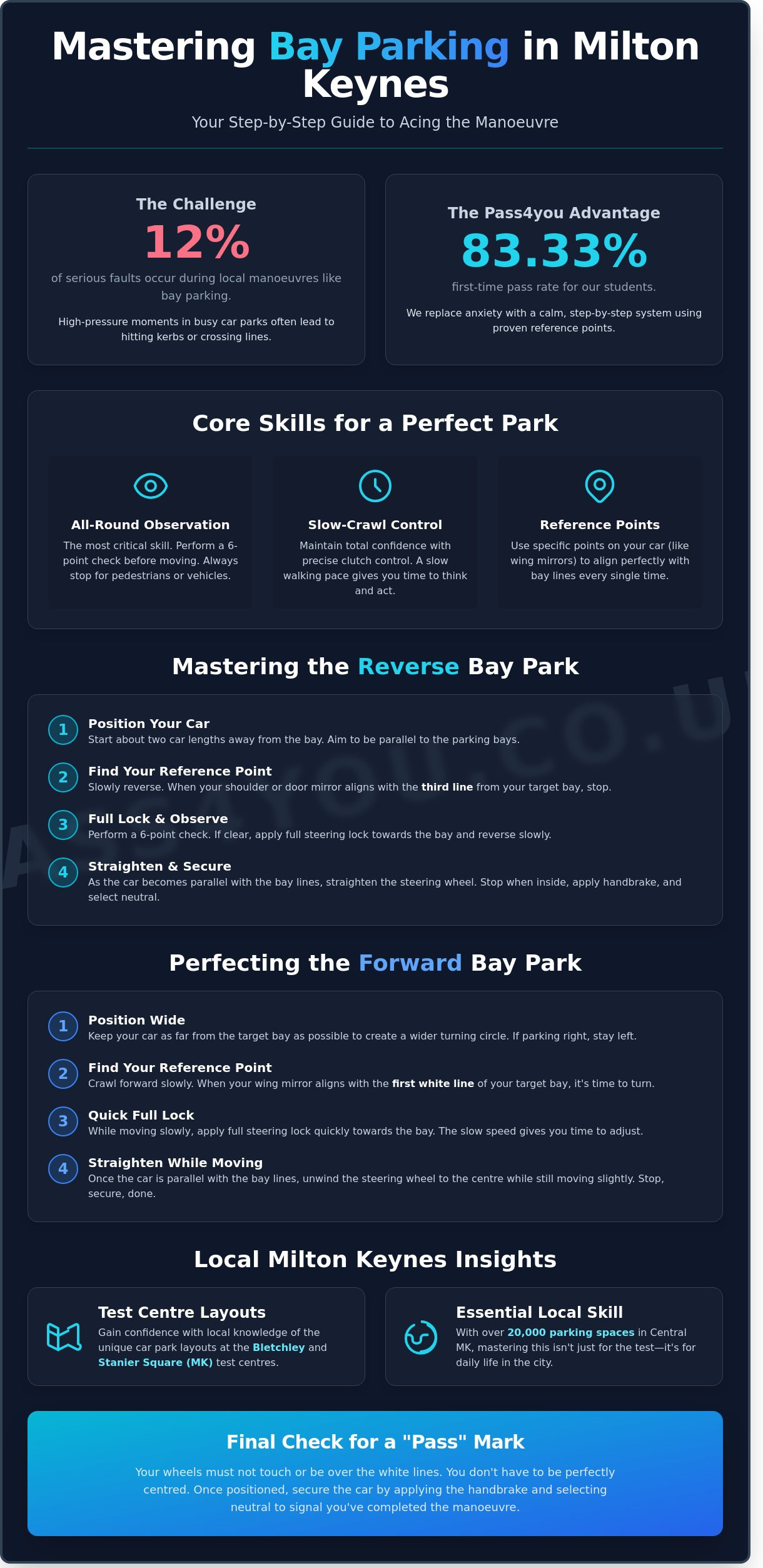
    Imagine you’re sitting at the Bletchley test centre, the examiner has just asked for a reverse bay park, and suddenly every pedestrian in Milton Keynes seems to be walking right behind your bumper. It’s a high-pressure moment that contributes to many of the 12% of serious faults recorded during local manoeuvres. If your heart sinks at the thought of hitting a kerb or drifting over the white lines, you’re certainly not alone. Most learners find the bay park one of the most stressful parts of the practical test, especially when navigating busy public car parks.

    During a professional bay parking lesson milton keynes, we’ll replace that anxiety with a calm, step-by-step system. I’ll share the exact reference points I’ve used to help Pass4you students achieve an impressive 83.33% first-time pass rate. You’ll learn how to manage your observations and steer with precision, giving you the confidence to park perfectly at the MK or Bletchley centres every single time. We’re going to break down the “two lines past” method and reveal the local secrets that make this manoeuvre feel like second nature.

    Key Takeaways

    • Understand the essential differences between forward and reverse bay parking to ensure you are fully prepared for any test scenario.
    • Learn how to use specific wing mirror reference points to position your vehicle perfectly within the lines every single time.
    • Master the “Third Line” technique and slow-crawl clutch control to maintain total confidence during 90-degree reverse manoeuvres.
    • Gain local insights into the unique car park layouts at the Bletchley and Stanier Square centres during your bay parking lesson milton keynes.
    • Discover how Simon’s patient, calm approach has helped us achieve an impressive 83.33% first-time pass rate for our students.

    What is a Bay Parking Manoeuvre and Why Does it Matter?

    A bay parking manoeuvre involves safely positioning your vehicle within a marked space using either forward or reverse gears. To understand the basics of What is Bay Parking, think of it as perpendicular parking where you aim to be central within the white lines. It is a fundamental skill that demonstrates your ability to judge the size of your car and its position relative to fixed objects.

    During your driving test, you will be asked to perform one of two types. Forward bay parking requires you to drive into a space and then reverse out safely. Reverse bay parking involves reversing into the bay and then driving out. Both versions require a calm, methodical approach. We focus on these techniques during every bay parking lesson milton keynes to ensure you feel prepared for any car park layout.

    Milton Keynes is famous for its 1967 grid system, which makes parking skills particularly vital for local life. With over 20,000 parking spaces in the city centre alone, including busy hubs like the Centre:MK and the Hub, you’ll encounter bay parking every time you leave the house. Mastering this isn’t just about passing a test; it’s about gaining the freedom to visit shops, gyms, and offices without feeling anxious about how you’ll get the car into a space.

    Examiners prioritise this manoeuvre because it tests your coordination and awareness in a confined environment. At Pass4you, we’ve helped many students achieve our 83.33% first-time pass rate by breaking these complex movements down into simple, manageable steps. We don’t believe in rushing you. We want you to feel in total control of the vehicle at all times.

    The Importance of Accuracy and Control

    Finishing between the lines is critical for a “Pass” mark. You don’t have to be perfectly straight or exactly in the middle, but your wheels must not be touching or over the white lines. If you find yourself slightly wonky, you can usually correct it as long as you stay within the boundaries. Once you’re happy with the position, you must secure the car by applying the handbrake and selecting neutral. This clear sequence tells the examiner you’ve finished the task successfully.

    Observation: The Secret to Passing

    Observation is the area where many learners struggle, but it’s actually the most important part. Before you move the car an inch, you must perform a full 6-point check to ensure the area is clear. If a pedestrian or another vehicle enters the car park near you, stop immediately. You don’t need to panic. Stopping the car is often the best way to show the examiner you’ve got excellent judgement and are prioritising safety. We’ll teach you to keep your eyes moving so you never miss a hazard.

    Step-by-Step: Perfecting the Forward Bay Park

    Forward bay parking is a skill that demands patience and precise car control. Since the DVSA updated the driving test requirements in December 2017, as explained in the Milton Keynes Test Centres: Local Tips for Success, this manoeuvre has become a standard part of the practical exam. To get it right, you need to start with your positioning. You should keep your car as far away from the target bay as possible. If you’re turning into a bay on the right, hug the left side of the lane. This creates a wider turning circle, making it much easier to enter the bay squarely without clipping the white lines.

    Your reference point is the secret to a successful turn. As you crawl forward at a slow walking pace, watch your right-hand wing mirror. When your mirror aligns with the first white line of the bay you want to enter, it’s time to act. You’ll need to apply full steering lock quickly. Many learners find this part stressful, but Simon’s calm teaching style helps you focus on keeping the car moving slowly while your hands work fast. Keeping the speed down gives you the time to adjust if you realise you’ve turned a fraction too early or late.

    Straightening up is the final piece of the puzzle. Once your car is parallel with the lines of the bay, you must unwind the steering wheel to the centre position. Don’t wait until you’ve stopped to do this; it’s better to straighten up while the car is still slightly moving. If you’re feeling nervous about these steps, booking a tailored driving session can help you build the muscle memory needed for a perfect park every time.

    Selecting Your Target Bay

    Choosing the right spot is half the battle during your bay parking lesson milton keynes. Most instructors recommend picking a bay on the right because it offers a better view and more room to swing the front of the car. In busy areas like the Kingston District Centre or The Centre:mk, always look for “one-way” arrows painted on the ground. Driving the wrong way down a one-way aisle is a common mistake that can lead to a serious fault. Always use the Mirror-Signal-Manoeuvre (MSM) routine before you begin your turn to ensure other drivers know exactly what you’re doing.

    Reversing Out Safely

    Leaving the bay is just as important as entering it. You must use the “Halfway” rule to avoid hitting the cars parked next to you. This means you should reverse straight back and only start turning your wheel once your shoulders or mirrors have passed the end of the bay lines. Throughout this process, you must keep up constant 360-degree observations to check for pedestrians or cars approaching from your sides. A blind spot check involves a quick look over your shoulder to ensure no pedestrians or vehicles are hidden from your mirrors. With an 83.33% first-time pass rate, our techniques are designed to make these safety checks feel like second nature.
    Mastering the Bay Parking Manoeuvre: Your Expert Lesson in Milton Keynes

    Mastering the Reverse Bay Park Method

    Reversing into a parking space is often the moment where learners feel the most pressure. At Pass4you, we’ve found that breaking this down into a simple, repeatable formula removes the anxiety. During your bay parking lesson milton keynes, Simon will show you the “Third Line” technique. This method is a reliable 90-degree reference system used by many of our students who contribute to our 83.33% first-time pass rate. It turns a guessing game into a precise science.

    Success starts with your feet. You must keep the car at a “slow crawl” using expert clutch control. If the car moves too fast, you won’t have time to react to your reference points. Think of it as a slow walking pace. This controlled speed gives you the headspace to check your surroundings, ensuring you’re safe from other vehicles or pedestrians in busy Milton Keynes car parks. It’s about being in total command of the vehicle at all times.

    The Set-Up and Reference Points

    To begin, position your car roughly two feet away from the row of bays. This 60cm gap is vital. If you’re too close, the turning angle becomes too sharp to manage. You’ll drive past your target bay until your “point of turn” reference line aligns with your shoulder or door pillar. Once you reach this mark, apply full steering lock. As you slowly reverse, watch your side mirrors. You’ll see the white lines of the bay appear, allowing you to judge exactly when to straighten the wheels and level the car.

    Fixing a Wayward Manoeuvre

    Don’t panic if you aren’t perfectly central on your first attempt. The driving examiner allows you to pull forward once to straighten up. It’s much better to recognise a mistake and fix it than to finish the park over a line. If you’re too close to the left line, steer slightly right as you pull forward to create space. Staying calm is essential here. Simon’s patient approach ensures you feel confident making these small adjustments without feeling rushed. We focus on building your ability to self-correct, which is a hallmark of a safe driver.

    Once you’re happy with your position, secure the vehicle. Apply the handbrake and select neutral. Before you tell the examiner you’ve finished, do a final 360-degree observation. This proves you’re thinking about the safety of others, not just the lines on the ground. Taking this extra second ensures you finish your bay parking lesson milton keynes with a sense of achievement and total control over the car.

    Milton Keynes Test Centres: Local Tips for Success

    Choosing where to take your test is a big decision, and in Milton Keynes, you generally have two main options: Bletchley or Stanier Square. Your examiner will decide whether to conduct the manoeuvre at the start or the end of your practical driving test. They often look for specific conditions to test your control. While the test centre car park is the most common spot, they might head to local retail parks if the centre is too busy. You need to be prepared for older car parks where bay lines have faded over time. In these spots, judging your position requires extra focus on the physical kerbs and surrounding vehicles rather than just the painted lines.

    Bletchley is known for its unique layout. The entrance can feel narrow, and the presence of parked instructor cars often creates a “bottleneck” effect. During a bay parking lesson milton keynes, we focus on these high-pressure environments. We make sure you can keep your head on a swivel. Stanier Square presents a different challenge with its high volume of shoppers. Pedestrians often walk behind reversing cars without looking, so your observation must be constant. If a pedestrian enters your “danger zone,” you must stop immediately. Examiners value this decisive safety action above almost anything else.

    Bletchley vs. Milton Keynes Test Layouts

    The Bletchley centre has a subtle but significant slope. This gradient means your car will naturally want to roll, making precise clutch control vital. If you don’t find the “bite” quickly, you might overshoot your mark. Conversely, the Stanier Square area features very tight corners. Keeping your speed below 2mph is your best friend here. It gives you the time to turn the wheel fully without the car swinging out too wide. For comprehensive support across all these locations, our driving lessons Milton Keynes cover every quirk of the local test routes.

    Dealing with Milton Keynes Traffic

    The biggest psychological jump for learners is transitioning from 60mph or 70mph dual carriageways down to a 5mph crawl in a car park. It’s easy to carry too much “mental speed” into the manoeuvre. Take a breath and reset your pace. This is also the perfect time to stay calm for your “Show Me, Tell Me” questions. These often happen while you are stationary in the bay or just before you move off. Patience is the number one quality examiners look for. They want to see that you aren’t rushing to finish, but instead are prioritising the safety of everyone around you.

    Ready to build your confidence? Book your bay parking lesson milton keynes today and benefit from our 83.33% first-time pass rate.

    Why Choose Pass4you for Your Bay Parking Lesson?

    Choosing the right instructor makes all the difference when you’re tackling tricky manoeuvres. Simon’s patient and calm approach is specifically designed for nervous learners who often dread the thought of reverse parking. Instead of feeling rushed or pressured, you’ll find a supportive environment where mistakes are viewed as simple steps toward success. This encouraging atmosphere is why so many locals choose us for their bay parking lesson milton keynes.

    Our impressive 83.33% first-time pass rate serves as concrete evidence that our reference point methods actually work. We don’t just tell you where to steer; we show you exactly what to look for in your mirrors so you feel in total control. You’ll learn in modern Volkswagen tuition vehicles, which are chosen for their excellent visibility and light, easy steering. These features make it much simpler to align your car perfectly between the lines every single time.

    We focus on providing genuine value for money rather than just being the cheapest option. Because we teach the correct techniques from your very first session, you’ll likely need fewer lessons overall. We’ve honed a tried and tested system over many years that saves you both time and stress, ensuring you’re test-ready much faster than with less experienced instructors.

    Building Your Confidence Behind the Wheel

    We break down complex manoeuvres into small, manageable steps that anyone can master. Simon has helped dozens of students who previously said they “hated parking” until they tried his straightforward method. One former student, Sarah, mentioned she nearly gave up driving entirely before switching to Simon’s calm mentorship. Our goal is to ensure you become a safe driver for life. This means giving you the skills to park confidently in a busy supermarket or a tight multi-storey car park long after you’ve passed your practical test.

    Book Your First Lesson Today

    Booking your session is a simple process for any Milton Keynes resident. We have extensive expertise in the local Milton Keynes theory test centre area, so we know exactly which car parks and routes examiners prefer to use. Don’t let parking anxiety hold you back from gaining your independence. Start your journey to a first-time pass with Simon at Pass4you and discover how easy bay parking can be with the right professional guidance.

    Take the Stress Out of Your Milton Keynes Driving Test

    Mastering the bay park isn’t just about ticking a box on your test sheet; it’s about gaining the confidence to navigate any busy car park in Milton Keynes with ease. By perfecting both forward and reverse techniques, you’re building a foundation for safe, lifelong driving. Our students benefit from learning in modern VW tuition vehicles, ensuring you have the latest technology and comfort to support your progress. With an impressive 83.33% first-time pass rate, we’ve proven that our calm and patient approach works for every type of learner, even if you’ve felt anxious or rushed in the past.

    Whether you’re nervous about hitting the lines or just need to fine-tune your specific reference points, a professional bay parking lesson milton keynes provides the expert guidance you need to succeed. We focus on clear, simple instructions that make sense, helping you feel completely in control behind the wheel. Don’t let parking anxiety hold you back from the freedom of the open road.

    Book your calm and patient bay parking lesson in Milton Keynes today and join the many successful drivers who’ve found their confidence with us. You’re closer to that pink licence than you think!

    Frequently Asked Questions

    Do I have to use my indicators during a bay parking manoeuvre?

    You don’t strictly have to use your indicators, but it’s often safer to do so. Signalling helps other road users understand your intentions in a busy car park. During your bay parking lesson Milton Keynes, Simon will show you exactly when a signal adds clarity and when it might confuse others. We focus on making you a safe driver for life, so clear communication is always a priority.

    Will I fail my driving test if I hit the kerb while parking?

    You’ll likely fail your driving test if you hit the kerb hard or mount it. A gentle touch might only result in a minor fault, provided you react calmly and correct the mistake safely. Our students achieve an 83.33% first time pass rate because we practice these manoeuvres until you feel completely confident. We’ll teach you how to use your mirrors to judge distances perfectly every time.

    Can I open my door to check if I am inside the lines?

    Yes, you’re allowed to open your door to check your position within the lines. It’s much better to take a quick look and adjust than to guess and end up over the white line. Just ensure you’ve secured the car with the handbrake and it’s safe to open the door first. Simon’s patient teaching style ensures you won’t feel rushed while making these important checks.

    What happens if another car tries to enter the bay I am using?

    You must stop and assess the situation if another vehicle enters the area. Safety and observation are 50% of the marking criteria for this manoeuvre. If the other driver waits, you can continue slowly; if they try to pass, you should pause and let them go. This calm approach is exactly what examiners look for during your practical test in 2024.

    Is reverse bay parking harder than forward bay parking?

    Most learners find reverse bay parking more challenging than driving in forward. It requires better spatial awareness and more precise steering. However, reversing into a space makes it much safer to drive out later. Our bay parking lesson Milton Keynes covers both methods thoroughly. We’ve helped 100s of nervous students master these techniques with a calm, step-by-step approach that builds genuine skill.

    Do I have to get the car perfectly straight to pass the manoeuvre?

    You don’t need to be perfectly straight to pass, but you must be entirely within the lines of the bay. The examiner wants to see that you’re safe and in control of the vehicle. If you’re slightly wonky but safely parked, it won’t stop you from passing. We focus on building your confidence so you can park accurately without feeling under pressure.

    How many times am I allowed to adjust my position during the test?

    You’re generally allowed to make two adjustments to your position during the test. If you realise you’re too close to a line, simply pull forward, straighten up, and reverse back in. Examiners value the ability to recognise a mistake and fix it safely. This is a core part of the 83.33% success rate our students enjoy when they head to the test centre.

    Which test centre in Milton Keynes is easier for the parking manoeuvre?

    Neither Bletchley nor the Milton Keynes (Stanier House) test centres are officially easier than the other. Both locations use various car parks for the manoeuvre, including the test centre’s own bays. Success depends on your preparation rather than the specific location. Since we’ve worked with students across Milton Keynes for 15 years, we’ll ensure you’re familiar with the local layout at both sites.
  • How to Parallel Park: A Step-by-Step UK Driving Lesson Guide

    How to Parallel Park: A Step-by-Step UK Driving Lesson Guide

    Imagine you’re halfway through your practical test when the examiner asks you to pull up alongside a parked car; suddenly, your palms are sweaty and you’re terrified of clipping a wing mirror. It’s a scenario that causes over 60% of learners to feel a sharp spike in anxiety, often leading to simple mistakes that could easily be avoided. We know that mastering a how to parallel park uk driving lesson feels like the ultimate hurdle, especially when you’re worried about the timing of your steering or failing the test on this one move.

    You aren’t alone in feeling this way, and it’s completely normal to be nervous about such a precise task. It doesn’t have to be stressful. Our goal is to make you feel calm and capable behind the wheel, just like the hundreds of students who have worked with Simon to build their skills. We’ve helped 83.33% of our learners achieve a first time pass by breaking down complex manoeuvres into simple, manageable steps. In this guide, you’ll discover the exact reference points and safety checks needed to park perfectly every single time, ensuring you stay relaxed and in control on your big day.

    Key Takeaways

    • Master the “1-2-1” method to find your perfect reference points and eliminate the guesswork when reversing into tight spaces.
    • Learn exactly how to parallel park uk driving lesson style to build the calm confidence required to impress your examiner on test day.
    • Identify common observation errors and learn how to distinguish between a minor “brush” and a serious kerb strike during the manoeuvre.
    • Discover the best quiet residential areas in Milton Keynes to practise your skills away from the pressure of busy traffic.
    • See how professional, patient instruction helps you avoid “bad habits” and contributes to our exceptional 83.33% first-time pass rate.

    Understanding the Parallel Park Manoeuvre for the UK Driving Test

    Parallel parking is often the one exercise that makes learners feel most anxious. Put simply, it involves reversing your car into a gap behind another parked vehicle, usually along the side of a busy street. The DVSA includes this in the practical driving test to ensure you have the spatial awareness and car control required for everyday UK driving. It is a fundamental skill that separates a nervous learner from a confident, safe driver for life.

    While bay parking is usually done in the controlled environment of a car park, parallel parking happens on the open road. Mastering this during your how to parallel park uk driving lesson makes a massive difference once you qualify. Instead of feeling stressed in a crowded town centre, you will have the ability to nip into a space quickly and safely. This saves you time and prevents the frustration of driving in circles looking for an “easy” spot that doesn’t require reversing.

    Will I have to parallel park on my driving test?

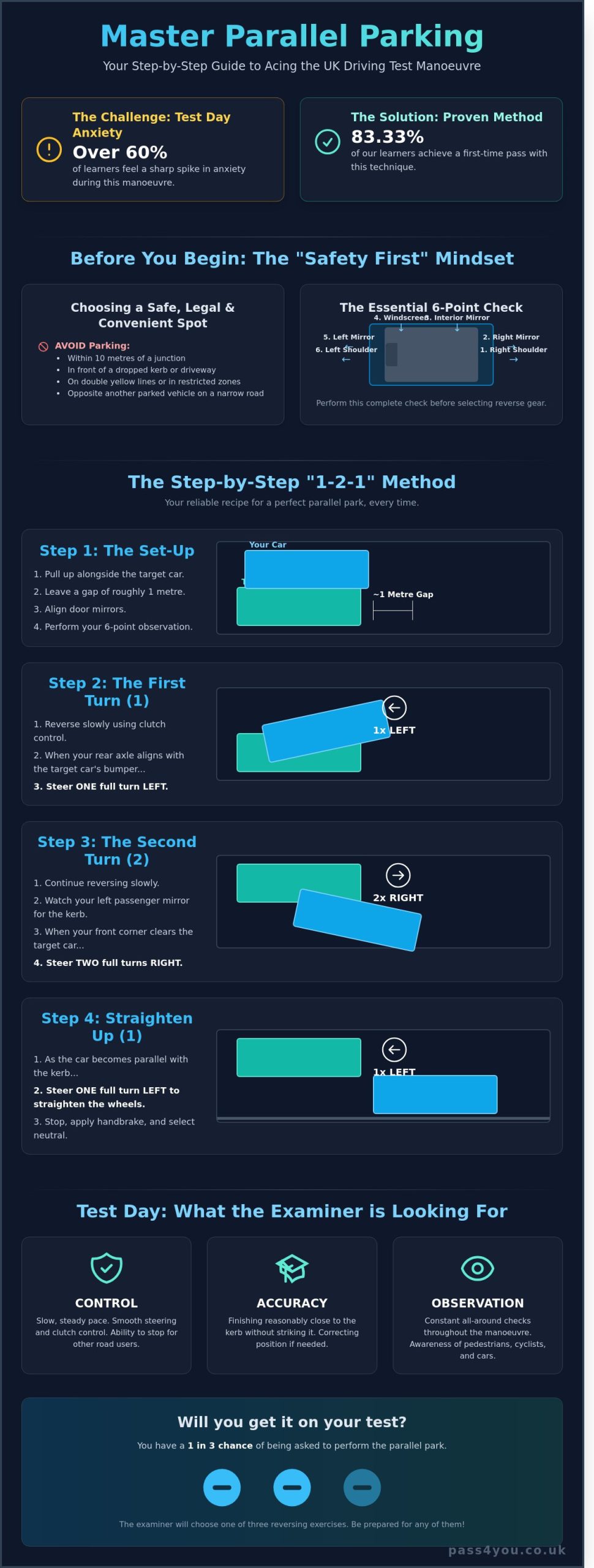
    There is a 1 in 3 chance of being asked to perform this manoeuvre during your test. Since the driving test changes in December 2017, the examiner chooses one of three reversing exercises to assess your skills. You won’t know which one it is until the moment arrives. The examiner is looking for three main things: control, accuracy, and observation. You don’t need to be perfect to pass. If you end up slightly too far from the kerb, you can often correct it if you stay calm. At Pass4you, Simon focuses on building your confidence so you feel supported under pressure. This patient approach is why we maintain a high 83.33% first-time pass rate.

    The “Safety First” mindset before you start

    Success begins before you even select reverse gear. You need to choose a place that is safe, legal, and convenient. On your how to parallel park uk driving lesson, you will learn to avoid spots within 10 metres of a junction or areas that block a resident’s driveway. Always check for double yellow lines or restricted parking zones. Once you’ve found a spot, the 6-point check is your most important tool. You must look:

    • Over your right shoulder to check the blind spot.
    • In your right-hand door mirror for passing traffic.
    • In the interior rearview mirror.
    • Through the front windscreen.
    • In your left-hand door mirror.
    • Over your left shoulder towards the rear window.

    This ensures you are aware of every pedestrian, cyclist, and vehicle around you. Keeping a slow, steady pace allows you to maintain this high level of observation throughout the move. If a car approaches while you are mid-manoeuvre, you must stop and wait to see what they do. Being a safe driver means being a predictable and observant one.

    The Step-by-Step 1-2-1 Method: Mastering Reference Points

    Learning how to parallel park uk driving lesson style doesn’t need to be a source of stress. At Pass4you, we use the “1-2-1 method” because it provides a clear, repeatable framework for every learner. This technique is a core part of why we maintain an 83.33% first time pass rate. It gives you a reliable “recipe” for success that works in almost any standard car, regardless of its size.

    Step 1: The Set-Up and Initial Observation

    Begin by pulling up alongside the target vehicle. You should aim for a gap of roughly one metre between your car and the parked one. Line up your door mirror with the front of the other car. You must indicate your intention to stop early so other road users understand your plan. Before you select reverse gear, perform a full 360-degree observation. Look over both shoulders and check all mirrors. If you see a cyclist or another vehicle approaching within 10 metres, wait for them to pass before you start moving.

    Step 2: Finding Your Turning Points

    Mastering how to parallel park uk driving lesson manoeuvres relies on precise turning points. Once it’s safe, start reversing slowly using clutch control. When your rear axle aligns with the back bumper of the target car, apply “the 1”: one full turn of the steering wheel to the left. This creates the necessary angle to enter the space.

    As the car moves, keep your eyes moving too. Use your passenger side mirror to track your distance from the kerb. When the front corner of your car clears the rear of the target vehicle, apply “the 2”: two full turns to the right. This brings the front of your car into the gap. Simon, our lead instructor, always tells students that slow speed is the secret to steering accuracy. If a pedestrian steps onto the pavement near you, stop the car immediately and wait for them to move clear.

    Step 3: Finishing and Securing the Car

    As your car becomes parallel to the kerb, apply the final “1”: one full turn back to the left. This simple action straightens your wheels. You should aim to finish within 20 to 30cm of the kerb. If you’re slightly too far away, don’t worry. You can pull forward a small amount to refine your position.

    Once you’re satisfied with the result, select neutral and apply the handbrake. This secures the vehicle and tells the examiner you’ve completed the task. If you’re still feeling a bit anxious about these reference points, booking a professional lesson with a patient mentor can help you find your confidence. Remember, the goal isn’t just to park; it’s to be a safe driver for life.

    How to Parallel Park: A Step-by-Step UK Driving Lesson Guide

    Common Parallel Parking Mistakes and How to Avoid Them

    Most learners feel a spike in anxiety during a how to parallel park uk driving lesson, but mistakes don’t have to lead to a fail. Understanding the difference between a minor slip and a serious fault is key to staying calm. One of the most frequent worries is the kerb. If you gently “brush” the kerb while moving at a snail’s pace, it’s often recorded as a minor fault. However, if you hit the kerb with enough force to jar the car or mount the pavement, that’s a serious fault. You’ll also be marked down if you finish more than 30 centimetres away from the kerb, as this obstructs the flow of traffic.

    Pressure from other road users often causes panic. If another vehicle pulls up behind you and waits, your instinct might be to rush. Don’t. Rushing leads to poor steering and missed observations. Take a deep breath and remember that you have as much right to be on the road as they do. Most drivers will be patient if they see you’re under instruction. Keeping your composure shows the examiner you’re a safe, confident driver who won’t be bullied into making dangerous decisions.

    Observation Failures: The #1 Reason for Test Fails

    Observation is the most common reason for failing the manoeuvre. Government data from 2023 shows that “lack of observation” during manoeuvres remains a top ten reason for test failure across the UK. You can’t just stare at the kerb or your left mirror. You must demonstrate “active” observation by looking over your right shoulder, checking your blind spots, and using the rear window. If a pedestrian steps onto the pavement near your car or a cyclist approaches, you must stop the car immediately. Wait for them to pass before you continue. This shows the examiner you’re prioritising safety over the completion of the task.

    Correction Techniques: It is not a fail if you fix it

    Many students believe they must get the car into the space in one perfect “shot” to pass. This isn’t true. At Pass4you, we teach our students that a calm correction is a sign of a skilled driver. If you realise you’re too far from the kerb or at a bad angle, don’t give up. You can ask the examiner, “I’m not happy with my position, may I pull forward to re-adjust?” They’ll almost always say yes. Using a “shunting” technique to straighten up is perfectly acceptable as long as you:

    • Maintain 360-degree observations before moving forward or back.
    • Keep the car under total control using slow clutch work.
    • Don’t take an excessive amount of time to finish the move.

    Our instructor Simon has helped hundreds of nervous learners achieve a first time pass by focusing on these recovery steps. Fixing a mistake safely is much better than hoping for a lucky one-shot park. It proves you understand the how to parallel park uk driving lesson principles and can manage the vehicle in real-world conditions.

    Parallel Parking in Milton Keynes: Local Practice Tips

    Milton Keynes presents a unique environment for any learner. The famous grid system means you often transition from 60mph H and V roads directly into quiet, 20mph residential zones. This sudden change in pace can be jarring. Mastering how to parallel park uk driving lesson techniques is vital here because while our residential roads are often wider than those in older Victorian towns, they are frequently lined with parked cars that require high levels of precision. You need to manage your speed and observations perfectly as you move from the fast-paced grid into a tight parking spot.

    Top Practice Locations in Milton Keynes

    We recommend starting your practice in quieter residential areas like Loughton or Shenley Church End. These estates offer wide roads and plenty of safely parked vehicles to use as your markers. Practising here allows you to find your reference points without the pressure of heavy traffic. As your confidence grows, we’ll move closer to the Bletchley or Milton Keynes test centres. It is essential to familiarise yourself with the specific kerbs and road widths near these hubs. By 2026, DVSA test routes are expected to incorporate even more “real-world” scenarios, meaning examiners will look for fluid, confident parking in busy residential pockets rather than just quiet side streets.

    Using a modern Volkswagen tuition vehicle significantly helps during these sessions. These cars are designed with excellent all-round visibility and large mirrors, which makes spotting your “point of turn” much simpler. The light steering and responsive clutch control in a VW allow you to focus on your surroundings rather than struggling with the car’s mechanics. This clarity is a major factor in why our students feel so prepared on test day.

    Mental Preparation: Building Confidence with Pass4you

    Parking is often the part of the how to parallel park uk driving lesson that causes the most anxiety. Simon’s approach is built on patience and calm instruction. If you make a mistake, we don’t rush; we simply stop, breathe, and analyse what happened. We use positive visualisation techniques, encouraging you to “see” the car moving into the space before you even select reverse gear. This mental rehearsal reduces stress and helps the physical movements become second nature.

    Our philosophy focuses on safe driving for life, not just passing a 40-minute test. We want you to feel comfortable parking at the shops, at work, or outside your home long after you’ve got your pink licence. With our current 83.33% first-time pass rate, we’ve proven that a supportive environment leads to better results. We don’t just teach you to pass; we teach you to be a calm, competent member of the Milton Keynes driving community.

    Ready to master your manoeuvres with a patient professional? Book your Milton Keynes driving lessons with Simon today.

    Why Professional Instruction is Key to a First-Time Pass

    Mastering the steering is only half the battle. Learning with friends or family often leads to “bad habits” that can result in an immediate fail on your test day. While your parents might be excellent drivers, they likely don’t follow the strict observational patterns required by the DVSA. During a professional how to parallel park uk driving lesson, you learn to prioritise the six-point check and constant blind-spot monitoring. These are the details that examiners watch for, and they are often the first things casual supervisors forget to mention.

    At Pass4you, we’ve developed a tried and tested technique that has helped us achieve an 83.33% first-time pass rate in Milton Keynes. This success comes from training in a professional tuition vehicle equipped with dual controls. This setup gives you a safety net, allowing you to build confidence without the fear of hitting the kerb or another vehicle. It creates a calm environment where you can focus on your reference points and clutch control. This preparation is vital for practical driving test success, as it ensures you can perform under pressure without hesitation.

    Saving Time and Money with Expert Lessons

    It’s a common mistake to think that DIY practice is the cheapest route. A failed test costs £62 for the booking alone, not including the cost of car hire and additional practice. Investing in a structured driving lesson in Milton Keynes actually saves you money in the long run. Simon’s patient, expert instruction ensures you need fewer hours to reach test standard. You can book your first lesson with Simon today to start your journey with a mentor who understands the local roads and test routes perfectly.

    Ready to Pass? Your Next Steps

    If you haven’t started yet, your first priority is applying for your provisional licence UK. Once you have that, we can begin your how to parallel park uk driving lesson programme. Before the big day, we highly recommend a mock test. This settles those parallel parking nerves by mimicking the exact conditions of the exam. You have the skills and the coordination; now you just need to apply them with the confidence that comes from professional training. We’re here to help you become a safe driver for life.

    Master Your Manoeuvres and Claim Your Freedom

    Mastering the 1-2-1 method and hitting specific reference points transforms a stressful manoeuvre into a simple routine. Avoiding common errors like misjudging kerb distance or rushing observations ensures you stay safe and pass with confidence. Practising these skills on the roads of Milton Keynes prepares you for the exact conditions you’ll face on test day. It’s about building a habit of precision that stays with you long after the examiner hands over your certificate.

    Mastering how to parallel park uk driving lesson techniques is much easier when you have a patient expert by your side. Our students benefit from a supportive environment in modern Volkswagen tuition vehicles, which helps them achieve an impressive 83.33% first-time pass rate. Even if you’re a nervous learner, our 5-star reviews prove that the right mentor makes all the difference. You’ll gain the skills to become a safe driver for life while saving money by needing fewer lessons overall. Book your calm, professional driving lessons in Milton Keynes today. We can’t wait to help you get on the road and start your journey toward independence.

    Frequently Asked Questions

    Is parallel parking still on the UK driving test in 2026?

    Yes, parallel parking remains a core part of the DVSA driving test requirements for 2026. It is one of three possible reversing manoeuvres the examiner might ask you to perform, alongside forward or reverse bay parking and pulling up on the right. Since the DVSA updated the test format in December 2017, there is a one in three chance this specific exercise will appear during your practical exam.

    What happens if I hit the kerb during my parallel park on the test?

    Touching the kerb gently is usually recorded as a minor driving fault, but mounting the pavement or hitting it with force will result in a serious fault and an automatic fail. If you feel the wheel nudge the kerb, don’t panic. You can pull forward slightly to correct your position. Our instructors focus on building your confidence so you can handle these small errors calmly and safely.

    How many times can I adjust my position during a parallel park?

    You can adjust your position once or twice during the manoeuvre as long as you maintain effective all-round observations. The examiner is looking for accuracy and control rather than a single, perfect movement. During your how to parallel park uk driving lesson, Simon will teach you how to use these corrections to stay within the lines while maintaining our 83.33% first time pass rate.

    Can I use a reversing camera or sensors during my driving test?

    You are allowed to use factory-fitted reversing cameras and parking sensors, but you must not rely on them as your primary source of information. You still need to perform physical 360-degree observations through your windows and mirrors throughout the entire process. Relying solely on technology without looking around is a frequent reason for failing the test, as it doesn’t demonstrate you’re a safe driver.

    What is the 1-2-1 method for parallel parking?

    The 1-2-1 method is a simple steering technique where you use one turn of the wheel left, two turns right, and one turn left to straighten up. This sequence helps guide the car into the space at the correct angle. It is a tried and tested method we use at Pass4you to help nervous learners feel more in control of the vehicle’s path.

    How far from the kerb should I be when parallel parking?

    You should aim to finish your manoeuvre between 20cm and 30cm away from the kerb. This distance ensures you’re parked closely enough to be safe without being so close that you risk damaging your tyres or wheels. We’ve helped students across Milton Keynes master this by using clear reference points that work in almost any modern car.

    Do I need to use my indicators when parallel parking?

    You must use your indicators if there are other road users nearby who would benefit from knowing your intentions. If a car is following you, signaling left before you stop alongside the target vehicle is essential. It’s all about being a responsible and predictable driver, which is exactly what examiners look for during the 40-minute test.

    What should I do if another car comes while I am parallel parking?

    You must stop the car immediately and wait for the other driver to pass or signal for you to continue. Do not try to rush the finish just because someone is waiting. Keep a close eye on their position and only resume your manoeuvre when you’re certain it’s safe. This patient approach proves to the examiner that you’re a safe driver for life.