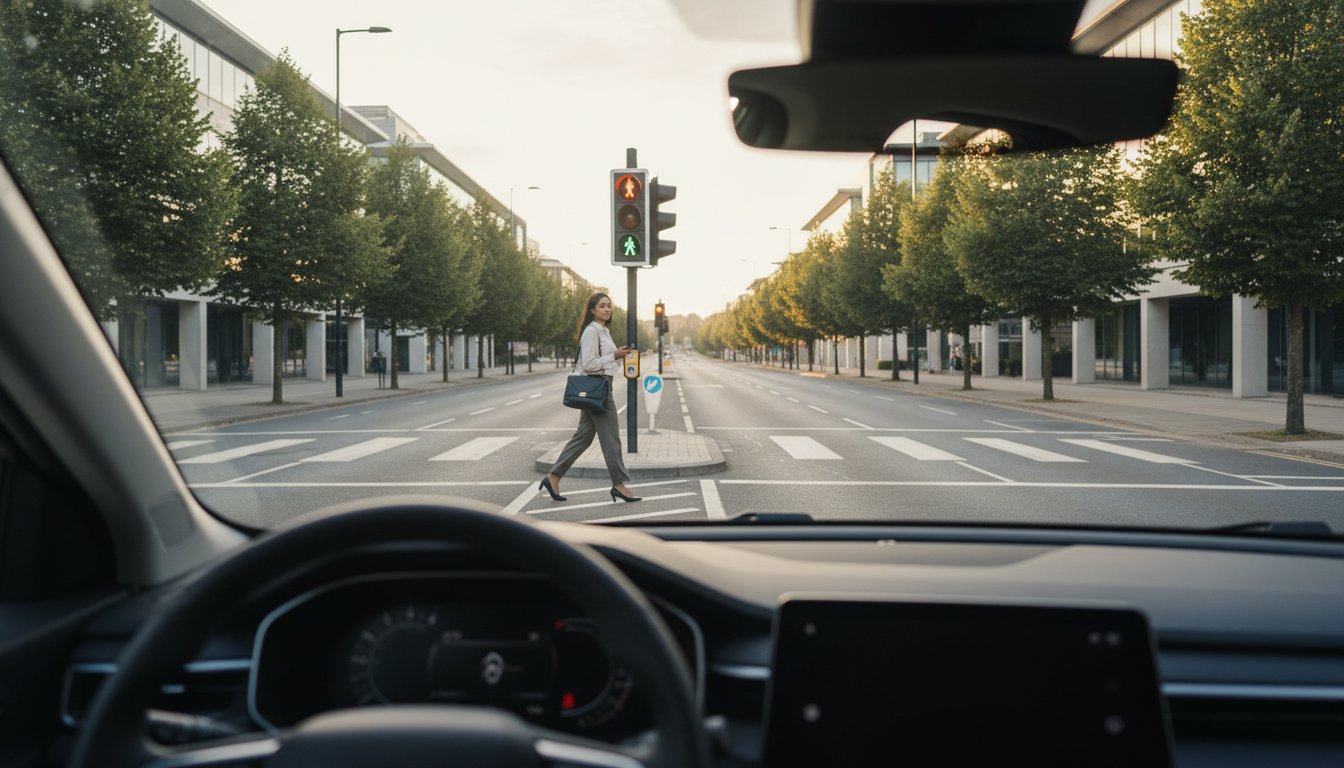
Imagine you’re 35 minutes into your driving test in Milton Keynes and everything is going perfectly. You approach a pelican crossing, the light turns red, and a pedestrian starts to cross. Suddenly, the light begins to flash amber while they are still in the middle of the road. Do you wait, or do you move off? Making the wrong split-second decision here is a common trap, often contributing to the 10% of test failures linked to poor observation and response to signals.
We know that the pressure of the examiner’s clipboard can make even a simple set of lights feel daunting. It’s completely normal to feel anxious about pedestrians lingering on the tarmac or getting confused between different crossing types. Our goal is to replace that worry with the calm confidence you need to succeed. This expert guide will walk you through the exact light sequence and the legal rules for flashing amber signals. You’ll gain the clarity needed to handle these crossings safely, helping you join the 83.33% of our students who achieve a first-time pass.
Key Takeaways
- Understand the unique light sequence of a pelican crossing, including how to react correctly to the flashing amber phase to stay safe and confident.
- Learn how to instantly distinguish between various UK pedestrian signals so you can adjust your driving plan without hesitation.
- Master the MSM routine and the essential rules for zig-zag lines to avoid common mistakes on your practical driving test.
- Discover why a calm, patient approach is the secret to navigating Milton Keynes’ busy grid system and numerous light-controlled junctions.
- Gain the professional insight needed to achieve a first-time pass and become a responsible, safe driver for life.
Understanding Pelican Crossings: The Basics for UK Learners
Learning to drive in the UK involves mastering a variety of road layouts and signal systems. One of the most common sights you’ll encounter during your lessons is the pelican crossing. These signals are a vital part of the Highway Code, designed to keep both drivers and pedestrians safe. At Pass4you Driving School, we understand that approaching these crossings can feel a bit daunting for nervous learners. Our goal is to help you build the confidence you need to handle these situations calmly and professionally. By understanding how these systems work, you move one step closer to achieving that coveted first time pass.
The UK road network is famous for its “pedestrian zoo,” a collection of crossings named after animals like the Zebra, Puffin, Toucan, and Pegasus. The Pelican crossing was a major milestone in this history, providing a structured way to manage busy junctions. Since its introduction to British roads in 1969, it has remained a staple of urban planning. Unlike older systems, it uses a specific sequence of lights to ensure traffic flows smoothly while giving people a safe window to cross the street. We focus on these details during our lessons because being a safe driver for life starts with a deep understanding of the rules of the road.
The Etymology and Meaning
The name “Pelican” isn’t just a nod to the bird; it’s a clever acronym for PEdestrian LIght CONtrolled. These crossings were first rolled out in 1969 to replace the less efficient “X-way” system. They fit perfectly into the UK’s tradition of using animal names to make road safety rules more memorable for the public. A Pelican crossing is a fixed-time signal system that stops traffic to allow pedestrians to cross the road. This fixed-time nature means the signals follow a set pattern once the button is pressed, which is different from newer, sensor-based systems. Understanding this pattern helps you anticipate the road ahead, making your driving experience much smoother and more predictable.
Key Features to Look For
Identifying a Pelican crossing is a key skill for any learner driver. The most obvious sign is the placement of the pedestrian signals. On a Pelican crossing, these signals are located on the “far side” of the road, meaning the red and green man are positioned across the street from where the pedestrian is standing. This is a primary way to distinguish them from Puffin crossings, where the signals are located on the same side as the pedestrian. Every Pelican crossing is equipped with a yellow push-button unit on the pole. These units are designed with accessibility in mind, ensuring all road users can navigate the streets safely. Some of the specific features you’ll notice include:
- Far-side signals: The pedestrian lights are visible across the road, staying in the pedestrian’s line of sight as they cross.
- Push-button units: A yellow box with a button that pedestrians must press to request a crossing phase.
- Tactile cones: A small, ridged cone underneath the push-button box that spins when the green man is showing, helping visually impaired users.
- Audible beeps: A rhythmic sound that plays during the steady green man phase to signal it’s safe to walk.
We take pride in our 83.33% first time pass rate, and much of that success comes from our patient approach to technical topics like this. We don’t just teach you to pass the test; we teach you to understand the environment around you. When you see those far-side signals, you’ll know exactly what type of crossing you’re dealing with. This clarity reduces anxiety and helps you make safe, confident decisions behind the wheel. Whether you’re driving through Milton Keynes or a quiet village, these basics are the foundation of your journey toward becoming a fully licensed driver.
The Pelican Crossing Light Sequence: A Step-by-Step Guide
Understanding the light sequence of a pelican crossing is a vital milestone for any learner driver. It builds the confidence you need to handle busy urban junctions without feeling flustered. Unlike standard traffic lights, pelican crossings use a specific timed cycle that includes a unique phase designed to keep traffic moving while prioritising safety. Mastering this rhythm helps you avoid common test day nerves and ensures you remain a predictable, safe driver for everyone on the road.
The Motorist’s Perspective
As you approach, your primary focus should be on the three main stages of the signal. Each stage requires a calm, calculated response to keep your vehicle under control and your examiner happy.
- Step 1: Steady Green – You’re clear to proceed. You should maintain a steady speed, usually 30mph in built-up areas, but always keep a “defensive” eye on the pavement. If you see a pedestrian reaching for the button, start preparing mentally for a change.
- Step 2: Steady Amber – This is the “point of no return” phase. You must stop unless you’ve already crossed the stop line or are so close that braking hard might cause a rear-end collision. At 30mph, your total stopping distance is roughly 23 metres; use this as your guide.
- Step 3: Steady Red – This is a mandatory stop. You must bring the car to a halt behind the solid white stop line. Creeping over this line, even by a few inches, can result in a serious fault during a driving test.
The Flashing Amber Phase Explained
The flashing amber light is the defining feature of a pelican crossing. It appears after the red light and acts as a transition phase. For many students, this is the most confusing part of the sequence, but it’s actually designed to be helpful. It allows drivers to get moving sooner if the crossing is empty, reducing unnecessary congestion. If you’re feeling unsure about these specific rules, booking a few refresher driving lessons can help solidify your understanding in real-world traffic.
The legal requirement here is straightforward but strict. On a flashing amber light, drivers must give way to pedestrians on the crossing but may proceed if the road is clear. If a pedestrian is still on the stripes, even if they’re walking slowly, you must wait. Only once they’ve safely reached the pavement can you move off. This rule is clearly defined in the Highway Code rules for pelican crossings, which states that pedestrians have priority during this phase.
Pedestrian Signals and the Stop Line
The lights you see as a driver are perfectly synced with the pedestrian “Green Man” and “Red Man” signals. When your light is red, the pedestrian signal is green. When your light begins to flash amber, the pedestrian’s green man will also start to flash. This tells the pedestrian not to start crossing, but it gives those already on the road time to finish their journey.
A frequent misconception involves the wait time at the stop line. Some drivers feel pressured to rev their engines or “creep” forward while the amber light is still flashing. This is a mistake. Professional instructors, like Simon, who maintains an 83.33% first-time pass rate, teach students that patience is a legal requirement. You shouldn’t move until the way is completely clear. Remember that the stop line is there for a reason; it provides a safety buffer for people using the crossing. Staying behind it until the sequence allows you to move ensures you remain a responsible road user.
Pelican vs Puffin vs Toucan: Clearing the Confusion
Learning the different types of crossings can feel like a lot to take in when you’re first starting your driving lessons. Don’t worry; it’s much simpler than it looks once you know what to spot. At Pass4you, we’ve helped many students achieve our 83.33% first time pass rate by breaking these rules down into easy, manageable steps. The UK is currently moving away from the traditional pelican crossing in favour of smarter, safer technology. Since 2016, Puffin crossings have become the preferred choice for new installations across the country because they adapt to the people using them.
The main reason for this change is safety and traffic flow. Older crossings rely on fixed timers that don’t care if a person is walking slowly or has already reached the other side. This often leads to drivers sitting at a red light when the road is completely clear. By understanding how these systems work, you’ll feel much more confident and patient during your practical test.
Pelican vs Puffin Crossings
You can tell the difference between these two in a split second by looking at the pedestrian signals. On a pelican crossing, the red and green man signals are located on the “far-side” of the road, opposite where the pedestrian is standing. On a Puffin crossing, these signals are located on the “near-side,” right above the push button. This design encourages pedestrians to look towards the oncoming traffic while they wait for the signal to change.
The technical “brain” of the crossing is also different. Puffin crossings use smart infrared sensors or pressure mats to detect movement. If a pedestrian is walking slowly, the sensor keeps the traffic light red for longer. If they cross quickly, the sensor returns the light to green sooner. According to the Official Highway Code Rules for Pedestrians, the flashing amber phase is a key feature of the Pelican style. Puffin crossings don’t have a flashing amber phase; they follow the standard red, red and amber, then green sequence just like a normal junction.
Toucan and Pegasus Crossings
Toucan crossings are designed for both pedestrians and cyclists. A helpful way to remember this is the phrase “two-can” cross together. These are usually wider than standard crossings to allow enough space for bikes. You’ll see a green cycle signal next to the green man. Unlike other crossings, cyclists don’t have to dismount; they can ride straight across while you wait. Being aware of these helps you stay calm and avoid rushing when you see a group of cyclists approaching the crossing area.
Pegasus crossings, sometimes called equestrian crossings, are specifically for horse riders. You’ll often find these near bridleways or in more rural areas. They look similar to Toucan crossings but feature a green horse symbol. A key identifier for drivers is the height of the control panel. There is often a second push button located two metres high so the rider can reach it without getting off their horse. Identifying these early is vital for your Hazard Perception test. It gives you the time to slow down gradually, ensuring you don’t startle the horses with sudden braking or loud engine noises. This patient approach is exactly what examiners look for to ensure you’re a safe driver for life.
Mastering the Pelican Crossing on Your Practical Driving Test
Approaching a pelican crossing during your practical test feels daunting, but it’s actually a great chance to show off your hazard perception skills. Your examiner wants to see that you’re a thinking driver who prioritises safety over speed. The Mirror, Signal, Manoeuvre (MSM) routine is your best friend here. Check your interior and door mirrors as soon as you spot the crossing. You don’t usually need a signal, but your manoeuvre involves adjusting your speed and position to stay in full control.
Zig-zag lines require your full attention. These markings are governed by the 1997 Pedestrian Crossings Regulations, and they’re there for a reason. They keep the view clear for both you and the pedestrians. You must never park or overtake the leading vehicle within these lines. If you try to nip past a slow cyclist or a stationary car near the crossing, you’ll likely face an immediate fail. It’s a serious breach of the Highway Code that carries a £100 fine and three penalty points on a standard licence.
Approaching with Confidence
Scan the pavement at least 50 yards before you reach the lights. If you see a group of people waiting or a pedestrian reaching for the button, assume the light will change. Ease off the accelerator early and prepare to downshift. This proactive approach prevents the “harsh braking” fault that catches out many nervous learners. Simon often reminds students that a smooth stop proves you’re reading the road ahead, which is a hallmark of our 83.33% first-time pass rate.
Common Fail Points and How to Avoid Them
Stopping over the thick white stop line is a major fault that ends many tests prematurely. In 2023, “response to signals” remained one of the top ten reasons for test failures in the UK. Another common mistake happens during the flashing amber phase. If a pedestrian is still on the road, you must stay stationary. Even if they’re on the opposite side of a wide road, it’s safer to wait until they’ve reached the pavement. Never rev your engine or creep forward; it’s intimidating and shows a lack of patience.
One specific trap is the “Invitation to Proceed” logic. A green light doesn’t always mean “go”. It’s simply an invitation to move if the way is clear. If the crossing is blocked by traffic or a pedestrian suddenly changes their mind and steps back onto the road, you must wait. Examiners look for this level of maturity. They want to know you won’t blindly follow a light if it leads to a dangerous situation.
Pedestrians can be unpredictable, especially children or people distracted by phones. If someone looks like they might step out at the last second, slow down even if your light is green. Being a safe driver means expecting the unexpected. This calm, methodical approach is exactly what helps our students become safe drivers for life. If you’re feeling nervous about your upcoming test, you can build your skills with professional driving lessons that focus on these tricky road features.
Remember that the examiner isn’t looking for perfection; they’re looking for safety. If the lights change to amber as you’re crossing the line, don’t slam on the anchors. If you’ve already crossed the stop line, it’s safer to continue than to stop in the middle of the crossing. Keep your eyes moving, stay patient, and treat every pelican crossing as an opportunity to demonstrate your expert training.
Why Expert Instruction in Milton Keynes Makes the Difference
Milton Keynes presents a unique challenge for new drivers. Its famous grid system, composed of horizontal (H) and vertical (V) roads, means you’ll encounter a high density of roundabouts and pedestrian signals. Learning how to manage a pelican crossing while transitioning from a 70mph dual carriageway to a 30mph residential zone requires precise timing and focus. At Pass4you, we don’t just teach you to pass; we teach you to handle these specific local complexities with total confidence. Our instruction focuses on the rhythm of the city, ensuring you aren’t caught off guard by the rapid changes in speed limits and road types.
Many students feel anxious about stalling or making mistakes in heavy traffic. Simon’s calm and patient teaching style is designed to eliminate that stress. We’ve found that a supportive environment helps learners progress much faster than traditional, high-pressure methods. You’ll learn in modern, manual Volkswagen tuition vehicles, which are chosen for their reliability and ease of use. These cars offer excellent visibility and light controls, making it much simpler to spot pedestrians waiting at a pelican crossing or approaching a busy junction. Having a car that feels intuitive allows you to focus your mental energy on the road ahead rather than struggling with the gear stick.
Our results speak for themselves. We maintain a verified 83.33% first-time pass rate, which is significantly higher than the national average. While some schools focus on being the cheapest per hour, we focus on providing real value for money. By using proven, professional techniques, our students often require fewer total hours to reach test standard. This saves you hundreds of pounds in the long run and prevents the frustration of multiple retakes. Choosing an expert means you’re investing in a skillset that will keep you safe for decades, not just for the duration of a forty-minute exam.
Local Knowledge for Milton Keynes Drivers
You’ll likely start your practical test at the Bletchley test centre. This area is notorious for its mix of narrow older streets and fast multi-lane sections. Simon knows exactly which crossings and junctions examiners prefer to use during assessments. We practice the specific transition from high-speed dual carriageways to urban areas where pedestrians are more active. Having this local insight means there won’t be any surprises on your big day. We focus on the tricky spots near the centre where lane discipline is vital for a pass.
Book Your Lessons with Pass4you
We believe in creating a “safe driver for life,” not just someone who can tick boxes for a certificate. Our instruction covers defensive driving and hazard perception that stays with you long after you’ve ditched the L-plates. We take the time to ensure you’re comfortable with every aspect of the car and the road. If you want a professional, friendly, and highly effective learning experience in Milton Keynes, we’re ready to help you get behind the wheel. Ready to start? Book your driving lessons in Milton Keynes with Pass4you today.
Take the Next Step Toward Driving Independence
Mastering every pelican crossing and junction in Milton Keynes is a vital part of becoming a safe, competent driver. You now understand the specific light sequences and the key differences between various pedestrian crossings that often confuse learners. While reading the theory is a great start, real confidence comes from practical experience in a supportive environment. Simon offers calm and patient instruction tailored to your pace, helping you overcome any nerves you feel behind the wheel.
We use modern Volkswagen tuition vehicles to ensure your learning experience is comfortable and reliable. Our focused approach doesn’t just prepare you for the test; it builds habits that last a lifetime. With an impressive 83.33% first-time pass rate, our students consistently achieve their goals faster than the national average. You don’t have to face the stress of learning with unreliable instructors who rush your progress. Instead, choose a proven method that prioritises your success and safety on the road.
Join the 83% who pass first time; book your Milton Keynes driving lessons now
You’ve got the knowledge to succeed, and we’re here to help you put it into practice. We look forward to seeing you in the driver’s seat and helping you earn that pink licence with total confidence.
Frequently Asked Questions
What is the main difference between a Pelican and a Puffin crossing?
The main difference is that a Pelican crossing operates on a fixed timer, whereas a Puffin crossing uses infrared sensors to detect pedestrians. On a Puffin crossing, you’ll see the pedestrian lights located on the same side of the road as the person waiting. These smart sensors can extend the red light for slower walkers, making the road much safer for everyone. Pelican crossings rely on the traditional flashing amber phase instead.
Do I have to stop if the amber light is flashing but no one is on the crossing?
You don’t have to stay stationary if the amber light is flashing and the road is completely clear of pedestrians. The flashing amber signal means you must give way to anyone already on the pelican crossing, but you can proceed if it’s empty. It’s vital to look both ways and stay calm before you move off. This rule keeps traffic flowing while ensuring you remain a responsible and safe driver.
Can I be fined for stopping on the zig-zag lines of a Pelican crossing?
Yes, you can receive a £100 fixed penalty notice and 3 points on your licence for stopping on these markings. Highway Code Rule 191 strictly prohibits parking or stopping on white zig-zags because they maintain a clear view for both drivers and pedestrians. Our students learn that keeping these areas clear is essential for a first time pass. Authorities use cameras and patrols to enforce these rules 24 hours a day.
Why do some Pelican crossings beep while others do not?
Pelican crossings beep to provide an audible signal for visually impaired people, but they’re often silenced at night to prevent noise pollution. In many residential areas, the sound is turned off between 21:00 and 07:00. If there’s no beep, pedestrians can feel a tactile rotating cone beneath the push-button box. This ensures that everyone can cross the road safely, regardless of the time of day or any physical impairments they may have.
What should I do if a pedestrian starts crossing after the light turns green for me?
You must give way to any pedestrian who is still on the crossing, even if your signal has turned green. It’s important to be patient and wait until they’ve reached the pavement on the other side before you move. Forcing your way through is dangerous and would result in an automatic fail during a driving test. Being a confident driver means staying calm and prioritising the safety of more vulnerable road users at all times.
Is it a fail if I stop too far past the white line at a red light?
Stopping any part of your vehicle past the solid white stop line at a red light is a serious fault and will result in a failed test. This line marks the boundary of the crossing, and crossing it puts pedestrians at risk. We focus on helping our learners master smooth braking to avoid this common mistake. Precise stopping is a key reason why we maintain an 83.33% first time pass rate for our students.
How long does the red light stay on at a Pelican crossing?
The solid red light typically stays on for a minimum of 4 seconds before it transitions into the flashing amber phase. After the pedestrian presses the button, the red light duration is designed to give them enough time to reach the middle of the road. On wider roads, this period might be slightly longer to accommodate slower walkers. Understanding these timings helps you anticipate the road ahead and stay relaxed while you wait.
Are Pelican crossings being removed from UK roads in 2026?
There’s no official government mandate to remove all Pelican crossings by 2026, though many are being replaced by Puffin crossings during upgrades. Local councils often prefer Puffin crossings because their sensors improve traffic flow and pedestrian safety. While the number of Pelicans is decreasing, they’ll remain a common sight on British roads for many years to come. You’ll still need to know the rules for them to be a safe driver for life.