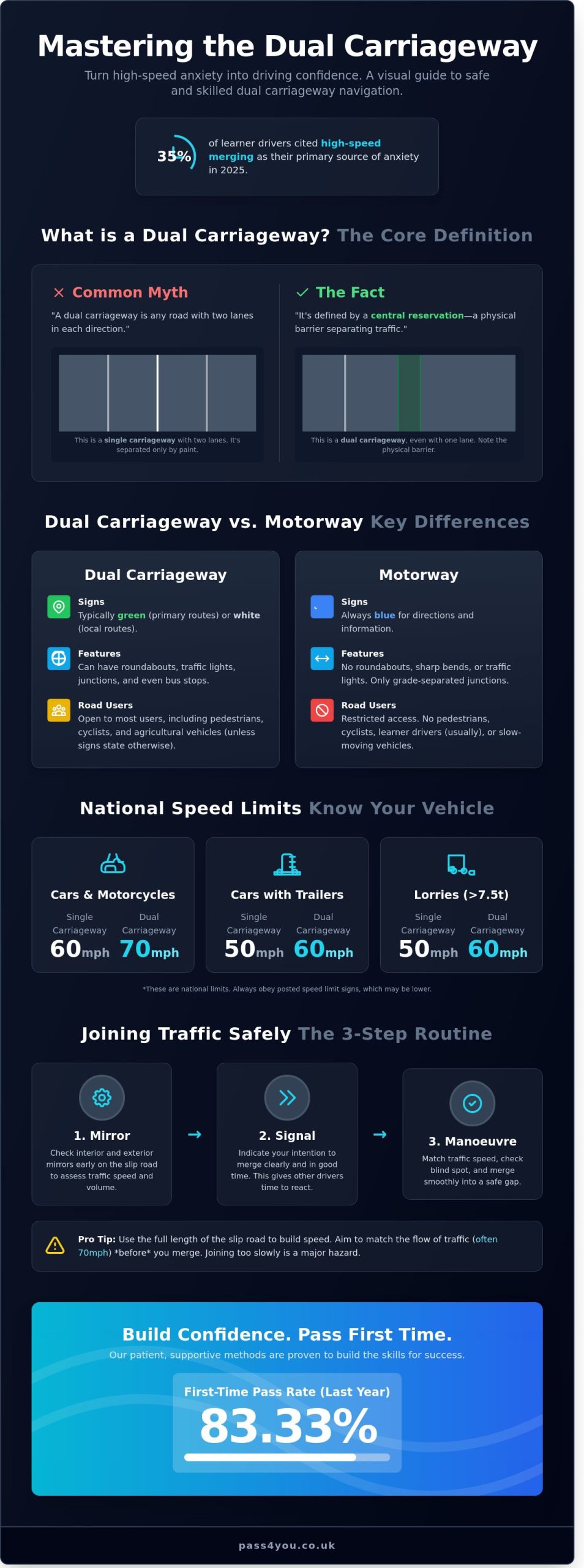
Did you know that roughly 35% of learner drivers cited high-speed merging as their primary source of anxiety during their 2025 driving lessons? It’s perfectly normal to feel a bit shaky when you first approach a dual carriageway, especially when the traffic is moving at the national speed limit. You might worry about picking the wrong lane at a roundabout or mistaking the road for a motorway. We understand those nerves because, at Pass4you Driving School, we’ve helped thousands of students move past them.
We want you to feel calm and capable every time you turn the key. This guide will show you exactly how to join traffic safely, decode complex road markings, and master the specific high-speed skills needed to pass your test in 2026. We’ll break down the essential rules of the road and share the proven, patient methods that helped 83.33% of our students achieve a first time pass last year. By the time you finish reading, you’ll have the knowledge to turn that high-speed road from a source of fear into a symbol of your new-found freedom.
Key Takeaways
Understand the technical definition of a dual carriageway and debunk common myths to ensure you have a solid foundation of road knowledge.
Learn how to use the ‘Mirror-Signal-Manoeuvre’ routine and slip roads to merge confidently with high-speed traffic without feeling rushed or anxious.
Master lane discipline and stay legal by identifying how speed limits change based on the specific vehicle you are driving or towing.
Develop expert hazard perception skills to navigate complex roundabouts and safely manage slow-moving vehicles like tractors or cyclists.
Identify the common mistakes that lead to test failure and see how a patient, supportive teaching style builds the skills needed for a first-time pass.
What is a Dual Carriageway? Definition and Common Myths
Learning to drive involves a lot of new terminology. It’s completely normal to feel a bit overwhelmed by different road types. Simon and the team at Pass4you focus on making these concepts simple so you feel confident behind the wheel. Understanding the technical definition of a dual carriageway is a great place to start. Many people assume the “dual” part refers to having two lanes of traffic in each direction. This is a common misconception that can lead to confusion during your theory test or practical lessons.
The Highway Code defines a what is a dual carriageway based on the presence of a central reservation. This is a physical barrier or a strip of land, like a grass verge, that separates the opposing flows of traffic. If you see a physical gap or a crash barrier between you and the cars coming the other way, you’re on a dual carriageway. It doesn’t matter if there’s only one lane for your direction of travel. In fact, several rural roads in the UK consist of a single lane in each direction separated by a narrow grass verge. These are legally dual carriageways, and the national speed limit for a car on these roads is 70mph unless signs say otherwise.
Identifying these roads correctly is essential for your safety. We’ve helped students in Milton Keynes navigate these transitions for years, and the key is looking for the barrier rather than counting lanes. If there’s no physical separation, and only paint divides the traffic, it’s a single carriageway. On those roads, the national speed limit for a car drops to 60mph.
Dual Carriageway vs Motorway: Key Differences
While they might look similar at high speeds, dual carriageways and motorways have distinct rules. One major difference is access control. Under the Road Traffic Regulation Act 1984, motorways are restricted to certain vehicle classes. You won’t find pedestrians, cyclists, or horse riders there. However, all these groups can legally use a dual carriageway. You’ll also notice different signage colours. Dual carriageways use green signs for primary routes and white for local roads. Motorways always use blue. Finally, dual carriageways often have roundabouts, traffic lights, and even bus stops, which you’ll never see on a standard motorway.
Single Carriageway vs Dual Carriageway
Spotting the transition between these road types is a vital skill for any learner. Before a single road becomes dual, you’ll see a warning sign showing two arrows pointing up with a physical divider between them. This is your cue to prepare for a change in road layout and potential speed limit changes. Don’t be fooled by road markings. Even if a road has two lanes on your side separated by a broken white line, it remains a single carriageway if there’s no central reservation. Our 83.33% first time pass rate comes from teaching students to spot these physical cues early, ensuring they always maintain the correct speed and road position.
Joining and Exiting: Mastering Slip Roads and Intersections
Entering a high-speed road can feel daunting, but it’s all about preparation and timing. You’ll use the Mirror-Signal-Manoeuvre (MSM) routine to ensure you’re fully aware of the traffic flow before you even reach the end of the slip road. In Milton Keynes, many dual carriageway sections begin directly from a roundabout. This means you need to balance your lane positioning while building enough speed to merge safely. If you’re joining from a ‘give way’ junction without an acceleration lane, you must wait for a clear, 100-yard gap in traffic to avoid forcing others to brake or change lanes suddenly.
Building speed on the slip road is essential. You should aim to match the speed of the vehicles already on the main road, which is often 70mph. If you join too slowly, you create a hazard for yourself and others. To stay safe, always follow the official Highway Code rules for dual carriageways, which highlight the importance of lane discipline and early observation. If you’re feeling nervous about these high-speed merges, our Milton Keynes driving lessons focus on building your confidence until merging becomes second nature.
Joining Traffic Safely and Confidently
Timing your gap is a skill that improves with practice. We encourage you to look for the ‘space’ rather than the ‘car’. This mindset shift helps you focus on where you want to be rather than what you’re trying to avoid. If you encounter a short slip road or heavy traffic, you might need to adjust your speed early to slot into a gap. Always perform a quick ‘blind spot’ check over your right shoulder before you move across. This ensures no motorcycles or smaller vehicles are hidden from your mirrors. Simon has helped hundreds of students master these tricky spots, contributing to our 83.33% first-time pass rate.
Match the flow: Use the full length of the slip road to reach 60-70mph if conditions allow.
Early observation: Start glancing at the main carriageway as soon as the slip road opens up.
Be decisive: Once you’ve identified a safe gap, commit to the move without hesitating.
Exiting the Dual Carriageway
Exiting a dual carriageway requires just as much planning as joining. Identifying exit signs early is the key to a smooth transition. You’ll see the primary directional signs about half a mile before the junction. Shortly after, you’ll spot the countdown markers. These are blue rectangular signs with white diagonal bars. Three bars represent 300 yards, two bars represent 200 yards, and one bar represents 100 yards. You should ideally signal left as you pass the 300-yard marker to give following drivers ample warning.
Deceleration should happen on the slip road, not on the main carriageway. If you start braking too early while still in the left-hand lane, you risk being rear-ended by faster traffic. Maintain your speed until you’ve fully entered the exit lane, then use firm, progressive braking to slow down for the junction or roundabout ahead. Our instructors pride themselves on being patient and calm, ensuring you feel in control during every exit, whether it’s a dedicated lane or a sharp ‘give way’ turn-off.
Speed Limits and Lane Discipline: Staying Legal and Safe
Driving on a faster road can feel a bit daunting at first, but understanding the rules helps you stay calm and in control. The National Speed Limit on a dual carriageway is 70mph for cars unless signs state otherwise. This is the maximum speed you should travel at when conditions are perfect, though you must always adjust your speed if it’s raining or visibility is poor. At Pass4you, we focus on helping you find that balance between maintaining progress and staying safe.
It’s vital to remember that the 70mph limit doesn’t apply to every vehicle. If you’re driving a transit van or a car towing a caravan, your legal limit drops to 60mph on these roads. Lorries with a maximum authorised mass over 7.5 tonnes are also restricted to 60mph in England and Wales. Being aware of these different speeds helps you anticipate the movement of traffic around you. If you see a van ahead, don’t be surprised if they’re travelling slightly slower than you; they’re simply following the law.
Lane discipline is the foundation of safety on any dual carriageway. You should always stay in the left-hand lane unless you’re overtaking slower vehicles. Many new drivers feel tempted to stay in the right-hand lane to avoid merging, but this causes congestion and can lead to frustration for others. Think of the left lane as your “travel lane” and the right lane as your “passing lane.” Once you’ve finished overtaking, you should move back to the left as soon as it’s safe to do so.
You’ll often encounter variable speed limits, especially on busier sections of the road. These are shown on digital gantries and are used to manage traffic flow or protect workers during roadworks. If a sign shows 40mph or 50mph, it’s a mandatory limit. These areas are frequently monitored by average speed cameras, which calculate your speed between two points. Keeping a steady, legal pace through roadworks keeps everyone safe and prevents the “stop-start” traffic that causes so much stress.
Lane Selection and Overtaking
Deciding when to move out requires a calm approach and plenty of observation. You should only move into the right-hand lane when you’ve identified a slower vehicle and checked that the path behind you is clear. Following the Highway Code rules for dual carriageways is the best way to ensure you’re making these moves legally. Never “undertake” by passing a vehicle on its left. This is dangerous because drivers don’t expect to be passed on that side, and it can lead to serious collisions if they decide to move back to the left lane suddenly.
Speed Limit Exceptions and Signage
Signs are there to guide you, so it’s important to recognise them instantly. If you’re driving through a built-up area and see street lights but no speed limit signs, the limit is 30mph. This often happens where a dual carriageway enters a town or village. You might also see a “clearway” sign, which is a blue circle with a red cross. This means you must not stop on the main carriageway at any time. If you spot a blue circular sign with a red diagonal line, this marks the end of a minimum speed limit, though these are quite rare on UK roads.
Simon and the team at Pass4you are here to help you master these rules with patience and care. We know that high-speed roads can be intimidating, but with the right guidance, you’ll become a confident driver for life. Our 83.33% first-time pass rate shows that focusing on these core safety skills really does pay off when it’s time for your test.
Hazard Perception: Navigating Roundabouts and Junctions
Driving on a dual carriageway requires a high level of awareness because of the speeds involved. You aren’t just managing your own car; you’re constantly reading the road ahead to spot potential issues before they become dangerous. Many learners feel a bit nervous when they see a large roundabout approaching at 70mph. Don’t worry, because with the right training, you’ll handle these complex junctions with total confidence. The UK has roughly 2,200 miles of dual carriageway roads, and each stretch presents unique challenges that require a calm, methodical approach.
Roundabouts are common on these roads because they’re a cost-effective way to manage high traffic volumes. You’ll often encounter slow-moving hazards like tractors or road maintenance crews. If a tractor is moving at 15mph and you’re travelling at 70mph, the gap closes incredibly fast. You need to scan the horizon for the amber flashing beacons that these vehicles must display. Similarly, stay alert for “U-turn” gaps in the central reservation. These are common on older rural roads. Drivers waiting to turn right might misjudge your speed, so always be ready to ease off the accelerator if you see a car waiting in the middle. It’s about being a proactive driver, not a reactive one.
Scan for the “snake” of brake lights at least 15 cars ahead to anticipate sudden stops.
Look for “Lane Closed” signs or traffic cones at least 800 yards before any merge point.
Maintain a safe two-second gap; this should double to four seconds in wet weather or spray.
Watch for cyclists near junctions, as they may need to cross multiple lanes to turn right.
Approaching Roundabouts at Speed
Success at a high-speed roundabout starts with early preparation. Look for the map-style sign about 200 yards before the junction to plan your lane. If you’re turning right, you’ll usually need the right-hand lane of the dual carriageway. Spiral roundabouts are designed to lead you into the correct exit lane automatically. Don’t panic if the lines seem complex; just follow your lane markings carefully. Simon always teaches students to lose speed early and smoothly, which keeps the car balanced and gives you more time to think.
Pedestrians and Crossings
It’s easy to assume pedestrians aren’t an issue on fast roads, but that’s a mistake. While many sections use footbridges, some have “at-grade” crossings where people walk directly across the lanes. Be especially careful near bus stops. Passengers often step off a bus and try to cross the road immediately. If you see an emergency vehicle, stay calm and signal your intentions clearly. Our instructors help you build these instincts, contributing to our impressive 83.33% first-time pass rate.
Ready to master these high-speed skills with a patient instructor? Book your driving lessons today and become a safe driver for life.
Preparing for Your Test: Building Confidence with Pass4you
Approaching your practical driving test often feels like a mountain to climb, especially when you think about high-speed sections. At Pass4you, we don’t believe in just “getting you through” the exam. Our goal is to transform you into a safe, self-assured driver for life. This philosophy is exactly why we maintain an 83.33% first-time pass rate. We achieve these results by breaking down complex scenarios, such as navigating a dual carriageway, into manageable steps that build your skill level gradually. We know that many learners feel anxious about the speed and volume of traffic on these roads. That’s why Simon and our team of instructors use a patient, calm approach to ensure you never feel rushed or overwhelmed during your lessons.
Common faults that lead to test failure on faster roads often stem from hesitation or poor observation. Many students fail because they don’t adjust their speed quickly enough when joining from a slip road, or they move lanes without a clear understanding of the traffic behind them. We focus on these specific pain points from day one. By the time your test date arrives, you won’t just be hoping for the best; you’ll have the technical ability and the mental composure to handle whatever the road throws at you.
What the Examiner is Looking For
During your test, the examiner needs to see that you are in total control of the vehicle. This means demonstrating “clear intent” whenever you change lanes or merge. If you’re indecisive, it confuses other road users and creates danger. You must show that you’ve checked your mirrors and blind spots thoroughly before making any move. Maintaining a safe following distance is another critical factor. We teach you to strictly follow the two-second rule in dry conditions, doubling it to four seconds when it’s raining. Examiners watch your mirrors closely; they expect to see you checking them every time your speed or direction changes, ensuring you’re fully aware of the environment around you.
Lane Discipline: Staying in the left-hand lane unless overtaking or turning right.
Observation: Using the interior and door mirrors early and often.
Speed Control: Reaching the speed of traffic on the slip road before merging safely.
Local Expertise in Milton Keynes
Learning to drive in Milton Keynes offers a unique advantage that you won’t find in many other UK towns. The famous H and V grid roads are effectively a dual carriageway network that allows you to practise high-speed discipline throughout every single lesson. You’ll become an expert at roundabouts and merging before you even realise it. Simon has developed a “tried and tested” technique specifically for nervous learners in this area. He focuses on “reading the road” ahead, which gives you more time to react and reduces the stress of last-minute decisions. This local knowledge is invaluable; knowing exactly how the local grid system flows gives our students a massive edge on test day.
We understand that the transition from quiet residential streets to 70mph roads is a big jump. Our instructors are experts at pacing your learning so you only tackle these challenges when you’re truly ready. This supportive environment is why so many of our students pass the first time with zero “serious” faults. If you want to stop feeling nervous and start feeling capable, we are here to help you reach that milestone. Our professional guidance ensures you aren’t just passing a test, but gaining the freedom that comes with being a confident driver.
Take the Next Step Toward Your Full Driving Licence
Mastering the dual carriageway is a vital milestone that transforms a nervous learner into a capable, independent driver. You now understand that success on these high-speed roads relies on precise slip road merging and strict lane discipline. By anticipating hazards at major intersections and managing your speed effectively, you’re already halfway to passing your test. It’s about building the muscle memory and mental focus required for 2026 traffic conditions.
You don’t need to tackle these challenges without support. Simon provides the calm and patient instruction necessary to settle your nerves, ensuring you feel comfortable in our modern Volkswagen tuition vehicles. Our 83.33% first-time pass rate proves that the right environment makes all the difference. We’ve spent years helping Milton Keynes students develop the skills to stay safe for life, moving far beyond simple test preparation. It’s time to stop worrying about the road and start enjoying the freedom it provides.
We look forward to seeing you in the driver’s seat and helping you achieve your goals with confidence.
Frequently Asked Questions
What is the national speed limit on a dual carriageway in the UK?
The national speed limit for cars and motorcycles on a dual carriageway is 70 mph unless signs show a lower limit. If you’re towing a caravan or trailer, your maximum speed drops to 60 mph. Staying aware of these limits helps you remain a safe driver and keeps your confidence high during every journey.
Can a dual carriageway have only one lane?
Yes, a dual carriageway can have just a single lane in each direction. The defining feature isn’t the number of lanes, but the physical central reservation that separates the opposing flows of traffic. You’ll often find these on rural bypasses where the road might expand to two lanes later for safer overtaking.
What is the difference between a dual carriageway and a motorway?
The main difference is that motorways are restricted roads marked with blue signs, whereas a dual carriageway uses green or white signs. On a dual carriageway, you may encounter roundabouts, traffic lights, and even right-hand turns across the central reservation. Motorways don’t allow slow-moving vehicles like tractors or mopeds under 50cc, ensuring a different flow of traffic.
Am I allowed to cycle on a dual carriageway?
You can cycle on most dual carriageways unless there’s a specific sign featuring a red circle that prohibits bicycles. It can be a nervous experience for cyclists, so we always teach our students to give at least 1.5 metres of space when overtaking. Being patient and supportive of vulnerable road users is a hallmark of a truly skilled driver.
What should I do if I miss my exit on a dual carriageway?
If you miss your exit, you must continue to the next junction or roundabout to turn around safely. Never attempt to reverse or stop on the road, as this is extremely dangerous for you and other drivers. Taking a few extra minutes to reach the next exit keeps you calm and ensures everyone stays safe on the road.
Is a road with a painted middle section a dual carriageway?
No, a road with painted hatched markings in the middle is still classed as a single carriageway. A road only becomes a dual carriageway when the two directions of travel are physically separated by a central reservation, such as a concrete barrier or a grass verge. This distinction is vital because it determines whether the national speed limit is 60 mph or 70 mph.
How do I know if I am on a dual carriageway or a single carriageway?
You’ll know you’re on a dual carriageway if there’s a physical barrier or a strip of land separating you from the traffic coming the other way. It’s a common misconception that the number of lanes defines the road type. Our instructors focus on helping you spot these physical cues early so you can adjust your speed and positioning with total confidence.
Can learner drivers drive on dual carriageways?
Learner drivers are fully allowed to drive on dual carriageways as long as they’re with a qualified instructor or a supervisor who meets the legal criteria. Practising on these faster roads is a brilliant way to build the skills needed for your test. With our 83.33% first time pass rate, we’ll make sure you feel safe and ready for any road type you encounter.
[…] comfortable with village roads, we will head toward the outskirts of Milton Keynes. Mastering the dual carriageway is a vital step for any learner. You will learn to merge safely at higher speeds on the A421 and […]
[…] don’t fully prepare you for the unique pressures of the M1. While you may have spent time mastering the dual carriageway, the transition to a motorway involves more than just a change in sign colour from green to blue. […]
[…] driving focuses on using full beams effectively to spot wildlife or sharp bends. We also spend time mastering the dual carriageway at night. These roads present unique challenges, such as judging the speed of vehicles behind you […]
Leave a Reply to Night Driving Lessons UK: Mastering the Dark for Safer Motoring in 2026 – My Blog Cancel reply