
What if those daunting 70mph entries onto the Milton Keynes grid system weren’t something to dread, but a challenge you could handle with total ease? We know that many learners feel a genuine spike of anxiety when they see a multi-lane junction approaching, especially when spiralling lanes feel like they’re pushing you out of position. It’s frustrating to feel like a minor lane discipline error is the only thing standing between you and your full driving licence.
We believe that mastering roundabouts milton keynes should be a calm and predictable experience. By learning the secrets of the grid, you’ll gain the confidence to navigate any junction without the usual panic or confusion. Our goal is to transform you into a safe driver for life, ensuring you feel as relaxed behind the wheel as our previous students who helped us reach an 83.33% first-time pass rate in 2024. In this guide, we’ll walk through the exact lane selection techniques and approach strategies you need to pass your test in 2026 with flying colours.
Key Takeaways
- Understand how the unique Milton Keynes grid system prioritises traffic flow, helping you anticipate the city’s driving rhythm with ease.
- Unlock the secrets to mastering roundabouts milton keynes by applying the “12 o’clock” rule and learning to decipher complex road markings.
- Identify the specific high-speed junctions and test-route roundabouts that often challenge learners, allowing you to approach them with a calm, prepared mindset.
- Master the “Plan, Act, Achieve” approach to the MSPSL routine to navigate even the most daunting multi-lane junctions with total confidence.
- Discover how patient, expert guidance in modern Volkswagen vehicles can help you overcome driving anxiety and achieve a safe, first-time pass.
The Milton Keynes Grid System: Why Roundabouts Rule the City
Milton Keynes wasn’t built by accident. In 1967, planners designed it as a “New Town” to solve the heavy congestion found in older British cities. Instead of narrow, winding streets and endless traffic lights, they implemented Milton Keynes’ unique grid system. This layout prioritises constant movement. You’ll notice that traffic lights are rare on the main grid roads. Instead, roundabouts act as the primary way to manage junctions. Because these roads often have speed limits of 60mph or 70mph, your approach to a junction happens much faster than in a typical town centre. Mastering roundabouts milton keynes is the single most vital skill you’ll need to pass your test here. If you can handle an MK roundabout with confidence, you’re already halfway to your pink licence.
The grid system allows traffic to bypass residential estates, keeping the main routes clear for through-traffic. This means you spend less time idling in queues and more time actually driving. It’s a different world compared to the cramped streets of nearby towns like Bedford or Luton. The city’s design demands a high level of observation. You need to look ahead and process information quickly. Our instructors focus on building this “active scanning” habit from your very first lesson. It’s how we help you feel safe and in control, even when the national speed limit applies.
Understanding H-Roads and V-Roads
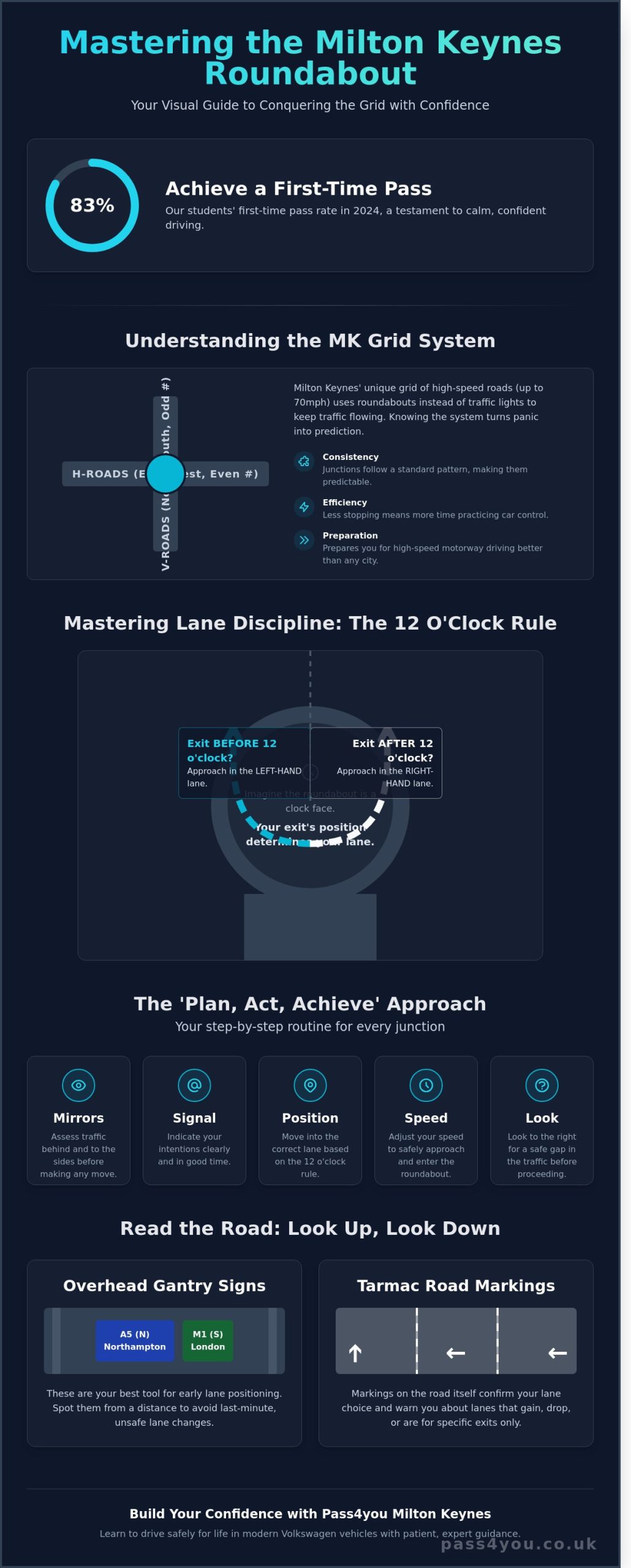
The city is laid out like a giant chessboard. Horizontal roads (H-roads) run roughly east to west, while Vertical roads (V-roads) run north to south. H-roads have even numbers, like the H6 Childs Way, and V-roads have odd numbers, such as the V8 Marlborough Street. Knowing this helps you anticipate what’s coming. If you’re on a V-road approaching an H-road, you know you’re heading for a major junction. Using these road names helps you plan your exit directions long before you see the road markings. It’s all about forward planning and reducing that last-minute panic. When you know where you’re going, your confidence naturally grows.
Why the Grid System Benefits Learner Drivers
For many learners, the grid system feels intimidating at first. However, it’s actually your best friend. Unlike the unpredictable layouts of older towns, MK offers incredible consistency. Every junction follows a similar logic. You won’t find many “stop-start” situations caused by pedestrian crossings or tight corners on the grid. This flow helps you build a steady rhythm. It also provides the perfect training ground for advanced dual carriageway driving. By the time you reach your test, you’ll feel calm and prepared because you’ve practiced these high-speed approaches dozens of times. Mastering roundabouts milton keynes isn’t just about passing a test; it’s about becoming a safe driver for life.
- Consistency: Most junctions follow a standard pattern, making lane selection easier to learn.
- Efficiency: Less time spent at red lights means more time practicing your actual car control.
- Preparation: The high-speed grid roads prepare you for motorway driving better than almost any other UK city.
Mastering Lane Discipline: How to Choose the Right Path
Choosing the correct lane is often the most stressful part of mastering roundabouts milton keynes learners face. With over 130 roundabouts across the city’s grid system, the sheer volume of choices can feel overwhelming. We teach our students a simple “12 o’clock” rule to simplify this. Imagine the roundabout as a clock face. If your exit is located before 12 o’clock, you typically approach in the left-hand lane. If the exit is after 12 o’clock, you should move into the right-hand lane. This follows the official Highway Code rules for roundabouts, which provide the foundation for safe driving.
In Milton Keynes, you must look up as well as down. Road markings on the tarmac can fade or be hidden by traffic during rush hour. Overhead gantry signs on approach roads like the H6 Childs Way or V8 Marlborough Street are your best tools for early positioning. Seeing these signs early prevents last-minute swerving, which is a common reason for faults during a driving test. Our instructors focus on building your confidence so you can spot these cues 100 yards before the junction.
You also need to be aware of “lane gain” and “lane drop” scenarios. A lane gain occurs when an extra lane opens up on the approach, often to increase capacity for left turns. Conversely, a lane drop means your current lane might be forced to exit. Recognising these patterns early is why Pass4you maintains an 83.33% first time pass rate. We help you read the road layout long before you reach the give-way line. If you’re feeling a bit overwhelmed by the grid roads, our calm driving lessons are designed to help you find your feet at your own pace.
Turning Left and Going Ahead
For the first exit (turning left) or the second exit (going straight), the left-hand lane is your standard choice. However, some larger Milton Keynes roundabouts feature three lanes on approach. In these cases, the middle lane is often dedicated to “ahead” only. Always check the arrows on the road. When exiting, use your interior and left door mirrors to ensure no cyclists or vehicles are tucked into your nearside before you steer towards the exit road.
Turning Right at Multi-Lane Junctions
Exits located past the 12 o’clock position require a right-hand lane entry. As you follow the curve of the roundabout, you must maintain your lane discipline to avoid “drifting” into other drivers. Many roundabouts here use a spiral system that naturally pushes you towards your exit. Before you move from the inner lane to the outer lane to leave the roundabout, perform a “lifesaver” glance over your left shoulder. This quick check ensures another vehicle isn’t trying to overtake you on the left. Simon and our team of instructors will practice this move with you until it becomes a natural habit.
Navigating the Most Notorious Milton Keynes Roundabouts
Milton Keynes is famous for its grid system and over 130 unique roundabouts. For a learner, this can feel like a daunting maze. Mastering roundabouts milton keynes is the biggest hurdle to getting your pink licence, but it doesn’t have to be a source of stress. The psychological pressure of high-speed traffic and large HGVs is a common concern. Simon at Pass4you understands this anxiety. He uses a patient, calm approach to help you feel in control. This isn’t just about passing a test; it’s about becoming a safe driver for life. You can also study expert advice from the RAC to supplement your practical lessons with Simon.
Local knowledge is your secret weapon. Test examiners often use specific junctions because they test your ability to read signs and lane markings simultaneously. Common challenges include:
- Managing heavy commercial traffic near the Magna Park and Brinklow industrial estates.
- Maintaining a steady speed while checking blind spots on multi-lane approaches.
- Deciphering faded lane markings on older Bletchley routes.
- Responding to aggressive drivers who may not follow standard priority rules.
The Roman Roundabout (Bletchley)
The Roman Roundabout, often called the “B&Q Roundabout” by locals, is a regular feature on Bletchley test routes. It’s notorious for its spiralling lane markings. Many learners fail here because they find themselves in the wrong lane for the A5 or Bletchley town centre. Simon’s local knowledge is a huge advantage. He’ll show you exactly where to position your car before you even reach the white lines. We focus on deciphering these markings under pressure. In 2024, lane discipline remained a top reason for test failures in the UK. We’ll make sure you’re prepared so you don’t become part of that statistic.
Northfield and Pineham Roundabouts
These junctions are the gateway to the M1. You’ll often find yourself surrounded by 44-tonne HGVs and commuters rushing to work. Traffic here moves at speeds up to 60mph, making gap selection critical. If you’re nervous, you might wait too long or pull out too late. We help you build the confidence to judge high-speed gaps accurately. Simon’s coaching focuses on reading the body language of other vehicles. This ensures you can merge safely without causing others to slow down. We’ve helped hundreds of students navigate these high-pressure zones, contributing to our 83.33% first-time pass rate. You’ll learn to stay calm even when the traffic feels overwhelming.
The Step-by-Step Approach for a First-Time Pass
Navigating the complex grid system requires more than just luck; it demands a structured method. At Pass4you, we teach the MSPSL routine as the foundation for mastering roundabouts milton keynes. You’ll start by checking your mirrors to understand the traffic behind you. Next, you’ll signal your intent clearly. Your position comes next, followed by adjusting your speed, and finally, looking for a safe gap. This routine keeps you calm and in control. It’s a key reason why our students achieve an 83.33% first time pass rate.
We use a “Plan, Act, Achieve” mindset to help you stay ahead of the car. You should begin planning your approach at least 100 yards before the junction by reading the gantry signs or road markings. Once you act on that plan by choosing your lane, your goal is to achieve a safe exit. Clear communication is your best tool here. By positioning your car early and using your signals correctly, you tell everyone else exactly where you’re going. This reduces the risk of others cutting you off or becoming confused by your intentions.
If you realise you’re in the wrong lane, don’t panic. This is a common worry for learners, but the solution is simple. Stay in the lane you’ve chosen. Follow it safely to whichever exit it leads to, even if it’s not the one you wanted. The examiner won’t fail you for taking a wrong turn if you do it safely. They will, however, mark a serious fault if you cross a solid line or swerve to “fix” the mistake. We focus on building this “safety first” habit so you stay relaxed during your test.
Dealing with Spiralling Lanes
Many larger junctions in Milton Keynes, like those connecting to the A5, use spiral markings. These lanes are designed to naturally “drift” you towards your exit as you move around the circle. You simply need to stay between your white lines and follow them as they move outwards. Never cross a solid white line to change lanes. If you follow the spiral correctly, you’ll find yourself perfectly positioned for your exit without needing any sudden steering movements.
The Exit Strategy: Signalling and Speed
Timing your exit signal is vital. You should apply your left signal just after you’ve passed the exit immediately before the one you want. As you move onto the new road, check your interior mirror to ensure it’s safe to accelerate. Once you’re clear of the junction, you can gradually increase your speed to match the local limit. This smooth transition shows the examiner you’re a confident, capable driver. If you’re feeling nervous about these junctions, you can book a lesson with a patient instructor to build your confidence and skills.
Build Your Confidence with Pass4you Milton Keynes
Mastering roundabouts milton keynes requires more than just knowing the Highway Code; it demands confidence and precise car control. At Pass4you, our instructors specialise in helping learners overcome the unique challenges of the city’s grid system. We don’t believe in a one-size-fits-all approach. Instead, we tailor every lesson to focus on your specific fears. If merging onto a high-speed dual carriageway makes your heart race, we’ll spend extra time there. Our goal is to transform your anxiety into competence through patient, expert guidance.
You’ll learn to drive in modern Volkswagen vehicles that are specifically chosen for their ease of use. These cars offer excellent visibility and light, responsive controls, which are essential when you’re trying to maintain lane discipline on a busy MK roundabout. Learning in a high-quality vehicle means you can focus on the road rather than struggling with a heavy clutch or stiff gears. This professional environment is part of why we maintain an 83.33% first-time pass rate. This figure is the highest in the local area, proving that our methods produce results for students of all ability levels.
Personalised Instruction with Simon
Simon has built a reputation as a mentor who provides a calm, non-shouting environment. This is vital for nervous learners who may have felt pressured by other instructors in the past. We use actual local test routes to ensure your experience is relevant to the real world. You won’t just be driving in quiet residential streets; you’ll be tackling the same junctions you’ll face during your practical exam. Booking your first lesson is the simplest way to start your journey toward independence and the freedom of the open road.
Value for Money: Saving Lessons by Learning Right
Many people look for the cheapest hourly rate, but expert instruction actually saves you money in the long run. By learning the correct techniques from day one, you reduce the total number of lessons needed before you’re test-ready. The cost of failing a test is significant when you factor in the retest fee and the price of additional practice. Investing in high-quality training ensures you’re a safe driver for life, not just for the duration of your test. You can find full details on our driving lessons Milton Keynes page. We focus on getting you through your test quickly and safely, avoiding the need for expensive repeat attempts.
- Expertise: Instructors who know every MK roundabout shortcut and trap.
- Success: A verified 83.33% first-time pass rate that leads the local market.
- Comfort: Modern Volkswagen cars that make learning to drive a pleasure.
- Support: A patient, empathetic approach that builds genuine driver confidence.
Our commitment to your success goes beyond just passing a test. We want you to feel entirely comfortable mastering roundabouts milton keynes on your own once that pink licence arrives. By focusing on your individual needs and providing a supportive atmosphere, we ensure you’re prepared for any situation the road throws at you.
Take Control of the Milton Keynes Grid
Navigating the city’s unique layout doesn’t have to be a source of stress. By understanding the grid system and focusing on precise lane discipline, you’ll transform those daunting junctions into simple routines. Successful driving in 2026 relies on early preparation and the ability to stay calm under pressure, especially at the busier multi-lane intersections. You aren’t just learning to pass a test; you’re developing skills that keep you safe for a lifetime on the road.
Mastering roundabouts milton keynes is much easier when you have the right support. At Pass4you, we provide a supportive environment in modern Volkswagen tuition vehicles, helping you build confidence at your own pace. Our patient approach is why we’re proud of our 83.33% first-time pass rate. We’ve helped countless nervous learners turn their anxiety into expertise through clear, professional guidance. You’ve got the potential to be a great driver, and we’re here to help you prove it.
Book your first lesson with Pass4you and master MK roundabouts today!
We can’t wait to see you gain your independence and enjoy the freedom of the open road.
Frequently Asked Questions
How many roundabouts are actually in Milton Keynes?
Milton Keynes is home to more than 130 roundabouts across its unique grid system. These junctions help keep traffic flowing smoothly without the need for constant stop-start signals. While the high number can feel overwhelming at first, mastering roundabouts in Milton Keynes becomes second nature once you understand the consistent layout patterns used throughout the city. Our instructors help you build the confidence needed to navigate every one of them safely.
Do I always need to signal left when exiting a mini-roundabout?
You should signal left when exiting a mini-roundabout if there’s enough time and space to do so safely. However, because these junctions are small, it’s often physically impossible to signal left after passing the previous exit without losing control of the steering. Your priority is to maintain a steady course. If a signal helps others understand your intentions, use it; if it causes a safety risk, focus on your road position instead.
What should I do if I realise I am in the wrong lane on a roundabout?
Stay in your current lane and follow the path it takes, even if it means going the wrong way. Never try to cut across lanes or stop suddenly, as this is a common cause of accidents and test failures. You won’t fail your driving test for taking the wrong exit as long as you do it safely. Mastering roundabouts in Milton Keynes is about staying calm. Just tell the examiner you’ve made a mistake and they’ll help you get back on track.
Which lane should I use for “straight ahead” if there are three lanes?
You should typically use the left-hand or middle lane for straight ahead, but you must always check the road markings and signs first. In Milton Keynes, many larger junctions have specific lane markings that direct traffic into three or more lanes. If the left lane is marked for “left turn only,” the middle lane becomes your primary choice for going straight. Simon and our team help you build a patient, observant approach to reading these signs early.
Why do some roundabouts in MK have traffic lights?
Traffic lights are installed on larger roundabouts to manage high traffic volumes and improve safety during peak hours. These signals prevent the junction from becoming blocked when one direction is much busier than the others. According to 2024 traffic management data, signalised junctions in MK help maintain a steady flow of vehicles. Staying patient and following the stop lines ensures you navigate these complex areas with total confidence.
Is it a major fault to clip the kerb on a roundabout during a test?
Clipping the kerb is often recorded as a serious fault if it affects the car’s stability or endangers other road users. A gentle brush might only result in a minor fault, but mounting the kerb will lead to an immediate fail. We focus on a patient, wide-entry technique to ensure you have plenty of room. Our 83.33% first-time pass rate shows that teaching learners to stay calm helps avoid these small steering errors.
How do I handle the high speed limits when approaching a roundabout?
You should begin your preparation early by checking your mirrors and easing off the accelerator well before the junction. Many grid roads in Milton Keynes have 60mph or 70mph limits, which requires a structured approach to braking. Use the “Information, Position, Speed, Gear, Look” routine to slow down smoothly. By planning ahead, you’ll feel more confident as you transition from high speeds to the roundabout entry.
Can I fail my test for being too hesitant at a busy junction?
Yes, you can fail if you stay stationary when there’s a safe, clear gap to join the traffic. This is known as “undue hesitation” and can frustrate other drivers or cause unnecessary delays. It’s important to be safe, but you also need to show the examiner you’re a confident driver. We’ll work with you to recognise safe gaps in traffic, helping you feel ready to move away promptly and safely every time.
Leave a Reply