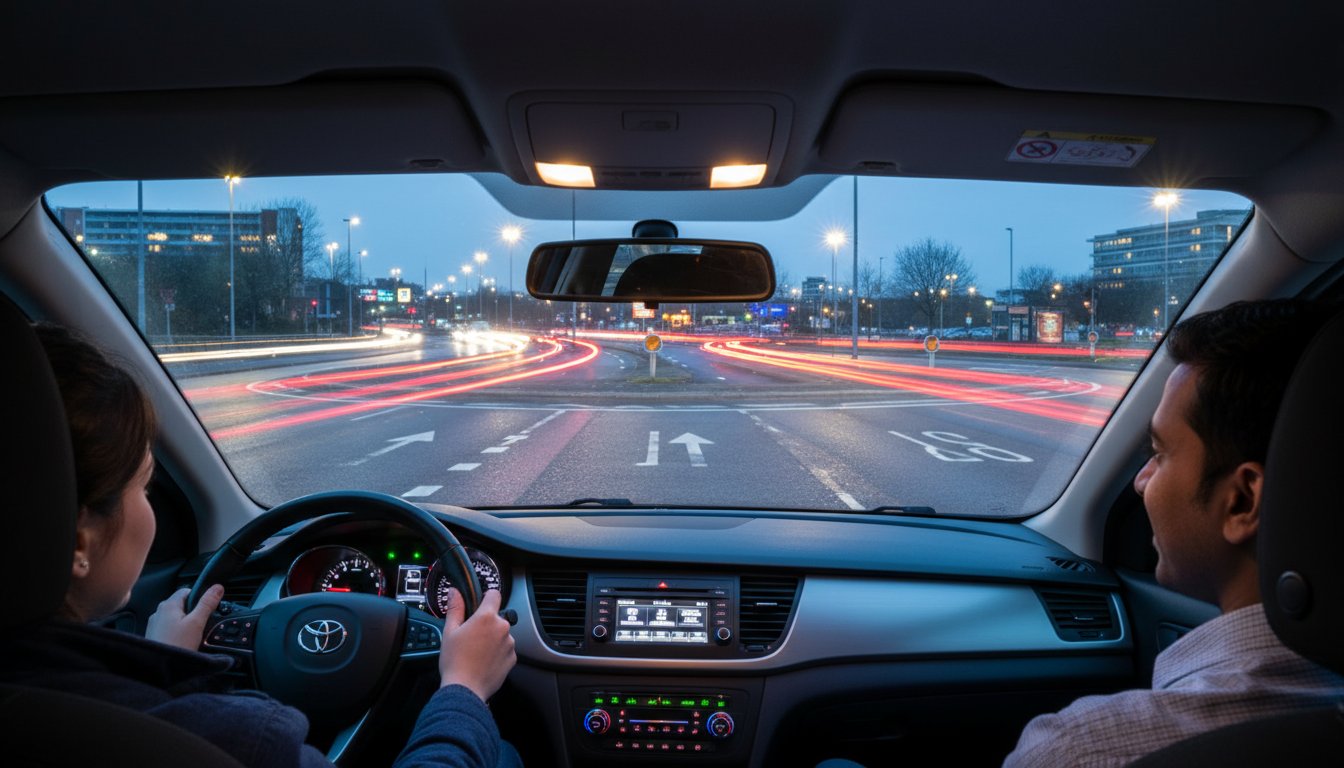
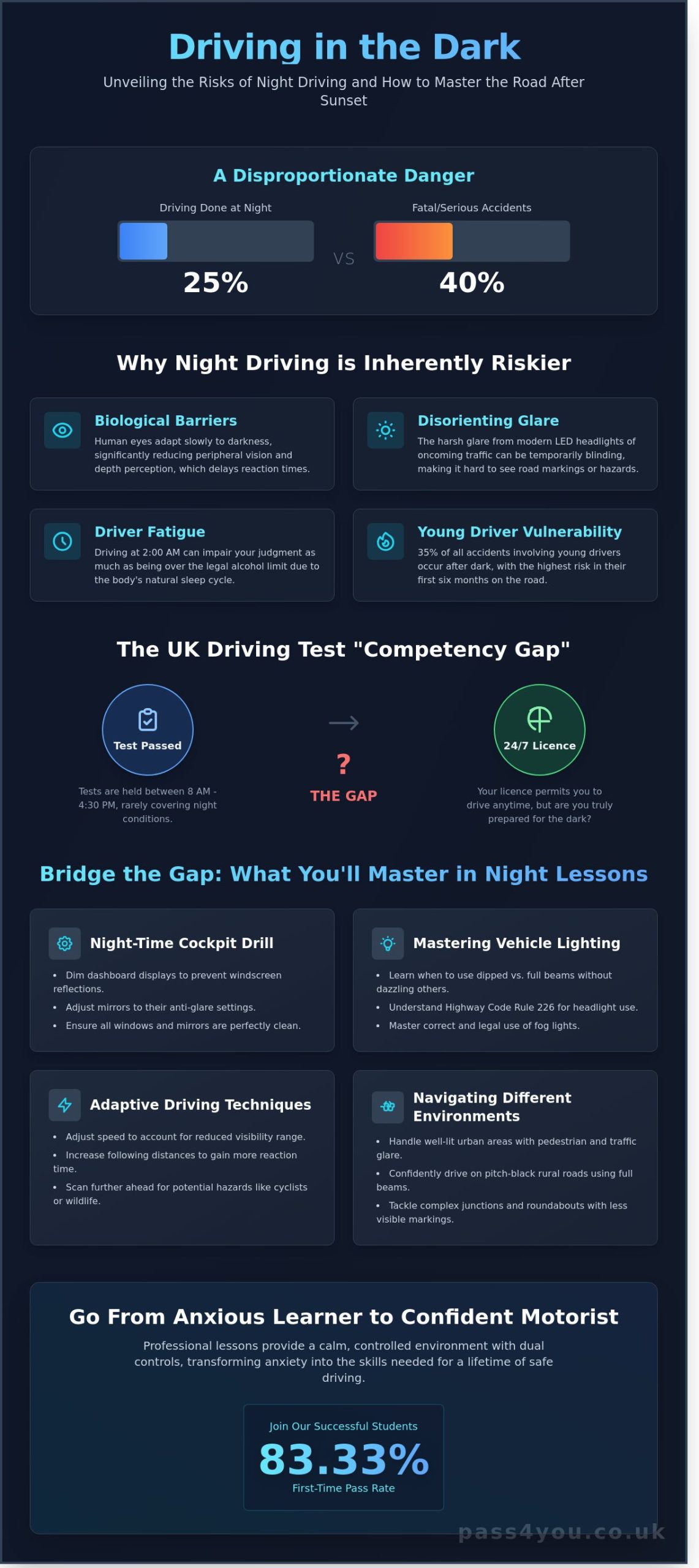
Did you know that while only 25% of all driving in the UK happens after sunset, 40% of fatal or serious accidents occur in the dark? It is a startling figure that highlights why many learners feel a genuine sense of dread when the sun begins to dip below the horizon. You might find yourself squinting against the harsh glare of modern LED headlights or feeling unsure about when to switch from dipped to full beams on a winding country lane. It is completely natural to feel this way; the road becomes a different world once the streetlights flicker on.
At Pass4you, we believe that learning to drive should be a calm and supportive experience, no matter the time of day. Taking professional night driving lessons uk is the secret to transforming that evening anxiety into total confidence. We will help you understand night-specific hazards and master your car’s lighting controls so you feel safe and in control. By the end of this guide, you will see how expert tuition helps you join the 83.33% of our students who pass their test first time, ensuring you are a safe driver for life in every possible lighting condition.
Key Takeaways
- Learn how professional guidance helps bridge the safety gap, addressing why over a third of young driver accidents occur after sunset.
- Master the essential “cockpit drill” and learn to adjust your speed and following distances to account for reduced depth perception at night.
- Discover the advantages of booking night driving lessons uk to benefit from dual controls and avoid the common “bad habits” passed on during private practice.
- Gain the confidence to navigate the unique Milton Keynes grid system and handle complex roundabouts when lane markings become less visible.
- Develop the calm, patient mindset needed to transition from a nervous learner to a safe, independent motorist in all lighting conditions.
Why Night Driving Lessons are Essential for UK Learners
Night driving lessons are specialised instructional sessions conducted after sunset. They focus on helping you familiarise yourself with low-light hazards that simply do not appear during the day. While your standard daytime driving lessons in Milton Keynes provide a solid foundation, the road environment changes completely once the streetlights flicker on. The shadows grow longer, distances become harder to judge, and the glare from oncoming traffic can be disorienting for the unprepared.
The safety gap for new motorists is stark. According to DVSA data, 35% of accidents involving young drivers occur during the hours of darkness. This happens because the skills needed for night motoring aren’t just daytime driving with the lights on. It involves overcoming what experts call the biological barrier. Human eyes take time to adapt to the dark, and our peripheral vision and depth perception often decrease significantly in low light. This delay in processing visual information directly impacts your reaction times, making professional night driving lessons uk a vital part of your training.
The UK driving test rarely includes a night-time element because most tests are scheduled between 8:00 am and 4:30 pm. However, your driving licence is a permit to drive 24 hours a day. The DVSA expects you to be competent in all conditions the moment you pass. This is where Driver’s education bridges the gap between passing a practical test and being a truly capable, independent motorist.
The Statistics Behind the Danger
Statistics show that new drivers are most vulnerable during their first six months on the road. Reduced visibility is a primary factor, but fatigue also plays a major role in night-time collisions. Research indicates that driving at 2:00 am can be as dangerous as driving while over the legal alcohol limit due to natural tiredness. Our lessons mitigate these risks through controlled exposure. We help you navigate dark country lanes and busy urban junctions, ensuring you feel calm and prepared rather than overwhelmed by the dark.
Bridging the Gap to Independence
Daytime practice is only half the story for a learner. Taking your first night drive with a patient, calm instructor like Simon provides a massive psychological boost. We don’t just want you to pass your test; we want you to maintain our 83.33% first-time pass rate while building a foundation for safe driving for life. By tackling the dark with a mentor, you’ll learn how to manage headlight glare and use your full beams correctly. It is about building the confidence to handle any journey, regardless of the time of day or the season.
What to Expect During Your Night Driving Lessons
Transitioning from daylight to dusk requires more than just flicking a switch. During your night driving lessons uk, we follow a structured path that begins as the sun dips below the horizon. This timing allows you to experience how shadows lengthen and how your eyes adapt to fading light. Your instructor, Simon, will guide you through a specific night-time cockpit drill. This includes dimming your internal dashboard displays to prevent reflections on the windscreen and ensuring your mirrors are adjusted to their anti-glare settings. It’s a calm, step-by-step process designed to make you feel in control before the road gets truly dark.
Mastering Vehicle Lighting
Modern cars feature complex lighting systems, including “Auto” settings that don’t always trigger when you need them most. You’ll learn exactly when to switch from dipped beams to full beams and, crucially, when to flick them back to avoid dazzling others. We cover the official Highway Code rules for night driving, specifically focusing on Rule 226. This rule dictates that you must use headlights when visibility is reduced to 100 metres or less. Mastering fog lights is also vital; using them incorrectly is actually illegal and can attract a fixed penalty notice. We’ll ensure you understand every symbol on your dashboard so you never feel confused in the dark.
Navigating Different Light Environments
Driving in a well-lit town centre is vastly different from a pitch-black country lane. In urban areas, you’ll practice spotting pedestrians in dark clothing against the glare of shop fronts and streetlights. Rural driving focuses on using full beams effectively to spot wildlife or sharp bends. We also spend time mastering the dual carriageway at night. These roads present unique challenges, such as judging the speed of vehicles behind you simply by the distance between their headlights. You’ll learn to maintain a safe gap, as depth perception often decreases by 20% in low-light conditions.
Biological Factors and Vision
One of the biggest hurdles for new drivers is the glare from modern “blue” LED headlights, which are significantly brighter than older halogen bulbs. We teach the “look away” technique, where you focus on the left-hand kerb or white line to preserve your night vision when a car approaches. You’ll also learn to identify vulnerable road users like cyclists, who may only be visible by a small flickering red light. These practical skills are a core part of our night driving lessons uk. If you feel nervous about the dark, our calm and patient instructors are here to build your confidence step by step.
Professional Instruction vs Private Practice at Night
Choosing between a professional instructor and a well-meaning family member is a pivotal decision for any learner. While private practice helps build mileage, the unique risks of the dark require a more sophisticated approach. In the UK, statistics from the Royal Society for the Prevention of Accidents (RoSPA) show that 40% of all fatal collisions occur at night, despite there being far less traffic. This is why professional night driving lessons uk are a sensible investment in your long-term safety.
Safety and Dual Controls
The presence of dual controls is the single most important safety feature when visibility is low. During a night lesson, your instructor can intervene instantly if you fail to spot a pedestrian in dark clothing or a cyclist without lights. Private cars don’t have this safety net, leaving you and your supervisor vulnerable if a hazard emerges from the shadows. At Pass4you, we prioritise a stress-free environment. Simon’s patient, calm approach ensures that even the most nervous learners feel supported. We don’t shout or rush you; we provide the steady guidance needed to handle high-pressure situations safely.
Structured Learning vs Aimless Driving
Private practice often descends into aimless driving around familiar, well-lit streets. This doesn’t prepare you for the reality of 2026 road conditions. Professional instruction follows a targeted night curriculum, covering everything from complex rural bends to high-speed dual carriageways. We track your progress meticulously to ensure you’re ready for every scenario. If you’re still deciding on the right path for your education, you can read our guide on choosing a driving school in Milton Keynes to see how we compare.
Friends and family members often pass on “bad habits” without realising it. They might use fog lights incorrectly or forget the strict rules regarding full-beam etiquette, which can dazzle other road users and cause accidents. Learning these technical skills correctly from the start prevents you from developing dangerous routines that are hard to break later.
From a financial perspective, professional lessons offer a clear cost-benefit advantage. While an hour with an instructor costs more than a tank of petrol for a private car, our 83.33% first time pass rate proves that structured learning is more efficient. By mastering night driving professionally, you reduce the likelihood of accidents in your first year of solo driving. This keeps your no-claims bonus intact and can save you hundreds of pounds on insurance premiums in the long run. It’s about becoming a safe driver for life, not just passing a test.
Essential Skills and Safety Tips for Driving in the Dark
Driving at night requires a total shift in your mental approach. You can’t rely on the same visual cues you use at midday. The speed limit on a road is a maximum legal cap, not a target you must hit. In 2024, data from the Department for Transport indicated that nighttime collisions often involve higher speeds because drivers mistakenly believe the roads are “empty”. You should treat every limit as a ceiling. If your visibility is reduced by rain or a lack of streetlights, drop your speed by 5 or 10 mph. This simple change gives you the vital seconds needed to react to a sudden hazard.
Your depth perception changes significantly when the sun goes down. It’s much harder to judge how fast a car is approaching or how far away it is when you only see two dots of light. To stay safe, double your following distance. On a dry motorway, the standard two-second gap should become a four-second gap. This extra space is your safety net. It accounts for the fact that your eyes take longer to process information in low-light conditions.
Visibility isn’t just about your eyes; it’s about your glass. A thin layer of grime on the inside of your windscreen can turn the glare from oncoming modern LED headlights into a blinding white haze. Clean your windows and mirrors every week using a dedicated glass cleaner. This reduces light refraction and keeps your view clear. If you’re feeling anxious about these conditions, taking night driving lessons uk can help you practice these habits with a professional mentor who understands the unique pressures of the dark.
Staying alert is the final piece of the puzzle. According to the Road Safety Trust, fatigue is a factor in 20% of accidents on major roads. Recognise the early signs: heavy eyelids, frequent yawning, or realizing you can’t remember the last two miles of your journey. Don’t try to “power through” with the radio up. Pull over in a safe, well-lit area and take a break. Your safety is worth more than arriving ten minutes earlier.
Hazard Perception in the Dark
You need to become a “light detective” when driving at night. Look for reflections in shop windows or on the surface of parked cars; these often signal an approaching vehicle at a junction before you can see its bonnet. Pedestrians wearing dark clothing are nearly invisible until they’re within 30 metres of your car. On rural roads, watch the hedgerows. The glow of oncoming lights will often appear over a hill or around a sharp bend long before the car itself is visible.
Vehicle Maintenance for Night Safety
Before you set off, do a quick “walk-around” check of all your bulbs. A single blown headlight makes you look like a motorbike to other road users, which can lead to dangerous overtaking decisions. Ensuring your headlights are correctly levelled is also a critical part of preparing for your practical driving test. If they’re aimed too high, you’ll dazzle others; if they’re too low, your stopping distance might exceed your vision. Always use your heaters or air conditioning to fully de-mist every window to maintain 360-degree awareness.
Ready to feel more confident behind the wheel after sunset? You can book your night driving lessons with our patient instructors to master the road in any light.
Mastering Milton Keynes at Night with Pass4you
Milton Keynes is famous for its unique grid system, but the H and V roads change character completely after dark. While the daytime layout is logical, the night brings reduced visibility that can make even the simplest journey feel daunting. This is why specialist night driving lessons uk learners choose often focus heavily on the MK infrastructure. At Pass4you, we’ve helped hundreds of students find their feet on these roads. Our impressive 83.33% first time pass rate isn’t a coincidence. It’s the result of comprehensive preparation that includes mastering the town’s most challenging junctions under the cover of darkness. We believe that local knowledge is the secret to feeling confident on your test and beyond.
Local Night-Time Challenges
High-speed H and V roads like the H6 Childs Way or V8 Marlborough Street require a different level of concentration at night. You’ll learn how to manage your full beams and dipped headlights while maintaining a steady 60mph or 70mph pace. Specific roundabouts, such as the Northfield or Pineham interchanges, often have faded lane markings that become nearly invisible in the rain or dark. We guide you through these, ensuring your lane discipline remains perfect. We also spend time in residential areas like Wolverton or Fishermead. These spots are ideal for practicing night-time parking and manoeuvres where limited street lighting tests your spatial awareness and depth perception.
- Handling High Speeds: Safely managing the 70mph limits on unlit sections of the A5.
- Roundabout Mastery: Learning the specific lane exits for the Oldbrook and Hub roundabouts when visibility is low.
- Residential Awareness: Navigating narrow streets in Bletchley where parked cars and shadows create hidden hazards.
Book Your Night Lessons with Simon
Simon is well known across Milton Keynes for his calm and patient approach. He understands that driving at night can be stressful for new learners, so he creates an environment where you feel safe to make mistakes and learn from them. Every lesson plan is bespoke, fitting into your existing schedule and comfort level. You won’t be rushed into high-speed scenarios before you’re ready. Instead, you’ll build your confidence gradually until the dark no longer feels like an obstacle. Simon’s methods have consistently delivered results, helping his students achieve that coveted 83.33% pass rate. You can book your first night lesson with Pass4you today and join the hundreds of successful drivers who started their journey with us.
Choosing Pass4you means you aren’t just learning to pass a test; you’re learning to be a safe driver for life. By tackling the MK grid at night, you’ll be prepared for any road conditions the UK can throw at you.
Take the Fear Out of the Dark and Start Driving Today
Driving after sunset requires a specific set of skills that go far beyond what you learn during the day. Mastering the glare of oncoming headlights and navigating the complex Milton Keynes grid roads requires expert guidance. When you choose professional night driving lessons uk, you’re moving past the risks of private practice and into a structured, safe environment. We use modern Volkswagen vehicles to ensure you’re learning in comfort while building the muscle memory needed for 2026 road standards.
Simon’s calm and patient instruction is designed to turn even the most nervous student into a confident motorist. We don’t just teach you how to pass; we provide the foundation for a lifetime of safe travel. Our local expertise in Milton Keynes means you’ll know exactly how to handle every roundabout and high-speed dual carriageway, even in total darkness. With our proven track record, you can feel certain that you’re in the best possible hands for your journey.
You’ve got the talent to become a brilliant driver, and we’re here to help you prove it. Let’s get you behind the wheel and ready for the freedom of the open road.
Frequently Asked Questions
Can I take night driving lessons before I pass my theory test?
Yes, you can start night driving lessons at any time once you have your provisional licence. There’s no legal requirement to pass your theory test before getting behind the wheel for practical sessions. Many of our students find that seeing road signs and hazard markings in the dark helps them understand the theory material more clearly. It’s a great way to build confidence while you study for the exam.
How many night driving lessons do I typically need?
Most learners find that two to four hours of dedicated night driving lessons UK wide are enough to master the basics. We usually suggest booking one or two evening sessions to focus on headlight control and judging distances in the dark. Since we maintain an 83.33% first-time pass rate, we ensure these hours are highly productive. Your instructor will adjust the timing based on how quickly you feel comfortable.
Are night driving lessons more expensive than daytime lessons?
No, we don’t charge extra for evening tuition at Pass4you. Our standard hourly rates remain the same regardless of the time of day you choose to learn. We believe in providing transparent value for money rather than adding hidden surcharges for after-dark sessions. Investing in this training now saves you money in the long run by ensuring you are a safe driver for life who can handle any conditions.
Will I have to drive at night during my actual driving test?
It’s unlikely you’ll drive in total darkness during your test, as most DVSA appointments are scheduled between 8:00 AM and 3:30 PM. However, if you book a late afternoon slot in December or January, it’s very common for the sun to set during the exam. Preparing for these conditions ensures you won’t be caught off guard. We want you to feel calm and capable, no matter what the British weather or season throws at you.
What happens if it is raining or foggy during my night lesson?
Your lesson will usually go ahead as planned because these conditions provide excellent real-world experience. Learning how to manage glare on a wet windscreen or when to use fog lights is much safer with a patient instructor by your side. Simon and our team specialize in building your confidence during these tricky moments. If the weather becomes truly dangerous, we’ll simply reschedule the session to ensure your safety remains the top priority.
Can I do night lessons in an automatic car with Pass4you?
Yes, we offer night tuition for both manual and automatic learners. Driving an automatic at night can be less stressful for nervous students because you don’t have to manage gear changes while squinting through the dark. This allows you to focus entirely on your lane positioning and spotting hazards. Our instructors provide the same supportive, mentor-like guidance regardless of the type of car you choose to drive.
Is it legal to drive on a provisional licence at night?
Yes, it is perfectly legal to drive at night as long as you meet the standard learner requirements. You must be supervised by a qualified driver over 21 who has held their licence for at least three years. Taking night driving lessons UK with a professional instructor is the best way to stay safe. It prevents you from picking up the bad habits that friends or family members might have developed over the years.
What should I bring to my first night driving lesson?
You only need to bring your provisional licence and any prescription glasses or contact lenses you use for driving. If your licence has the 01 code on the back, you must wear your corrective lenses to stay legal. It’s also a good idea to wear comfortable, flat shoes and ensure you’re well-rested. Your instructor will handle everything else, providing a calm environment so you can focus on mastering the road after sunset.