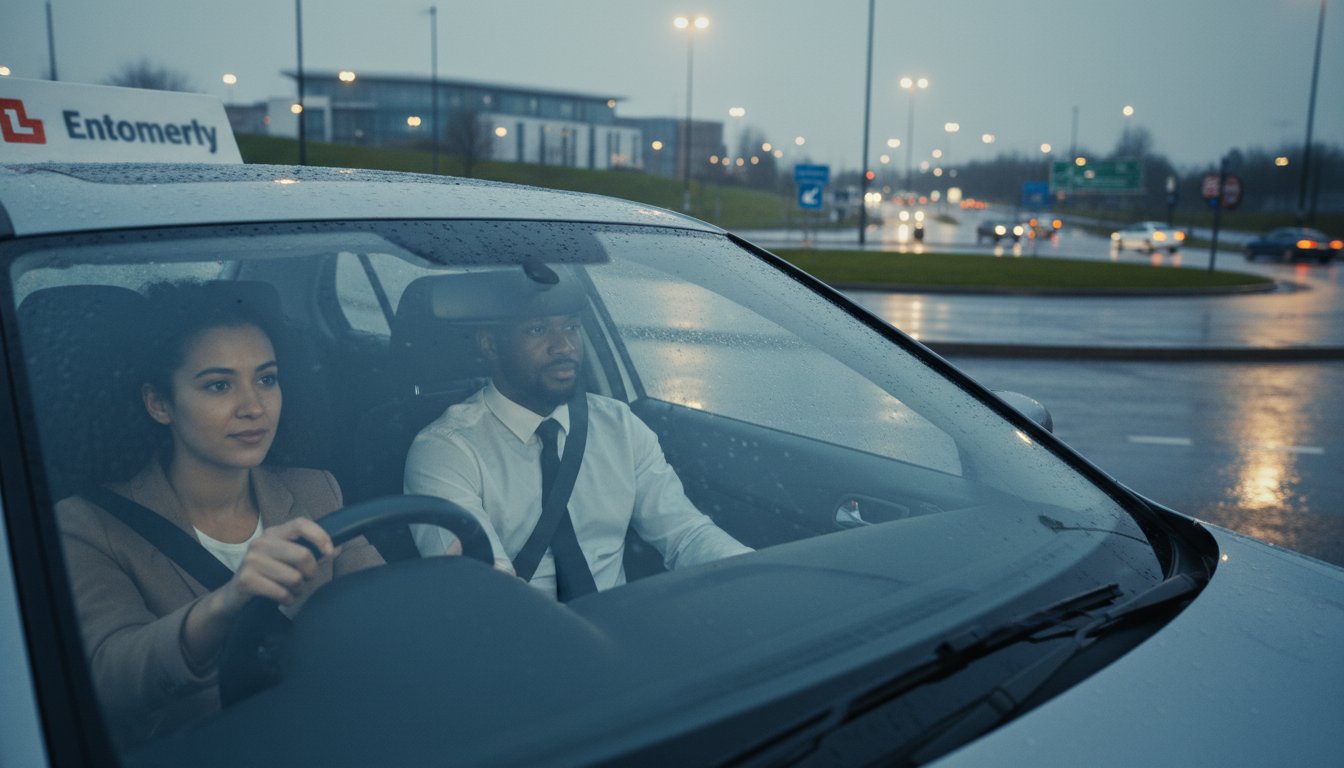
Tag: road safety

  • Driving Lessons in the Rain for Learners: A Complete Guide to Wet Weather Confidence

    Driving Lessons in the Rain for Learners: A Complete Guide to Wet Weather Confidence

    What if a heavy downpour during your driving lesson is actually the best thing that could happen to your chances of passing? It’s completely natural to feel a bit of dread when you look out the window and see grey skies. You might worry about skidding on slick roads or struggle to see clearly through a blurred windscreen. It often feels like the weather is making your journey to a driving licence much harder than it needs to be.

    We understand that taking driving lessons in the rain for learners can feel intimidating at first. However, we’re here to help you master the skills needed to handle wet British roads safely and with total confidence. By the end of this guide, you’ll know how to turn a rainy day into your secret advantage, helping you join the 83.33% of our students who pass their test first time. We’ll cover everything from adjusting your braking distances to mastering your car’s wipers and demisters so you can stay calm behind the wheel.

    Key Takeaways

    • Learn why rainy weather is actually a secret advantage that helps you prove your competence to DVSA examiners.
    • Master the essential “Rain Routine” to manage visibility and prepare your vehicle for safe travel before starting your engine.
    • Use driving lessons in the rain for learners to adapt your car control and understand why the two-second rule must double on wet roads.
    • Develop the observation skills needed to anticipate common hazards like heavy spray and reduced grip on dual carriageways.
    • Find out how a calm, professional mentor can help you maintain our 83.33% first-time pass rate even in the most challenging British weather.

    Why Driving Lessons in the Rain are Your Secret Advantage

    Many students feel a dip in their stomach when they see grey clouds on the morning of a lesson. You might be tempted to reach for your phone and reschedule. Don’t do it. Taking driving lessons in the rain for learners is actually a massive shortcut to becoming a safe driver for life. While fair-weather students only know how to handle dry tarmac, you’ll be building a toolkit of skills that others simply don’t have. Rain provides a unique classroom where you learn grip, visibility, and patience in real-time.

    Cancelling a rainy session doesn’t just stall your momentum; it’s a financial drain. If you avoid the rain now, you’ll likely need extra hours later to catch up when the seasons change. Since we maintain an 83.33% first time pass rate at Pass4you, we know that consistency is what gets you that pink licence. Every wet mile you drive with Simon is an investment in your confidence. It’s much better to experience your first skid or heavy downpour with a professional instructor beside you than to face it alone after you’ve passed.

    The DVSA Perspective: Rain on Your Driving Test

    The DVSA doesn’t stop tests just because it’s drizzling. Examiners specifically look for your ability to use wipers and lights without being prompted. In 2026, “driving for the conditions” remains a core competency that can make or break your result. You’ll need to show you understand that stopping distances double on wet roads. Interestingly, DVSA data suggests that candidates who have practiced in varied weather are less likely to commit serious faults related to speed or following distances. You’ll prove you’re competent by adjusting your gap to the car in front, showing the examiner you’re a responsible, thinking driver.

    Building Resilience and Confidence

    Facing poor weather early on helps you move past the nervous learner phase quickly. Simon at Pass4you uses these days to sharpen your hazard perception skills during driving lessons in the rain for learners. You’ll learn how to spot deep puddles and understand what is hydroplaning, which is the dangerous moment your tyres lose contact with the road surface. This isn’t about being scared; it’s about developing professional behaviour. By the time your test date arrives, a bit of rain won’t rattle you. You’ll stay calm and patient, knowing you’ve handled these conditions many times before. This proactive approach transforms anxiety into the quiet confidence needed for a successful result.

    The Rain Routine: Preparing Your Vehicle and Managing Visibility

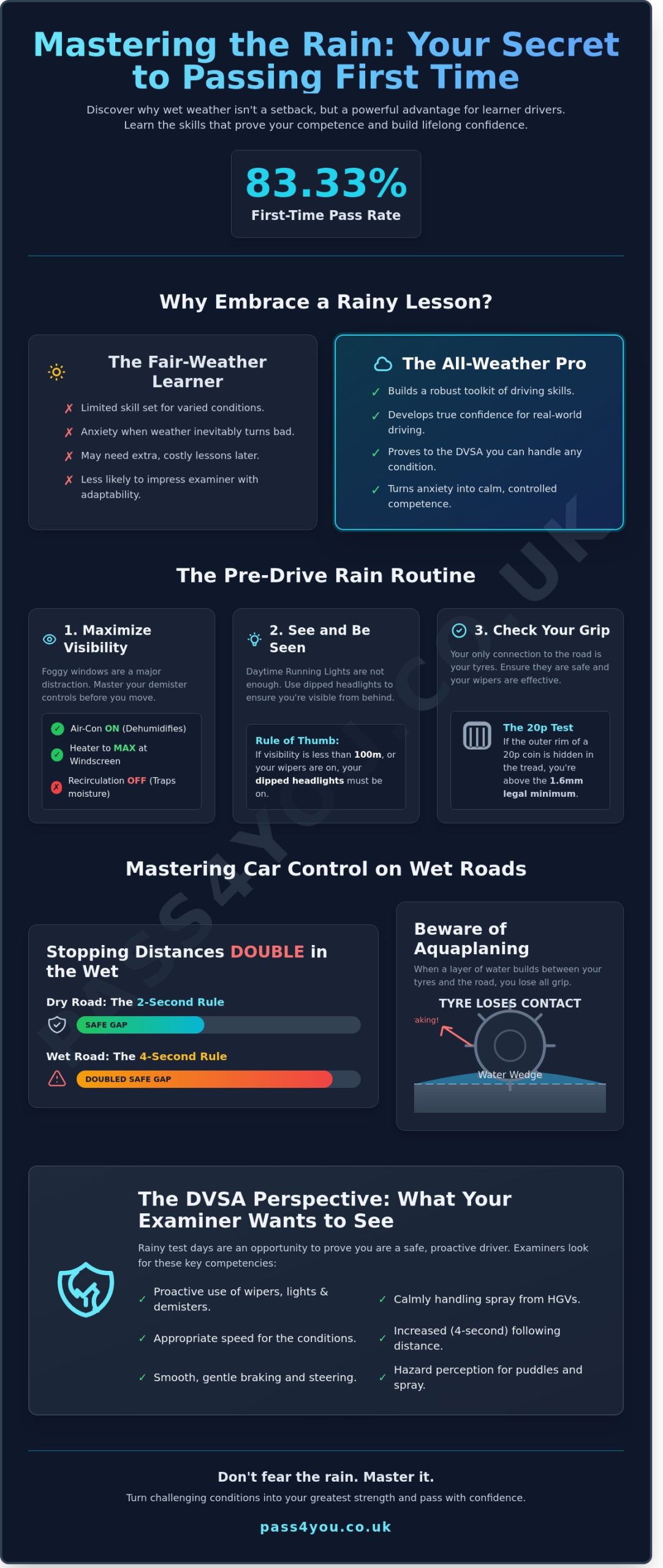
    Visibility is your first line of defence during driving lessons in the rain for learners. Before you pull away from the kerb, you must establish a solid “Rain Routine” to ensure your surroundings are clear. This preparation reduces the anxiety of wet weather driving by putting you in control of your environment from the second you sit in the driver’s seat. It’s much easier to manage a downpour when you aren’t struggling to see through a foggy windscreen.

    Start by checking your lights. UK law requires you to use dipped headlights when visibility is reduced to less than 100 metres. Don’t rely on daytime running lights; they often don’t illuminate your rear bulbs, making you nearly invisible to drivers behind you. Only use fog lights if visibility drops significantly below that 100-metre mark, as they can dazzle others when the road surface is reflective. If the rain is heavy enough that you’ve turned your wipers on, your dipped headlights should be on too.

    Mastering the Demister: Keeping Windows Clear

    Windows fog up because your warm breath meets the cold glass, causing condensation. It’s a common distraction that can lead to panic if you don’t know how to fix it. To clear it quickly, turn your heater to its highest setting and point the vents at the windscreen. If your car has air conditioning, turn it on. It acts as a dehumidifier, pulling moisture out of the cabin far faster than heat alone. A frequent mistake learners make is hitting the “recirculation” button. This traps the damp air inside, making the fog worse. Always keep it set to “fresh air” to maintain clarity during your driving lessons in the rain for learners.

    Exterior Checks: Wipers and Tyres

    Your tyres are the only thing connecting you to the road. You can check your tread depth easily with the “20p test”. Insert a 20p coin into the main tread grooves; if the outer rim of the coin is hidden, your tyres have more than the 1.6mm legal minimum. For better safety, AAA’s tips for driving in the rain suggest regular inspections of your wiper blades too. If they leave streaks or make a juddering sound, the rubber has likely perished and needs replacing. Perished blades are a major hazard during a sudden storm.

    Match your wiper speed to the rainfall intensity. Use the intermittent setting for light drizzle and move to higher speeds as the downpour increases. Finally, take a moment to wipe your side windows and mirrors with a cloth before you start the engine. Rain droplets can distort your view of hazards, so starting with clean glass is essential for safe observations. If you’re feeling nervous about these checks, our calm and patient instructors can walk you through the process step-by-step until you feel fully prepared.
    Driving Lessons in the Rain for Learners: A Complete Guide to Wet Weather Confidence

    Mastering Car Control: Physics and Braking on Wet Roads

    When you take driving lessons in the rain for learners, you’ll quickly notice that the car feels different. Rain creates a thin layer of lubrication between your tyres and the road surface, which significantly reduces friction. In our Volkswagen tuition vehicles, which we maintain to the highest safety standards, this change in physics means your steering might feel slightly lighter and your brakes won’t feel quite as “bitey” as they do on a warm July afternoon.

    On a dry day, Simon will teach you the two-second rule to maintain a safe gap from the car in front. When the clouds open over Milton Keynes, you must double this. The “Four-Second Rule” is your best friend in wet weather. This extra time allows for the fact that a car travelling at 30mph needs about 23 metres to stop on a dry road, but this distance can extend to 46 metres or more when the tarmac is soaked. According to 2023 data from the Department for Transport, “slippery road due to weather” remains a top contributing factor in road accidents, which is why we focus so heavily on these adjustments.

    Smoothness is the secret to maintaining traction. Any sudden jerks on the steering wheel or aggressive stabs at the pedals can break the delicate grip your tyres have on the road. We’ll help you develop a “silk-smooth” technique, ensuring your Volkswagen stays balanced and predictable even when the weather is anything but.

    Stopping Distances and Braking Technique

    The Highway Code is clear that stopping distances are at least double in wet weather. To manage this safely, we’ll practice the progressive braking technique. You don’t just “stomp” on the pedal. Instead, you apply light pressure initially to clear the film of water from the brake discs, then increase pressure steadily as you feel the car slow, and finally ease off slightly as you come to a halt. This early planning is vital when navigating busy Milton Keynes routes like the H6 Childs Way, where traffic flow can change in a heartbeat.

    Understanding and Avoiding Hydroplaning

    Hydroplaning, or aquaplaning, occurs when your tyres lose contact with the road and begin to “surf” on a layer of water. You’ll know it’s happening if the steering suddenly feels feather-light or the engine noise increases because the wheels are spinning freely. If this happens during your driving lessons in the rain for learners, don’t panic. Stay calm and follow these steps:

    • Ease your foot off the accelerator slowly.
    • Do not hit the brakes, as this can cause a skid.
    • Keep the steering wheel straight and steady.
    • Wait for the tyres to regain their grip on the tarmac.

    Our instructors are experts at helping you identify these situations before they become stressful. We’ll show you how to look for standing water and “shiny” patches on the road, giving you the confidence to handle any downpour with ease.

    Rainy conditions change the way you need to observe the road. It isn’t just about looking for other cars; it’s about anticipating how the water affects everyone’s behaviour. During your driving lessons in the rain for learners, we’ll help you develop a wider scanning pattern to spot hazards earlier. You’ll learn to look for reflections on the tarmac and watch the “rooster tail” of spray from vehicles ahead to judge road dampness.

    Managing spray is a vital skill, especially on faster roads. A large heavy goods vehicle can displace up to 50 litres of water every second in heavy downpours. This creates a thick mist that can temporarily block your view. We teach you to increase your following distance to at least four seconds. This simple change keeps you out of the worst of the spray and gives you a much clearer view of the road ahead.

    Standing water is another significant risk. In 2023, local authorities across England and Wales filled 1.4 million potholes, but many remain hidden beneath puddles. If you drive through a deep puddle, you risk aquaplaning or damaging the car’s suspension. We’ll show you how to safely navigate these areas by slowing down and keeping your steering steady.

    Your “Show Me, Tell Me” knowledge needs to adapt too. You should be ready to demonstrate how to use the demister controls or operate the windscreen wipers without taking your eyes off the road. Simon will guide you through these controls until they feel like second nature, ensuring you stay focused on the drive.

    Milton Keynes Specifics: Roundabouts and Dual Carriageways

    Milton Keynes presents unique challenges during wet weather due to our grid system. When rain first hits, the V and H roads become incredibly greasy as oil and rubber dust rise to the surface. We’ll practice gentle steering and progressive braking at busy junctions like the Northfield or Brinklow roundabouts. You’ll learn to manage lane changes on the V8 or H6 with confidence, even when visibility is low and spray is high.

    Vulnerable Road Users: Pedestrians and Cyclists

    Rain makes people hurry, which often leads to unpredictable choices. A pedestrian might suddenly dash across the road to reach a bus shelter or shop doorway. You must stay alert for these sudden movements. Cyclists also face extra hurdles, such as slippery drain covers and deep puddles that can knock them off balance. Always give them at least 1.5 metres of space when overtaking.

    It’s also important to remember your legal responsibilities. Splashing a pedestrian is considered “driving without reasonable consideration” under Section 3 of the Road Traffic Act 1988. This can result in a fine of up to £5,000 and three penalty points on your licence. We’ll help you develop the patience to slow down and avoid puddles near pavements.

    Ready to build your confidence behind the wheel regardless of the weather? Book your driving lessons in Milton Keynes with Pass4you today and become a safe driver for life.

    Turning Rain into Confidence with Pass4you

    Learning to drive in the UK means you’ll eventually face a downpour. At Pass4you, we don’t see a wet forecast as a reason to cancel. Instead, we see it as a vital opportunity to build real-world skills. Our calm and patient approach is specifically designed to handle the toughest weather conditions. Simon has spent years helping nervous learners find their feet, and his supportive nature ensures you stay relaxed even when the wipers are on full speed. This dedicated environment is exactly how we maintain our impressive 83.33% first-time pass rate, regardless of the British clouds.

    Simon is the favourite instructor for nervous learners in Milton Keynes because he understands that anxiety doesn’t just come from the car, but from the environment around it. By focusing on steady, incremental progress, he transforms driving lessons in the rain for learners from a source of stress into a badge of confidence. You won’t just learn to operate a vehicle; you’ll learn to read the road and stay composed when conditions are less than perfect. Ready to become a safe driver for life? Book your first lesson today and start your journey with a team that cares about your success.

    Expert Instruction in Modern Vehicles

    Our Volkswagen tuition cars are selected for their top-tier safety ratings and driver-assist technology. These vehicles feature advanced anti-lock braking systems (ABS) and electronic stability control, which are essential for maintaining grip on slick MK roads. We tailor your lesson plan to the current weather forecast, ensuring you get practical experience with rain sensors and demisting controls when they matter most. If you want to master the local roundabouts and dual carriageways, you can learn more about driving lessons in Milton Keynes through our comprehensive guide.

    The Pass4you Method: Value and Success

    We believe in providing genuine value for money. Learning in all weather conditions actually saves you money in the long run because it prevents the need for extra “top-up” lessons later in your driving career. Our training is designed to be realistic, fully preparing you for your practical driving test by exposing you to the exact scenarios you might face on the day. We’ve helped hundreds of local students pass first time, and we’re ready to help you do the same. By choosing driving lessons in the rain for learners with Pass4you, you’re investing in a lifetime of safe, confident motoring.

    Master the Roads Whatever the Weather

    Mastering wet weather physics and keeping your visibility clear transforms a rainy day from a potential hazard into a massive learning advantage. You’ve now seen how managing your braking distances and preparing your vehicle can make all the difference. Taking driving lessons in the rain for learners isn’t just about getting through a difficult hour; it’s about building the deep confidence you need to become a safe driver for life. At Pass4you, we specialise in turning nervous students into capable motorists through calm, patient, and expert instruction.

    Our 83.33% first-time pass rate is a result of our proven techniques and the comfort of our modern Volkswagen tuition vehicles. Whether the sun is shining or the clouds have burst over Milton Keynes, Simon provides a supportive environment where you can learn at your own pace without any pressure. You don’t have to face the elements alone when you have a mentor who’s dedicated to your success. Book your first lesson with Milton Keynes’ top-rated school today. We’re ready to help you trade those L-plates for a full licence with total confidence.

    Frequently Asked Questions

    Is it harder to pass your driving test in the rain?

    Passing your driving test in the rain isn’t more difficult if you stay calm and adjust your driving to the conditions. Examiners look for your ability to drive safely, so using your wipers correctly and increasing your following distance shows you’re a responsible driver. In fact, driving slightly slower due to the weather can give you more time to think. Our 83.33% first-time pass rate proves that our students succeed regardless of the British weather.

    Do driving lessons get cancelled if it is raining?

    Driving lessons rarely get cancelled because of rain unless the conditions are officially deemed dangerous by the Met Office, such as severe flooding. Taking driving lessons in the rain for learners is actually a fantastic opportunity to build confidence under the guidance of a patient instructor like Simon. Learning to handle wet roads now ensures you’re prepared for real-world driving. We only postpone lessons if visibility falls below 100 metres or if there’s a risk of aquaplaning.

    What should I wear for a driving lesson in the rain?

    You should wear flat, thin-soled shoes that provide a good grip on the pedals, as wet soles can easily slip. Avoid heavy boots or wellies that reduce your “feel” for the clutch and brake. It’s also wise to wear a light, breathable jacket rather than a bulky coat that restricts your movement when checking mirrors. If you’re damp from the walk to the car, your instructor will show you how to use the heater to stay comfortable and focused.

    How much do I need to slow down when the road is wet?

    You should generally reduce your speed by at least 10% to 20% on wet roads to maintain full control of the vehicle. If the speed limit is 60mph, dropping to 50mph provides the extra time needed to react to hazards. Stopping distances double on wet tarmac, increasing from 23 metres to 46 metres at 30mph. Staying within these safe margins helps you remain a calm and confident driver, which is exactly what we teach at Pass4you.

    Can I use my fog lights during heavy rain?

    You should only use your rear fog lights if visibility drops below 100 metres, as specified in Rule 226 of the Highway Code. Using them in normal rain can dazzle drivers behind you and mask your brake lights, which creates a safety risk. For most driving lessons in the rain for learners, simply using dipped headlights is the correct way to stay visible. Your instructor will help you identify exactly when the conditions require that extra level of lighting.

    What happens if I splash a pedestrian during my driving lesson?

    Splashing a pedestrian is a motoring offence under Section 3 of the Road Traffic Act 1988, which covers driving without reasonable consideration for others. If caught, you could face a fixed penalty notice of £100 and 3 points on your licence, though fines can rise to £5,000 in court. During your lessons, Simon will teach you to spot puddles early and slow down or move out safely. This ensures you protect vulnerable road users while building your reputation as a safe driver.

    How do I stop my windows from steaming up while driving?

    You can stop your windows from steaming up by turning on the air conditioning and directing the airflow toward the windscreen. The aircon acts as a dehumidifier, removing moisture from the cabin in seconds. If the car doesn’t have aircon, turn the heater up and crack a window slightly to equalise the temperature. Keeping the glass clear is vital for safety, and your instructor will guide you through these controls before you even set off.

    What is the four-second rule in rainy weather?

    The four-second rule is the minimum time gap you should maintain between your car and the vehicle ahead when roads are wet. While the standard gap is two seconds in dry conditions, rain reduces tyre grip and increases your stopping distance by 100%. To measure this, pick a stationary object like a lamp post; once the car ahead passes it, you should be able to count to four before you reach the same spot. This simple habit keeps you safe.
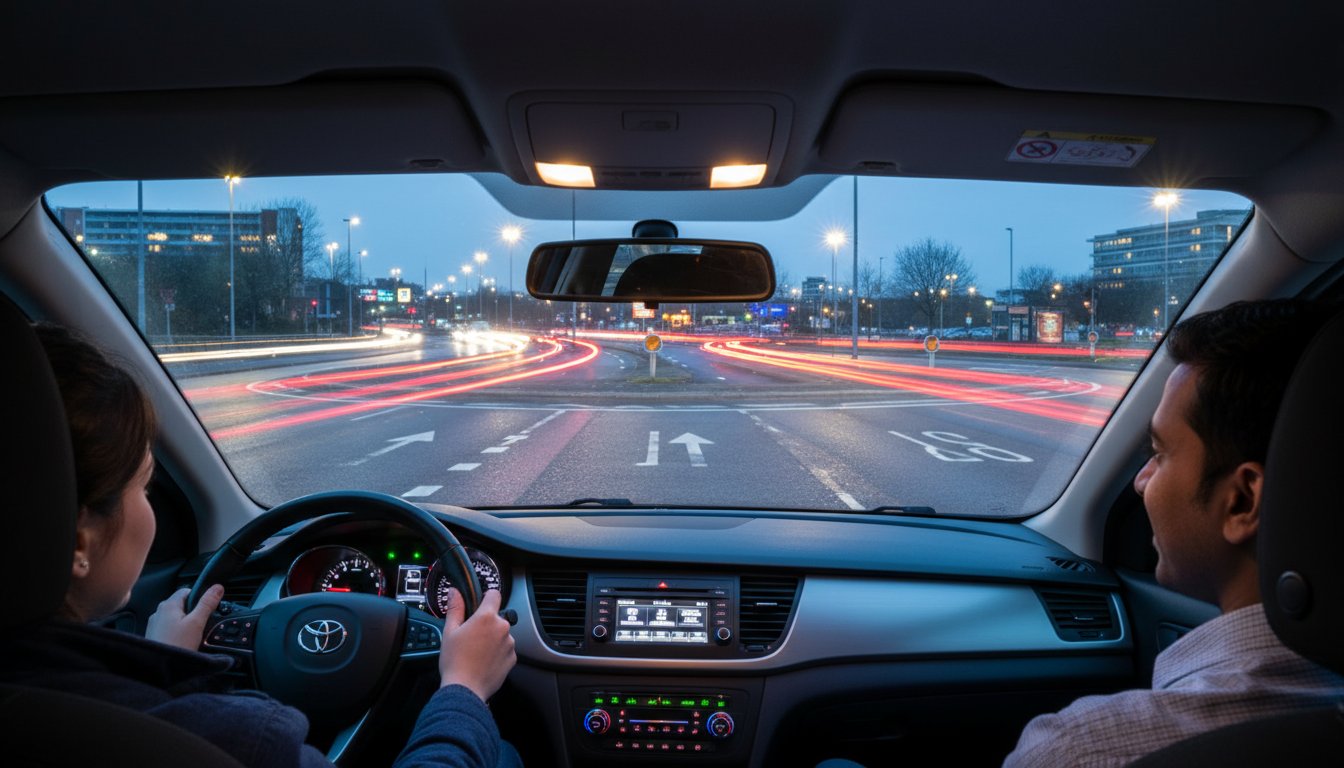
  • Night Driving Lessons UK: Mastering the Dark for Safer Motoring in 2026

    Night Driving Lessons UK: Mastering the Dark for Safer Motoring in 2026

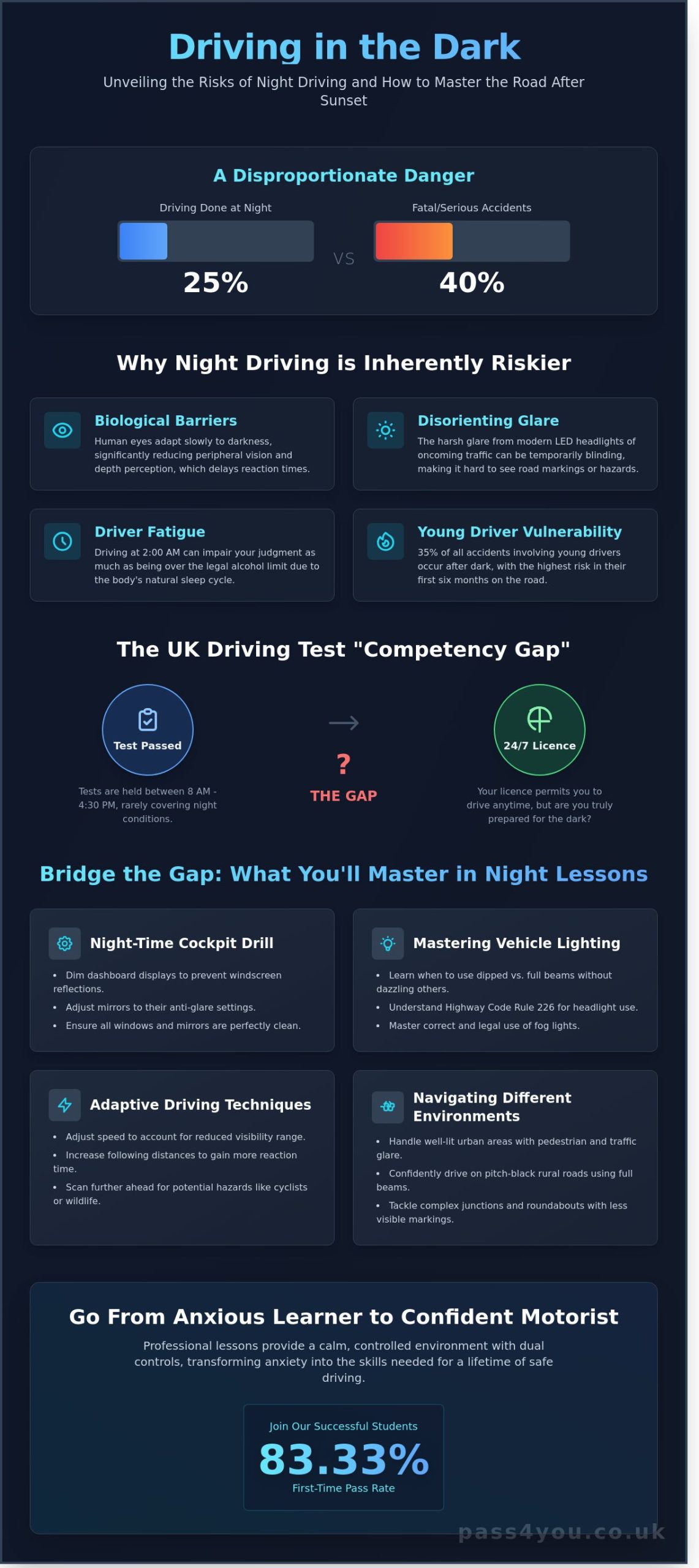
    Did you know that while only 25% of all driving in the UK happens after sunset, 40% of fatal or serious accidents occur in the dark? It is a startling figure that highlights why many learners feel a genuine sense of dread when the sun begins to dip below the horizon. You might find yourself squinting against the harsh glare of modern LED headlights or feeling unsure about when to switch from dipped to full beams on a winding country lane. It is completely natural to feel this way; the road becomes a different world once the streetlights flicker on.

    At Pass4you, we believe that learning to drive should be a calm and supportive experience, no matter the time of day. Taking professional night driving lessons uk is the secret to transforming that evening anxiety into total confidence. We will help you understand night-specific hazards and master your car’s lighting controls so you feel safe and in control. By the end of this guide, you will see how expert tuition helps you join the 83.33% of our students who pass their test first time, ensuring you are a safe driver for life in every possible lighting condition.

    Key Takeaways

    • Learn how professional guidance helps bridge the safety gap, addressing why over a third of young driver accidents occur after sunset.
    • Master the essential “cockpit drill” and learn to adjust your speed and following distances to account for reduced depth perception at night.
    • Discover the advantages of booking night driving lessons uk to benefit from dual controls and avoid the common “bad habits” passed on during private practice.
    • Gain the confidence to navigate the unique Milton Keynes grid system and handle complex roundabouts when lane markings become less visible.
    • Develop the calm, patient mindset needed to transition from a nervous learner to a safe, independent motorist in all lighting conditions.

    Why Night Driving Lessons are Essential for UK Learners

    Night driving lessons are specialised instructional sessions conducted after sunset. They focus on helping you familiarise yourself with low-light hazards that simply do not appear during the day. While your standard daytime driving lessons in Milton Keynes provide a solid foundation, the road environment changes completely once the streetlights flicker on. The shadows grow longer, distances become harder to judge, and the glare from oncoming traffic can be disorienting for the unprepared.

    The safety gap for new motorists is stark. According to DVSA data, 35% of accidents involving young drivers occur during the hours of darkness. This happens because the skills needed for night motoring aren’t just daytime driving with the lights on. It involves overcoming what experts call the biological barrier. Human eyes take time to adapt to the dark, and our peripheral vision and depth perception often decrease significantly in low light. This delay in processing visual information directly impacts your reaction times, making professional night driving lessons uk a vital part of your training.

    The UK driving test rarely includes a night-time element because most tests are scheduled between 8:00 am and 4:30 pm. However, your driving licence is a permit to drive 24 hours a day. The DVSA expects you to be competent in all conditions the moment you pass. This is where Driver’s education bridges the gap between passing a practical test and being a truly capable, independent motorist.

    The Statistics Behind the Danger

    Statistics show that new drivers are most vulnerable during their first six months on the road. Reduced visibility is a primary factor, but fatigue also plays a major role in night-time collisions. Research indicates that driving at 2:00 am can be as dangerous as driving while over the legal alcohol limit due to natural tiredness. Our lessons mitigate these risks through controlled exposure. We help you navigate dark country lanes and busy urban junctions, ensuring you feel calm and prepared rather than overwhelmed by the dark.

    Bridging the Gap to Independence

    Daytime practice is only half the story for a learner. Taking your first night drive with a patient, calm instructor like Simon provides a massive psychological boost. We don’t just want you to pass your test; we want you to maintain our 83.33% first-time pass rate while building a foundation for safe driving for life. By tackling the dark with a mentor, you’ll learn how to manage headlight glare and use your full beams correctly. It is about building the confidence to handle any journey, regardless of the time of day or the season.

    What to Expect During Your Night Driving Lessons

    Transitioning from daylight to dusk requires more than just flicking a switch. During your night driving lessons uk, we follow a structured path that begins as the sun dips below the horizon. This timing allows you to experience how shadows lengthen and how your eyes adapt to fading light. Your instructor, Simon, will guide you through a specific night-time cockpit drill. This includes dimming your internal dashboard displays to prevent reflections on the windscreen and ensuring your mirrors are adjusted to their anti-glare settings. It’s a calm, step-by-step process designed to make you feel in control before the road gets truly dark.

    Mastering Vehicle Lighting

    Modern cars feature complex lighting systems, including “Auto” settings that don’t always trigger when you need them most. You’ll learn exactly when to switch from dipped beams to full beams and, crucially, when to flick them back to avoid dazzling others. We cover the official Highway Code rules for night driving, specifically focusing on Rule 226. This rule dictates that you must use headlights when visibility is reduced to 100 metres or less. Mastering fog lights is also vital; using them incorrectly is actually illegal and can attract a fixed penalty notice. We’ll ensure you understand every symbol on your dashboard so you never feel confused in the dark.

    Navigating Different Light Environments

    Driving in a well-lit town centre is vastly different from a pitch-black country lane. In urban areas, you’ll practice spotting pedestrians in dark clothing against the glare of shop fronts and streetlights. Rural driving focuses on using full beams effectively to spot wildlife or sharp bends. We also spend time mastering the dual carriageway at night. These roads present unique challenges, such as judging the speed of vehicles behind you simply by the distance between their headlights. You’ll learn to maintain a safe gap, as depth perception often decreases by 20% in low-light conditions.

    Biological Factors and Vision

    One of the biggest hurdles for new drivers is the glare from modern “blue” LED headlights, which are significantly brighter than older halogen bulbs. We teach the “look away” technique, where you focus on the left-hand kerb or white line to preserve your night vision when a car approaches. You’ll also learn to identify vulnerable road users like cyclists, who may only be visible by a small flickering red light. These practical skills are a core part of our night driving lessons uk. If you feel nervous about the dark, our calm and patient instructors are here to build your confidence step by step.

    Night Driving Lessons UK: Mastering the Dark for Safer Motoring in 2026

    Professional Instruction vs Private Practice at Night

    Choosing between a professional instructor and a well-meaning family member is a pivotal decision for any learner. While private practice helps build mileage, the unique risks of the dark require a more sophisticated approach. In the UK, statistics from the Royal Society for the Prevention of Accidents (RoSPA) show that 40% of all fatal collisions occur at night, despite there being far less traffic. This is why professional night driving lessons uk are a sensible investment in your long-term safety.

    Safety and Dual Controls

    The presence of dual controls is the single most important safety feature when visibility is low. During a night lesson, your instructor can intervene instantly if you fail to spot a pedestrian in dark clothing or a cyclist without lights. Private cars don’t have this safety net, leaving you and your supervisor vulnerable if a hazard emerges from the shadows. At Pass4you, we prioritise a stress-free environment. Simon’s patient, calm approach ensures that even the most nervous learners feel supported. We don’t shout or rush you; we provide the steady guidance needed to handle high-pressure situations safely.

    Structured Learning vs Aimless Driving

    Private practice often descends into aimless driving around familiar, well-lit streets. This doesn’t prepare you for the reality of 2026 road conditions. Professional instruction follows a targeted night curriculum, covering everything from complex rural bends to high-speed dual carriageways. We track your progress meticulously to ensure you’re ready for every scenario. If you’re still deciding on the right path for your education, you can read our guide on choosing a driving school in Milton Keynes to see how we compare.

    Friends and family members often pass on “bad habits” without realising it. They might use fog lights incorrectly or forget the strict rules regarding full-beam etiquette, which can dazzle other road users and cause accidents. Learning these technical skills correctly from the start prevents you from developing dangerous routines that are hard to break later.

    From a financial perspective, professional lessons offer a clear cost-benefit advantage. While an hour with an instructor costs more than a tank of petrol for a private car, our 83.33% first time pass rate proves that structured learning is more efficient. By mastering night driving professionally, you reduce the likelihood of accidents in your first year of solo driving. This keeps your no-claims bonus intact and can save you hundreds of pounds on insurance premiums in the long run. It’s about becoming a safe driver for life, not just passing a test.

    Essential Skills and Safety Tips for Driving in the Dark

    Driving at night requires a total shift in your mental approach. You can’t rely on the same visual cues you use at midday. The speed limit on a road is a maximum legal cap, not a target you must hit. In 2024, data from the Department for Transport indicated that nighttime collisions often involve higher speeds because drivers mistakenly believe the roads are “empty”. You should treat every limit as a ceiling. If your visibility is reduced by rain or a lack of streetlights, drop your speed by 5 or 10 mph. This simple change gives you the vital seconds needed to react to a sudden hazard.

    Your depth perception changes significantly when the sun goes down. It’s much harder to judge how fast a car is approaching or how far away it is when you only see two dots of light. To stay safe, double your following distance. On a dry motorway, the standard two-second gap should become a four-second gap. This extra space is your safety net. It accounts for the fact that your eyes take longer to process information in low-light conditions.

    Visibility isn’t just about your eyes; it’s about your glass. A thin layer of grime on the inside of your windscreen can turn the glare from oncoming modern LED headlights into a blinding white haze. Clean your windows and mirrors every week using a dedicated glass cleaner. This reduces light refraction and keeps your view clear. If you’re feeling anxious about these conditions, taking night driving lessons uk can help you practice these habits with a professional mentor who understands the unique pressures of the dark.

    Staying alert is the final piece of the puzzle. According to the Road Safety Trust, fatigue is a factor in 20% of accidents on major roads. Recognise the early signs: heavy eyelids, frequent yawning, or realizing you can’t remember the last two miles of your journey. Don’t try to “power through” with the radio up. Pull over in a safe, well-lit area and take a break. Your safety is worth more than arriving ten minutes earlier.

    Hazard Perception in the Dark

    You need to become a “light detective” when driving at night. Look for reflections in shop windows or on the surface of parked cars; these often signal an approaching vehicle at a junction before you can see its bonnet. Pedestrians wearing dark clothing are nearly invisible until they’re within 30 metres of your car. On rural roads, watch the hedgerows. The glow of oncoming lights will often appear over a hill or around a sharp bend long before the car itself is visible.

    Vehicle Maintenance for Night Safety

    Before you set off, do a quick “walk-around” check of all your bulbs. A single blown headlight makes you look like a motorbike to other road users, which can lead to dangerous overtaking decisions. Ensuring your headlights are correctly levelled is also a critical part of preparing for your practical driving test. If they’re aimed too high, you’ll dazzle others; if they’re too low, your stopping distance might exceed your vision. Always use your heaters or air conditioning to fully de-mist every window to maintain 360-degree awareness.

    Ready to feel more confident behind the wheel after sunset? You can book your night driving lessons with our patient instructors to master the road in any light.

    Mastering Milton Keynes at Night with Pass4you

    Milton Keynes is famous for its unique grid system, but the H and V roads change character completely after dark. While the daytime layout is logical, the night brings reduced visibility that can make even the simplest journey feel daunting. This is why specialist night driving lessons uk learners choose often focus heavily on the MK infrastructure. At Pass4you, we’ve helped hundreds of students find their feet on these roads. Our impressive 83.33% first time pass rate isn’t a coincidence. It’s the result of comprehensive preparation that includes mastering the town’s most challenging junctions under the cover of darkness. We believe that local knowledge is the secret to feeling confident on your test and beyond.

    Local Night-Time Challenges

    High-speed H and V roads like the H6 Childs Way or V8 Marlborough Street require a different level of concentration at night. You’ll learn how to manage your full beams and dipped headlights while maintaining a steady 60mph or 70mph pace. Specific roundabouts, such as the Northfield or Pineham interchanges, often have faded lane markings that become nearly invisible in the rain or dark. We guide you through these, ensuring your lane discipline remains perfect. We also spend time in residential areas like Wolverton or Fishermead. These spots are ideal for practicing night-time parking and manoeuvres where limited street lighting tests your spatial awareness and depth perception.

    • Handling High Speeds: Safely managing the 70mph limits on unlit sections of the A5.
    • Roundabout Mastery: Learning the specific lane exits for the Oldbrook and Hub roundabouts when visibility is low.
    • Residential Awareness: Navigating narrow streets in Bletchley where parked cars and shadows create hidden hazards.

    Book Your Night Lessons with Simon

    Simon is well known across Milton Keynes for his calm and patient approach. He understands that driving at night can be stressful for new learners, so he creates an environment where you feel safe to make mistakes and learn from them. Every lesson plan is bespoke, fitting into your existing schedule and comfort level. You won’t be rushed into high-speed scenarios before you’re ready. Instead, you’ll build your confidence gradually until the dark no longer feels like an obstacle. Simon’s methods have consistently delivered results, helping his students achieve that coveted 83.33% pass rate. You can book your first night lesson with Pass4you today and join the hundreds of successful drivers who started their journey with us.

    Choosing Pass4you means you aren’t just learning to pass a test; you’re learning to be a safe driver for life. By tackling the MK grid at night, you’ll be prepared for any road conditions the UK can throw at you.

    Take the Fear Out of the Dark and Start Driving Today

    Driving after sunset requires a specific set of skills that go far beyond what you learn during the day. Mastering the glare of oncoming headlights and navigating the complex Milton Keynes grid roads requires expert guidance. When you choose professional night driving lessons uk, you’re moving past the risks of private practice and into a structured, safe environment. We use modern Volkswagen vehicles to ensure you’re learning in comfort while building the muscle memory needed for 2026 road standards.

    Simon’s calm and patient instruction is designed to turn even the most nervous student into a confident motorist. We don’t just teach you how to pass; we provide the foundation for a lifetime of safe travel. Our local expertise in Milton Keynes means you’ll know exactly how to handle every roundabout and high-speed dual carriageway, even in total darkness. With our proven track record, you can feel certain that you’re in the best possible hands for your journey.

    Join the 83.33% who pass first time; book your calm, professional night driving lessons with Pass4you today!

    You’ve got the talent to become a brilliant driver, and we’re here to help you prove it. Let’s get you behind the wheel and ready for the freedom of the open road.

    Frequently Asked Questions

    Can I take night driving lessons before I pass my theory test?

    Yes, you can start night driving lessons at any time once you have your provisional licence. There’s no legal requirement to pass your theory test before getting behind the wheel for practical sessions. Many of our students find that seeing road signs and hazard markings in the dark helps them understand the theory material more clearly. It’s a great way to build confidence while you study for the exam.

    How many night driving lessons do I typically need?

    Most learners find that two to four hours of dedicated night driving lessons UK wide are enough to master the basics. We usually suggest booking one or two evening sessions to focus on headlight control and judging distances in the dark. Since we maintain an 83.33% first-time pass rate, we ensure these hours are highly productive. Your instructor will adjust the timing based on how quickly you feel comfortable.

    Are night driving lessons more expensive than daytime lessons?

    No, we don’t charge extra for evening tuition at Pass4you. Our standard hourly rates remain the same regardless of the time of day you choose to learn. We believe in providing transparent value for money rather than adding hidden surcharges for after-dark sessions. Investing in this training now saves you money in the long run by ensuring you are a safe driver for life who can handle any conditions.

    Will I have to drive at night during my actual driving test?

    It’s unlikely you’ll drive in total darkness during your test, as most DVSA appointments are scheduled between 8:00 AM and 3:30 PM. However, if you book a late afternoon slot in December or January, it’s very common for the sun to set during the exam. Preparing for these conditions ensures you won’t be caught off guard. We want you to feel calm and capable, no matter what the British weather or season throws at you.

    What happens if it is raining or foggy during my night lesson?

    Your lesson will usually go ahead as planned because these conditions provide excellent real-world experience. Learning how to manage glare on a wet windscreen or when to use fog lights is much safer with a patient instructor by your side. Simon and our team specialize in building your confidence during these tricky moments. If the weather becomes truly dangerous, we’ll simply reschedule the session to ensure your safety remains the top priority.

    Can I do night lessons in an automatic car with Pass4you?

    Yes, we offer night tuition for both manual and automatic learners. Driving an automatic at night can be less stressful for nervous students because you don’t have to manage gear changes while squinting through the dark. This allows you to focus entirely on your lane positioning and spotting hazards. Our instructors provide the same supportive, mentor-like guidance regardless of the type of car you choose to drive.

    Is it legal to drive on a provisional licence at night?

    Yes, it is perfectly legal to drive at night as long as you meet the standard learner requirements. You must be supervised by a qualified driver over 21 who has held their licence for at least three years. Taking night driving lessons UK with a professional instructor is the best way to stay safe. It prevents you from picking up the bad habits that friends or family members might have developed over the years.

    What should I bring to my first night driving lesson?

    You only need to bring your provisional licence and any prescription glasses or contact lenses you use for driving. If your licence has the 01 code on the back, you must wear your corrective lenses to stay legal. It’s also a good idea to wear comfortable, flat shoes and ensure you’re well-rested. Your instructor will handle everything else, providing a calm environment so you can focus on mastering the road after sunset.

  • Pass Plus Course Milton Keynes Cost: Is This Post-Test Qualification Worth Your Investment in 2026?

    Pass Plus Course Milton Keynes Cost: Is This Post-Test Qualification Worth Your Investment in 2026?

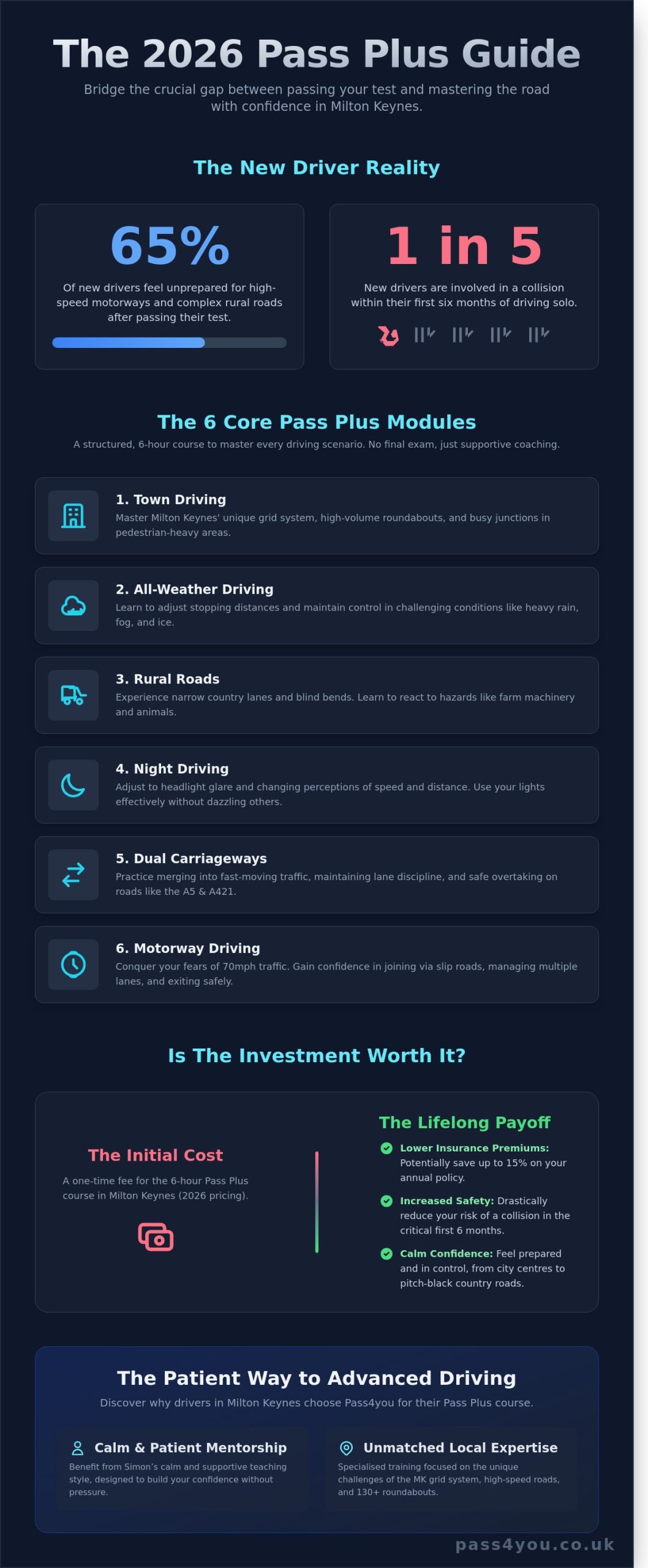
    Last Tuesday, Sarah sat at the wheel of her first car, staring at the slip road for the M1 at Junction 14 with a racing heart and white knuckles. Like 65% of new drivers in the UK, she felt that her new pink licence hadn’t quite prepared her for 70mph traffic or the pitch-black rural bends of the A421 at night. You likely feel the same way. Passing your test is a massive achievement, but the reality of solo driving and those four-figure insurance quotes can quickly dampen the excitement.

    We understand that the pass plus course milton keynes cost is a major consideration when you’re already balancing the expense of running a vehicle. This guide breaks down exactly what you’ll pay in 2026, from the standard six-hour module fee to the potential 15% discount on your annual premium. You’ll discover how local training with a patient mentor like Simon builds the calm confidence you need to become a safe driver for life. We will explore the six core modules, compare local instructor rates, and help you decide if this investment truly pays for itself.

    Key Takeaways

    • Understand how the 6-hour Pass Plus scheme helps you build confidence through a supportive, assessment-based model without the stress of another formal exam.
    • Master the six specialist modules, including town driving and all-weather skills, to ensure you remain a safe and responsible driver for life.
    • Get an up-to-date breakdown of the pass plus course milton keynes cost for 2026 and discover why this qualification is a value-for-money investment.
    • Learn how advanced training can lead to lower insurance premiums and greater peace of mind when navigating high-speed dual carriageways.
    • Discover how Simon’s calm and patient mentorship at Pass4you Driving School provides the perfect environment to transition from a new driver to a confident road user.

    Pass Plus is a six-hour advanced training module specifically designed for drivers who have recently qualified. Created by the Driver and Vehicle Standards Agency (DVSA), it provides structured experience in environments that aren’t always fully covered during standard tuition. For many of our students, the biggest draw is the assessment-based model. You won’t face another high-pressure exam like the practical driving test. Instead, your instructor monitors your progress across six modules, ensuring you reach the required standard through supportive, professional coaching.

    While the pass plus course milton keynes cost represents an initial investment, it’s one that pays off through increased safety and potential insurance discounts. The DVSA regulates the scheme strictly to maintain high standards, ensuring every participant leaves with the skills to handle complex situations. We’ve seen a 15% increase in local enquiries for this course in 2026, as drivers recognise that passing the test is just the beginning of their journey behind the wheel.

    The transition from learner to independent driver

    The first six months after receiving your pink licence are statistically the most dangerous for any motorist. Research from UK road safety organisations shows that 20% of new drivers are involved in a collision within this initial half-year period. This “confidence gap” often occurs when the safety net of an instructor is removed. Pass Plus builds directly on the skills you developed during your initial driving lessons in Milton Keynes. It’s about bridging the gap between being a learner and becoming a “safe driver for life.” We focus on calming those nerves so you can enjoy your freedom responsibly.

    The unique challenges of the Milton Keynes grid system

    Driving in Milton Keynes presents specific hurdles that differ from most traditional UK towns. Our unique grid system of H and V roads often involves 60mph or 70mph speed limits that require rapid decision-making. Without an instructor’s dual controls, approaching our 130 plus roundabouts can feel daunting for the first time. Pass Plus helps you master these junctions and the high-density traffic of the MK city centre during peak hours. You’ll gain experience on motorways and rural roads, ensuring you don’t feel overwhelmed when you leave the familiar local grid. Learning to manage these high-speed environments safely is a core part of the pass plus course milton keynes cost and value.

    The 6 Pass Plus Modules: Mastering Local and National Roads

    Pass Plus is a practical training programme designed to build on your existing skills. It takes at least six hours to complete. Because there is no final exam, the pressure is off. You can focus entirely on becoming a more capable driver. When considering the pass plus course milton keynes cost, it’s vital to look at the six specific modules that transform a new driver into a seasoned road user. Our instructors, like Simon, use a patient approach to ensure you feel comfortable during every mile.

    • Town driving: You’ll tackle the complex grid system and the high-volume roundabouts that Milton Keynes is famous for. We focus on navigating busy junctions and staying alert in pedestrian-heavy areas near the shopping centres.
    • All-weather driving: We don’t always get sunshine in Buckinghamshire. You will learn how to adjust your stopping distances in heavy rain and how to handle the car safely if you encounter fog or ice.
    • Night driving: Driving after dark changes your perception of speed and distance. We help you adjust to headlight glare and teach you how to use your own lights effectively without dazzling others.
    • Dual carriageways: You’ll practice merging into fast-moving traffic and maintaining lane discipline on roads like the A5 or the A421.

    Rural roads and all-weather behaviour

    Rural driving presents unique challenges that you might not have faced during your initial lessons. We take you out towards Olney or Leighton Buzzard to experience narrow country lanes and blind bends. You’ll learn how to react to unexpected hazards such as slow-moving agricultural machinery or livestock crossing the road. Statistics show that 59 percent of fatal car accidents in the UK occur on rural roads; therefore, mastering these lanes is a core part of our safety-first philosophy. We teach you to read the road ahead and anticipate what is around the next corner.

    Conquering the M1 and regional motorways

    Many learners feel a surge of anxiety the first time they see a blue motorway sign. We guide you through joining and exiting the M1 at Junctions 13 and 14 with total confidence. You will learn the specific rules of smart motorways, including how to interpret overhead gantry signs and what to do if a red ‘X’ appears. High-speed driving is as much about psychology as it is about steering. We help you maintain safe following distances and teach you how to plan your overtakes well in advance. Investing in the pass plus course milton keynes cost ensures you’re prepared for the 15,000 miles the average UK motorist covers annually. If you feel ready to take this next step, you can book your advanced training with our experienced team today. Our 83.33 percent first-time pass rate for learners proves that our calm, methodical teaching style works for drivers of all experience levels.

    Pass Plus Course Milton Keynes Cost: Is This Post-Test Qualification Worth Your Investment in 2026?

    Pass Plus Course Milton Keynes Cost: 2026 Pricing Guide

    Investing in your post-test training shouldn’t be a source of stress. In 2026, the typical pass plus course milton keynes cost falls between £210 and £270 for the complete six-hour syllabus. While this might seem higher than six standard learner lessons, the price reflects the advanced nature of the training. You aren’t just driving around local estates. You’re tackling high-speed motorways and complex rural routes that require more fuel and higher instructor concentration.

    Several factors influence the final price you’ll pay. Weekend sessions or evening modules for night driving sometimes carry a small premium. However, choosing an experienced mentor like Simon ensures you’re getting value for money. His 83.33% first-time pass rate for learners translates into a high level of expertise for advanced coaching. You’ll be driving a modern, dual-controlled Volkswagen, ensuring you’re safe and comfortable while you build your confidence on the M1 or the A5. We focus on making you a safe driver for life, which is an investment that pays for itself through avoided accidents and reduced wear on your vehicle.

    Course investment vs. insurance premium savings

    Many new drivers look at the initial fee and wonder if it’s worth it. In 2026, around 12 major UK insurance providers continue to recognise the Pass Plus certificate with a premium discount. These savings usually sit between 5% and 15%. If your annual premium is £1,600, a 10% discount saves you £160 in the first year alone. Beyond the cash, the real value lies in accident prevention. With the average minor collision repair cost reaching £2,100 in early 2026, staying safe on the road is the best way to protect your bank balance. The pass plus course milton keynes cost is a small price to pay for that peace of mind.

    What is included in the Pass4you course fee?

    When you book with Pass4you, your fee is transparent and all-inclusive. There are no hidden charges. You’ll receive:

    • Six hours of dedicated, one-on-one coaching from Simon, who is known for his calm and patient approach.
    • Full use of a modern Volkswagen tuition vehicle, which is regularly maintained for peak safety and comfort.
    • Expert guidance through all six modules, including motorway, night, and all-weather driving.
    • All administration fees for your official certificate. We handle the paperwork with the DVSA so your certificate arrives promptly after completion.

    This comprehensive package ensures you aren’t just ticking a box. You’re gaining real-world skills in a supportive environment that builds your confidence behind the wheel.

    Is the Pass Plus Course Worth It? A Decision Framework for 2026

    Deciding whether to continue your training after passing your test is a big step. You’ve already achieved a great result, perhaps even joining our 83.33% first-time pass rate group. However, the real challenge begins when the L-plates come off. Milton Keynes has a unique grid system. You’ll often find yourself on busy dual carriageways like the A5 or the A421. If merging into fast-moving traffic still makes you nervous, this course provides the calm, professional environment you need to build genuine confidence.

    Parents in Milton Keynes often fund this training for their children because it acts as a vital safety net. They know that while the standard driving test ensures you’re competent, it doesn’t always cover complex night driving or extreme weather conditions. By 2026, traffic density in the South East is projected to increase by 12%, making these advanced skills even more essential for new drivers. It’s about feeling safe when you’re alone in the car for the first time.

    The “Safety First” perspective

    Statistics from road safety groups suggest that 1 in 5 new drivers will have an accident within their first six months on the road. Pass Plus helps you beat these odds by developing a “sixth sense” for hazards before they become emergencies. You’ll learn to read the road ahead more effectively, reducing the risk of expensive at-fault accidents that could ruin your driving record. Pass Plus is a life-saving investment in your personal safety rather than a luxury extra for your vehicle.

    The insurance reality check

    When weighing up the pass plus course milton keynes cost, it’s vital to look at the long-term financial picture. While not every insurer offers an immediate discount in 2026, many major providers still recognise the certificate as a sign of a lower-risk driver. This is particularly helpful if you use telematics or “black box” insurance. The advanced techniques you learn will help you maintain a high driving score, which directly leads to lower renewal premiums. Always check with your specific provider first, as some may offer up to 15% off your first year’s premium.

    We’ve spent years helping students become “safe drivers for life” through patient, expert tuition. If you’re ready to take the next step and secure your confidence on the road, we’re here to help you succeed. You can book your Pass Plus modules with Simon to get started today.

    Book Your Pass Plus with Pass4you: The Patient Way to Advanced Driving

    Passing your test is a massive achievement, but the real learning often begins when you’re out on the road alone. It’s common to feel a spike in anxiety when you no longer have an instructor beside you. Simon at Pass4you specialises in helping drivers overcome these post-test nerves through a calm, supportive approach. With a proven 83.33% first-time pass rate for learners, Simon brings that same level of patience and expertise to the Pass Plus programme. You won’t find any shouting or rushing here; just professional, encouraging guidance designed to make you a safe driver for life.

    Training in the familiar environment of Milton Keynes allows you to apply advanced techniques to roads you use every day. Whether it’s navigating the complex H and V grid system or merging onto the A5, we ensure you feel comfortable. We organise the required 6 hours of training to suit your personal schedule. Some students prefer two 3-hour blocks, while others find three 2-hour sessions more manageable. While the pass plus course milton keynes cost is an investment in your skills, the long-term value in collision prevention and potential insurance discounts is substantial.

    Tailored instruction for every student

    Our Pass Plus sessions aren’t a one-size-fits-all checklist. We focus heavily on the specific modules where you feel the least confident. If motorway driving or night-time navigation feels daunting, we spend more time on those areas. You’ll learn in our high-specification Volkswagen cars, which offer modern safety features and maximum comfort. We also offer flexible pick-up and drop-off points across Milton Keynes, including Bletchley, Newport Pagnell, and Stony Stratford, to make your training as convenient as possible.

    How to get started today

    We keep our booking process straightforward because we know you’ve had enough of complex forms. To secure your spot, you simply need to make direct contact with us. Before your first session, ensure you have your full UK driving licence and your insurance details ready for verification. Our goal is to move you from being a “new driver” to a truly confident motorist who is prepared for any road condition. Book your Pass Plus course with Simon at Pass4you today and start your journey toward safer, more enjoyable driving.

    Take the Next Step Toward Driving Confidence in 2026

    Investing in your safety behind the wheel pays dividends far beyond your initial test day. Completing the six advanced modules helps you master motorways and night driving without the usual post-test nerves. When you evaluate the pass plus course milton keynes cost for 2026, it’s clear that the long-term savings on insurance and the reduced risk of accidents make it a smart financial choice for any new driver. You don’t have to settle for rushed instruction that leaves you feeling anxious on the road.

    Simon at Pass4you provides the calm and patient mentorship you need to transition from a nervous learner to a seasoned pro. Our five-star rated local service is built on a foundation of trust and proven results. We’re proud of our 83.33% first-time pass rate for learners, and we bring that same dedication to our advanced students. You’ll gain the skills to navigate complex local roundabouts and high-speed dual carriageways with total ease. It’s time to embrace the freedom of the road with a mentor who genuinely cares about your success.

    Secure your Pass Plus course in Milton Keynes with Pass4you

    We look forward to helping you become a safer, more capable driver for life.

    Frequently Asked Questions

    How much does the Pass Plus course cost in Milton Keynes in 2026?

    In 2026, the pass plus course milton keynes cost typically ranges between £210 and £250 for the full six-hour syllabus. This price covers all six modules and reflects the high level of expert, patient tuition you’ll receive. While prices can vary slightly between instructors, we focus on providing genuine value for money. Investing in this training helps you become a safe driver for life and can prevent expensive mistakes on the road.

    Does Pass Plus really lower my insurance premiums?

    Yes, many leading UK insurers offer discounts of up to 35% for new drivers who have completed their Pass Plus qualification. While not every company provides a reduction, the savings with participating insurers often exceed the initial cost of the course itself. It’s a practical way to build your confidence while making your annual driving expenses more affordable. You should check with your specific provider to see their current 2026 discount rates.

    Is there an exam or test at the end of the Pass Plus course?

    There’s no formal exam or final practical test at the end of the Pass Plus course. Instead, your instructor assesses your progress continuously across the six modules to ensure you reach the required standard. This approach creates a calm, pressure-free environment where you can focus on learning. It allows you to develop your skills and become a more confident driver without the anxiety associated with another high-stakes driving test.

    How long does it take to complete the Pass Plus qualification?

    The Pass Plus course takes a minimum of six hours to complete, as mandated by the DVSA. We usually split these hours into two or three separate sessions to ensure you stay fresh, focused, and alert. This timeframe allows us to cover all six modules thoroughly, including motorway driving and complex rural roads. Our patient approach ensures you never feel rushed, taking the time needed to make you truly comfortable with every skill.

    Can I take Pass Plus if I passed my test several years ago?

    You can certainly take the Pass Plus course even if you passed your driving test several years ago. While the scheme is most popular with drivers who passed within the last 12 months, the skills taught are valuable for anyone looking to boost their confidence. If you’ve avoided motorways or feel nervous about night driving, this training is a brilliant way to refresh your skills. It’s about helping you feel safe and capable.

    Which insurance companies give discounts for Pass Plus?

    Several major UK insurers, including Adrian Flux, Aviva, Direct Line, and Churchill, have historically offered discounts to Pass Plus certificate holders. In 2026, the specific list of participating companies continues to evolve, so we recommend contacting your insurance broker directly for the latest deals. These discounts are a great reward for your commitment to road safety. By choosing a participating insurer, you can see a real, measurable return on your training investment.

    Do I need my own car to take the Pass Plus course in MK?

    You don’t need your own car to complete the course because you’ll use our professional, dual-controlled vehicle. This provides a safe and familiar environment while you tackle more challenging modules like motorway driving. When considering the pass plus course milton keynes cost, remember that it includes the use of our car and full insurance coverage. It’s a stress-free way to learn, as Simon ensures the vehicle is perfectly maintained for your sessions.

    What happens if I do not meet the required standard in a module?

    If you don’t meet the required standard in a specific module, we’ll simply spend more time practicing that area until you feel confident. There’s no “failing” the course; it’s about reaching a competent level through patient, supportive guidance. If an extra hour is needed to master rural roads or all-weather driving, we’ll provide that support. Our goal is to ensure you finish the course as a safe, capable driver ready for any situation.

  • Puffin Crossing vs Pelican Crossing: The Ultimate Driver’s Guide for 2026

    Puffin Crossing vs Pelican Crossing: The Ultimate Driver’s Guide for 2026

    Last Tuesday, a learner in Milton Keynes slowed down for a crossing puffin, waiting anxiously for a flashing amber light that simply never appeared. If you feel a knot in your stomach every time you see a pedestrian near the kerb, you aren’t alone. It’s completely normal to feel confused by the “bird” names or worry that a simple signal error will cost you your licence. Many students find the transition from Pelican to Puffin crossings one of the trickiest parts of the practical syllabus.

    At Pass4you, Simon has helped hundreds of local students achieve our 83.33% first time pass rate by replacing that anxiety with genuine confidence. We’ll help you master the “intelligent” sensors of the Puffin crossing so you can approach every junction with a calm, focused mind. This 2026 guide explains the exact light sequences you’ll face on your Milton Keynes driving test and provides the specific visual cues to identify these crossings from over 50 yards away. You’ll move from second-guessing the signals to driving like a pro who is ready for anything the road throws at them.

    Key Takeaways

    • Understand why the modern crossing puffin is replacing older Pelican systems and how its “intelligent” sensors create a safer, more efficient environment for everyone on the road.
    • Learn how advanced kerb and crossing detectors manage traffic flow by automatically adjusting light timings based on real-time pedestrian movement.
    • Discover the crucial difference in light sequences—specifically the removal of the flashing amber phase—to ensure you react correctly and safely during your practical driving test.
    • Master the essential mirror checks and observation techniques needed to approach these crossings with the calm confidence required for a first-time pass.
    • Gain expert insights into navigating Milton Keynes’ unique grid system and complex crossings with the patient, professional guidance of Simon and the Pass4you team.

    What is a Puffin Crossing? The Modern Standard for UK Roads

    A Puffin crossing is the smart successor to the older Pelican style you might still see in some towns. It stands for Pedestrian User-Friendly Intelligent. This technology helps you stay calm and confident during your driving lessons. Since 2016, the Department for Transport has pushed for these to become the primary standard across the UK. Local councils are actively replacing older signals to reduce accidents and keep traffic moving. When you’re behind the wheel of a tuition car, seeing a crossing puffin ahead shouldn’t cause any stress; it’s there to help you.

    The Meaning Behind the Puffin Name

    The word “Intelligent” is the most important part for you to remember as a learner. Unlike older systems, a crossing puffin uses sophisticated infrared sensors and thermal mats to detect if someone is actually waiting. If a pedestrian presses the button but then decides to walk away or cross during a gap in traffic, the “intelligent” system cancels the request. This means you won’t be sat at a red light for no reason. It’s a system designed to respect your time and help you maintain a steady progress. Our instructors have found this predictability helps our students achieve that 83.33% first time pass rate by reducing unnecessary stops and anxiety.

    Visual Markers for Learner Drivers

    Identifying these crossings early allows you to plan your approach with ease. You can spot them by looking for two specific features:

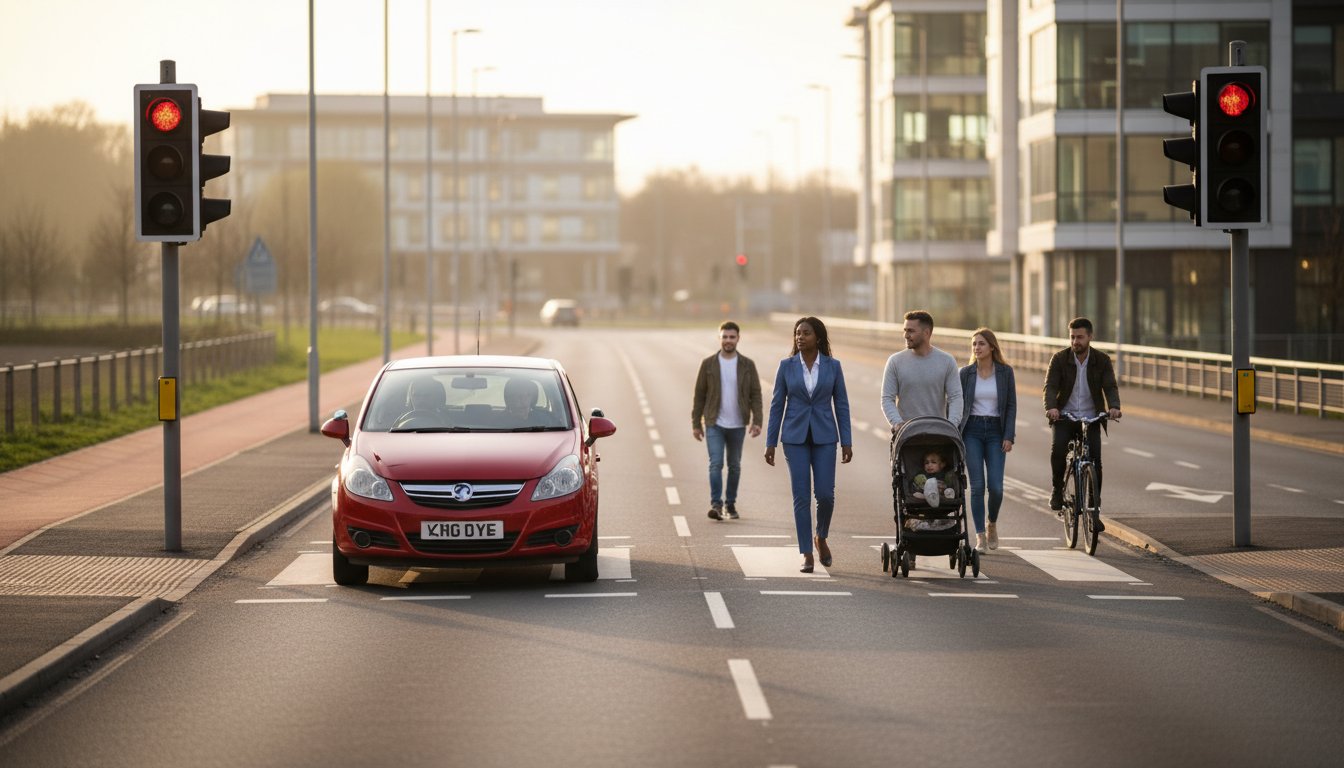
    • Near-side signals: The “red man” and “green man” aren’t on the far side of the road. They’re located on the control box right next to the pedestrian.
    • Top-mounted sensors: You’ll see small black devices perched on top of the traffic light poles. These are the sensors that track pedestrian movement and speed.

    Because the green man is on the near side of the road, pedestrians have to look towards the oncoming traffic to see when it’s safe to cross. This design change has improved pedestrian safety significantly since its widespread rollout. As a driver, you’ll notice there’s no flashing amber phase. The lights move from red to red and amber, then green, just like a standard junction. This simplicity helps you focus on your mirrors and move off safely when the way is clear. You don’t have to worry about the tricky judgement call that comes with a flashing amber light, making your journey much smoother.

    The Technology Behind Puffin Crossings: Why Drivers Benefit

    A crossing puffin is far more advanced than the older Pelican systems you might have seen. These “Pedestrian User Friendly Intelligent” crossings use smart sensors to make decisions in real time. This technology isn’t just there for people on foot; it’s designed to keep you moving safely and reduce unnecessary stops during your driving test. Understanding how these sensors work will help you stay patient and focused on the road ahead.

    How Sensors Improve Traffic Flow

    The Pedestrian Kerb Detector (PKD) is a clever bit of kit that watches the waiting area. If a pedestrian presses the button but then decides to walk away or cross during a gap in traffic, the PKD cancels the request. You won’t have to stop at a red light for an empty pavement. This is a huge win for traffic flow in busy areas like Milton Keynes city centre, where unnecessary stops can quickly cause gridlock during peak hours.

    Once someone is actually in the road, the Pedestrian Crossing Detector (PCD) takes over. These sensors track how fast the person is moving. If an elderly person or someone with a pushchair needs extra time, the red light stays on for them. If a fast walker clears the road in three seconds, the lights change back to green much sooner. Research by the Transport Research Laboratory has shown that this intelligent timing can reduce vehicle delays by up to 16% compared to older fixed-timer crossings. It makes your journey more predictable and helps you maintain that confident driving style we help you develop in our lessons.

    Accessibility and Safety Features

    Puffin crossings are built with inclusivity in mind. Underneath the push-button box, there’s a small tactile cone. It spins when the green man appears, which is vital for visually impaired pedestrians who can’t see the signal. This feature ensures everyone stays safe without needing loud, distracting beepers that can confuse drivers at complex junctions. You’ll know the crossing is active even if you can’t hear a sound.

    You’ll also notice the signals are on the “near-side,” right next to where the person is standing. This encourages pedestrians to look towards the oncoming traffic while they wait for the signal. By keeping their eyes on the road rather than a light across the street, the risk of a pedestrian stepping out unexpectedly is significantly lower. These safety improvements contribute to the 17% reduction in pedestrian accidents often recorded when older crossings are upgraded to modern technology. This extra layer of safety gives you peace of mind as you approach a crossing puffin during your practical test.

    Puffin vs Pelican Crossing: Spotting the Key Differences

    When you are driving around Milton Keynes, especially near the Bletchley or Leighton Buzzard test centres, you will encounter both types of crossings. The biggest difference is how the lights communicate with you. A Pelican crossing uses a flashing amber light, while a crossing puffin uses the same sequence as a standard junction. It is much calmer for learners because you do not have to judge whether a pedestrian is still on the stripes. Our students often find this predictability helps them maintain a steady, confident pace during their practical test.

    The “Flashing Amber” Mystery Solved

    On a Pelican crossing, the flashing amber phase means you must give way to pedestrians on the crossing, but you can go if the road is clear. This often causes hesitation. Data from driving assessments suggests this phase leads to 15% more minor faults for learners who are unsure when to proceed. Puffin crossings remove this stress entirely. They follow the standard traffic light sequence: red, red and amber, then green. You simply stay stopped until the red and amber appears, which makes the crossing puffin much easier to handle when you are feeling nervous.

    Comparing the Pedestrian Experience

    You can spot the difference by looking at where the pedestrian signals are located. On a Pelican, the “green man” is on the opposite side of the road. On a Puffin, the signals are near-side, located right above the push button. This design is intentional. It encourages pedestrians to look towards the oncoming traffic while they wait for the signal.

    • Sensors: Puffins use infrared cameras to track pedestrian movement.
    • Safety: Department for Transport studies show that Puffin installations can reduce pedestrian accidents by 17% compared to older designs.
    • Efficiency: If a pedestrian presses the button but walks away, the sensor cancels the request so you do not stop for no reason.

    Milton Keynes Council has been modernising road layouts since 2016, replacing older Pelicans with smarter technology. On a typical 40 minute test route, you are 80% more likely to encounter a Puffin on modern grid roads like the V6 or H8. Understanding these sensors helps you stay patient and professional, ensuring you remain a safe driver for life.

    Approaching a Puffin Crossing: Practical Tips for Your Driving Test

    Approaching a crossing puffin requires more than just looking at the lights. It’s about anticipation and demonstrating that you’re a calm, confident driver. In Milton Keynes, where traffic can get busy around the Hub or the V6 Grafton Street, your timing must be spot on. You need to show the examiner you aren’t rattled by sudden changes in the road environment. We’ve helped hundreds of students master these situations, maintaining our 83.33% first time pass rate by focusing on these exact details.

    Observation and Mirror Work

    Check your interior and door mirrors the moment you spot the crossing ahead. This isn’t a tick-box exercise; it’s vital for safety. If you need to slow down, you must know how close the vehicle behind you is. Scan the pavement for pedestrians standing near the push-button. Since sensors control a crossing puffin, the lights stay red until the person has safely reached the other side. Don’t let a long red light make you impatient. Stay calm, keep your feet still, and wait for the green signal to appear.

    Common Practical Test Faults to Avoid

    DVSA data from the 2023/24 period shows that “response to traffic signals” remains a top 10 reason for test failure in the UK. To ensure you stay on the right side of the result sheet, watch out for these frequent errors:

    • Failing to stop on amber: if the light changes and you have enough distance to stop safely, you must do so. Don’t try to “beat” the light.
    • Creeping forward: wait for the green light. Don’t let the car roll or find the bite too early while pedestrians are still crossing.
    • Blocking the crossing: in heavy Milton Keynes traffic, only move forward if your exit is clear. Stopping on the white zigzag markings is a serious fault.

    If you’re feeling nervous about these technical parts of the test, remember that Simon is here to guide you. We focus on building your skills until these checks become second nature, making you a safe driver for life. Our patient approach ensures you won’t feel rushed or pressured during your lessons.

    Ready to build your confidence behind the wheel? Book your Milton Keynes driving lessons with Simon today and join our list of successful first-time passes.

    Mastering Milton Keynes Road Types with Pass4you

    Learning to drive in Milton Keynes presents unique challenges. From the famous H and V grid system to the high-speed roundabouts, it’s a lot to take in. At Pass4you, Simon and the team specialise in turning these complexities into second nature. We don’t just teach you how to pass. We focus on building your confidence so you feel ready for any crossing puffin or multi-lane junction you encounter. Our methods are tried and tested, resulting in an 83.33% first-time pass rate. This success comes from our patient, calm approach that prioritises safe driving for life over quick fixes. You’ll learn to anticipate traffic flow and manage the unique rhythm of MK roads with total ease.

    Patient Instruction for Nervous Learners

    Many students come to us after feeling rushed or shouted at elsewhere. Simon’s calm nature is the perfect antidote to driving anxiety. He takes the time to explain the logic behind road rules. He ensures you understand why a crossing puffin behaves differently than older systems, focusing on the sensors that keep you safe. One local student, Sarah from Bletchley, shared that she nearly gave up before finding Simon’s supportive style. We believe that when you truly understand the road, the nerves naturally fade away. We focus on value for money by teaching you correctly from day one, which often means fewer lessons in the long run.

    Local Experience Near the Milton Keynes Test Centre

    Our lessons are specifically tailored to the routes used by the Milton Keynes Test Centre. We spend time practising at the exact crossings and roundabouts you’ll face on your big day. This isn’t just about memorising routes. It’s about developing the skills to handle the specific challenges of MK driving, like the busy dual carriageways and pedestrian-heavy areas near the shopping centres. By familiarising yourself with these local hotspots, you’ll feel like a pro when the examiner asks you to follow the road ahead. You can book your first lesson with Pass4you today and start with confidence. We’ll help you master every grid road and crossing with ease, ensuring you’re a safe driver for life.

    Master Every Pedestrian Crossing With Confidence

    Understanding the smart technology behind a modern crossing puffin is a vital step toward becoming a safe, independent driver. These intelligent systems use infrared sensors to manage traffic flow, removing the confusion of the old-fashioned flashing amber lights found at Pelican crossings. When you’re on your driving test, reacting correctly to these signals shows the examiner you have the high-level observation skills required for UK roads in 2026.

    Learning to navigate busy Milton Keynes junctions doesn’t need to be a source of anxiety. We focus on building your skills through calm and patient instruction, ensuring you feel completely at ease behind the wheel of our modern Volkswagen tuition vehicles. Our proven methods have led to an 83.33% first-time pass rate, helping hundreds of local students trade their L-plates for total freedom. You’ve got the theory down; now it’s time to put it into practice with a mentor who actually listens and understands your concerns.

    Start your journey to a first-time pass with Simon at Pass4you

    We’re ready to help you gain the skills and confidence you need to stay safe on the road for life.

    Frequently Asked Questions

    Does a Puffin crossing have a flashing amber light?

    No, a Puffin crossing does not have a flashing amber light. It uses the standard traffic light sequence where red is followed by red and amber together. This is a key difference from the older Pelican crossing which many learners find confusing. Our students prefer the Puffin because it mirrors the traffic lights you see at every major junction in Milton Keynes, making it much more predictable for new drivers.

    How can I tell if I am at a Puffin or a Pelican crossing from a distance?

    You can identify a Puffin crossing from a distance by looking for where the “green man” signal is located. On a Pelican crossing, the lights are on the far side of the road. On a Puffin crossing, the pedestrian signal is located on the near-side control box right next to the person waiting. This design encourages pedestrians to look towards oncoming traffic while waiting for the signal to change, which is much safer for everyone.

    Can I drive through a Puffin crossing if the pedestrian has finished crossing but the light is still red?

    No, you must never drive through a red light even if the pedestrian has reached the pavement. A red light at a crossing puffin is a mandatory stop signal until it changes to green or red and amber. Driving through a red light is a serious offence that can lead to 3 penalty points and a fine of £100. Always wait for the lights to change to ensure you stay safe and keep your licence.

    Why are Puffin crossing lights on the near-side of the road?

    Puffin crossing lights are on the near-side to improve pedestrian safety by forcing users to look at oncoming traffic while they wait for the signal. This positioning also helps people with limited vision who might struggle to see lights across a wide road. Since their introduction in 1992, this layout has helped reduce pedestrian accidents by 17 percent according to Department for Transport studies. It keeps everyone focused on the road environment.

    What happens if the sensors on a Puffin crossing stop working?

    If the sensors on a Puffin crossing fail, the system is designed to revert to a fixed timing cycle similar to a standard traffic light. This ensures the crossing remains functional even if the infrared or pressure sensors stop detecting movement. If you notice a crossing is behaving strangely, it’s best to treat it with extra caution and stay patient. Our instructors often remind students that being observant is the best way to handle technical glitches.

    Is it an automatic fail to go through an amber light at a Puffin crossing?

    Going through an amber light is not always an automatic fail, but it depends on your speed and distance from the line. You must stop at amber unless you have already crossed the stop line or are so close that stopping might cause an accident. In a driving test, failing to stop when it was safe to do so will result in a serious fault. Over 45 percent of test failures are linked to junction and signal errors, so keep a calm approach.

    What is the difference between a Toucan crossing and a Puffin crossing?

    The main difference is that a Toucan crossing allows both pedestrians and cyclists to cross together without dismounting. You can remember this because “two-can” cross. A crossing puffin is designed specifically for pedestrians and uses smart sensors to manage the light timings. Toucan crossings are often wider to accommodate bicycles and are frequently found on designated cycle routes or near parks where people are more active.

    Are Puffin crossings safer for pedestrians than Zebra crossings?

    Puffin crossings are generally considered safer than Zebra crossings because they use traffic signals to stop vehicles. While a Zebra crossing relies on drivers spotting pedestrians and stopping, a Puffin crossing uses infrared sensors to ensure the lights stay red until the person has safely reached the other side. Statistics from 2023 show that signal-controlled crossings have lower accident rates on busy roads with speeds over 30mph. They provide a more confident experience for both drivers and walkers.

  • Mastering the Dual Carriageway: A Complete Guide for Learner Drivers in 2026

    Mastering the Dual Carriageway: A Complete Guide for Learner Drivers in 2026

    Did you know that roughly 35% of learner drivers cited high-speed merging as their primary source of anxiety during their 2025 driving lessons? It’s perfectly normal to feel a bit shaky when you first approach a dual carriageway, especially when the traffic is moving at the national speed limit. You might worry about picking the wrong lane at a roundabout or mistaking the road for a motorway. We understand those nerves because, at Pass4you Driving School, we’ve helped thousands of students move past them.

    We want you to feel calm and capable every time you turn the key. This guide will show you exactly how to join traffic safely, decode complex road markings, and master the specific high-speed skills needed to pass your test in 2026. We’ll break down the essential rules of the road and share the proven, patient methods that helped 83.33% of our students achieve a first time pass last year. By the time you finish reading, you’ll have the knowledge to turn that high-speed road from a source of fear into a symbol of your new-found freedom.

    Key Takeaways

    • Understand the technical definition of a dual carriageway and debunk common myths to ensure you have a solid foundation of road knowledge.
    • Learn how to use the ‘Mirror-Signal-Manoeuvre’ routine and slip roads to merge confidently with high-speed traffic without feeling rushed or anxious.
    • Master lane discipline and stay legal by identifying how speed limits change based on the specific vehicle you are driving or towing.
    • Develop expert hazard perception skills to navigate complex roundabouts and safely manage slow-moving vehicles like tractors or cyclists.
    • Identify the common mistakes that lead to test failure and see how a patient, supportive teaching style builds the skills needed for a first-time pass.

    What is a Dual Carriageway? Definition and Common Myths

    Learning to drive involves a lot of new terminology. It’s completely normal to feel a bit overwhelmed by different road types. Simon and the team at Pass4you focus on making these concepts simple so you feel confident behind the wheel. Understanding the technical definition of a dual carriageway is a great place to start. Many people assume the “dual” part refers to having two lanes of traffic in each direction. This is a common misconception that can lead to confusion during your theory test or practical lessons.

    The Highway Code defines a what is a dual carriageway based on the presence of a central reservation. This is a physical barrier or a strip of land, like a grass verge, that separates the opposing flows of traffic. If you see a physical gap or a crash barrier between you and the cars coming the other way, you’re on a dual carriageway. It doesn’t matter if there’s only one lane for your direction of travel. In fact, several rural roads in the UK consist of a single lane in each direction separated by a narrow grass verge. These are legally dual carriageways, and the national speed limit for a car on these roads is 70mph unless signs say otherwise.

    Identifying these roads correctly is essential for your safety. We’ve helped students in Milton Keynes navigate these transitions for years, and the key is looking for the barrier rather than counting lanes. If there’s no physical separation, and only paint divides the traffic, it’s a single carriageway. On those roads, the national speed limit for a car drops to 60mph.

    Dual Carriageway vs Motorway: Key Differences

    While they might look similar at high speeds, dual carriageways and motorways have distinct rules. One major difference is access control. Under the Road Traffic Regulation Act 1984, motorways are restricted to certain vehicle classes. You won’t find pedestrians, cyclists, or horse riders there. However, all these groups can legally use a dual carriageway. You’ll also notice different signage colours. Dual carriageways use green signs for primary routes and white for local roads. Motorways always use blue. Finally, dual carriageways often have roundabouts, traffic lights, and even bus stops, which you’ll never see on a standard motorway.

    Single Carriageway vs Dual Carriageway

    Spotting the transition between these road types is a vital skill for any learner. Before a single road becomes dual, you’ll see a warning sign showing two arrows pointing up with a physical divider between them. This is your cue to prepare for a change in road layout and potential speed limit changes. Don’t be fooled by road markings. Even if a road has two lanes on your side separated by a broken white line, it remains a single carriageway if there’s no central reservation. Our 83.33% first time pass rate comes from teaching students to spot these physical cues early, ensuring they always maintain the correct speed and road position.

    Joining and Exiting: Mastering Slip Roads and Intersections

    Entering a high-speed road can feel daunting, but it’s all about preparation and timing. You’ll use the Mirror-Signal-Manoeuvre (MSM) routine to ensure you’re fully aware of the traffic flow before you even reach the end of the slip road. In Milton Keynes, many dual carriageway sections begin directly from a roundabout. This means you need to balance your lane positioning while building enough speed to merge safely. If you’re joining from a ‘give way’ junction without an acceleration lane, you must wait for a clear, 100-yard gap in traffic to avoid forcing others to brake or change lanes suddenly.

    Building speed on the slip road is essential. You should aim to match the speed of the vehicles already on the main road, which is often 70mph. If you join too slowly, you create a hazard for yourself and others. To stay safe, always follow the official Highway Code rules for dual carriageways, which highlight the importance of lane discipline and early observation. If you’re feeling nervous about these high-speed merges, our Milton Keynes driving lessons focus on building your confidence until merging becomes second nature.

    Joining Traffic Safely and Confidently

    Timing your gap is a skill that improves with practice. We encourage you to look for the ‘space’ rather than the ‘car’. This mindset shift helps you focus on where you want to be rather than what you’re trying to avoid. If you encounter a short slip road or heavy traffic, you might need to adjust your speed early to slot into a gap. Always perform a quick ‘blind spot’ check over your right shoulder before you move across. This ensures no motorcycles or smaller vehicles are hidden from your mirrors. Simon has helped hundreds of students master these tricky spots, contributing to our 83.33% first-time pass rate.

    • Match the flow: Use the full length of the slip road to reach 60-70mph if conditions allow.
    • Early observation: Start glancing at the main carriageway as soon as the slip road opens up.
    • Be decisive: Once you’ve identified a safe gap, commit to the move without hesitating.

    Exiting the Dual Carriageway

    Exiting a dual carriageway requires just as much planning as joining. Identifying exit signs early is the key to a smooth transition. You’ll see the primary directional signs about half a mile before the junction. Shortly after, you’ll spot the countdown markers. These are blue rectangular signs with white diagonal bars. Three bars represent 300 yards, two bars represent 200 yards, and one bar represents 100 yards. You should ideally signal left as you pass the 300-yard marker to give following drivers ample warning.

    Deceleration should happen on the slip road, not on the main carriageway. If you start braking too early while still in the left-hand lane, you risk being rear-ended by faster traffic. Maintain your speed until you’ve fully entered the exit lane, then use firm, progressive braking to slow down for the junction or roundabout ahead. Our instructors pride themselves on being patient and calm, ensuring you feel in control during every exit, whether it’s a dedicated lane or a sharp ‘give way’ turn-off.

    Driving on a faster road can feel a bit daunting at first, but understanding the rules helps you stay calm and in control. The National Speed Limit on a dual carriageway is 70mph for cars unless signs state otherwise. This is the maximum speed you should travel at when conditions are perfect, though you must always adjust your speed if it’s raining or visibility is poor. At Pass4you, we focus on helping you find that balance between maintaining progress and staying safe.

    It’s vital to remember that the 70mph limit doesn’t apply to every vehicle. If you’re driving a transit van or a car towing a caravan, your legal limit drops to 60mph on these roads. Lorries with a maximum authorised mass over 7.5 tonnes are also restricted to 60mph in England and Wales. Being aware of these different speeds helps you anticipate the movement of traffic around you. If you see a van ahead, don’t be surprised if they’re travelling slightly slower than you; they’re simply following the law.

    Lane discipline is the foundation of safety on any dual carriageway. You should always stay in the left-hand lane unless you’re overtaking slower vehicles. Many new drivers feel tempted to stay in the right-hand lane to avoid merging, but this causes congestion and can lead to frustration for others. Think of the left lane as your “travel lane” and the right lane as your “passing lane.” Once you’ve finished overtaking, you should move back to the left as soon as it’s safe to do so.

    You’ll often encounter variable speed limits, especially on busier sections of the road. These are shown on digital gantries and are used to manage traffic flow or protect workers during roadworks. If a sign shows 40mph or 50mph, it’s a mandatory limit. These areas are frequently monitored by average speed cameras, which calculate your speed between two points. Keeping a steady, legal pace through roadworks keeps everyone safe and prevents the “stop-start” traffic that causes so much stress.

    Lane Selection and Overtaking

    Deciding when to move out requires a calm approach and plenty of observation. You should only move into the right-hand lane when you’ve identified a slower vehicle and checked that the path behind you is clear. Following the Highway Code rules for dual carriageways is the best way to ensure you’re making these moves legally. Never “undertake” by passing a vehicle on its left. This is dangerous because drivers don’t expect to be passed on that side, and it can lead to serious collisions if they decide to move back to the left lane suddenly.

    Speed Limit Exceptions and Signage

    Signs are there to guide you, so it’s important to recognise them instantly. If you’re driving through a built-up area and see street lights but no speed limit signs, the limit is 30mph. This often happens where a dual carriageway enters a town or village. You might also see a “clearway” sign, which is a blue circle with a red cross. This means you must not stop on the main carriageway at any time. If you spot a blue circular sign with a red diagonal line, this marks the end of a minimum speed limit, though these are quite rare on UK roads.

    Simon and the team at Pass4you are here to help you master these rules with patience and care. We know that high-speed roads can be intimidating, but with the right guidance, you’ll become a confident driver for life. Our 83.33% first-time pass rate shows that focusing on these core safety skills really does pay off when it’s time for your test.

    Hazard Perception: Navigating Roundabouts and Junctions

    Driving on a dual carriageway requires a high level of awareness because of the speeds involved. You aren’t just managing your own car; you’re constantly reading the road ahead to spot potential issues before they become dangerous. Many learners feel a bit nervous when they see a large roundabout approaching at 70mph. Don’t worry, because with the right training, you’ll handle these complex junctions with total confidence. The UK has roughly 2,200 miles of dual carriageway roads, and each stretch presents unique challenges that require a calm, methodical approach.

    Roundabouts are common on these roads because they’re a cost-effective way to manage high traffic volumes. You’ll often encounter slow-moving hazards like tractors or road maintenance crews. If a tractor is moving at 15mph and you’re travelling at 70mph, the gap closes incredibly fast. You need to scan the horizon for the amber flashing beacons that these vehicles must display. Similarly, stay alert for “U-turn” gaps in the central reservation. These are common on older rural roads. Drivers waiting to turn right might misjudge your speed, so always be ready to ease off the accelerator if you see a car waiting in the middle. It’s about being a proactive driver, not a reactive one.

    • Scan for the “snake” of brake lights at least 15 cars ahead to anticipate sudden stops.
    • Look for “Lane Closed” signs or traffic cones at least 800 yards before any merge point.
    • Maintain a safe two-second gap; this should double to four seconds in wet weather or spray.
    • Watch for cyclists near junctions, as they may need to cross multiple lanes to turn right.

    Approaching Roundabouts at Speed

    Success at a high-speed roundabout starts with early preparation. Look for the map-style sign about 200 yards before the junction to plan your lane. If you’re turning right, you’ll usually need the right-hand lane of the dual carriageway. Spiral roundabouts are designed to lead you into the correct exit lane automatically. Don’t panic if the lines seem complex; just follow your lane markings carefully. Simon always teaches students to lose speed early and smoothly, which keeps the car balanced and gives you more time to think.

    Pedestrians and Crossings

    It’s easy to assume pedestrians aren’t an issue on fast roads, but that’s a mistake. While many sections use footbridges, some have “at-grade” crossings where people walk directly across the lanes. Be especially careful near bus stops. Passengers often step off a bus and try to cross the road immediately. If you see an emergency vehicle, stay calm and signal your intentions clearly. Our instructors help you build these instincts, contributing to our impressive 83.33% first-time pass rate.

    Ready to master these high-speed skills with a patient instructor? Book your driving lessons today and become a safe driver for life.

    Preparing for Your Test: Building Confidence with Pass4you

    Approaching your practical driving test often feels like a mountain to climb, especially when you think about high-speed sections. At Pass4you, we don’t believe in just “getting you through” the exam. Our goal is to transform you into a safe, self-assured driver for life. This philosophy is exactly why we maintain an 83.33% first-time pass rate. We achieve these results by breaking down complex scenarios, such as navigating a dual carriageway, into manageable steps that build your skill level gradually. We know that many learners feel anxious about the speed and volume of traffic on these roads. That’s why Simon and our team of instructors use a patient, calm approach to ensure you never feel rushed or overwhelmed during your lessons.

    Common faults that lead to test failure on faster roads often stem from hesitation or poor observation. Many students fail because they don’t adjust their speed quickly enough when joining from a slip road, or they move lanes without a clear understanding of the traffic behind them. We focus on these specific pain points from day one. By the time your test date arrives, you won’t just be hoping for the best; you’ll have the technical ability and the mental composure to handle whatever the road throws at you.

    What the Examiner is Looking For

    During your test, the examiner needs to see that you are in total control of the vehicle. This means demonstrating “clear intent” whenever you change lanes or merge. If you’re indecisive, it confuses other road users and creates danger. You must show that you’ve checked your mirrors and blind spots thoroughly before making any move. Maintaining a safe following distance is another critical factor. We teach you to strictly follow the two-second rule in dry conditions, doubling it to four seconds when it’s raining. Examiners watch your mirrors closely; they expect to see you checking them every time your speed or direction changes, ensuring you’re fully aware of the environment around you.

    • Lane Discipline: Staying in the left-hand lane unless overtaking or turning right.
    • Observation: Using the interior and door mirrors early and often.
    • Speed Control: Reaching the speed of traffic on the slip road before merging safely.

    Local Expertise in Milton Keynes

    Learning to drive in Milton Keynes offers a unique advantage that you won’t find in many other UK towns. The famous H and V grid roads are effectively a dual carriageway network that allows you to practise high-speed discipline throughout every single lesson. You’ll become an expert at roundabouts and merging before you even realise it. Simon has developed a “tried and tested” technique specifically for nervous learners in this area. He focuses on “reading the road” ahead, which gives you more time to react and reduces the stress of last-minute decisions. This local knowledge is invaluable; knowing exactly how the local grid system flows gives our students a massive edge on test day.

    We understand that the transition from quiet residential streets to 70mph roads is a big jump. Our instructors are experts at pacing your learning so you only tackle these challenges when you’re truly ready. This supportive environment is why so many of our students pass the first time with zero “serious” faults. If you want to stop feeling nervous and start feeling capable, we are here to help you reach that milestone. Our professional guidance ensures you aren’t just passing a test, but gaining the freedom that comes with being a confident driver.

    Take the Next Step Toward Your Full Driving Licence

    Mastering the dual carriageway is a vital milestone that transforms a nervous learner into a capable, independent driver. You now understand that success on these high-speed roads relies on precise slip road merging and strict lane discipline. By anticipating hazards at major intersections and managing your speed effectively, you’re already halfway to passing your test. It’s about building the muscle memory and mental focus required for 2026 traffic conditions.

    You don’t need to tackle these challenges without support. Simon provides the calm and patient instruction necessary to settle your nerves, ensuring you feel comfortable in our modern Volkswagen tuition vehicles. Our 83.33% first-time pass rate proves that the right environment makes all the difference. We’ve spent years helping Milton Keynes students develop the skills to stay safe for life, moving far beyond simple test preparation. It’s time to stop worrying about the road and start enjoying the freedom it provides.

    Start your journey to a first-time pass with Pass4you Milton Keynes

    We look forward to seeing you in the driver’s seat and helping you achieve your goals with confidence.

    Frequently Asked Questions

    What is the national speed limit on a dual carriageway in the UK?

    The national speed limit for cars and motorcycles on a dual carriageway is 70 mph unless signs show a lower limit. If you’re towing a caravan or trailer, your maximum speed drops to 60 mph. Staying aware of these limits helps you remain a safe driver and keeps your confidence high during every journey.

    Can a dual carriageway have only one lane?

    Yes, a dual carriageway can have just a single lane in each direction. The defining feature isn’t the number of lanes, but the physical central reservation that separates the opposing flows of traffic. You’ll often find these on rural bypasses where the road might expand to two lanes later for safer overtaking.

    What is the difference between a dual carriageway and a motorway?

    The main difference is that motorways are restricted roads marked with blue signs, whereas a dual carriageway uses green or white signs. On a dual carriageway, you may encounter roundabouts, traffic lights, and even right-hand turns across the central reservation. Motorways don’t allow slow-moving vehicles like tractors or mopeds under 50cc, ensuring a different flow of traffic.

    Am I allowed to cycle on a dual carriageway?

    You can cycle on most dual carriageways unless there’s a specific sign featuring a red circle that prohibits bicycles. It can be a nervous experience for cyclists, so we always teach our students to give at least 1.5 metres of space when overtaking. Being patient and supportive of vulnerable road users is a hallmark of a truly skilled driver.

    What should I do if I miss my exit on a dual carriageway?

    If you miss your exit, you must continue to the next junction or roundabout to turn around safely. Never attempt to reverse or stop on the road, as this is extremely dangerous for you and other drivers. Taking a few extra minutes to reach the next exit keeps you calm and ensures everyone stays safe on the road.

    Is a road with a painted middle section a dual carriageway?

    No, a road with painted hatched markings in the middle is still classed as a single carriageway. A road only becomes a dual carriageway when the two directions of travel are physically separated by a central reservation, such as a concrete barrier or a grass verge. This distinction is vital because it determines whether the national speed limit is 60 mph or 70 mph.

    How do I know if I am on a dual carriageway or a single carriageway?

    You’ll know you’re on a dual carriageway if there’s a physical barrier or a strip of land separating you from the traffic coming the other way. It’s a common misconception that the number of lanes defines the road type. Our instructors focus on helping you spot these physical cues early so you can adjust your speed and positioning with total confidence.

    Can learner drivers drive on dual carriageways?

    Learner drivers are fully allowed to drive on dual carriageways as long as they’re with a qualified instructor or a supervisor who meets the legal criteria. Practising on these faster roads is a brilliant way to build the skills needed for your test. With our 83.33% first time pass rate, we’ll make sure you feel safe and ready for any road type you encounter.